Marinens Flyvebaatfabrikk M.F.5
 Norwegian Navy Floatplane (1919): 9 provided.
Development
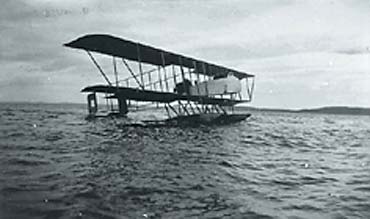 Marinens flyvebaatfabrikk was established in May 26, 1915, in Horten (closed its doors 1972) as a Norwegian aircraft factory. No more than a glorified workshop, it only succeeded to deliver 130 aircraft between 1915 and 1940. Co-located with the Royal Norwegian Navy Air Service at Karljohansvern, Horten it was however conventient to access by the staff. Together with the Kjeller Aircraft Factory (Kjeller Flyfabrikk) as mostly land-based models, both formed the core of local aircraft manufacturers. The first model came from Germany in August 1912, converted into a seaplane in 1913 and by 1914, Roald Amundsen donated his French Farman MF.7 seaplane which became the basis for the MF1. The factory was formally established in May 1915 and created a whole lineage until the MF-12. It also produced under license models such as the Sopwith Baby and Hansa-Brandenburg W33...
The factory, which at its peak had about 86 employee in 1938, developed the MF1 (photo) as a copy of the Farman MF.7. It was a biplane pusher with two floats, with a few made, F.2, F.4, F.6, F.8, and F.8(II) after the first crashed. They trained many pilots intended in WW1 for other models and was followed by the MF2, first official recce model from the company, actively used. Only three were made, F10, F10 bis and F12, essentially a modified MF1 with bombs and a machin gun. The last was operational in 1917. Next the MF3 appeared (4 made in 1917: F.14, F.16, F.18, F.20) essentially the same bit powered by a 160 hp Curtiss engine. Next came the MF4 used for training, with 7 made in 1918–24 as a further development of MF1. The MF5 was a completely new model, essentially a licence Sopwith Baby. It was used for reconnaissance. The reat novelty was that it became the first modern model using a pusher engine configuration.
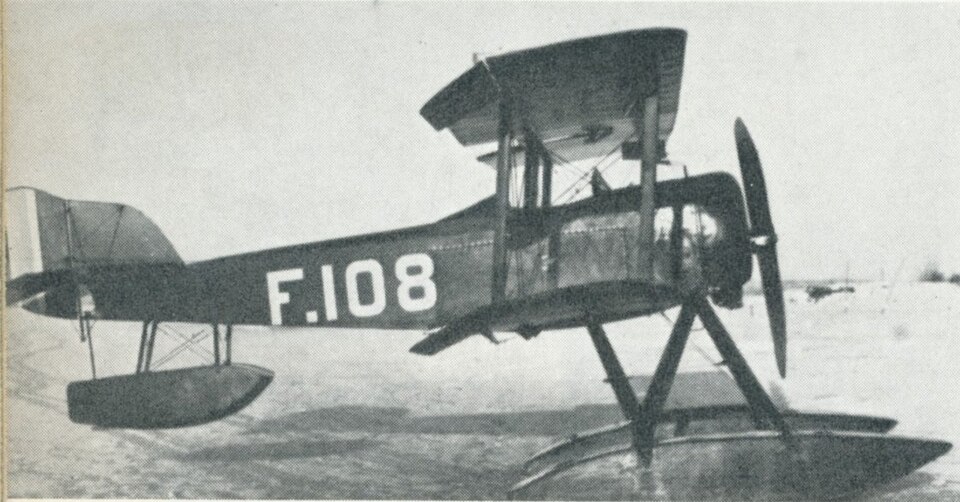
Indeed, the Maurice Farman MF.7, designed in 1912 and introduced in 1913 (3,310 made by France) was powered by a 70 to 100 hp engine, and declined into 5 versions, also used by Britain (13 squadrons), nown locally as the "longhorn", as well as Austrlia, Italy and Belgium. From the MF1 to the MF4, the Norwegian produced some 20 until 1917, some used for training and others for recce. However by 1917 given the rapid pace of aviation technology, the MF.7 appeared obsolete and had been already replaced by new models in the entente. To keep pace with the technology of the time, the naval air branch decided to go for a completely new model, fresh in 1917, the Sopwith Baby.
The Sopwith Baby was a fighter aircraft equipped with floats, based on the Sopwith Schneider race model, further developed as a fighter and sharng some characterics with the Pup. It had however a powerful engine, the 110 hp, 9-cylinder Clerget 9A rotary and was fitted to receive on demand, machine guns, bombs, even rockets. Some 195 were manufactured total by Blackburn and a further 105 with a 130 hp Clerget 9B engine.
Design specifics
Thus, in 1917, the Royal Norwegian Navy Air Service purchased ten of these. They came with a licence for local production. Thus, an additional seven could be built at the aircraft factory in Horten. The adoption of this model was based on the experience with this type by the director and Captain Halfdan Gyth Dehli. Work on this first tractor in Norwegian history started in 1917 but it occupied all the space at the Marinens Flyvebaatfabrikk from 1918. Halfdan Gyth Dehli was a businessman and aviator, at the head Marinens Flyvebaatfabrikk from 1916 to 1918. He essentially transformed a 1-seat fighter floatplane into a 2-seater scout. A total of nine of these seaplane scouts were produced in 1918, plus another two planned, but never completed as better models were available.General conception
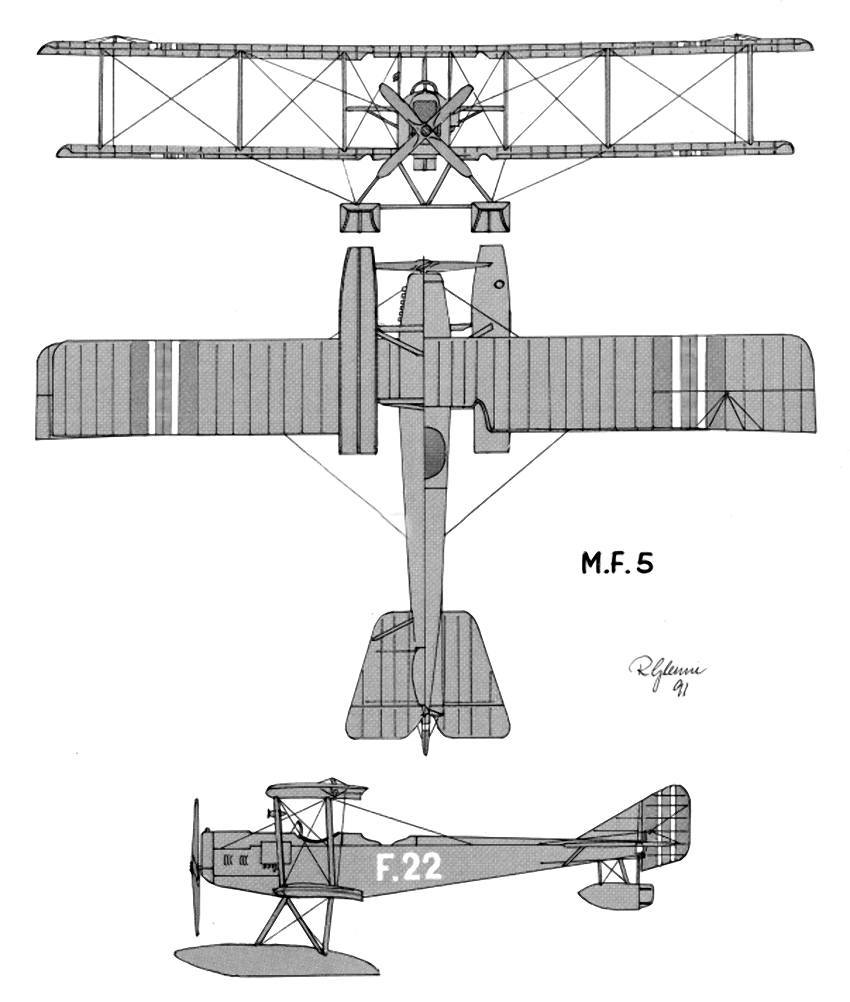 The MF5 was much larger than the original one-seater Baby (23 ft (7.01 m), long wingspan 25 ft 8 in (7.82 m) height 10 ft 0 in (3.05 m), weight 1,226 lb/556 kg, gross 1,715 lb/778 kg). Indeed, given the second seat, it had not only a longer fuselage and added wingspan. Indeed the MF5 measured 10 meters overall (32 ft 10 in), for a wingspan ported to 15 m (49 ft 3 in), height of 3.66 m (12 ft). Its empty weight was 1,200 kg (2,646 lb) and its gross weight reached 1,580 kg (3,483 lb). However the entire structure remained the same, metallic tubes for the fuselage, wrapped in doped canvas and a mix of metal and wooden frames for the wings, tail and ailerons. The general design recalled more the Short 184 than the Baby by a long shot.
The general outlook was however very different indeed: First off the fuselage was lenghtened, the engine was now inline and thus completely changed the nose shape, the wings were much elongated instead of the original stubby ones, the tail was triangular, the ailerons had a more geometric, triangular shape, and the main wings were unequal, with the upper one a bit wider making for a sesquiplane configuration. Plus they were attached by three sets of "H" bay struts. If the general float configuration was about the same, with two main, one axial under the tail, the main floats were reinforced to deal with ice, larger, and attached by inverted W struts.
Engine
Instead of the original Clerget 9Z 9-cylinder air-cooled rotary piston engine rated for 110 hp (82 kW) and drving a wooden 2-bladed, later 4-bladed fixed-pitch propeller, the MF5 was powered by a more potent 160 hp (120 Kw) 16-cylinder Sunbeam water-cooled engine, imported, but they did not perform as well as hoped. The Norwegians tried to return the engines, and this led to an agreement reducing the cost on 12 out of 16 imported engines. Still, they never functioned well, even to the point of being rebuilt several times over the years, causing four crashes, including the prototype. The last M.F.5s manufactured had instead the more powerful 240 hp 6-cylinder Siddeley Puma water-cooled engine. The MF5 managed to reach 132 km/h (82 mph, 71 kn) as max speed, for a cruise speed of 115 km/h (71 mph, 62 kn). Range was 500 km (310 mi, 270 nmi), more than the Baby, but the rate of climb was also better than the Baby at 1.19 m/s (234 ft/min).Armament
Armament on the original Baby consisted of a single Lewis machine gun in the fuselage and synchronised to fire through the propeller, but the Norwegian replaced it by a Madsen. However it was only for a short time, as later the Lewis were back. It could also carried a 40 kgs mine, or five 40 kgs bomblets. It seems the machne gun was synchonized and placed in front of the pilot of the left side. The observer had no additional defensive ring mount MG.⚙ MF5 specifications | |
| Light Weight | 1,200 kg (2,646 lb) |
| Gross Weight | 1,580 kg (3,483 lb) |
| Lenght | 10 m (32 ft 10 in) |
| Wingspan | 15 m (49 ft 3 in) |
| Height | 3.66 m (12 ft) |
| Wing Area | Unknown |
| Engine | Sunbeam 6-cyl. piston engine, 120 kW (160 hp) |
| Top Speed | 132 km/h (82 mph, 71 kn) |
| Cruise Speed | 115 km/h (71 mph, 62 kn) |
| Range | 500 km (310 mi, 270 nmi) |
| Climb Rate | 1.19 m/s (234 ft/min) |
| Ceiling | Unknown |
| Armament | Madsen machine gun, 40 kgs mine or 5 bomblets. |
| Crew | 1 pilot, 1 observer in tandem open cockpits |
Service
The MF5 completely missed the war. Its first flight took place on 19 November 1918, just after the armistice. This was M.F.5 F.22. However after two weeks of training it was lost on 4 December after an engine stoppage. It entered into a non-recoverable spin, crashing in Horten harbour. This spared the life of the two on board, which suffering injuries and were hospitalised at the Royal Norwegian Navy's hospital in Horten. F.22 by that time only cranked up 1 hour and 55 minutes of flight.By the winter of 1922, the F.22 (II) powered by a 240 hp Siddeley Puma multiplied successful test landings and take-offs, with new reinforced "ski-floats" designed to work both on snow and ice. Tests on ice were made at Karljohansvern naval base, Horten, and on snow nearby Lake Borrevannet. Not having the same buoyancy as proper floats, they remained optional for winter operation. The MF5 over its eight years of service developed a poor reputation: Six out of the nine provided were lost in accidents. Three had been caused by engine failure and the remainder, pilot error for two crashes. One, M.F.22 (II) just lost balance after a sudden burst of wind while takeing-off on 29 May 1922. However there was no fatality. All these trained pilots went into more modern model. Still the attrition rate of the M.F.5 was abysmal. All but one crashes were around the main base at Karljohansvern, Horten. F.32 crashed however off the port city of Kristiansand. Between the speed and water, it was survivable.
The three surviving M.F.5s were retired on 5 August 1926. F.26 clocked a total of 55 hours over seven years, which was not stellar. Although designed as scouts and reconnaissance model, a single one wasretained for training all thes eyears, F.34. It was stuck at the Royal Norwegian Navy's flying school until lost to pilot error, on 19 September 1921. They were replaced in their role by the MF9.
Gallery
Author's illustrations

Norwegian Sopwith Baby, one of ten purchased in 1918.
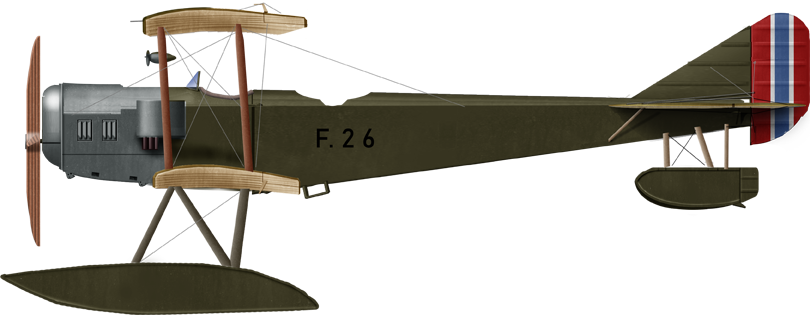
Norwegian MF5 in 1919.
Additional photos
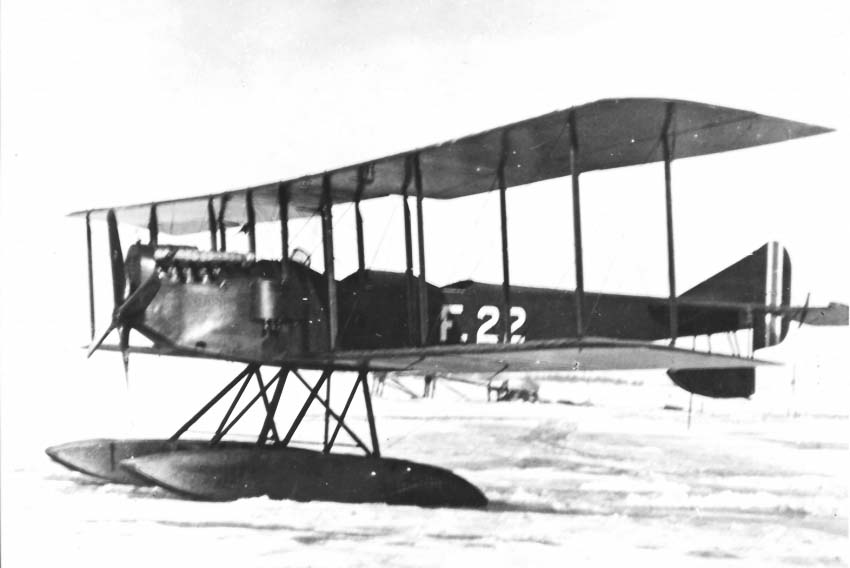
F.22, the prototype.
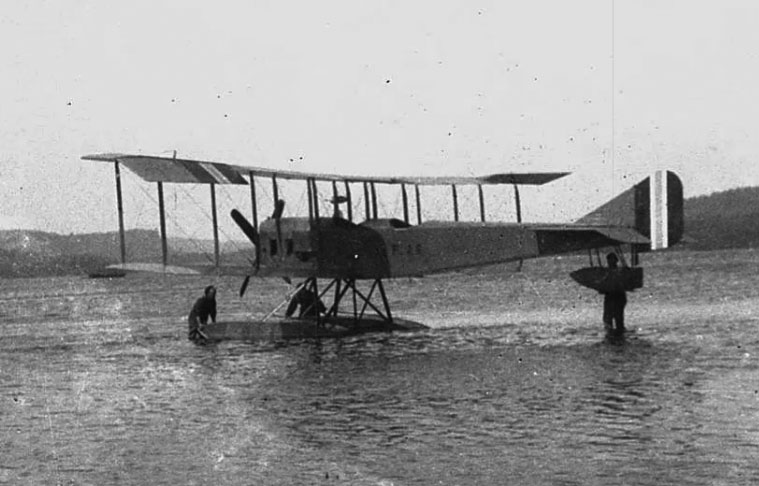
F.26, CC, see the source digitaltmuseum.no
F.26, same, other view
Resources
Books
Marinens Flygevåpen 1912–1944 by Bjørn Hafsten and Tom Arheim (2003)Hærens og Marinens flyvåpen 1912–1945
Links
On facebookPhotos of the MF5
Madsen MG
airwar.ru
Marinens_Flyvebaatfabrikk_M.F.5 (EN)
Farman_MF.7
The model corner
None found.- Lohner E (1913)
- Macchi M3 (1916)
- Macchi M5 (1917)
- Macchi M7 (1918)
- Ansaldo ISVA (1918)
- Short S.38 (1912)
- Sopwith Baby (1916)
- Short 184 (1916)
- Fairey Campania (1917)
- Sopwith Cuckoo (1917)
- Felixstowe F.2 (1917)
- Gotha WD.2 (1914)
- Friedrichshafen FF 33 (1916)
- Hansa-Brandenburg KDW
- Albatros W4 (1916)
- Albatros W8 (1918)
- Hanriot HD.2
- Grigorovich M5 (1915)
- Grigorovich M9 (1916)
- Grigorovich M11 (1917)
- IJN Farman MF.7
- IJN Yokosho Type Mo
- Yokosho Rogou Kougata (1917)
- Yokosuka Igo-Ko (1920)
- Curtiss N9 (1916)
- Curtiss H4 (1916)
- Curtiss H12 (1917)
- Curtiss H16 (1918)
- Aeromarine 39
- Vought VE-7
- Douglas DT (1921)
- NAF/Curtiss TS-1 (1922)
- Boeing FB.5 (1923)
- Boeing F4B (1928)
- Vought O2U/O3U Corsair (1928)
- Grumman FF (1931)
- Akron class airships (1931)
- Curtiss F9C Sparrowhawk (1931)
- Curtiss F11C Goshawk (1932)
- Curtiss BF2C Goshawk (1933)
- Blackburn Blackburn (1922)
- Supermarine Seagull (1922)
- Fairey Flycatcher (1923)
- Hawker Horsley (1925)
- Blackburn Ripon (1926)
- Fairey IIIF (1927)
- Fairey Seal (1930)
- LGL-32 C.1 (1927)
- Fokker T.II (1921)
- Fokker T.III (1923)
- Caspar U1 (1921)
- Dornier Do J Wal (1922)
- Rohrbach R-III (1924)
- Mitsubishi 1MF (1923)
- Mitsubishi B1M (1923)
- Yokosuka E1Y (1923)
- Nakajima A1N (1927)
- Nakajima E2N (1927)
- Mitsubishi B2M (1929)
- Nakajima A2N (1930)
- Nakajima A4N (1935)
- CANT 18 (1926)
Interwar Norway
- Marinen Flyg. M.F.5 (1918)
WW1
✠ K.u.K. Seefliegerkorps:
 Italian Naval Aviation
 RNAS
 Marineflieger
 French Naval Aviation
 Russian Naval Aviation
 IJN Air Service
 USA
Interwar
 Interwar US
 Interwar Britain
 Interwar France
 Interwar Netherlands
 Interwar Germany
 Interwar Japan
 Interwar Italy
- Grumman F2F (1933)
- Curtiss SOC seagull (1934)
- Grumman F3F (1935)
- Northrop BT-1 (1935)
- Consolidated PBY Catalina (1935)
- Grumman J2F Duck (1936)
- Brewster/NAF SBN-1 (1936)
- Curtiss SBC Helldiver (1936)
- Vought SB2U Vindicator (1936)
- Brewster F2A Buffalo (1937)
- Douglas TBD Devastator (1937)
- Vought Kingfisher (1938)
- Curtiss SO3C Seamew (1939)
- K-class Blimps (1939)
- Douglas SBD Dauntless (1939)
- Grumman F4F Wildcat (1940)
- F4U Corsair (NE) (1940)
- Brewster SB2A Buccaneer (1941)
- Grumman TBF/TBM Avenger (1941)
- Consolidated TBY Sea Wolf (1941)
- Grumman F6F Hellcat (1942)
- Curtiss SB2C Helldiver (1942)
- Curtiss SC Seahawk (1944)
- Grumman F7F Tigercat (1944)
- Grumman F8F Bearcat (1944)
- Ryan FR-1 Fireball (1944)
- Douglas AD-1 Skyraider (1945)
- Fleet Air Arm
- Hawker Osprey (1932)
- Fairey Swordfish (1934)
- Blackburn Shark (1934)
- Supermarine Walrus (1936)
- Fairey Seafox (1936)
- Blackburn Skua (1937)
- Short Sunderland (1937)
- Blackburn Roc (1938)
- Fairey Albacore (1940)
- Fairey Fulmar (1940)
- Grumman Martlet (1941)
- Hawker sea Hurricane (1941)
- Brewster Bermuda (1942)
- Fairey Barracuda (1943)
- Fairey Firefly (1943)
- Grumman Tarpon (1943)
- Grumman Gannet (1943)
- Supermarine seafire (1943)
- Blackburn Firebrand (1944)
- Hawker Sea Fury (1944)
- Coastal Command
- Vickers Wellington (1937)
- IJN aviation
- Yokosuka E6Y (1930)
- Aichi D1A "Susie" (1934)
- Mitsubishi A5M "Claude" (1935)
- Nakajima A4N (1935)
- Yokosuka B4Y "Jean" (1935)
- Mitsubishi G3M "Nell" (1935)
- Nakajima E8N "Dave" (1935)
- Kawanishi E7K "Alf" (1935)
- Nakajima B5N "Kate" (1937)
- Kawanishi H6K "Mavis" (1938)
- Aichi D3A "Val" (1940)
- Mitsubishi G4M "Betty" (1940)
- Mitsubishi A6M "zeke" (1940)
- Nakajima E14Y "Glen" (1941)
- Nakajima B6N "Jill" (1941)
- Mitsubishi F1M "pete" (1941)
- Aichi E13A Reisu "Jake" (1941)
- Kawanishi E15K Shiun "Norm" (1941)
- Nakajima C6N Saiun "Myrt" (1942)
- Yokosuka D4Y "Judy" (1942)
- Kyushu Q1W Tokai "Lorna" (1944)
 Luftwaffe
- Heinkel 114 (1935)
- Arado 196 (1937)
- Me109 T (1938)
- Blohm & Voss 138 Seedrache (1940)
 Italian Aviation
- Savoia-Marchetti S.55
- IMAM Ro.43/44
- CANT Z.501 Gabbiano
- CANT Z.506 Airone
- CANT Z.508
- CANT Z.511
- CANT Z.515
 French Aeronavale
- GL.300 (1926-39)
- CAMS 37 (1926)
- Levasseur PL.5 (1927)
- Potez 452 (1935)
- Loire 210 (1936)
- Loire 130 (1937)
- LN 401 (1938)
 Soviet Naval Aviation
- Shavrov SH-2 (1928)
- Tupolev TB-1P (1931)
- Beriev MBR-2 (1930)
- Tupolev MR-6 (1933)
- Tupolev MTB-1 (1934)
- Beriev Be-2 (1936)
- Polikarpov I16 naval (1936)
- Tupolev MTB-2 (1937)
- Ilyushine DB-3T/TP (1937)
- Beriev Be-4 (1940)
 Swedish Naval Aviation
- SAAB B17S
-
 Skoda Š-328V
 R-XIII Idro
 Fokker C.XI W (1934)
 Rogožarski PVT-H (1938)
WW2
 ☍ USNA
- De Havilland Sea Vixen
- Hawker Sea Hawk
- Supermarine Scimitar
- Blackburn Buccaneer
- Hawker Sea Harrier
- Douglas A4 Skyhawk
- Grumman F9F Panther
- Vought F8 Crusader
- McDonnell-Douglas F-4 Phantom-II
- North Am. A5 Vigilante
- TU-142
- Yak 38 forger
☢ Cold War
✧ NATO
Fleet Air Arm
 US Navy
☭ Warsaw Pact
Merch
Seafire Mark 45; HMS Pretoria Castle
Zeros vs its aversaries
Aichi D3A “Val” Junyo
Mitsubishi A5M poster
F4F wildcat
Macchi M5
SBD Dauntless Coral Sea
SBD Dauntless USS Enterprise
SBD-4 CV22