Fairey Flycatcher (1923)
 FAA 1923-34: 196 built.
Design development
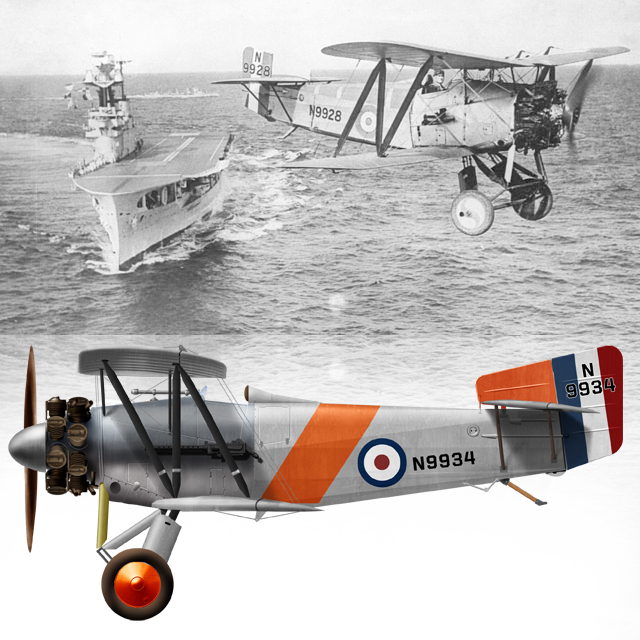
In WWI, experience with carrier-borne fighters with the RNAS was fairly limited. Only three ships were converted with full or semi-full decks: The most famous was HMS Furious, which in 1918 tested Sopwith Camels on deck for a mission that was eventually never carried out. The second was HMS Campania, but it only had a forward sloped deck for mostly seaplanes, albeit it deployed the Sopwith 1/12 Strutter, which was a jack of all trades also valued as fighter escort. The Sopwith Pup was also tested on her deck, a more serious fighter. And there was HMS Argus, whuch tested both the ungainly Parnall Panther (recce) and Sopwith Camel.
Needless to say, all these provided important experience about fighter operations. They were able to take off on very limited deck space, climbed fast, but had a limited range. Thus, the co,ncept of a CAP (Combat Air Patrol) to secure air operations close to the carrier and counter any air attack was already pioneered, at least in concept in 1918. Indeed, until 1919 and the completed of IJN Hosho, Britain stands alone in the very restricted club of carrier-borne aviation. This started to change quickly, and so the need for a truly tailored fighter fit for deck operations. The Camel and Strutter were sturdy, but they were originally designed for land operations, with plenty of airfields with soft grounds, stable surfaces, and no trouble with seawater spray. A carrier deck was something else entirely and the RNAS was well aware notably of the constrains it imposed on aircraft structures. The Pup, Came and Strutter were still light enough to not break apart on landing, but there were still close calls and accidents aplenty.

The forgotten Nightjar, first partly designed as carrier fighter
So in 1920, the first ideas about the ideal carrier borne fighters were first drafted, but discussions went on as technologies progressed. In between, the principle of arresting cables and a hook were well understood as a way forward, as well as the materials to use to avoid seawater corrosion and how to reinforce the undercarriage. This led to a delayed requirement for 1922, hence the Specification N6/22 for a carrier and floatplane fighter to replace the Gloster Nightjar.
The latter was itself a 1921 evolution of the Nieuport Nighthawk, a British Nieuport fighter which first flew in 1919 to replace the Sopwith Snipe. The latter was not designed for carrier operations, but the last variant of the Nighthawk called Gloster Mars X, became the Nightjar and was intended as a single-seat shipboard fighter to replace RNAS Sopwith Camels. However the model was not entirely successful and only 22 were made, with a single squadron equipped for the Navy, Sqn 203 deployed HMS Argus in September 1922 (future post).
In terms of ruggedness and raw power, this model already checked a few boxes, but this was still not the RAF wanted for the Navy. Its limitations were the true dirving specifications for the future carrier fighter. Specification N6/22 wanted a more powerful fighter, based on the latest engines being developed, either the Armstrong Siddeley Jaguar or Bristol Jupiter radial. Only Fairey and Parnall submitted designs meeting deadlines and all specification. Fairey presented the Flycatcher. Parnall presented the Plover. Fairey received the greenlight for comparative tests and was ordered three prototypes (N°160, 161 and 162). The first Flycatcher (N°163, F406) made its maiden flight on 28 November 1922. Later under Lt.Col. Vincent Nicoll (DSO, DFC). at Martlesham Heath the same made its landing and lying-off debts from HMS Argus by February 1923. It was modified with steel-jaws on the undercarriage spreader to engage the wires. Traverse standard wires only became the norm in 1933. This first prototype was re-engineered with a Bristol Jupiter. N°164 was tested as a seaplane with a Jaguar engine. The third was the amphibians with a Jupiter and roadwheel-equipped floats.
For it, Fairey choose the prescribed Jaguar II engine. However its own testes conducted a change later to the Jupiter IV. RAF and Navy officials approved the design for more comparative tests, ordering a few more, making for a total of nine Flycatcher, but also to Plover, ten aircraft for service evaluation, not on airfields but living, breathing aircraft carriers and likely HMS Argus, which was the go-to ship for such tests thanks to her perfectly flattop, wide and roomy. After these gruelling comparative trials, Fairey won the contest and the Flycatcher was ordered for full production. Pilots soon commented on the new salty bird. They praised its comfort to fly and aerobatics qualities, whereas it had all the ruggedness required for carrier operations.

Loosing design, but almost as good: The Parnall Plover
Now a few words about the Plover. Designed by Harold Bolas it was also a pure single-seat naval fighter aircraft, single-bay biplane in wood-and-fabric with full-span flaps and optional wheeled undercarriage or floats, even wheels protruding through the bottom of the floats as a true amphibians. The first prototype flew in late 1922 with a Bristol Jupiter. The Navy ordered a floatplane and another land-carriage model, then for the final carrier service tests, ten more, making for 13 Parnall Plover ever built. The first two failed against the Flycatcher, but the third managed to do as well, which led to the 10 supplementary orders. For these realistic service tests, they were integrated into the 403 and 404 Fleet Fighter Flights RAF 1923. But in 1924, the axe fell. Albet this was by a margin, the Flycatcher proved more popular to fly and was easier to rig. But they both performed the same, and both were rugged enough for deck landings.
Design specifics
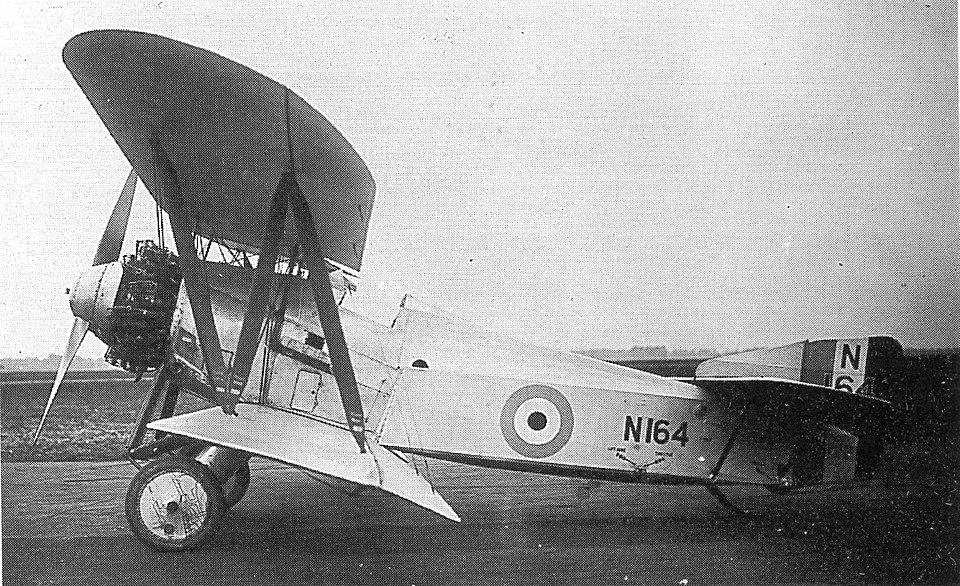
First Prototype
The winner design, the Flycatcher, designed by F. Duncanson was arguably less appealing than the Plover, notably because the latter had a rounded tail, rounded wingtips and a well-profiled nose with a proper effort made on the engine cowling. In contrast, Fairey preferred utility to aesthetics. The Flycatcher was designed as a purely functional fighter, in general construction it was the same two-bay biplane made in wood and canvas, but the tail was slab-sided, but all wings were rounded and the upper wing featuring a large dihedral. For best cooling, if the fuselage ended as a splindle, the twin-row radial cylinders happily protruded from it for better cooling. Access to maintenance was made easier and the rigging and bracing plan was simpler. Later a nose cone was proposed. Another advatage over the Parnall, was Fairey's choice of a mixed metal and wooden fuselage rather than all-wooden.
This was otherwise a remarkable design for its time, specifically designed for carrier operations. To land more softly, it had generous flaps than ran the entire trailing edges of both wings and could be lowered for landing and takeoff, so that at full throttle, the little seabird could bounce up in just 50 yd (46 m) of deck space. It could land the same, and for it had a remarkably strong, albeit disgraceful undercarriage. Like for the Parnall and on specifications, it could be swapped for floats. The cumbersome undercarriage flip to twin floats was also proposed in the same wheel/float combination for amphibian use as the Parnall, basically with a trench and axle through the float for the wheel, and enough space for suspension without damaging the floats on landings. The latter were reinforced in order to act as skis if the landing was rougher than usual.
Fairey was really for Britain, its Grumman. The company, with Blackburn, tailor made well-thought naval planes. The Flycatcher was also remakable for its hydraulic wheel brakes, added to assist a short stop, without any arresting hook or cable present, on a limited deck space. There was however an arrestor hook, or rather a pair of them, fitted on the undercarriage spreader bar instead of under the belly aft, like more later models. This was a quirky feature of the Flycatcher and others, designed to engage the arrestor wires based on lighter weight balance ratios. Later, heavier planes tended to be more tail heavy. Production started at Fairey's Hayes factory in 1923, with a grand total of 196 built (including prototypes) until 1926 so just a three years run. But the company planned its replacement, the Mark II, tested in October 1926 to match a new specifications (see later).
General Layout
Single seat two-bay biplane of equal span, it had a strong dihedral on the top wing, pronounced stagger, ungainly, but indestructible undercarriage, and a fuselage ending with an oddly shaped fin and rudder giving the impresion of being "cocked up" at the rear end. The structure was conventional, with mainplane and tail assembly all wooden, but with metal fittings, fabric covering, anf a composite fuselage of metallic structural framing coupled with wooden panels in places, and fabric covered overall.To aid stowage, the entire airframe was built in a way it could be dismantled so no section made more than 13 feet 6 inch (4.5 meters). It had a relatively short wingspan but still plenty of lift with a wing area of 288 sq ft (26.8 m2).The wing span was limited to 29 feet so it needed no folding. It also shared elements with the Hamble Baby and IIID/IIIF, like the patented camber-changing mechanism. As sais above, the flaps ran all along the trailing edges of the upper and lower wings so it could brake speed while keeping lift while landing, or be used for agressive take-off as well. This steepened the glide path, shortened deck operations. Reports of the tests at Martlesham Heath on 9 Feb. 1923 showed how much these flaps were game-changing on N°163. Pilot Flight Lt. Orlobar (future schneider trophy ace) and F.O. Bird showed that without wind, in zero flap setting, the Flycatcher could "unstick" in just 121 yards (110 meters) but it was down to 63 yards (57 meters) with the flaps at 8°. It could also land down to 47 mph (75 kph). It showed excellent stability in a steep dive as well, control lateral and longitudinal were excellent, but it started to swing when the landing flaps were fully lowered. They found also the location of the starboard gun impractical and it was later modified.
Further praised came from F.L. Fletcher on Argus, also that it wazs ideal even for rookie pilots, very forgiving, with a recommended approach speed of 70-75 mph, and praising the pilot's view as well. The precision of flight was also praised by GJ. Christopher Paul, which piloted it (Air Pictorial) and compared it to the Spitfire form the pilot/machine responsiveness intimacy. All this made the Flycatcher one of the most popular model in RNAS and British service overall, for a service dragging on until 1934 despite better models arrived in between, such as the Nimrod and Osprey. The Nimrod was essentially a navalized Fury, probably one of the very best fighters of the Interwar. It was comparable to the Fairey IIIF, easily one of the "immortals" produced by the company over the years. In 1930 there were still 17 flights equipped with the model.
Engine & Performances
The production Mark I had one engine, to lift a gross weight f 3,028 lb (1,373 kg), the Armstrong Siddeley Jaguar IV 14-cylinder, two-row, air-cooled radial piston engine. It developed 400 hp (300 kW). The power came to a front-mounted 2-bladed fixed-pitch wooden propeller for solid performances compared to land-based fighters: A top speed of 133 mph (214 km/h, 116 kn) at sea level, a range of 310 mi (500 km, 270 nmi) and a service ceiling of 19,000 ft (5,800 m), with a rate of climb of 1,090 ft/min (5.5 m/s) and a time to altitude of 10,000 ft (3,000 m) in 9 minutes 29 seconds. To compare, the best later land-based fighter, the 1926 Gloster Gamecock, was capable of 155 mph (249 km/h) at 5,000 ft, and 10K ft in 7 min. 36 sec. but contemporary, the Gloster Grebe, reached 152 mph (245 km/h) at sea level and could reach 10K feet in 8 min and twice that in 23 min.Armament
Being a 1920s fighter, there were not tons of option for the Flycatcher: As standard it had two 0.303 in (7.7 mm) Vickers machine guns placed either side of the fuselage, firing through the propeller thanks to a gear interrupter mechanism. If jammed, they could be un-jammed by the pilot using a small hammer, at least on paper, but it was a long reach. Fairey even managed to have four small racks under the wings for 20 lb (9.1 kg) bombs. This was almost never used, apart against pirates in the China sea in the early 1930s. And this was as a dive-bomber. This was only biplane from this generation to be able to go full throttle and recover after such as dive, proving its exceptional ruggedness, and the only one filling that hardcore requirement by the air ministry. Both the Nimrod and Skua also were able to act as dive bombers. Demonstrations were made at Hendon in 1928-29, delighting the spectators with the "blue note" of their engine when recovering or converging bombings in displays from three directions on the same target from 2000 ft.The Flycatcher Amphibians and Floatplanes
The floatplane version was developed to extend its operational capabilities and featured pure floats (no wheels) as a pure seaplane. It was deployed extensively in the Mediterranean, featuring a nose cone for better aerodynamics. N9678 was the truly first amphibian, bsed at Northolt, and flow on 19 February 1924 by Captain Norman MacMillan, writer and test pilot. The second, N9953, flew at Hamble in Octpber 1925. N9913 was modified, reinforced, to be catapulted by HMS Vindictive (former Hawkins class cruiser converted as carrier cruiser).Specifications Mark I | |
| Crew: | 1 Pilot |
| Lenght: | 23 ft (7.01 m) |
| Wingspan: | 29 ft (8.84 m) |
| Height: | 12 ft (3.66 m) |
| Wing Area: | 288 sq ft (26.8 m2) |
| Weight, Empty: | 2,038 lb (924 kg) |
| Gross weight: | 3,028 lb (1,373 kg) land-plane |
| Propulsion: | Armstrong Siddeley Jaguar IV 14-cyl. radial 400 hp (300 kW) |
| Propeller: | 2 bladed, wooden fixed pitch |
| Performances: |
|
| Armament | 2 × .303 in (7.7 mm) Vickers Machine Guns, bombs, see notes. |
Royal Navy service
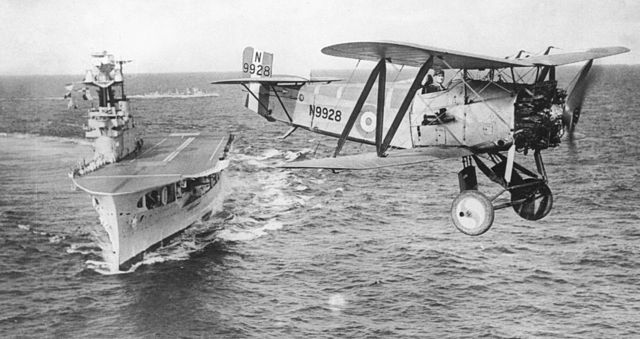
Flycatcher from HMS Eagle
As seen above, the first prototypes were tested in realistic conditions from HMS Argus in 1923 already. The first RAF unit operating this model was 402 flight from 1923. Next was 401, replacing the Nightjar, 403 and 404, replacing the Parnall Plover. The gradual buildup by September 1924 showed the 401, 402, 403, 404 and 406 all jad Flycatchers at Leuchars, except for 402 on HMS Argus. The next years, 402 was at Malta and 403 in the Mediterranean, rotating. In 1927, 404A and 404B were created flying at Donibristle and from HMS Argus at the China Station. 401 was also in China, 402 was on HMS Eagle in the Med., 403 was on HMS Hermes, China Station, and 405 was on HMS Furious with the Home Fleet. By 1928, 401 was still on, Argus, 402 on Eagle (Med, both), 403 on Hermes (China), 404 and 407 on HMS Courageous, 405 on Furious (Home fleet) and 406 at Donibristle. In 1929, same, expect N°408 was added at Donibristle. Courageous operated N°407 NAS. In 1930 all five aircraft carriers of the RN operated the Flycatcher as primary fighter.
In 1932 however, only N°401 and 407 kept these, but they started to be replaced by the Nimrod and by April 1933, FAA flights started to merge by air minstry order, albeit 801 Sqn. kept a mix of Flycatcher and Nimrods, notably on HMS Furious. It was understood the Flycatcher were used as CAP or local defense ou at sea whereas the long range Nimrod were used for offensive missions. That "high-low mix" was used also in 1945 with the British Pacific Fleet, the Spitfire performing this time as CAP fighter. It's in China that the last Flycatchers operated, with N°403 and in the east indies, Singapore with N°406 Sqn FAA. The latter had two units of catapulted floatplanes from Battleships and Cruisers, which retained flight status until... 1939. By June 1934 replacement in 403 and 406 started with the Osprey.
In very cold conditions, in winter in the north sea and Scotland, the Flycatcher was also tested with skis, proving its exceptional versatility. It was also the first seaplane fighter qualified for catapult launches in the FAA and other were launched from the gun platforms on battleships. Even in its floatplane configuration, the Flycatcher was able to do the full range of aerobatics. These well studied, wooden 'boat-built" floats provided stability, so no need to have it completed by a third, smaller float beneath the tail. By the late 1920s, Chinese pirate activity was such in East Indies waters and the China sea that flycatcher seaplanes of N°403 Sqn base din Hong Long spent their days patrolling and attacking Junks several times per day. This was well described by Owen Cathcart-Jones (Royal marines) in "Aviation Memoirs". A famous FAA figure, he operated from Courageous in 1929 and dropped on the CiC flagship thousands of brown paper sheets as a practical joke. Another anecdote was FO PD. Cracroft (later a vice marshall) from Glorious that during manoeuvers, saw a collision ready to happen and deliberatly ditched his aircraft on the path of incoming destroyer to draw their attention at the dange, avoiding possibly fatal consequences. That was before radios were mandatory...
And there were the famous "slip-flight" enables by the nimbler Flycatcher from Furious, Glorious and Courageous, the three ex-battlecruisers converted to carriers originally wanted by Lord Fisher for a Baltic raid. The crew trained to house six Flycatcher in the forward part of the hangar, close to the lift, engines running full throttle to war up, and taking off from the bow, so not in need to reach the proper flight deck, in rapid succession over 60 ft. This was so low they almost systematically touched water with their wheels, before gaining height. This proved to the admiralty that other aircraft could take off above on the normal deck. The Japanese did the same on Kaga and Akagi before their late 1930s reconstruction. For recovery, well trained crews would take down in the hangar six landing Flycatchers in succession in just about four minutes and 20 sec. A Flycatcher made also the first night landing of the FAA (Fleet Air Arm) on 26 November 1929 flying to HMS Courageous from Hal Far base at Malta. Eventually any good career had to end, the Air Minustry declared the model officially obsolete and to be retired eveywhere in April 1939, so more than a full decade after its introduction in 1923, a remarkable longevity, almost never equalled in the Royal Navy, especially under constant technological innovations.
Gallery
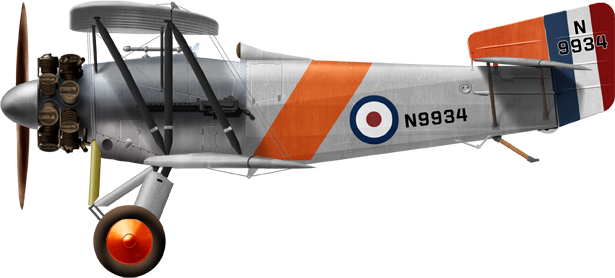
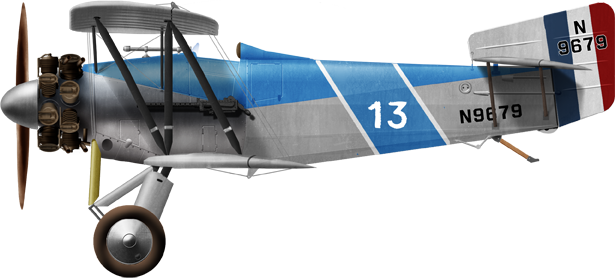
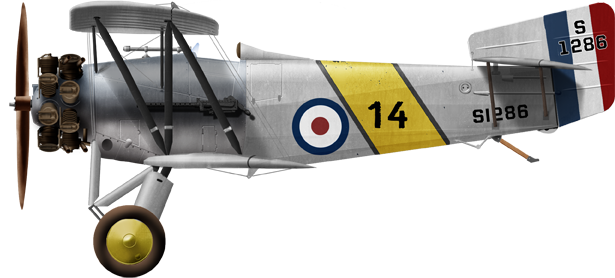
Author's illustrations: Types and liveries
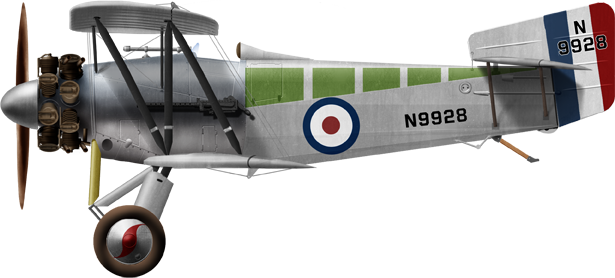
403 Flight HMS Eagle
405 Flight HMS Furious
404 Flight HMS Courageous
405 Flight HMS Glorious 1931
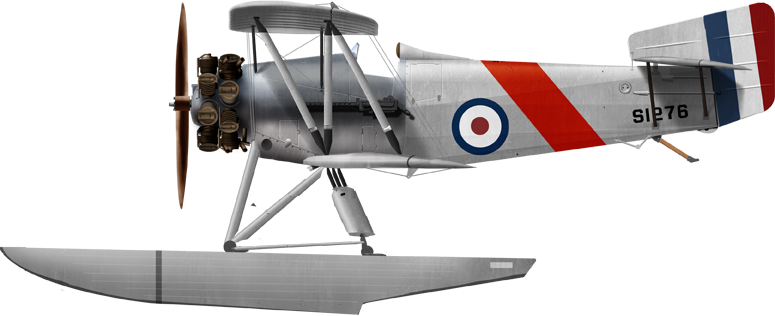
Flycatcher Floatplane, late 1930s
Additional photos
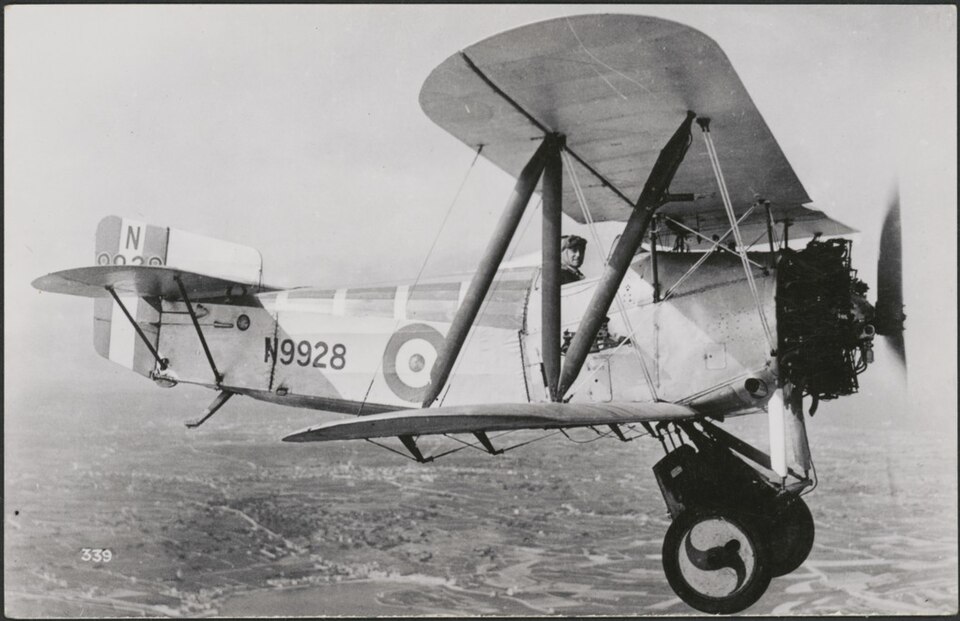
N9928 in flight c1920s
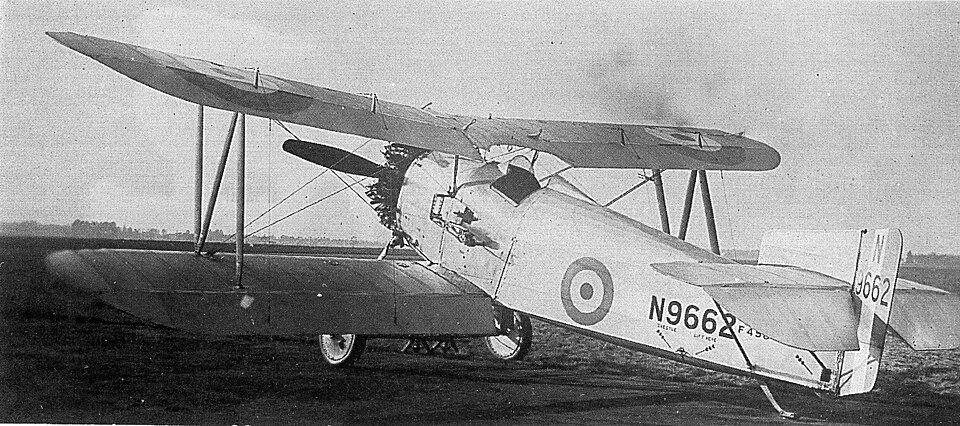
First production model
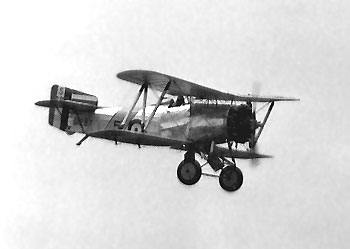
Flycatcher in flight
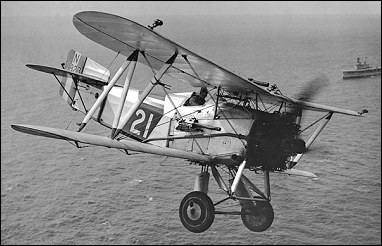
Flycatcher in flight
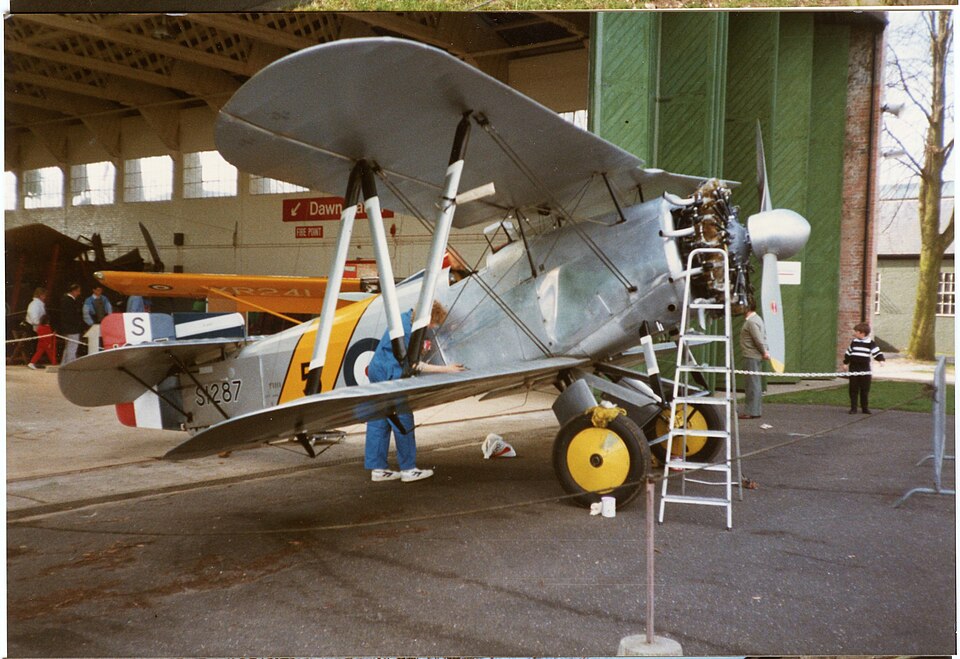
Modern Replica Duxford
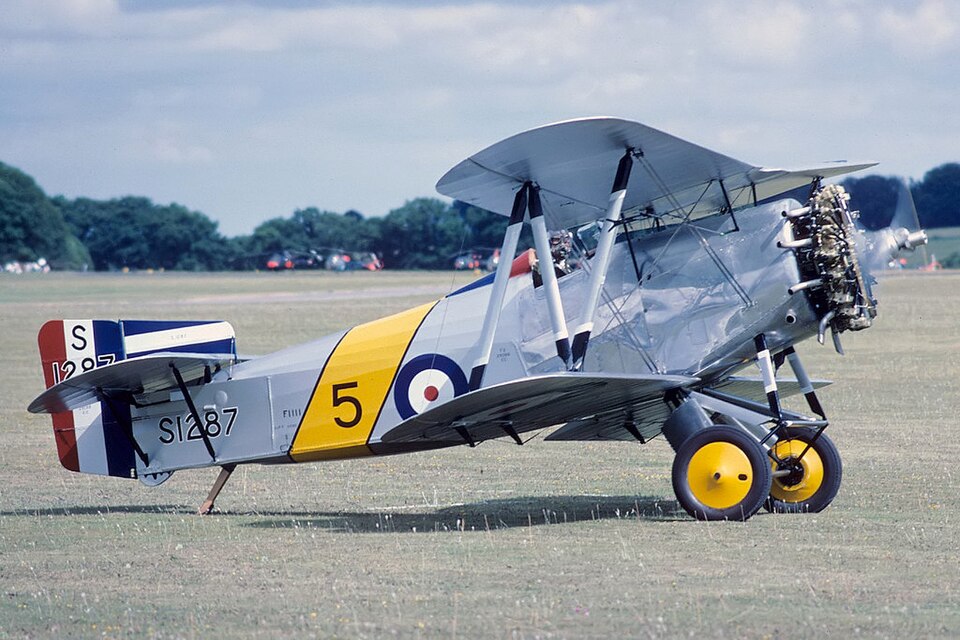
Modern Replica Duxford
Links and resources
Thetford, Owen (1978). Aircraft of the Royal Navy since 1912 (4th ed.).The Illustrated Encyclopedia of Aircraft (part work 1982–1985). London: Orbis.
"'Booted' Flycatchers". Air Enthusiast, No. 83, September–October 1999, p. 78.
Crosby, Francis. The World Encyclopedia of Naval Aircraft. Lorenz Books, 2008.
Mason, Francis K. The British Fighter since 1912. NIP
Taylor, H. A. Fairey Aircraft since 1915. London: Putnam, 1974
Thetford, Owen. British Naval Aircraft since 1912. London: Putnam, Fourth edition, 1978
Profile-Publications Aircraft 056
britishaircraft.co.uk
raf-in-combat.com
aviastar.org
speedreaders.info
globalmaritimehistory.com
aeroflight.co.uk
vintageaviationnews.com
CC photos
en.wikipedia.org
Video
Not A Pound For Air To Ground channel, FlycatcherModel Kits
On scalemates- Lohner E (1913)
- Macchi M3 (1916)
- Macchi M5 (1917)
- Macchi M7 (1918)
- Ansaldo ISVA (1918)
- Short S.38 (1912)
- Sopwith Baby (1916)
- Short 184 (1916)
- Fairey Campania (1917)
- Sopwith Cuckoo (1917)
- Felixstowe F.2 (1917)
- Gotha WD.2 (1914)
- Friedrichshafen FF 33 (1916)
- Albatros W4 (1916)
- Albatros W8 (1918)
- Hanriot HD.2
- Grigorovich M5 (1915)
- Grigorovich M9 (1916)
- Grigorovich M11 (1917)
- IJN Farman MF.7
- IJN Yokosho Type Mo
- Yokosho Rogou Kougata (1917)
- Yokosuka Igo-Ko (1920)
- Curtiss N9 (1916)
- Curtiss H4 (1916)
- Curtiss H12 (1917)
- Curtiss H16 (1918)
- Aeromarine 39
- Vought VE-7
- Douglas DT (1921)
- NAF/Curtiss TS-1 (1922)
- Boeing FB.5 (1923)
- Boeing F4B (1928)
- Vought O2U/O3U Corsair (1928)
- Grumman FF (1931)
- Akron class airships (1931)
- Curtiss F9C Sparrowhawk (1931)
- Curtiss F11C Goshawk (1932)
- Curtiss BF2C Goshawk (1933)
- Blackburn Blackburn (1922)
- Supermarine Seagull (1922)
- Fairey Flycatcher (1923)
- Hawker Horsley (1925)
- Blackburn Ripon (1926)
- Fairey IIIF (1927)
- Fairey Seal (1930)
- LGL-32 C.1 (1927)
- Fokker T.II (1921)
- Fokker T.III (1923)
- Caspar U1 (1921)
- Dornier Do J Wal (1922)
- Rohrbach R-III (1924)
- Mitsubishi 1MF (1923)
- Mitsubishi B1M (1923)
- Yokosuka E1Y (1923)
- Nakajima A1N (1927)
- Nakajima E2N (1927)
- Mitsubishi B2M (1929)
- Nakajima A2N (1930)
- Nakajima A4N (1935)
- CANT 18
WW1
✠ K.u.K. Seefliegerkorps:
 Italian Naval Aviation
 RNAS
RNAS
 Marineflieger
 French Naval Aviation
 Russian Naval Aviation
 IJN Air Service
 USA
USA
Interwar
 Interwar US
Interwar Britain
 Interwar France
 Interwar Netherlands
 Interwar Germany
 Interwar Japan
 Interwar Italy
- Grumman F2F (1933)
- Curtiss SOC seagull (1934)
- Grumman F3F (1935)
- Northrop BT-1 (1935)
- Consolidated PBY Catalina (1935)
- Grumman J2F Duck (1936)
- Brewster/NAF SBN-1 (1936)
- Curtiss SBC Helldiver (1936)
- Vought SB2U Vindicator (1936)
- Brewster F2A Buffalo (1937)
- Douglas TBD Devastator (1937)
- Vought Kingfisher (1938)
- Curtiss SO3C Seamew (1939)
- K-class Blimps (1939)
- Douglas SBD Dauntless (1939)
- Grumman F4F Wildcat (1940)
- F4U Corsair (NE) (1940)
- Brewster SB2A Buccaneer (1941)
- Grumman TBF/TBM Avenger (1941)
- Consolidated TBY Sea Wolf (1941)
- Grumman F6F Hellcat (1942)
- Curtiss SB2C Helldiver (1942)
- Curtiss SC Seahawk (1944)
- Grumman F7F Tigercat (1944)
- Grumman F8F Bearcat (1944)
- Ryan FR-1 Fireball (1944)
- Douglas AD-1 Skyraider (1945)
- Fleet Air Arm
- Hawker Osprey (1932)
- Fairey Swordfish (1934)
- Blackburn Shark (1934)
- Supermarine Walrus (1936)
- Fairey Seafox (1936)
- Blackburn Skua (1937)
- Short Sunderland (1937)
- Blackburn Roc (1938)
- Fairey Albacore (1940)
- Fairey Fulmar (1940)
- Grumman Martlet (1941)
- Hawker sea Hurricane (1941)
- Brewster Bermuda (1942)
- Fairey Barracuda (1943)
- Fairey Firefly (1943)
- Grumman Tarpon (1943)
- Grumman Gannet (1943)
- Supermarine seafire (1943)
- Blackburn Firebrand (1944)
- Hawker Sea Fury (1944)
- Coastal Command
- Vickers Wellington (1937)
- IJN aviation
- Yokosuka E6Y (1930)
- Aichi D1A "Susie" (1934)
- Mitsubishi A5M "Claude" (1935)
- Nakajima A4N (1935)
- Yokosuka B4Y "Jean" (1935)
- Mitsubishi G3M "Nell" (1935)
- Nakajima E8N "Dave" (1935)
- Kawanishi E7K "Alf" (1935)
- Nakajima B5N "Kate" (1937)
- Kawanishi H6K "Mavis" (1938)
- Aichi D3A "Val" (1940)
- Mitsubishi G4M "Betty" (1940)
- Mitsubishi A6M "zeke" (1940)
- Nakajima E14Y "Glen" (1941)
- Nakajima B6N "Jill" (1941)
- Mitsubishi F1M "pete" (1941)
- Aichi E13A Reisu "Jake" (1941)
- Kawanishi E15K Shiun "Norm" (1941)
- Nakajima C6N Saiun "Myrt" (1942)
- Yokosuka D4Y "Judy" (1942)
- Kyushu Q1W Tokai "Lorna" (1944)
 Luftwaffe
- Heinkel 114 (1935)
- Arado 196 (1937)
- Me109 T (1938)
- Blohm & Voss 138 Seedrache (1940)
 Italian Aviation
- Savoia-Marchetti S.55
- IMAM Ro.43/44
- CANT Z.501 Gabbiano
- CANT Z.506 Airone
- CANT Z.508
- CANT Z.511
- CANT Z.515
 French Aeronavale
- GL.300 (1926-39)
- CAMS 37 (1926)
- Levasseur PL.5 (1927)
- Potez 452 (1935)
- Loire 210 (1936)
- Loire 130 (1937)
- LN 401 (1938)
 Soviet Naval Aviation
- Shavrov SH-2 (1928)
- Tupolev TB-1P (1931)
- Beriev MBR-2 (1930)
- Tupolev MR-6 (1933)
- Tupolev MTB-1 (1934)
- Beriev Be-2 (1936)
- Polikarpov I16 naval (1936)
- Tupolev MTB-2 (1937)
- Ilyushine DB-3T/TP (1937)
- Beriev Be-4 (1940)
 Swedish Naval Aviation
- SAAB B17S
-
 Skoda Š-328V
  R-XIII Idro
 Fokker C.XI W (1934)
 Rogožarski PVT-H (1938)
WW2
 ☍ USNA
- De Havilland Sea Vixen
- Hawker Sea Hawk
- Supermarine Scimitar
- Blackburn Buccaneer
- Hawker Sea Harrier
- Douglas A4 Skyhawk
- Grumman F9F Panther
- Vought F8 Crusader
- McDonnell-Douglas F-4 Phantom-II
- North Am. A5 Vigilante
- TU-142
- Yak 38 forger
☢ Cold War
✧ NATO
Fleet Air Arm
 US Navy
☭ Warsaw Pact
Merch
Seafire Mark 45; HMS Pretoria Castle
Zeros vs its aversaries
Aichi D3A “Val” Junyo
Mitsubishi A5M poster
F4F wildcat
Macchi M5
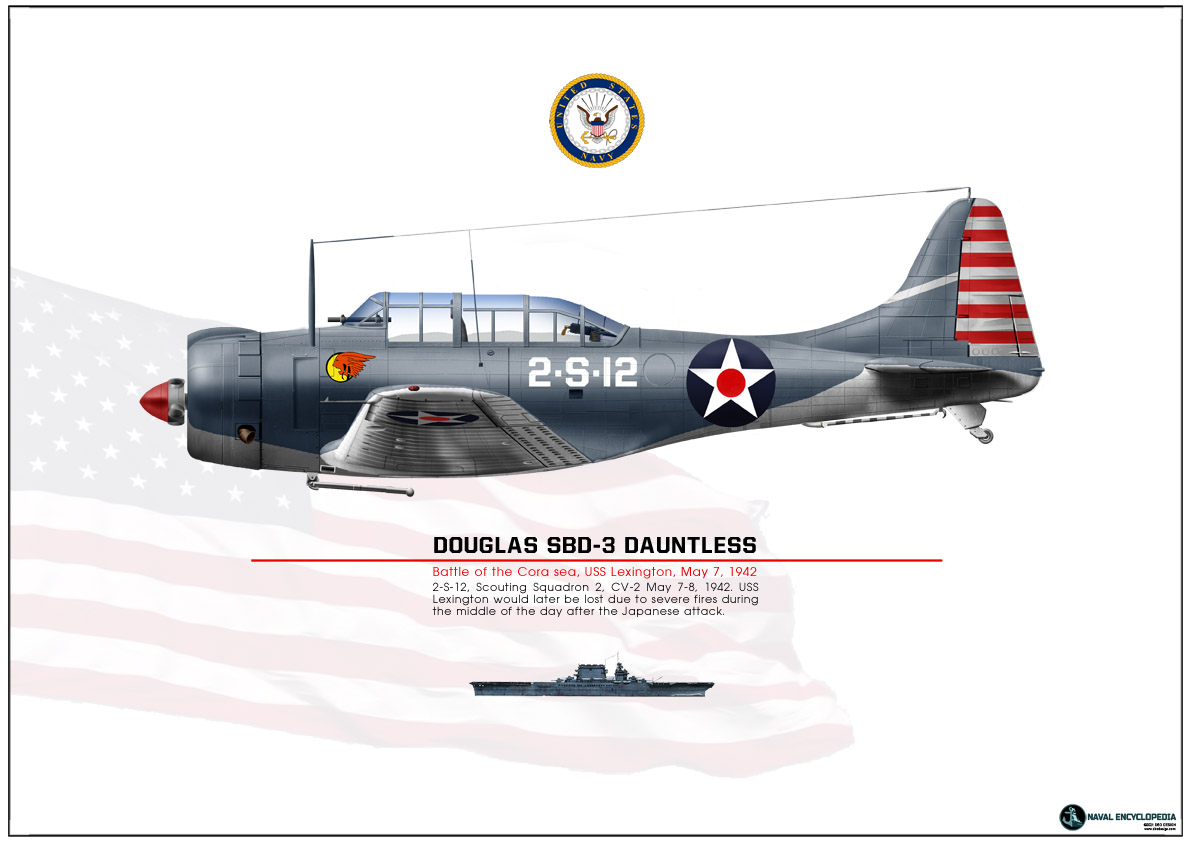
SBD Dauntless Coral Sea
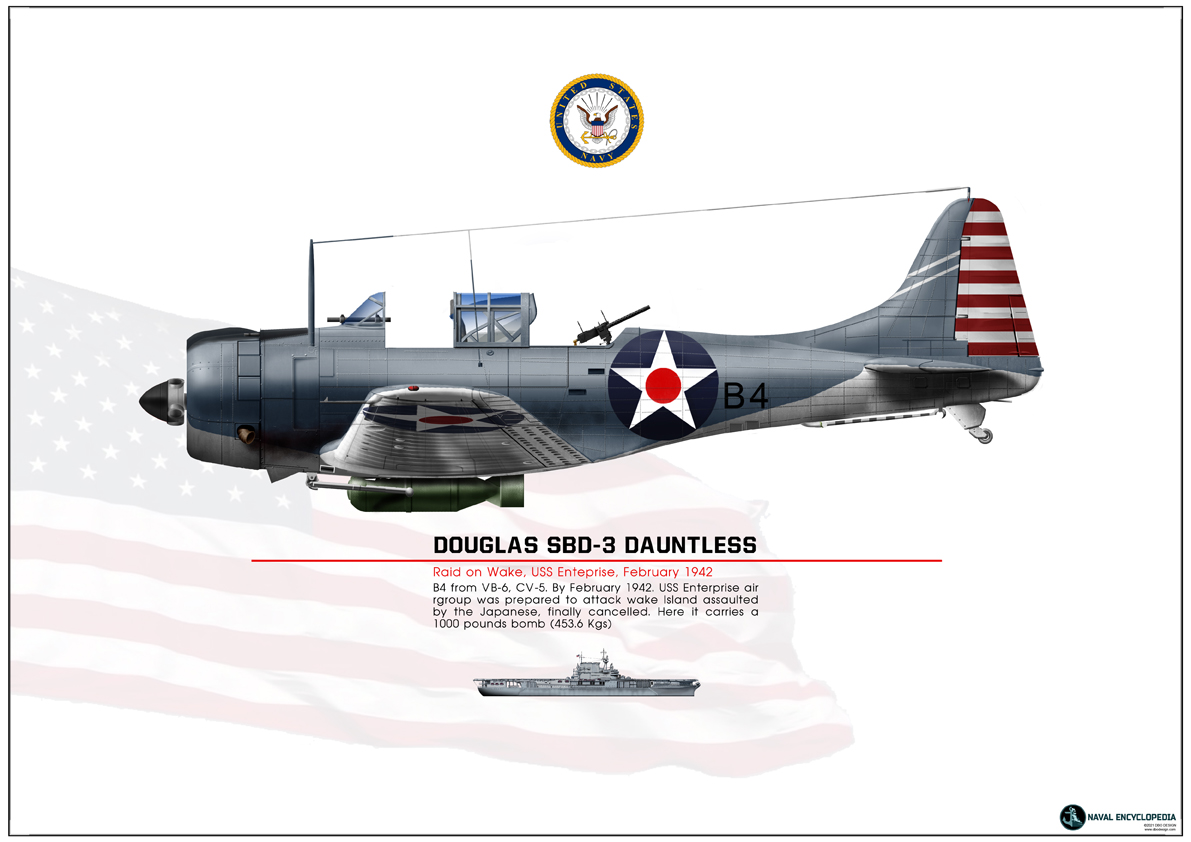
SBD Dauntless USS Enterprise
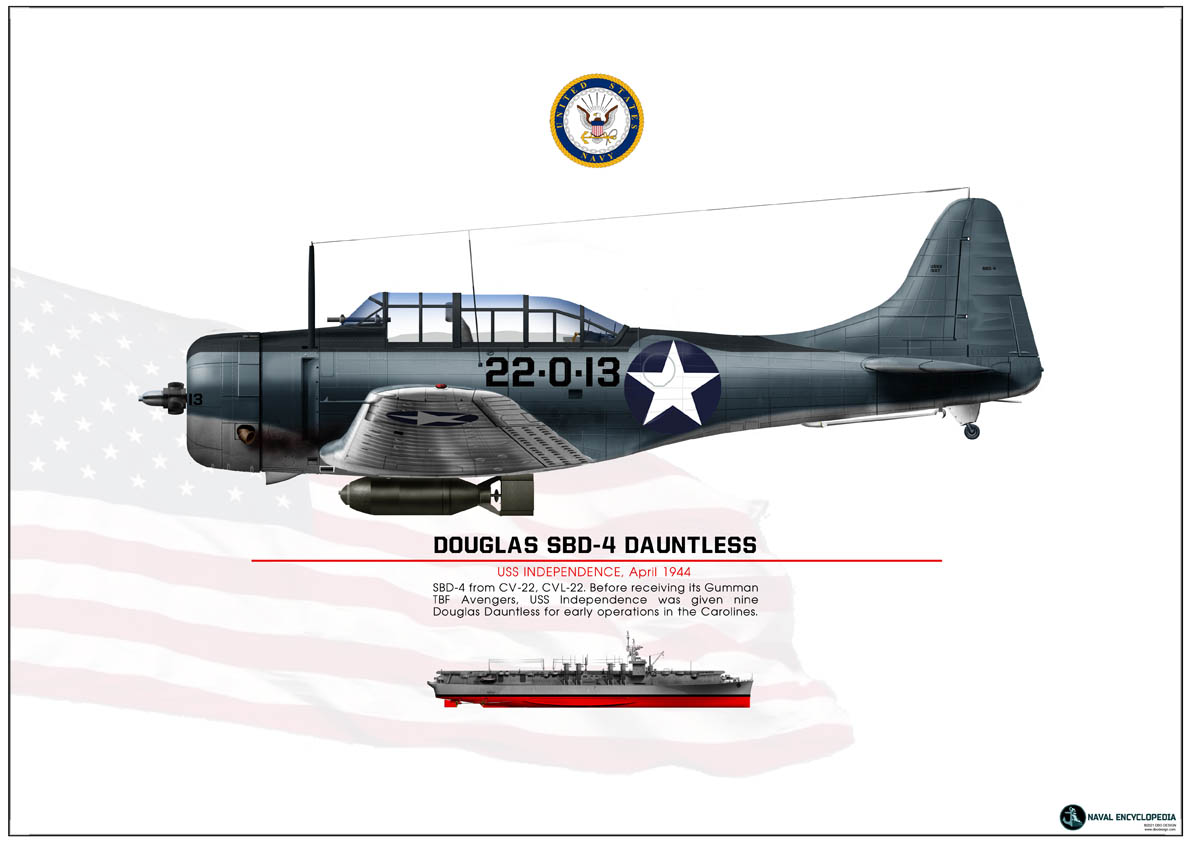
SBD-4 CV22