Rogožarski PVT-H
 4 built 1938-39.
Development
About Rogožarski
There were few firms in Yugoslavia that were able to design and manufacture aircraft from scratch in the interwar. Rogožarski is the the one. This company, Prva Srpska Fabrika Aeroplana ("First Serbian Aircraft Factory") Živojin Rogožarski (founder) was the first Sof its kind in Yugoslavia. It was founded in 1924 when the country was still young. It was responsible for most of country's air industry in the interwar with Ikarus. At first it started by repairing captured WWI models, then turned to manufacture its own models and license produce more from abroad.Three floatplane models were part of this effort, but the range comprised parasols, biplanes, and monoplanes, all using modern techniques and various inspirations, albeit engines were often French. The most iconic is certainly the "Yugoslavian Hurricane", the IK-3 in 1938, and a proper Hurricane was licence-made also in 1939. Production rates were low and many of these were trainers. The ther exceptions would be the Rogožarski SIM-XIV-H, a floatplane bomber built "in series", next on out list after the Rogožarski SIM-XII-H. However the company was nationalised by the Yugoslav government in 1946, merged together with Zmaj into Ikarus and remained in activity until 1962. Rogožarski always worked at the scale of a workshop, producing quality models in small quantities, and despite all its range never went beyond 286 aircraft total.
Development of the PVT (1933-36)
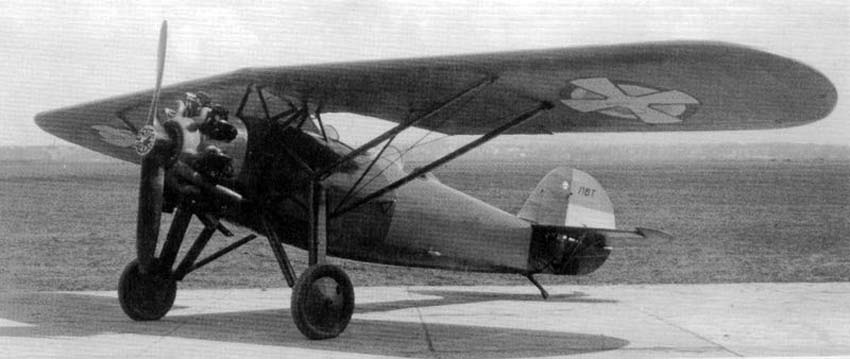
The regular land-based PVT. It could swap its wheels for skis in winter.
In the early 1930s, the Royal Yugoslavian Air Force Command considered purchasing a new transitional, monoplan training aircraft to its planned fighter groups, that would replace the now already outdated Zmaj "Gurda-Lesser" (Gourdou-Lesseure) biplane. The choice fell on the French Morane-Saulnier MS.230, which one was purchased and tested in Yugoslavia. But close examination led a group of engineers from the technical service of the Royal Yusgoslavian Air Force Command to recommend a much simpler and revised version of the type. Therefore, in early 1933, a design group was established which work outside working hours, with the consent of the managers on a derived transitional training fighter named the "Prototype avtoplovno-tekhniki", abbreviated "PVT".
In 1933 this technical team, comprising Rudolf Fizir, Sima Milutinović, Kosta Sivčev and Adem Biščević managed to complete working blueprints for the PVT training aircraft. It was a monoplane parasol with tandem open cockpits, in an oval wooden monocoque fuselage in wood. The main wing was also in wood and covered with canvas. The parasol was mounted well above the fuselage with struts fixed to the fuselage including a central inverted V cabane. They had long narrow chord ailerons with prominent spades well clear of the upper surfaces. Based on these promises, the RYAF command signed a contract with Rogožarski for the production of a complete prototype to start testings in March 1934, quite a close schedule. Despite of this, engineers worked day and night, and the prototype was completed in record time for its first test carried out by the factory test pilot, Lieutenant Milan Bjelanović. It was delayed however to the summer of 1934. In August, testing was transferred to the Official experimental group wht reports and factory fixes as recommended.
The PVT prototype flew again in front of the purchase commission for the Royal Yugoslavian Air Force (RYAF), leading to an initial production batch of 20 aircraft. They were intended to be delivered to the YAF in 1936, with another 40 to be delivered in 1938–1939, of which the last ten were converted as fighters at last with fixed 7.7 mm (0.303 in) forward-firing Darne machine guns. All were powered by the same licence-built Gnôme-Rhône 7K engine, called locally the IAM K7. More PVTs were under construction in April 1941.
Design

Blueprint
General Layout
The PVT and later PVT-H sared the same basic design. This was a robust high-wing (parasol) monoplane, called "transitional" before faster but less agile low-wing (cantilever) monoplanes, and yet faster than biplanes. Like the original Morane-Saulnier called in France the "flying Bugatti" it had excellent flight characteristics and was used for aerobatics. The Yugoslavian version was simplified and eneded lighter and faster as well as more agile than the original French MS.230. It was also intended for military use, for transitional fighter training, and kept the same original fuselage featuring a wooden, plywood-covered elliptical cross-section. The internal structure was braced by metal fittings.The PVT had a divided type undercarriage (later replaced by a pair of floats on the Hidro version) fixed without shaft and made entirely of steel tubes. Very much like the Morane, the main shock absorber leg had its upper end attached to a steel pyramid protruding from the mid-fuselage, keeping the leg in suspension whilst providing a wide track. Each wheel was connected to the lower fuselage with a swinging V-strut and it was completed by a tail skid. All in all, the Rog. PVT "looked right". It had elegant lines and proportions, weighting less than a ton when empty at 967 kg (2,132 lb) and 1,213 kg (2,674 lb) fully loaded (max take off weight). It was large for a parasol, measuring 8.54 m (28 ft) for a wingspan of 11.20 m (36 ft 9 in) making for a total wing area of 22.1 m2 (238 sq ft).
Wings and Tail
The wings had rounded ends on each side, supported by a pair of steel struts resting on the fuselage. Wing construction called for a full wooden structure covered with plywood, but reinforced by steel or aluminium brackets and joints. The horizontal tail and fixed fin were in wood also wrapped with doped canvas, but the moving surfaces had a metal structure, albeit canvas covered. The tailplane was strut braced to the fuselage from below, wire braced above to the fin. Its elevators had a spade-like shape, assisting like the ailerons but horn-balanced. The unbalanced rudder was broad and rounded, its shape revied compared to the MS.230.Powerplant and Performances
The PVT like the PVT-H were powered by a 420 hp (313 kW) 7-cylinder radial Gnome-Rhône 7K radial engine. It was housed, with its cylinder heads exposed in the forward fuselage section having a profiling. It was driving a two-bladed wooden single pitch propeller. This radial, air-cooled 7-cylinder Gnome-Rone 7Kfs1 420 hp engine enabled honorable performances: A top speed of 220 km/h (140 mph, 120 kn) at sea level, a climb Rate of 6.54 m/s (1,287 ft/min) to 2,000 m (6,562 ft) and a service ceiling of 7,000 m (23,000 ft). This was good for 1930 and the start of the MS.230 (1000+ of this advanced trainer were buult in France), but less so when the bulk of the production took place for the PVT in 1939. Of course like the MS.230 it had dual controls and two crew members, the pilot and flight instructor which sat one behind the other in tandem. It was unarmed, apart the few late armed versions, which Darne 7.7 mm LMGs were fitted on the nose, with a synchronization system. It was not fitted to carry bombs either.Conversion into the PVT-H floatplane
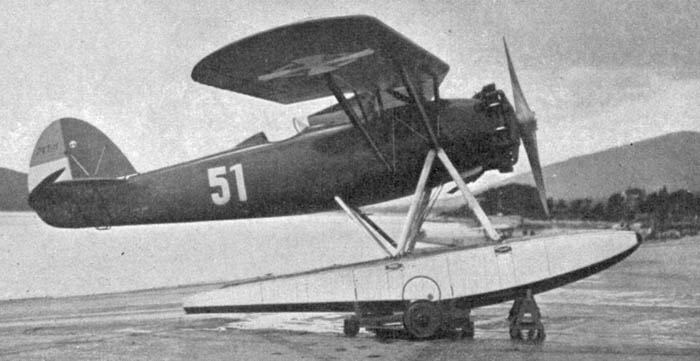
In 1936, the Royal Yugoslavian Navy Command asked Rogožarski to build a seaplane variant of the PVT, for observation. Engineer Sima Milutinović, then technical director of Rogožarski made all the necessary calculations for this simple float-based conversion. He determined that the new seaplane would be successful and even after fitting floats, still able to perform aerobatic training and advanced practice. One PVT from the second series was thus fitted with imported American-made EDO floats (a specialist of aero floats construction back then), but the PVT-H needed also a new propeller and an enlarged vertical stabilizer to stay stable after the fitting of floats. The latter were attached to the lower fuselage thanks to two "N" strut asemblies, with the heads of the forward struts joint to meet the lower hub of the struts supporting the wings to distribute loads. Both vertical struts hhad steps for the crew to climb in their cockpits, both unmodified with the same glass windshieldn, seats and fittings as the regular PVT.The PVT-H (H for hidro) was indeed configured as a seaplane with the undercarriage replaced by a pair of standard Edo Float Model 38, all metal, and mounted on N-shaped struts. In 1938 and 1939, four PVT-H aircraft were thus delivered (including the prototype based on a 2nd series model) to the Yugoslav Royal Navy. The prototype was tested by the Naval Aviation Experimental Commission in Divulje. It was highly rated, and the Navy Command ordered three more in 1938, delivered in 1939, officially designated PVT-H (PVT seaplane with the "H" standing for "Hidro"). Further modifications had been done in production: The PVT-H seaplanes received dynamic compensators on the elevator, and two 7.7 mm Darne machine guns located forward. Indeed, there was no rear-armed observer, the cockpit design remained the same, but the double command was removed.
Detailed specs
Specs Rog. PVT-H | |
| Crew: | 2: Pilot, Observer |
| Fuselage Lenght | 8.57 m (29 ft) |
| Wingspan | 11.23 m (36 ft 9 in), wing area 22.1 m2 (238 sq ft) |
| Height | 2.81 m (9.2 ft) |
| Empty weight: | 967 kg (2,132 lb) |
| Gross weight: | 1,213 kg (2,674 lb) |
| Powerplant: | Gnome-Rhône 7K 7-cylinder radial, 310 kW (420 hp) |
| Propeller: | 2 bladed fixed pitch wooden prop |
| Top speed: | 220 km/h (140 mph, 120 kn) at sea level* |
| Climb Rate: | 6.54 m/s (1,287 ft/min) to 2,000 m (6,562 ft) |
| Service ceiling: | 7,000 m (23,000 ft) |
| Armament | None |
The PVT-H Hydro in action:
During the invasion, PVTs that survived initial Luftwaffe airfield attacks, were used for reconnaissance and liaison. 15 PVTs were later captured by the Germans and presented to the newly formed Air Force of the Independent State of Croatia, used by them for reconnaissance against guerilla and resistance groups until 1944. Several were modified to carry a single 100 kg (220 lb) bomb. The Italians also captured 19 PVTs at Nikšić airport and refurbished 4 more, used for anti-partisan operations over Montenegro and Albania.. Two survived the war and were seen for a short while in service with Yugoslav Air Force until 1950. The first unit using the PVT in 1935 was the Fighter School of the 6th Aviation Regiment in Zemun, replacing 1920s Gourdou-Lesseure models and Fizir FP-2. A team created an aerobatic troika that toured the country and performed many shows.In 1937 engine deflectors in the first series were modified. The second series arrived in 1938, powered by a domestic IAM K-7 420 hp engine from Aircraft Engine Industry (IAM) in Rakovica, still under license. Like the PVT-H, they had dynamic compensators on the horizontal rudders, wings now made of two parts. There was at last a third series of 15 entering service by June 1939 (no changes) and a fourth series (10) late 1939- early 1940 this time like the PVT-H with two synchronized Darne 7.7 mm machine guns on the nose and an OPL photo machine gun to film air engagement training. The IAM K-7 also received new carburetors. One was tested as a dive bomber (100 kg bomb underbelly) and another received a NAKA ring with gas collector for the next, 5th series (15) never completed in late 1940/early 1941 with the invasion. Five were to be modified for night flights. In 1939 training squadrons used the model in Belgrade and Zagreb while all fighter groups received between 3 to 5 for aerobatics training. In 1940 a school for no visibility fliying was opened in Pančevo with 5 modified PVTs.
As for the four PVT-H seaplanes of the Royal Yugoslavian Navy, they were deployed to the Divulje and Boka bases, flying until the April Invasion. They had a role of trainer at first, but the Navy intended to use them for observation, and their two machine guns was a bonanza but they were vulnerable to rear attacks and even slower and les agile than the regular PVTs, reducing their survivability. The Italians captured two PVT-H but there is no information about their use. Neither the German or Croatians flew the PVT-H. The PVT-H appearance is deduced from a few photos. They had a camouflage made of standard army beige and olive green, including the floats, probably on a grey base. The tail had the tricolor, with horizontal bands like army models, with the code "PVT-X" on the tail and a unit number.
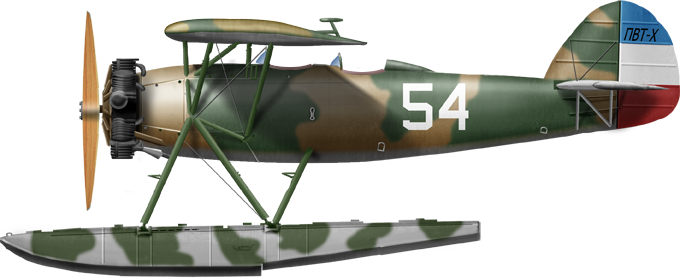
Rogozarski PVT-H N°51
Photo of N°51 published in L'Aerophile, June 1938 (CC)
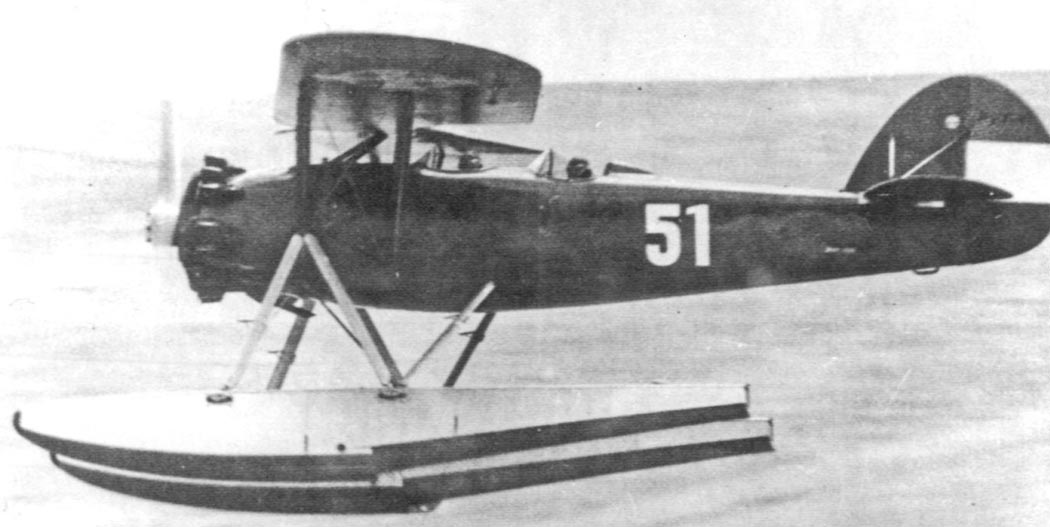
Same in flight.
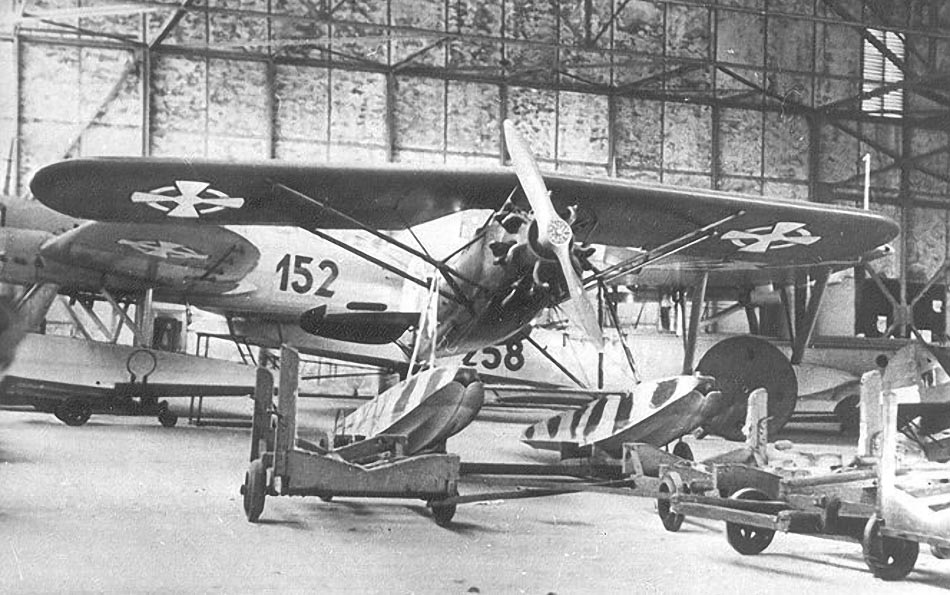
Camouflaged one in a hangar.
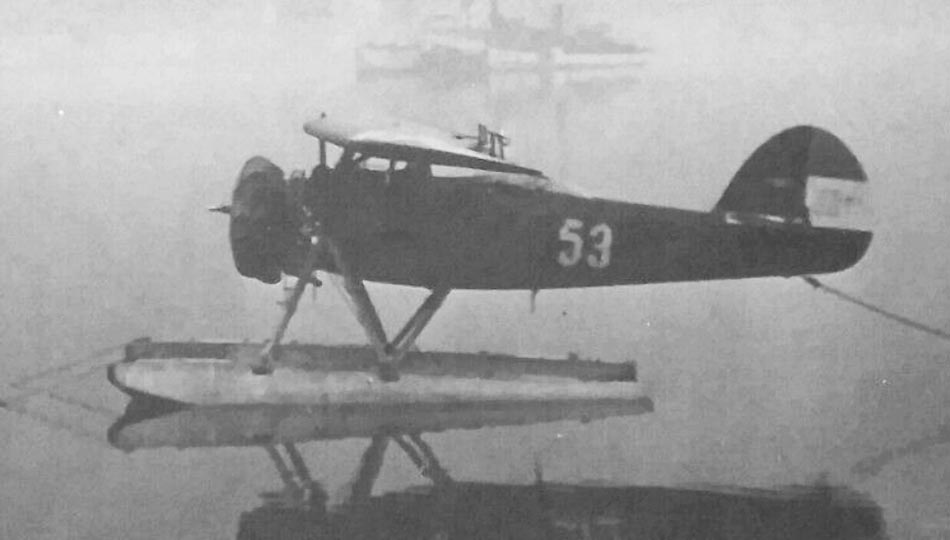
N°53 in the water, with its engine wrapped in canvas.
Read More and Sources
Dimitrijević, Bojan; Miladinović P., Micevski M. (2012). Military Air Force of the Kingdom of SHS/Yugoslavia 1918-1944. Belgrade: Institute for Contemporary History.O. Petrović., Military Airplanes of the Kingdom of SHS/Yugoslavia (Part II: 1931 – 1941), Flight 3/2004. Belgrade, 2004.
A. Kolo.;Acrobatic aircraft PVT, Aerosvet, no.2, May 1985
V. Mikić; Air Force of the NDH 1941-1945, VIIVJ, Belgrade, 2000.
links
valka.czaviadejavu.ru
airwar.ru
secretprojects.co.uk
sr.wikipedia.org
sr.wikipedia.org
sr.wikipedia.org
sr.wikipedia.org
vazduhoplovnetradicijesrbije.rs/
en.wikipedia.org
Model Kits
aviationmegastore.comVideo
- Lohner E (1913)
- Macchi M3 (1916)
- Macchi M5 (1917)
- Macchi M7 (1918)
- Ansaldo ISVA (1918)
- Short S.38 (1912)
- Sopwith Baby (1916)
- Short 184 (1916)
- Fairey Campania (1917)
- Sopwith Cuckoo (1917)
- Felixstowe F.2 (1917)
- Gotha WD.2 (1914)
- Friedrichshafen FF 33 (1916)
- Albatros W4 (1916)
- Albatros W8 (1918)
- Hanriot HD.2
- Grigorovich M5 (1915)
- Grigorovich M9 (1916)
- Grigorovich M11 (1917)
- IJN Farman MF.7
- IJN Yokosho Type Mo
- Yokosho Rogou Kougata (1917)
- Yokosuka Igo-Ko (1920)
- Curtiss N9 (1916)
- Curtiss H4 (1916)
- Curtiss H12 (1917)
- Curtiss H16 (1918)
- Aeromarine 39
- Vought VE-7
- Douglas DT (1921)
- NAF/Curtiss TS-1 (1922)
- Boeing FB.5 (1923)
- Boeing F4B (1928)
- Vought O2U/O3U Corsair (1928)
- Grumman FF (1931)
- Akron class airships (1931)
- Curtiss F9C Sparrowhawk (1931)
- Curtiss F11C Goshawk (1932)
- Curtiss BF2C Goshawk (1933)
- Blackburn Blackburn (1922)
- Supermarine Seagull (1922)
- Fairey Flycatcher (1923)
- Hawker Horsley (1925)
- Blackburn Ripon (1926)
- Fairey IIIF (1927)
- Fairey Seal (1930)
- LGL-32 C.1 (1927)
- Fokker T.II (1921)
- Fokker T.III (1923)
- Caspar U1 (1921)
- Dornier Do J Wal (1922)
- Rohrbach R-III (1924)
- Mitsubishi 1MF (1923)
- Mitsubishi B1M (1923)
- Yokosuka E1Y (1923)
- Nakajima A1N (1927)
- Nakajima E2N (1927)
- Mitsubishi B2M (1929)
- Nakajima A2N (1930)
- Nakajima A4N (1935)
- CANT 18
WW1
✠ K.u.K. Seefliegerkorps:
 Italian Naval Aviation
 RNAS
RNAS
 Marineflieger
 French Naval Aviation
 Russian Naval Aviation
 IJN Air Service
 USA
USA
Interwar
 Interwar US
 Interwar Britain
 Interwar France
 Interwar Netherlands
 Interwar Germany
 Interwar Japan
 Interwar Italy
- Grumman F2F (1933)
- Curtiss SOC seagull (1934)
- Grumman F3F (1935)
- Northrop BT-1 (1935)
- Consolidated PBY Catalina (1935)
- Grumman J2F Duck (1936)
- Brewster/NAF SBN-1 (1936)
- Curtiss SBC Helldiver (1936)
- Vought SB2U Vindicator (1936)
- Brewster F2A Buffalo (1937)
- Douglas TBD Devastator (1937)
- Vought Kingfisher (1938)
- Curtiss SO3C Seamew (1939)
- K-class Blimps (1939)
- Douglas SBD Dauntless (1939)
- Grumman F4F Wildcat (1940)
- F4U Corsair (NE) (1940)
- Brewster SB2A Buccaneer (1941)
- Grumman TBF/TBM Avenger (1941)
- Consolidated TBY Sea Wolf (1941)
- Grumman F6F Hellcat (1942)
- Curtiss SB2C Helldiver (1942)
- Curtiss SC Seahawk (1944)
- Grumman F7F Tigercat (1944)
- Grumman F8F Bearcat (1944)
- Ryan FR-1 Fireball (1944)
- Douglas AD-1 Skyraider (1945)
- Fleet Air Arm
- Hawker Osprey (1932)
- Fairey Swordfish (1934)
- Blackburn Shark (1934)
- Supermarine Walrus (1936)
- Fairey Seafox (1936)
- Blackburn Skua (1937)
- Short Sunderland (1937)
- Blackburn Roc (1938)
- Fairey Albacore (1940)
- Fairey Fulmar (1940)
- Grumman Martlet (1941)
- Hawker sea Hurricane (1941)
- Brewster Bermuda (1942)
- Fairey Barracuda (1943)
- Fairey Firefly (1943)
- Grumman Tarpon (1943)
- Grumman Gannet (1943)
- Supermarine seafire (1943)
- Blackburn Firebrand (1944)
- Hawker Sea Fury (1944)
- Coastal Command
- Vickers Wellington (1937)
- IJN aviation
- Yokosuka E6Y (1930)
- Aichi D1A "Susie" (1934)
- Mitsubishi A5M "Claude" (1935)
- Nakajima A4N (1935)
- Yokosuka B4Y "Jean" (1935)
- Mitsubishi G3M "Nell" (1935)
- Nakajima E8N "Dave" (1935)
- Kawanishi E7K "Alf" (1935)
- Nakajima B5N "Kate" (1937)
- Kawanishi H6K "Mavis" (1938)
- Aichi D3A "Val" (1940)
- Mitsubishi G4M "Betty" (1940)
- Mitsubishi A6M "zeke" (1940)
- Nakajima E14Y "Glen" (1941)
- Nakajima B6N "Jill" (1941)
- Mitsubishi F1M "pete" (1941)
- Aichi E13A Reisu "Jake" (1941)
- Kawanishi E15K Shiun "Norm" (1941)
- Nakajima C6N Saiun "Myrt" (1942)
- Yokosuka D4Y "Judy" (1942)
- Kyushu Q1W Tokai "Lorna" (1944)
 Luftwaffe
- Heinkel 114 (1935)
- Arado 196 (1937)
- Me109 T (1938)
- Blohm & Voss 138 Seedrache (1940)
 Italian Aviation
- Savoia-Marchetti S.55
- IMAM Ro.43/44
- CANT Z.501 Gabbiano
- CANT Z.506 Airone
- CANT Z.508
- CANT Z.511
- CANT Z.515
 French Aeronavale
- GL.300 (1926-39)
- CAMS 37 (1926)
- Levasseur PL.5 (1927)
- Potez 452 (1935)
- Loire 210 (1936)
- Loire 130 (1937)
- LN 401 (1938)
 Soviet Naval Aviation
- Shavrov SH-2 (1928)
- Tupolev TB-1P (1931)
- Beriev MBR-2 (1930)
- Tupolev MR-6 (1933)
- Tupolev MTB-1 (1934)
- Beriev Be-2 (1936)
- Polikarpov I16 naval (1936)
- Tupolev MTB-2 (1937)
- Ilyushine DB-3T/TP (1937)
- Beriev Be-4 (1940)
 Swedish Naval Aviation
- SAAB B17S
-
 Skoda Š-328V
  R-XIII Idro
 Fokker C.XI W (1934)
 Rogožarski PVT-H (1938)
WW2
 ☍ USNA
- De Havilland Sea Vixen
- Hawker Sea Hawk
- Supermarine Scimitar
- Blackburn Buccaneer
- Hawker Sea Harrier
- Douglas A4 Skyhawk
- Grumman F9F Panther
- Vought F8 Crusader
- McDonnell-Douglas F-4 Phantom-II
- North Am. A5 Vigilante
- TU-142
- Yak 38 forger
☢ Cold War
✧ NATO
Fleet Air Arm
 US Navy
☭ Warsaw Pact
Merch
Seafire Mark 45; HMS Pretoria Castle
Zeros vs its aversaries
Aichi D3A “Val” Junyo
Mitsubishi A5M poster
F4F wildcat
Macchi M5
SBD Dauntless Coral Sea
SBD Dauntless USS Enterprise
SBD-4 CV22