 Grigorovich M9
Russian Imperial navy, 183 (300 until 1923*) built 1915-1917.
Design & Development
For more about Dmitry Pavlovich Grigorovich (full bio), the fulls story of the M1, M2, M3, M4, see the previous post on the Grigorovich M5. The latter was born in 1883 in Kyiv, Ukraine. He graduated in 1909, went to an aeronautics institute in Liege and in 1911 to St. Petersburg, as aero journalist in "Bulletin of Aeronautics", and in 1912 associated with S.S. Shchetinin and Co" which produced from 1913 a Donnet-Lévêque flying boat copy, the M-1, followed by the prototypes M-2, M-3 and M-4 in 1914. Its first true production was in 1915 M-5, with a production which continued until 1923.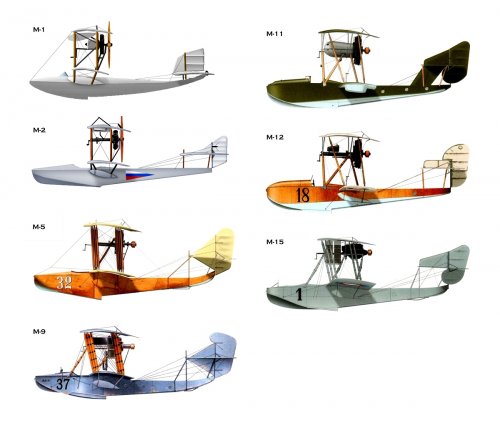
Full Array of Grigorovich models, from the M1 to the M15 in 1918.
In 1922, back in Moscow he was promoted to head the design bureau of GAZ No.1 plant and worked on the first Soviet fighters I-1 and I-2 as well as the reconnaissance aircraft R-1. In early 1924 her tried to revive his former factory renamed Leningrad's "Krasny Pilot" and reactualized the former Tsarist Department of Marine Experimental Aircraft Construction (OMOS). By late 1927 it was transferred to Moscow as OPO-3, but he continued working under Beriev on the MR-1, MR-2, MR-3, ROM-1 and ROM-2 naval reconnaissance aircrafts and MM-1 twin-float "naval destroyer" as well as the MT-1 naval torpedo bomber. A purged in 1928 saw him convicted on September 20, 1929 or being a counter-revolutionary, and he was sent to 10 years labor camp, albeit still working as an internee from the Butyrka prison with N. N. Polikarpov at the future TsKB-39 OGPU, notably on the Polikarpov I-5 fighter until amnestied on July 8, 1931 and ended at the Central Design Bureau and professor at the aircraft design department until he passed out in 1938.
Predecessors: Grigorovich M3, M4 and M5
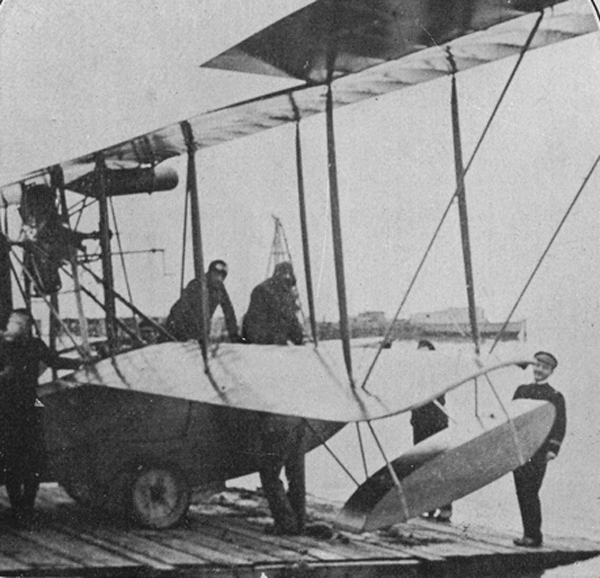
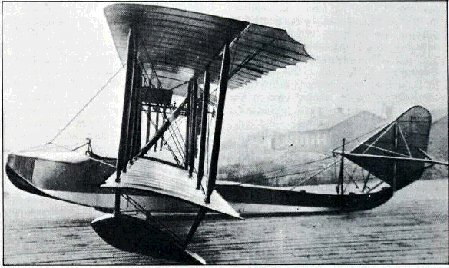 The M-3, was not entirely successful as a prototype, was a developent, a slightly modified M-2 with 100 hp Gnome-Monosoupape engine with a new wing profile was changed, with no improvementss in performances but better seaworthiness. Next came the M-4, a modified version of the M-3, same engine but new wing profile, hull modified, stabilizer with screw lift, and it was promising. This work culminated with the M-5 flying boat. It was designed in the spring of 1915, upon an urgent need, to face the German Empire, Austro-Hungarian and Ottoman Empires in the Baltic and Black Sea. The only Russian seaplanes in use at the time were foreign Curtiss Model K or French FBA flying boats, until the supply starved out. D. P. Grigorovich created a two-seater flying boat after constant improvements, making it fly in April, immediately showing a great improvement over the M3 and M4. It was greenlighted for production, construction was carried out in a brand-new facility. It delivered for the Russian naval aviation 183 of these. From July 1915 to June 1917 alone, 71 entered service for the Black Sea Fleet, 60 to flying schools. Some M-5s still flew during, and until the end of the Civil War for a grand total, final, of 300 aircraft, abeit the figure is still disputed among authors. It had been somewhat relegated however from 1916, to training, as operational flying boats were now mostly of the new M9 type. The M9 was also latter called the ShCh M-9, short for Shchetinin M-9.
Development of the M9

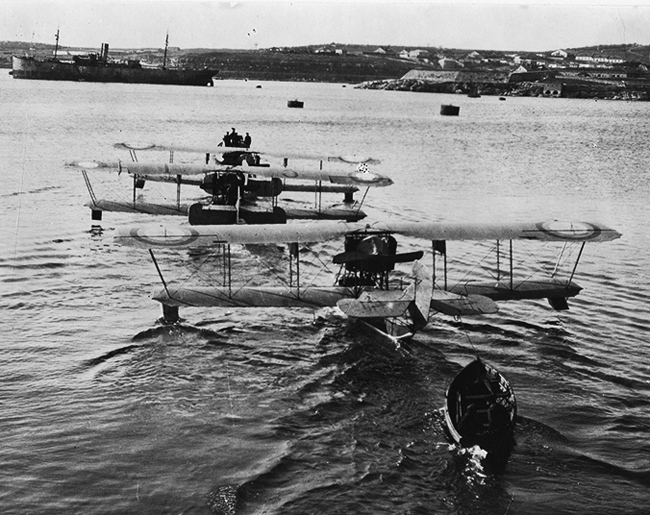
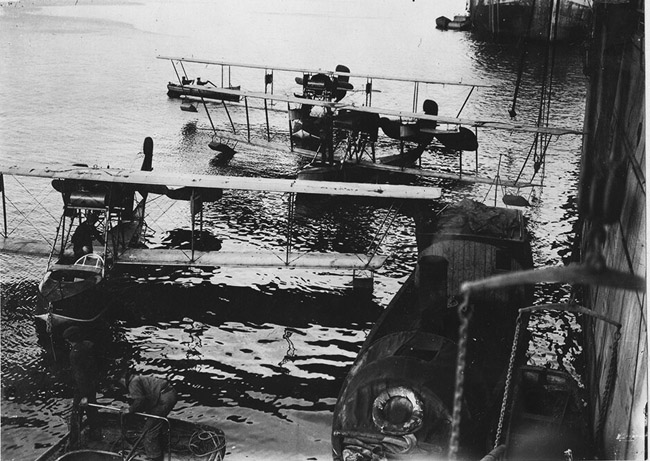
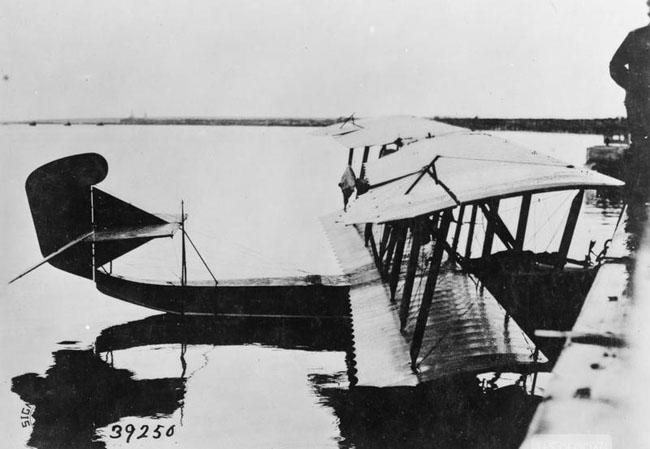
A Grigorovich M9 underway (pinterest)
The M9 started a development of the M5, identical in many aspects, but ditching the puny Gnome monosoupape engine for the more powerful Salmson P9 provided by the French. This forced many rearrangements of the structure, some strenghtening on the central struts (see below). The first M-9 was ready in 1915, made its maiden flight on January 9, 1916 at Baku. On September 17, 1916, test pilot Jan Nagórski showed how much the structure had been reinforced by making the first loop with a flying boat. Dmitry Pavlovich Grigorovich, heading S.S. Shchetinin and M.A. Shcherbakov plants in Petrograd had started work in the second half of 1915 on the promise of a better engine, but also at the request of the naval command, a larger aircraft for long-range reconnaissance and bombing.
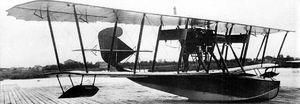 The prototype was equipped by a newly arrived 103 kW Salmson 9 engine which offered a gain of more than 50 hp compared to the Gnome. It first flew in December 1915, and flight tests conducted in Baku, from December 25, 1915, to February 9, 1916. After successful completion, including taking off and landing in waves as high as 0.5 meters, still excellent flight characteristics, same as the M5, this resulted in an order for a preserie of 30. Total production went from April 1916 to mid-1917, reaching a total of 212, over 100 sent to the Black Sea Fleet, at least 86 to the Baltic Fleet. Its true succeessor was the M-15. The M11/12 were entirely alternative developments, smaller, single-seat fighter flying boats.
Design of the Grigorovich M9

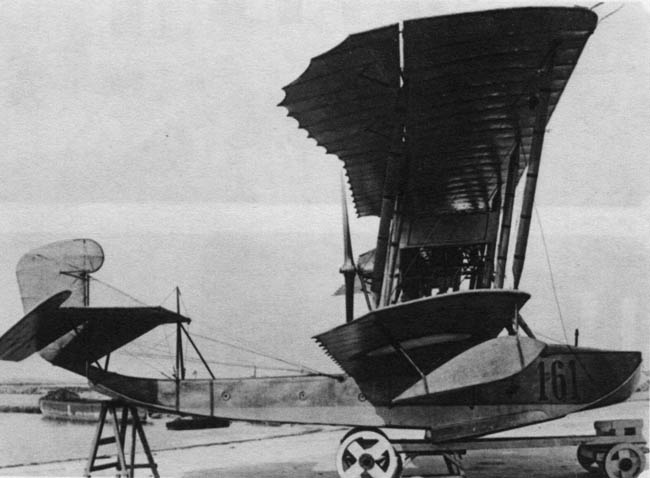
The M-9 was a biplane flying boat, of all-wooden construction. Its fuselage had a truss structure in ash wood, with plywood covering, of varying thicknesses: The top and sides were 3 mm, sides below the waterline were 6 mm, bottom was 10 mm. The fuselage had a single step and tailplane support at the rising end. Its bottom surface was significantly wider than the fuselage outline, providing greater stability on water. It was significantly larger than the M5, 9 meters long and 3.75 meters high. The wing was three-span, and supported by three pairs of teardrop-shaped struts, with the upper wing extended forward and ahead of the lower one. The wings were two-spar, made of pine wood.
The upper wing was three-piece with a canopy, and without dihedral but with a 2° leading edge sweep, a thin profile, and fabric-covered. The ailerons had a similar pine-based wooden strucutre, fabric-covered, without compensation, and extending beyond the upper wing outline. The lower wing was two-piece, with a slight dihedral, smaller in span and chord than the upper wing but identical in sweep. The wing structure was reinforced with steel wire. The wingspan was extended to 16 meters, the wing area was 54.8 m², making this model the largest of Grigorovich. The wooden tailplane was fabric-covered, with a large triangular vertical stabilizer. There were small auxiliary floats made of a plywood-covered wooden structure, rectangular cross-section, located at the ends of the lower wing. The M9 empty weight was 1,060 kg, the gross take-off weight reached 1,540 kg. The greatest difference compared to the M5 was its cabin that could accomodate a pilot and navigator or utility extra member, and a forward observer in the nose ring, also manning a flexible-mounted machine-gun, see below.
Powerplant: Salmson 9Dc
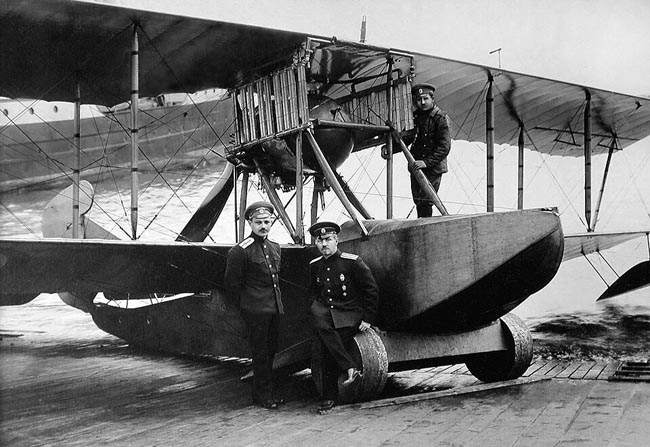
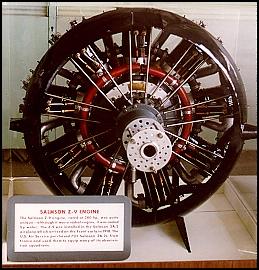 The engine was a liquid-cooled, 9-cylinder, 110 kW (150 hp) Salmson 9Dc radial, rotary engine, suspended under the upper wing, and supported by the fuselage. To make colling better, its forward part was uncapsulated into a well profiled, polished metal capsule-style cover. The starter was manual, and for it was a crank permanently attached to the front of the engine housing. There were two box radiators, unusually placed on both sides of the engine (framing it, but also susceptible to take a hit), plus a 225 dm³ fuel tank located behind the pilot's cockpit. The oil tank capacity was 33 dm³. The single, two-blade, fixed pitch, wooden propeller was in the classic pusher configuration. Top speed was 110 km/h, a real immprovement over the M5 but hardly enough to be used as fighter albeit it did not lacked agility. It could reach an altitude of 1,000 meters in 12 minutes and 4,000 meters in 38 minutes for a ceiling of 3,000 meters, and flight endurance was 3.5 hours. The final range remained hypothetical.
Armament

As said above, there was the main cabin large enough for two seats side by side, and without a windbreak. In front of theme cabin was the open gunner's station, with a flxeibly-mounted light machine gun. The standard type was the 7.7 mm Vickers, then 7.62 mm Maxim, both liquid cooled, before preferring the air-ccoled, lighter 7.65 mm Hotchkiss. However tests proceeded at the end of the war, to mount more serious firepower and deal some damaged to the ships encountered, either a 20 mm Oerlikon or a short 37 mm Puteaux cannon, light enough but lacking muzzle velocity. Other sources points out an Hotchkiss long barrel naval 2-pdr/37 mm but information is just lacking. Albeit it was stated they could carry bombs, they just lacked the output to carry many in addition to the rest, but it was done, as shown by their defensive strafing and bombing around Baku in the civil war.
⚙ specs. | |
| Empty Weight | 1060 kg (2,337 lb) |
| Gross Weight | 1,540 kg (3,395 lb) |
| Max TO Weight | 1,610 kg (3,549 lb) |
| Lenght | 9 m (53 ft 6 in) |
| Wingspan | 16 m (53 ft 6 in) |
| Height | 3.3 m (11 ft 10 in) |
| Wing Area | 54.8 m2 (589.86 sq ft) |
| Wing Loading | 25 kg/m2 (5.1 lb/sq ft) |
| Power/mass | 0.078 kW/kg (0.05 hp/lb) |
| Engine | 150 hp Salmson 9Dc |
| Propeller | 2-bladed fixed-pitch pusher propeller |
| Top Speed, sea level | 110 km/h (68 mph, 60 kn) |
| Cruise Speed | Unknow, c70 kph |
| Range/Autonomy | 3 hours 30 min. |
| Climb Rate | 1,000 m in 12 min. or 2,000 m (6,600 ft)/30 min. |
| Ceiling | 3,300 m (10,800 ft) |
| Armament | 1x 7.7/7.5 mm LMG or 20, 37 mm Hotchkiss cannon, bombs. |
| Crew | 2: Pilot, Observer/Gunner +1 close to pilot |
Models
- M-9: Main version, see above, ca500 made.
- M-10: Smaller version of the M9 built in 1916 with a Gnome Monosoupape engine, prototype.
- M-15: Later version od the M9 with new tail and other details.
- M-20: Two-seat recce. with Le Rhone 89 kW (120 hp) engine (few built 1916)
Operators
 Imperial Russian Navy
 Finnish Air Force
 Russian SFSR: Red Army and Soviet Naval Aviation
Combat Records, Grigorovich M9
The Grigorovich M-9 flying started to arrive in frontline unit in early to mid-1916 and they were used for reconnaissance, bombing, and even in some case, escort fighters. They were attached to the naval aviation of the Baltic Fleet and Black Sea Fleet in 1916–1917 and gradually replaced the M5, relegated to training. The M9 also carried on its traditional missions of photo-reconnaissance, artillery spotting duties, as well as air general un-tasked combat sorties. There are however little records of their precise activities until 1917, but precise actions and raids, notably from newly created seaplane transports, and they remained operational through the revolution of 1917 and afterwards. Most ended in Bolshevik hands, but not only: During the Civil War, M-9 seaplanes of the black sea fleet ended in part in the White Guards units, sometimes opposing those of the Red Army Air Force.This model also mirrored the Macchi for its excellent agility as shown on September 17, 1916, by Polish pilot and polar explorer in Russian service, Lieutenant Jan Nagórski. Her performed loop, first in the world in flying boat, and the next day, repeated this twice more, both with a passenger. Despite the war, this feat was officially registered at the Russian Aeroclub, forwarded to the international FAI, which registered it. From September 1916 to February 1917, Midshipman Eugeniusz Pławski (later commander of the destroyer ORP "Piorun") which trained at the Naval Aviation School in Petrograd, transferred to Baku in the autumn of 1916, performed flights on the M-5 and M-9 boats, and became the one that texted a 37 mm cannon on the M9, under his school commander (also a Pole), Lieutenant Colonel Grudziński, instructor Cadet Jerzy Weber. Another member of the school, Jerzy Kłossowski, later became commander of ORP "Bałtyk", former French cruiser D'Entrecasteaux.
M9s of the Black Sea Fleet
In 1916, M-9 flying boats took part in an interresting development for the Russian Naval Aviation, deployed on the seaplane carriers and tenders "Imperator Nikolai I" (5,642 GRT) and "Imperator Aleksandr I" (5,133 GRT), based in Sevastopol and Odessa respectively, to bring long range reconnaissance to the fleet. They replaced in this role the M-5 seaplanes or remained for a time alongside them. These ships could carry between seven and eight of these totam. They made their combat debut on August 25, 1916, taking part in a fleet sortie against the Bulgarian port of Varna, in which three seaplane carriers took par, the two Imperiators and Almaz. An air-sea battle broke out, in the air on the Russian side, led by four over a total of 20 embarked (12 M-5s and 8 M-9s in common). Aaccording to the Russians, three enemy aircraft were shot down, but their conceded own lost. Subsequent operations saw the M-9 making reconnaissance missions of the Constanța and Bosporus areas in March–April 1917, the bombardment of Sinope on May 24–27, 1917, by the "Aviator" (former "Imperial Nikolai I"). Modified M9 to carry an extra passenger or two, and cargo, flew in and out during the blockade of Turkish coalfields in the Eregli–Zonguldak area. They also attacked coal depots and mining/loading facilities from the air, securing fleet and shipping operations against Central Powers submarines.M-9 converted as passenger transports were operated from a serie of new seaplane carrier/auxiliary cruisers from November 16, 1916, the "Romania" ("3,152 GRT) carrrying 7 seaplanes each, the "Dacia" (3,147 GRT) for 3 seaplanes, "Imperator Trajan" (3,147 GRT) for 3 seaplanes, "King Karl I" (2,653 GRT) for 4 seaplanes and "Principessa Maria" (1,605 GRT) with a single one. There were also plans to convert other ships into aircraft carriers, but the Russian revolutions thwarted these plans for the Tarist Navy. The M-9's last action in the Black Sea was a sortie by the Romania with a battleship brigade to intercept the Turkish cruiser Midilli in November 1917. The Black Sea Fleet's naval aviation ceased to exist in 1918, due to the revolution and foreign military intervention.
M9s of the Baltic Fleet
In May 1916, M-9 seaplanes started operations in the Baltic and some operated from the seaplane carrier "Orlitsa" (2,763 GRT). Four could be carried on board. On July 2–3, 1916, the air group of the "Orlitsa", took part in a tactical group of the Gulf of Riga backed by the battleship Slava. They encountered German seaplanes, notably opposite from the seplane carrier SMS Glyndwr, former British captired freighter, and ex-Cragroland before she was renamed Answald. The class, according to the Russians, led three German aircraft down, conceding one of their own. They provided long range air cover for the fleet and notably hindered a a German aircraft attack on the gunboat Grozyashchiy, resulting in the ship near-mising all but one of the 14 bombs dropped. M-9 seaplanes also conducted artillery fire setting missions for Slava, from behind an island, attempting to destroy German field artillery batteries. On July 15-16, 1916, M-9 seaplanes from Orlitsa provided cover for the bombardment of German positions in the Dvina area, and in September 1916, the search for German submarines, targeted if spotted by light forces on the standby. At the end of 1917, with the loss of Helsingfors, the Baltic Fleet's naval aviation ceased to exist.Civil War
During the Civil War, M-9s took part in the defence of Baku, dropping approximately 6,000 kg of bombs, and ...160 kg of anti-personnel "arrows". These nasty solid darts were forged in one piece and weighted as to rapidly fall vertically, killing an random anyone unlucky to remain below. They were almost silent indeed. M-9 flying boats remained the premier Red Army's naval aviation asset. They operated them from newly created fixed-wing barges on the Volga, Northern Dvina, and Kama rivers. These aircraft performed combat missions for the ground forces, reconnaissance, bombing, and artillery fire control. Thes ebarges were "Kommuna" ("Commune") with six M-9s, "Smerch" ("death") with ten M9s on board, "Kniaginia Evpraksiya" with four M-5s and two M-9s, "Svoboda" with six M9s, and "Poseidon" with 5. General Kolchak's White Guards also used M-9s, from the barge "Danilikha" with four M9s on board. Following the end of the Civil War in 1920, all seaplane carriers were stripped of their aircraft, handed over to the civilian market.After the civil war ended, production resumed, with an unknown number built, with many sources pointed as far as 500 all combined. In 1920, however the newly created Soviet Naval Aviation had around 20 of this type remaining, versed to training until 1924-25. Nine were captured by the Finns as well, integrated by the Finnish Air Force and used until 1922, until spares ran out. The M-9 was also used for the first experiments on sea-shelf studies, participating in the discovery of new oil fields near Baku. Nine M-9s were captured by Finland during the Russian Civil War, one flown by a defecting Russian officer to Antrea on 10 April 1918. It was sunk the following day during evaluation. Eight more were captured at öland and Turku, used until 1922.
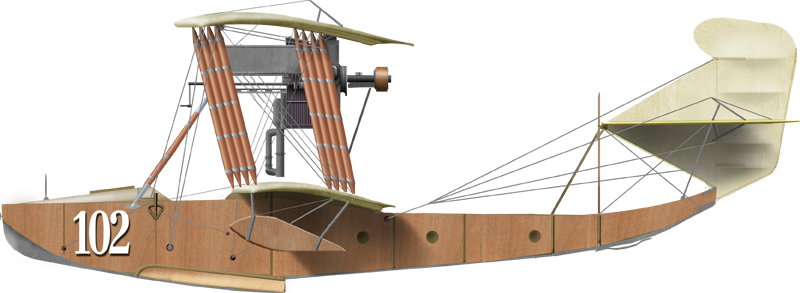
Basic M9 in 1916
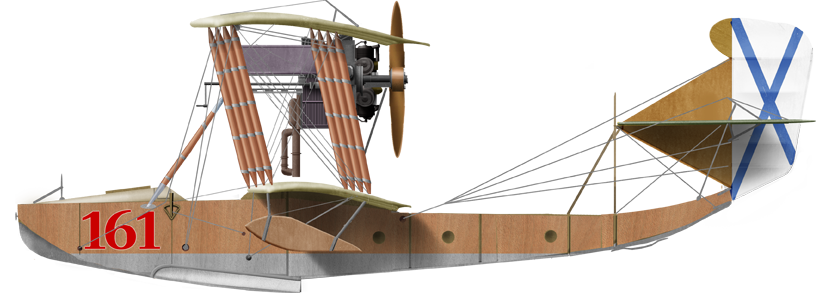
M9 with a St Andrew Tail
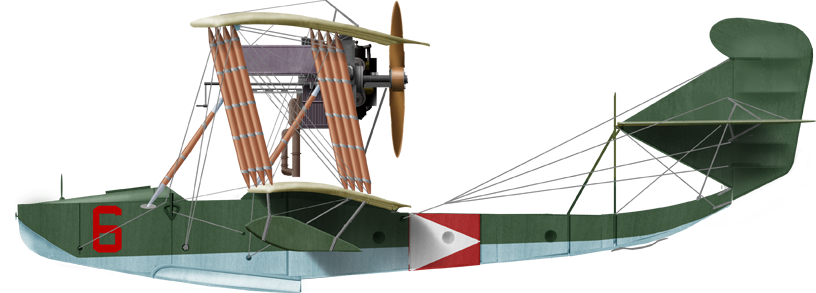
M9, riverine recce version
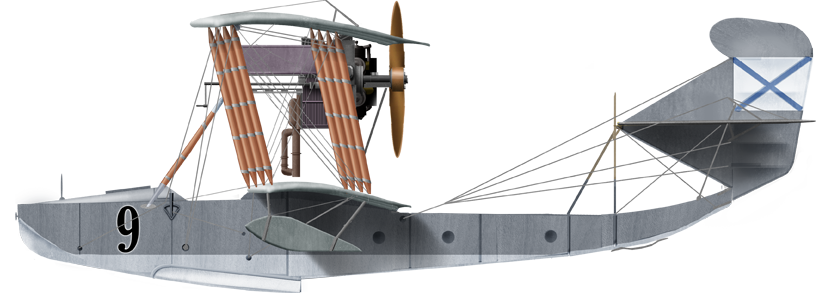
Naval Grey variant 1
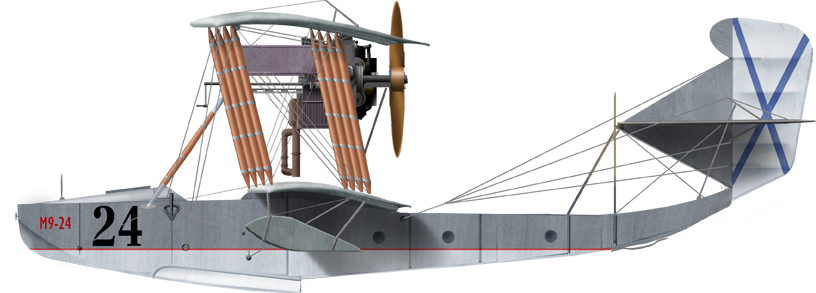
Naval Grey variant 2
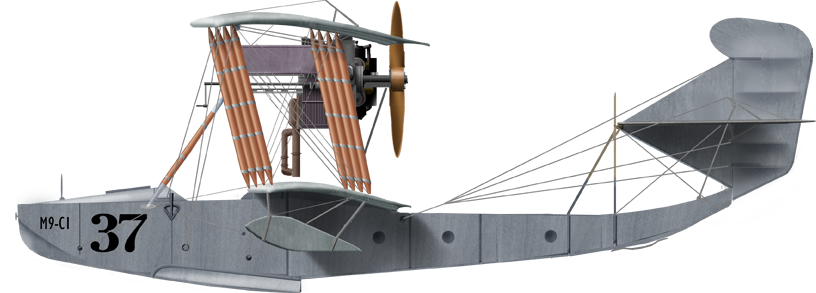
Naval Grey variant 3
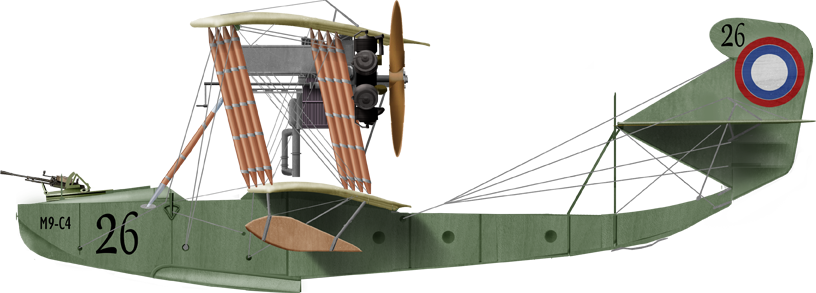
Green variant 1917 (pre-revolution)
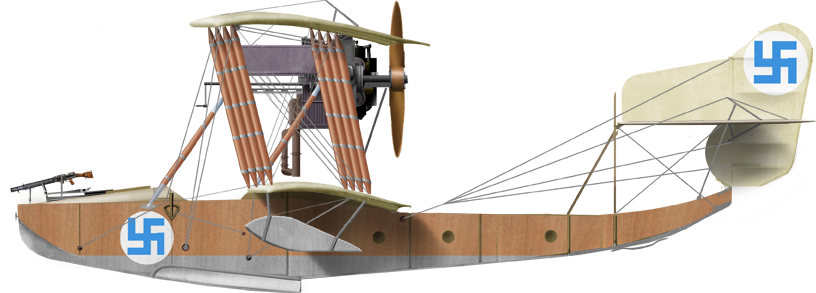
Grigorovich M15 of the Finnish Aviation in 1920

Sources
ecured.cukpi.ua
aviastar.org
wio.ru
avionslegendaires.net
Grigorovich_M-9
oruzhie.info
warhistory.org
flyingmachines.ru
secretprojects.co.uk
airwar.ru
On commons.wikimedia.org
scalemates.com
Mikhail Maslov. Dmitry Grigorovich's Aircraft.
Heinonen, Timo (1992). Thulinista Hornetiin – 75 vuotta Suomen ilmavoimien lentokoneita (in Finnish). Tikkakoski: Keski-Suomen ilmailumuseo.
"Grigorovich Flying Boats". Russian aviation in WW1 and Civilian War (in Russian and English).
Shavrov VB History of Aircraft Designs in the USSR to 1938 — 3rd. — Moscow: Mashinostroenie, 1985.
Durkota, Darcey & Kulikov (1995). The Imperial Russian Air Service - Famous Pilots and Aircraft of World War 1. Flying Machines Press.
Gunston, Bill (1995). The Osprey Encyclopedia of Russian Aircraft from 1875 - 1995. Osprey Aerospace.
Heinonen, Timo: Thulinista Hornetiin - Keski-Suomen ilmailumuseon julkaisuja 3, Keski-Suomen ilmailumuseo, 1992
Kulikov, Victor (December 1996). "Le fascinante histoire des hydravions de Dimitry Grigorovich" Avions FR
The Osprey Encyclopedia Of Russian Aircraft 1875-1995
Herbert Leonard Russian and Soviet fighters 1915-1950
- Lohner E (1913)
- Macchi M3 (1916)
- Macchi M5 (1917)
- Macchi M7 (1918)
- Ansaldo ISVA (1918)
- Short S.38 (1912)
- Sopwith Baby (1916)
- Short 184 (1916)
- Fairey Campania (1917)
- Sopwith Cuckoo (1917)
- Felixstowe F.2 (1917)
- Gotha WD.2 (1914)
- Friedrichshafen FF 33 (1916)
- Albatros W4 (1916)
- Albatros W8 (1918)
- Hanriot HD.2
- Grigorovich M5 (1915)
- Grigorovich M9 (1916)
- Grigorovich M11 (1917)
- IJN Farman MF.7
- IJN Yokosho Type Mo
- Yokosho Rogou Kougata (1917)
- Yokosuka Igo-Ko (1920)
- Curtiss N9 (1916)
- Curtiss H4 (1916)
- Curtiss H12 (1917)
- Curtiss H16 (1918)
- Aeromarine 39
- Vought VE-7
- Douglas DT (1921)
- NAF/Curtiss TS-1 (1922)
- Boeing FB.5 (1923)
- Boeing F4B (1928)
- Vought O2U/O3U Corsair (1928)
- Grumman FF (1931)
- Akron class airships (1931)
- Curtiss F9C Sparrowhawk (1931)
- Curtiss F11C Goshawk (1932)
- Curtiss BF2C Goshawk (1933)
- Blackburn Blackburn (1922)
- Supermarine Seagull (1922)
- Fairey Flycatcher (1923)
- Hawker Horsley (1925)
- Blackburn Ripon (1926)
- Fairey IIIF (1927)
- Fairey Seal (1930)
- LGL-32 C.1 (1927)
- Fokker T.II (1921)
- Fokker T.III (1923)
- Caspar U1 (1921)
- Dornier Do J Wal (1922)
- Rohrbach R-III (1924)
- Mitsubishi 1MF (1923)
- Mitsubishi B1M (1923)
- Yokosuka E1Y (1923)
- Nakajima A1N (1927)
- Nakajima E2N (1927)
- Mitsubishi B2M (1929)
- Nakajima A2N (1930)
- Nakajima A4N (1935)
- CANT 18
WW1
✠ K.u.K. Seefliegerkorps:
 Italian Naval Aviation
 RNAS
RNAS
 Marineflieger
 French Naval Aviation
 Russian Naval Aviation
 IJN Air Service
 USA
USA
Interwar
 Interwar US
 Interwar Britain
 Interwar France
 Interwar Netherlands
 Interwar Germany
 Interwar Japan
 Interwar Italy
- Grumman F2F (1933)
- Curtiss SOC seagull (1934)
- Grumman F3F (1935)
- Northrop BT-1 (1935)
- Consolidated PBY Catalina (1935)
- Grumman J2F Duck (1936)
- Brewster/NAF SBN-1 (1936)
- Curtiss SBC Helldiver (1936)
- Vought SB2U Vindicator (1936)
- Brewster F2A Buffalo (1937)
- Douglas TBD Devastator (1937)
- Vought Kingfisher (1938)
- Curtiss SO3C Seamew (1939)
- K-class Blimps (1939)
- Douglas SBD Dauntless (1939)
- Grumman F4F Wildcat (1940)
- F4U Corsair (NE) (1940)
- Brewster SB2A Buccaneer (1941)
- Grumman TBF/TBM Avenger (1941)
- Consolidated TBY Sea Wolf (1941)
- Grumman F6F Hellcat (1942)
- Curtiss SB2C Helldiver (1942)
- Curtiss SC Seahawk (1944)
- Grumman F7F Tigercat (1944)
- Grumman F8F Bearcat (1944)
- Ryan FR-1 Fireball (1944)
- Douglas AD-1 Skyraider (1945)
- Fleet Air Arm
- Hawker Osprey (1932)
- Fairey Swordfish (1934)
- Blackburn Shark (1934)
- Supermarine Walrus (1936)
- Fairey Seafox (1936)
- Blackburn Skua (1937)
- Short Sunderland (1937)
- Blackburn Roc (1938)
- Fairey Albacore (1940)
- Fairey Fulmar (1940)
- Grumman Martlet (1941)
- Hawker sea Hurricane (1941)
- Brewster Bermuda (1942)
- Fairey Barracuda (1943)
- Fairey Firefly (1943)
- Grumman Tarpon (1943)
- Grumman Gannet (1943)
- Supermarine seafire (1943)
- Blackburn Firebrand (1944)
- Hawker Sea Fury (1944)
- Coastal Command
- Vickers Wellington (1937)
- IJN aviation
- Yokosuka E6Y (1930)
- Aichi D1A "Susie" (1934)
- Mitsubishi A5M "Claude" (1935)
- Nakajima A4N (1935)
- Yokosuka B4Y "Jean" (1935)
- Mitsubishi G3M "Nell" (1935)
- Nakajima E8N "Dave" (1935)
- Kawanishi E7K "Alf" (1935)
- Nakajima B5N "Kate" (1937)
- Kawanishi H6K "Mavis" (1938)
- Aichi D3A "Val" (1940)
- Mitsubishi G4M "Betty" (1940)
- Mitsubishi A6M "zeke" (1940)
- Nakajima E14Y "Glen" (1941)
- Nakajima B6N "Jill" (1941)
- Mitsubishi F1M "pete" (1941)
- Aichi E13A Reisu "Jake" (1941)
- Kawanishi E15K Shiun "Norm" (1941)
- Nakajima C6N Saiun "Myrt" (1942)
- Yokosuka D4Y "Judy" (1942)
- Kyushu Q1W Tokai "Lorna" (1944)
 Luftwaffe
- Heinkel 114 (1935)
- Arado 196 (1937)
- Me109 T (1938)
- Blohm & Voss 138 Seedrache (1940)
 Italian Aviation
- Savoia-Marchetti S.55
- IMAM Ro.43/44
- CANT Z.501 Gabbiano
- CANT Z.506 Airone
- CANT Z.508
- CANT Z.511
- CANT Z.515
 French Aeronavale
- GL.300 (1926-39)
- CAMS 37 (1926)
- Levasseur PL.5 (1927)
- Potez 452 (1935)
- Loire 210 (1936)
- Loire 130 (1937)
- LN 401 (1938)
 Soviet Naval Aviation
- Shavrov SH-2 (1928)
- Tupolev TB-1P (1931)
- Beriev MBR-2 (1930)
- Tupolev MR-6 (1933)
- Tupolev MTB-1 (1934)
- Beriev Be-2 (1936)
- Polikarpov I16 naval (1936)
- Tupolev MTB-2 (1937)
- Ilyushine DB-3T/TP (1937)
- Beriev Be-4 (1940)
 Swedish Naval Aviation
- SAAB B17S
-
 Skoda Š-328V
  R-XIII Idro
 Fokker C.XI W (1934)
 Rogožarski PVT-H (1938)
WW2
 ☍ USNA
- De Havilland Sea Vixen
- Hawker Sea Hawk
- Supermarine Scimitar
- Blackburn Buccaneer
- Hawker Sea Harrier
- Douglas A4 Skyhawk
- Grumman F9F Panther
- Vought F8 Crusader
- McDonnell-Douglas F-4 Phantom-II
- North Am. A5 Vigilante
- TU-142
- Yak 38 forger
☢ Cold War
✧ NATO
Fleet Air Arm
 US Navy
☭ Warsaw Pact
Merch
Seafire Mark 45; HMS Pretoria Castle
Zeros vs its aversaries
Aichi D3A “Val” Junyo
Mitsubishi A5M poster
F4F wildcat
Macchi M5
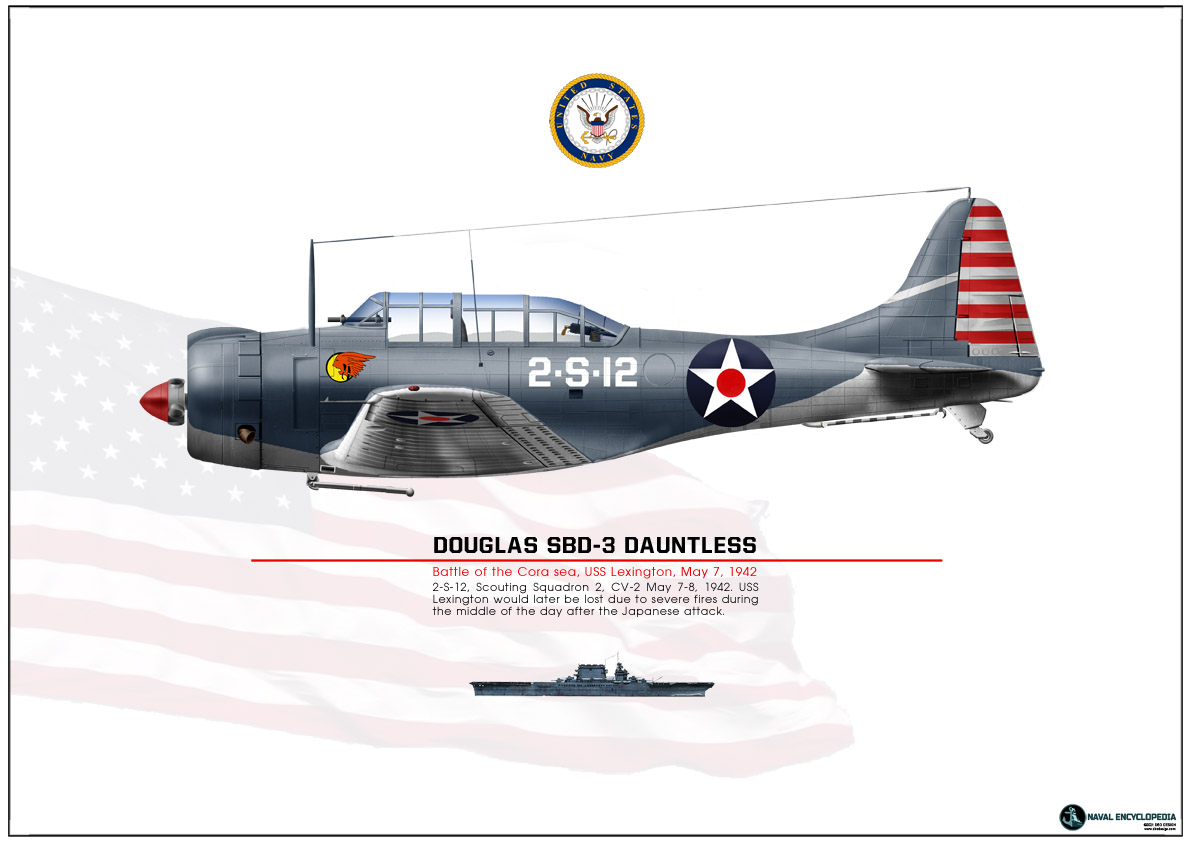
SBD Dauntless Coral Sea
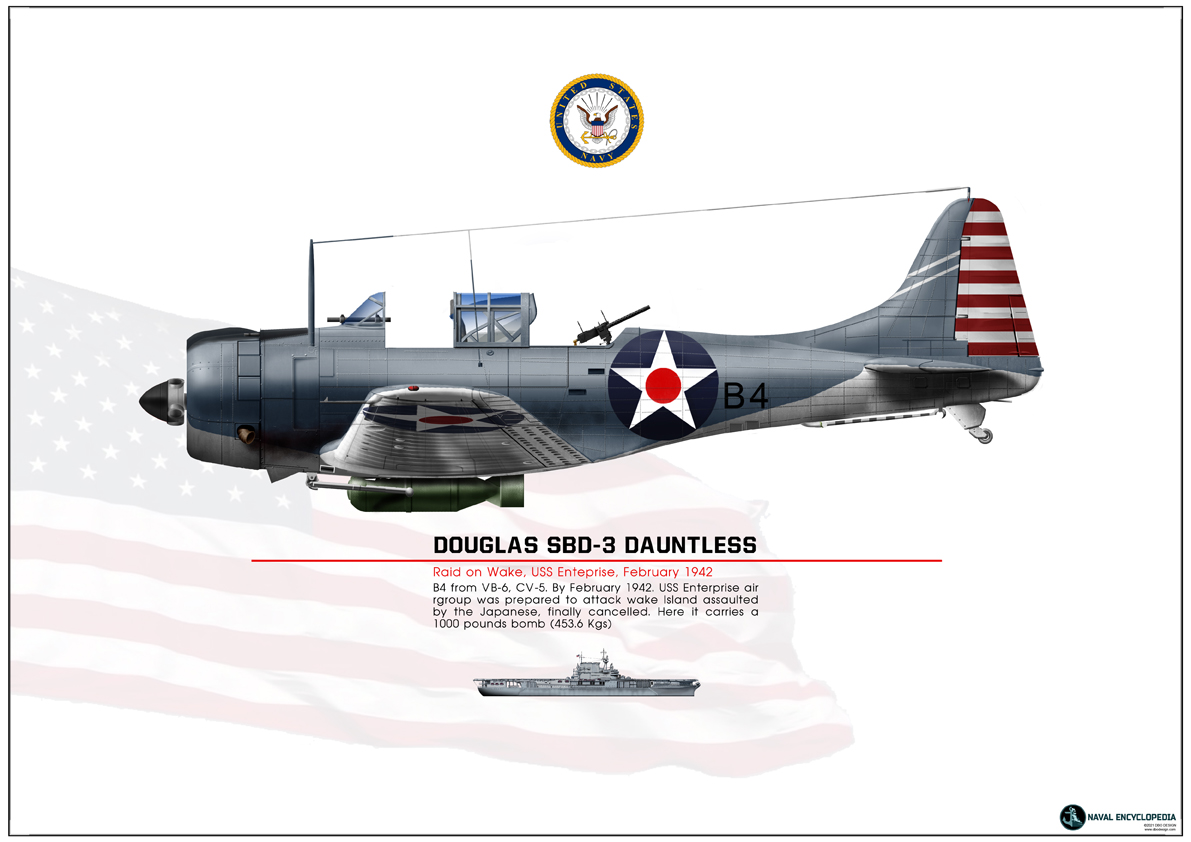
SBD Dauntless USS Enterprise
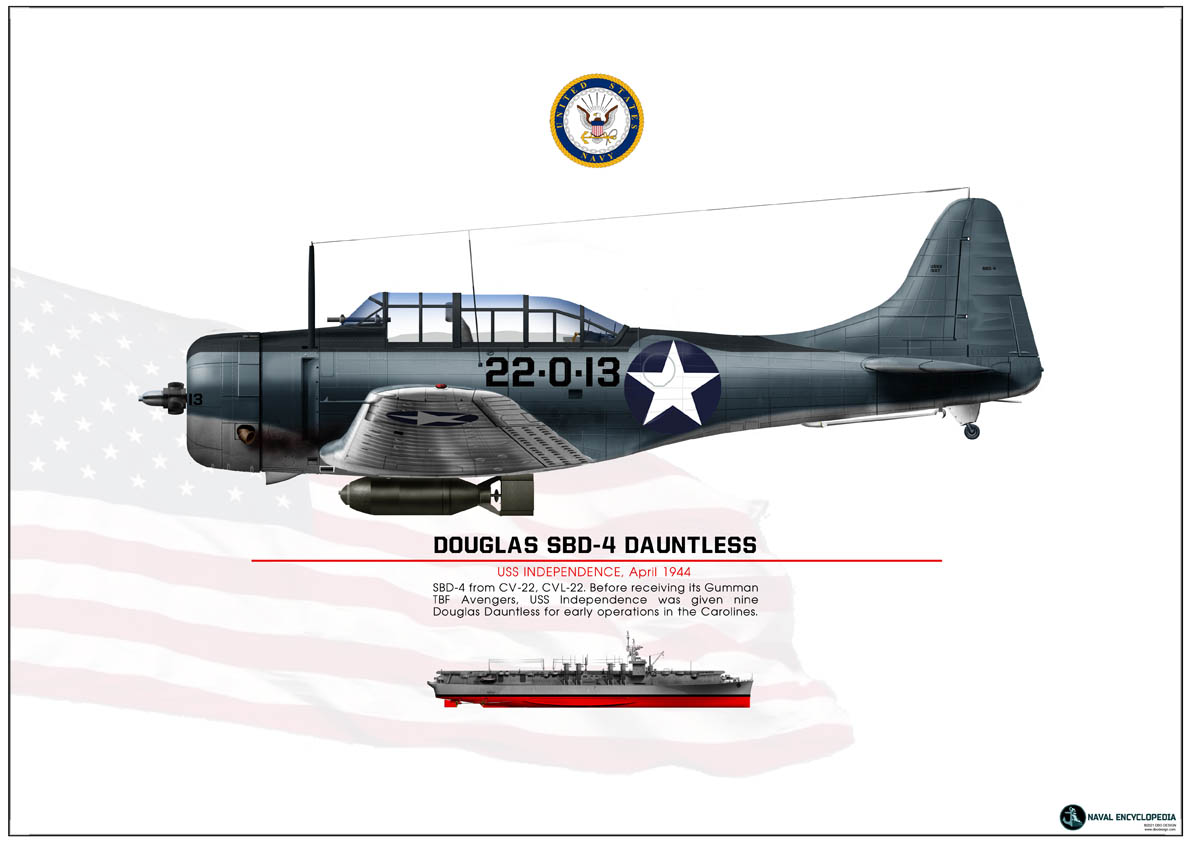
SBD-4 CV22