Short Type S.38 (1912)
 RNAS/FAA (1912) Coastal Patrollers, 48 made. Used until 1918.
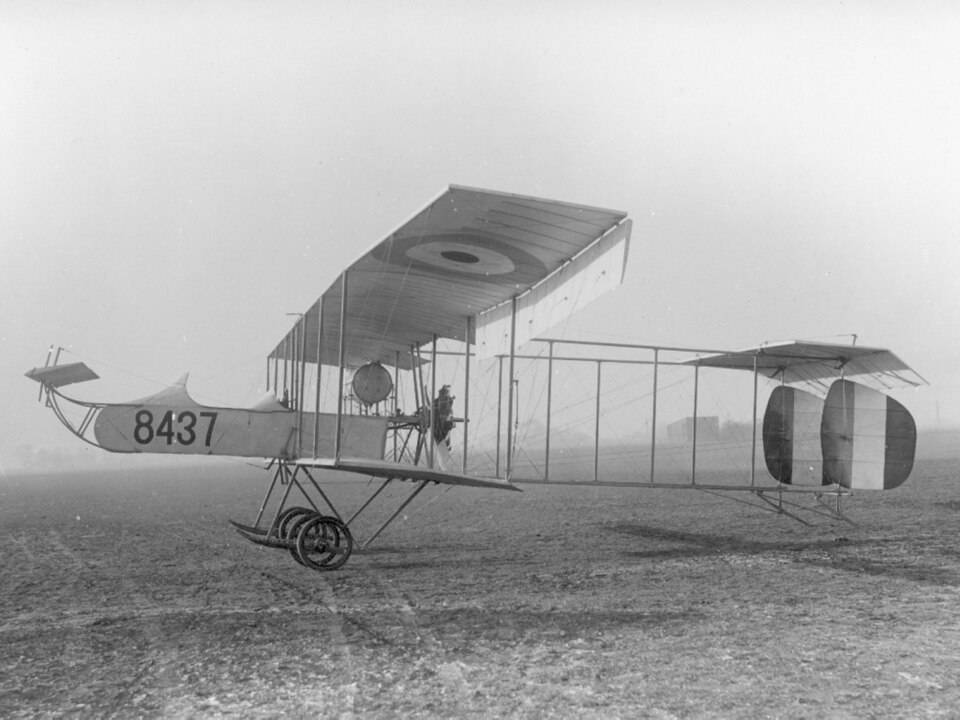
Late Production S.38 delivered in 1916 as a trainer
From the S.27 N°38 to the Short S.38
The Short S.38 was as said above a rebuilt and modified Short S.27, the N°38. The latter was a Short Improved S.27 or Short-Sommer biplane, an early model of the Short Brothers used later by the Admiralty and Naval Wing of the Royal Flying Corps for training the Royal Navy's first pilots and early naval aviation experiments. An Improved S.27 piloted by C.R. Samson performed the first successful take-off from a moving ship, HMS London, on 9 May 1912. The first flew in 1910, designed by Horace Short and based on the successful Farman III pusher configuration biplane. It was powered by a 40 hp (30 kW) Green engine in its first configuration.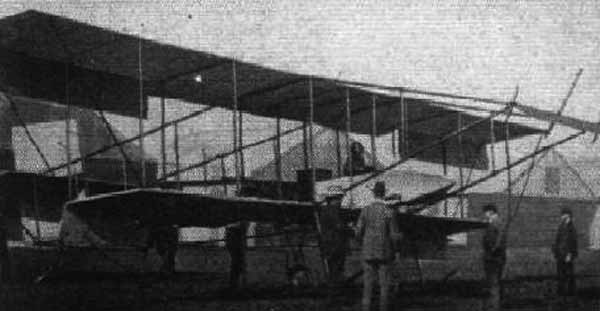
Modified S.27 with nacelle
The S.27 was an important aircraft for the birth of British Naval Aviation, as in 1910, Cecil Grace performed many records with it, notably in June an altitude record for Britain at 1180 ft or 360m. In order to beat Louis Bleriot's channel crossing of 1909, Grace adked Short to build the modified S.29 with a 60 hp (45 kW) E.N.V. engine to win the Baron de Forest Prize for the longest flight. On 22 December 1910 he took off from Dover, crossed the English Channel but landed near Calais due to poor visibility. He died in the attempt to fly back, his plane disappeared for ever. His sucessor George Cockburn offered to train Navy officers, with 200 applicants from the Royal Navy and even Royal Marine Light Infantry. By October 1911 at last the Royal Navy purchased two S.27 to establish the Naval Flying School in Eastchurch. The next S.38 became its staple from 1912, after setting a number of records (see later).
The S.27 N°S.38 was a an early record setter and very important, founding aircraft for the RNAS: In 1911, Lt. Longmore and Oswald Short installed streamlined air bags on the undercarriage struts and under the tail of the Improved S.27 No. 38 to land on water and on 1st December he made the first British attempts to take off from land and land on the river Medway, off Sheerness, from Eastchurch. Next, the pre-dreadnought battleship HMS Africa had a flying-off platform constructed over the foredeck, over its forward 12-inch (305 mm) gun turret, a soluition that became widespread in 1917-18 in the Royal Navy. On 10 January 1912, piloted by Samson, the same modified No.38 flew off this platform while anchored off Sheerness. I was Britain's first successful aeroplane take-off from a ship. Later tests were also performed on the battleship HMS Hibernia. Similar tests in the USA and France took place.
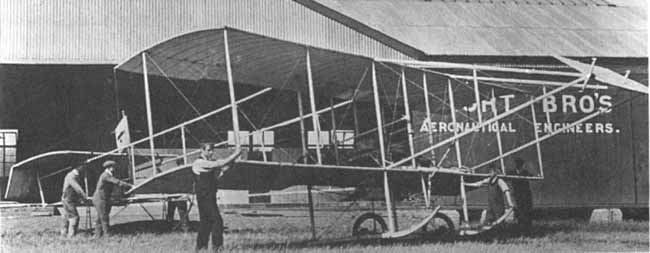
Another S.27 of the ealry type
The same N°S.38 also was selected to take part in the 1912 Fleet Review at Weymouth alongside a S.41 tractor biplane, Deperdussin and Nieuport monoplanes. The S.38 was flown by Samson (now a Commander) and Lieut. Gregory. in front of King George V and apanel of admirals. It was used to spot submerged submarine, even dropped 300 lb (140 kg) dummy bomb on an anchored target at sea. On 9 May still in the review, Samson flew off Hibernia and its permament bow ramp while under way into the wind, astablishing another "first". The ramp was dismounted and ended on HMS London for further trials on 4 July. Another pilot, on 10 August 1912, flew an S.33 with floats from Eastchurch to Westminster up the Thames. He also spectacularly flew though Tower Bridge, between the bascules and upper walkway and even under the remaining bridges, albeit the city authorities were not pleased. McClean was forbidden to do the same in reserve and had to taxi his aircraft down the Thames to Shadwell Basin, and returned to Eastchurch by road after a failed takeoff. Dual controls S.43 and S.44 ended at RAF Upavon in July 1912, still in use by 1914.
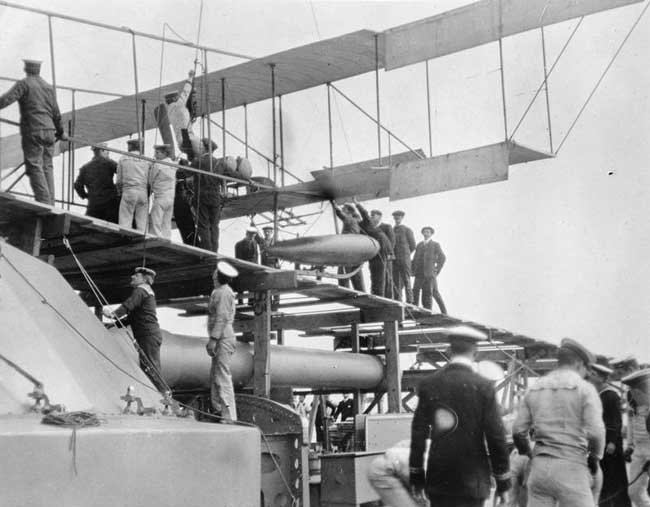
HMS Hibernia: Preparing the take off
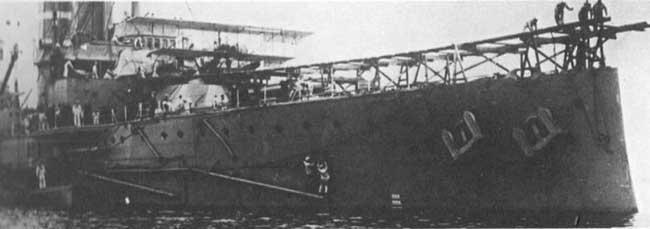
Same, prow view, as seen from an observer boat in June 1912.
Short also created a first 3-props twin-engine, the pusher-tractor "triple twin" powered by two 50 hp Gnome Omega engines on both ends of the nacelle and tested also by the Admirakty in June 1912, numbered T3. A later model, the S.39 was completely rebuilt as a single-engined pusher without front elevator, balanced rudders as the "Admiralty Type 3" with a top speed of 65 mph (105 km/h) and ceiling over 9,000 ft (2,700 m), used in France by the RNAS in the first months of the First World War a communications aircraft. Another sub-variant called the Short Tandem Twin had the same pusher-tractor design but with a prop fore and aft.
It was used for training by the RNAS until crashed by Samson in 1912. As for the Short S.32 modified, it was flown by 1913 Frank McClean and J.H. Spottiswoode on their attempted aerial expedition up the Nile with an extra bay to the wings, overhanging extensions, enlarged for 70 ft 6 in (21.49 m), elongated nacelle and a front elevator on an upswept outrigger and paired rudders still pushed by the 70 hp (52 kW) Gnome Lambda. Performance were disappointing and it led instead to the Short S.80, built, while the S.32 was reconverted as a standard Type 38. Note that back in 1911, Short Brothers did not assign type designations but instead individual airframe numbers prefixed by 'S' with type numbers given retrospectively making for a confusing system. It was a time no seriel production existed and airframes recycled and frequently rebuilt. The type S.38 was indeed the improved S.27 type N°38. A non-flying replica of an S.27 was created, now on display at the Fleet Air Arm Museum at RNAS Yeovilton in 1971. This was the 1910 Short S.29 with an 60 hp ENV V-8 engine, also transported to be displayed at Old Rhinebeck, USA.
Design
The Short Type 38 like the Type 27, was an equal span pusher biplane with a monoplane tailplane and an elevator mounted on booms forward of the wings. The elevator was extended outboard of the supporting booms. There were single-acting ailerons fitted to both upper and lower wings. Instead of a single rudder mounted underneath the tailplane there was an alternative also tested of an additional rudder mounted above it. The undercarriage was a simple pair of wheels mounted on an axle attached to the skids with supplementary tailskids attached to the ends of the tail booms to prevent rollovers.That was the base, but the S.38 derived from the Improved S.27 which featured strut-braced extensions to the upper wings or a greater upper wingspan as well as a strengthened wing structure, reduced span front elevator without outboard booms sections, while more powerful engines were tried, the 50 or 70 hp (37 or 52 kW) Gnome rotary engine. One intermediate design was the S.35 which had a 2-seats nacelle with a pilot and passenger or observe in tandem, also adopted for the S.34 and S.38. Like the latter, all could be built with dual controls for instruction, or extensively rebuilt. Thus, the S.38 was sometimes recycled from earlier models, all put to a new standard.
This was the case of the S.38, iriginally an S.27 in flying off platform tests on the battleship HMS London, that was lost after an hoisting accident. It detached itself from the hooks and broke apart after falling down. Parts were fortunately light enough to float and returned to Shorts, entirely rebuilt with extensive modifications and put to the latest standards. So the resulting design becoming became the Short S.38. It was still the same an unequal-span pusher biplane with a forward-mounted elevator, empennage, all carried on wire-braced wooden booms staged behind the wing. It was a pusher, but its new reinforced wings had increased span as well as a nacelle accommodating two crew members seated in tandem.
It had also modified tail surfaces and compared to earlier models its tailplane was enlarged, with new twin rudders fitted. The front elevator was back on booms however as the S.27. But on production when approved by the admiralty, the front elevator was eventually mounted on an upswept outrigger forward of the nacelle instead. Additionally, the outer panels of the upper wing had a swept back leading edge, and were rigged with a slight dihedral.
Engine

The S.27 in its most common form from S.27 to S.37 was powered by a Gnome Omega 7 cylinder, air-cooled rotary engine rated for 50 hp (37 kW) making for 48 mph (77 km/h, 42 kn) in top speed with a a wing loading of 3 lb/sq ft (15 kg/m2). Instead the Type S.38 (all aircraft manufactured from the N°S.38 onwards) had a Gnome Lambda 7-cylinder air-cooled radial. It was mounted at the back of the nacelle, with the engine behind instead of the contrary in most classic pushers. The prop was indeed sandwiched on a shaft running between a gearbox in the nacelle behind the observer and the rotary gnome engine. The engine turned with the propeller for cooling as customary for the time. This to tune finely the balance due to this spinning weight between the booms at the rear of the nacelle, extra rigidity was required to its main ladder frame.
This mature engine had a first runc.1911 and was manufactured in France (2,720) and britain, Coventry (979), moslty used on the Avro 504, Bristol Boxkite and Bristol Scout, but many, many more models in reality. After one model crashed in German lines it was also copied in Germany as the Motorenfabrik Oberursel U.0 and later U.III. For Short alone, it was standard on the Types S.37, S.38, S.41, S.60 and S.70.
Performances were as follows: This engine was claimed to produce 80 horsepower (60 kW) from a capacity of 12 litres (730 cubic inches), but in reality a bit less, around 70-75. The Type S.38 was capable of 58 mph (93 km/h, 50 kn) in top speed, with a range of 290 mi (464 km, 250 nmi), and endurance of 5 hours. It had a wing loading of 3.0 lb/sq ft (15 kg/m2).
Armament
The S.38 given its role was unarmed, apart regulatory revolvers for pilots in wartime.⚙ S.38 specifications | |
| Empty Weight | 1,100 lb (499 kg) |
| Gross weight | 1,500 lb (680 kg) |
| Lenght | 35 ft 6 in (10.82 m) |
| Wingspan | 52 ft (16 m) |
| Wing Area | 500 sq ft (46 m2) |
| Engine | Gnome Lambda 7-cylinder air-cooled radial c75 hp |
| Top Speed, sea level | 58 mph (93 km/h, 50 kn) |
| Range | 290 mi (464 km, 250 nmi), endurance 5 hours |
| Ceiling | 6,500 ft (c2,000m) |
| Wing Loading | 3.0 lb/sq ft (15 kg/m2) |
| Armament | None |
| Crew | two (pilot and observer) |
Combat
Shorts subsequently built nine production aircraft, numbered S.54-62 in 1912-13. Some remained in use with the RNAS even after World War I broke out for coastal patrol work at RNAS Great Yarmouth, and later for training purposes at RNAS Eastchurch. In 1915, the RNAS, pleased with their Short pushers, wanted to place orders for further S.38-type aircraft for use as basic trainers. As Short Brothers was busy building later types, orders were instead placed with subcontractors, twelve aircraft being built by Pemberton-Billing Ltd and twenty-four S.38s by White and Thompson, with deliveries continuing until 1916 and the type remaining in service until 1917. Note that future PM and 1st Lord of the Admiralty Sir Winston Churchill took flying lessons with Capt Wildman Lushington on an S.38 at the Naval Flying School, Eastchurch, in November 1913. There were also a few incidents:-12 September 1915 N°65 was destroyed in a midair collision with a Caudron G.III at Eastchurch, both pilots killed.
-10 January 1916 N°3148 crashed while low-flying near Eastbourne, two crew killed.
Gallery
Illustrations

Late type by Norman Thompson Flight Co. licenced model for the RNAS with a modified landing gear, small forward elevator, improved undercarriage, and new rudders (1915).
Photos
View of Commander Charles Samson of the Royal Naval Air Service modified Shorts S.38 "hydro-aeroplane on slipway of HMS HIBERNIA. The S.38 T.2 aircraft had air-bag floats to enable landing on water and was launched via a trolley-shuttle system off of a ramp which stretched from Hibernia's bridge to bow, over her forward 12 inch guns. Commander Samson was to be the first pilot to take off from a ship underway at sea. 4 June 1912.
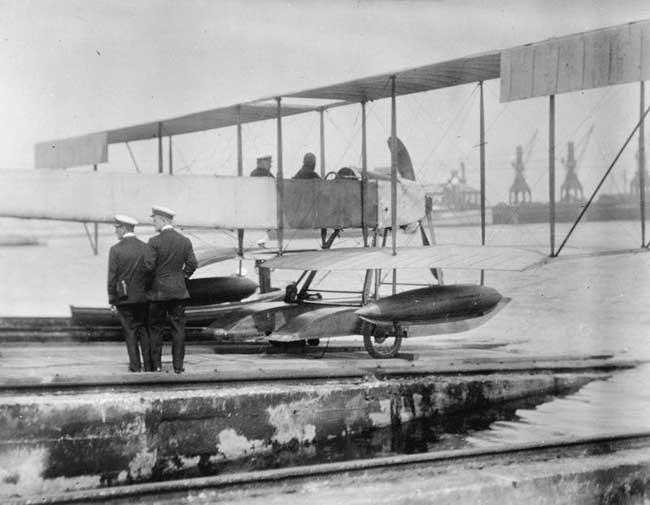
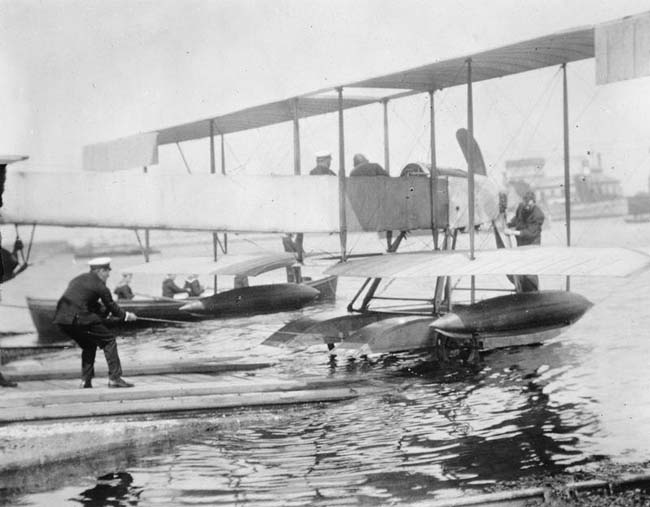
Commander Charles Samson of the Royal Naval Air Service and Captain Grafton of HMS Hibernia in his modified Shorts S.38 "hydro-aeroplane" about to take off from slipway in an attempt to be the first pilot to take off from a ship underway at sea. Weymouth. The S.38 T.2 aircraft had air-bag floats to enable landing on water and was launched via a trolley-shuttle system off of a ramp which stretched from Hibernia's bridge to bow, over her forward 12 inch guns. June 1912
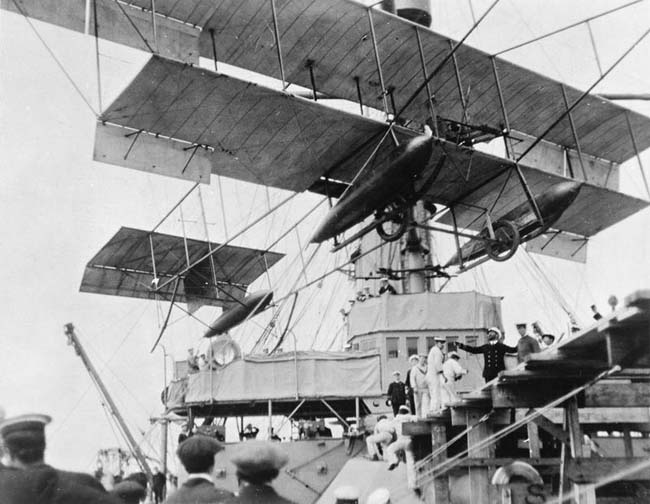
Modified Shorts S.38 "hydro-aeroplane" of Commander Charles Samson of the Royal Naval Air Service (facing camera) being hoisted in to be embarked in a warship, HMS HIBERNIA. This was Commander Samson's attempt to be the first pilot to take off from a ship underway at sea. The S.38 T.2 aircraft had air-bag floats to enable landing on water and was launched via a trolley-shuttle system off of a ramp which stretched from Hibernia's bridge to bow, over her forward 12 inch guns. 4 June 1912.
First Lord of the Admiralty, Winston Churchill (centre, facing camera), stands in front of Short Type S.38 Biplane (a.k.a. Short S.77), No. 66, of the Naval Wing of the Royal Flying Corps, during a visit to Eastchurch, Kent. No. 66, seen here with a Vickers Maxim gun fitted on the front of the gondola, was used for experimental gun and wireless installation tests at Eastchurch. On the extreme right stands Commander C R Samson, Commanding Officer of the Eastchurch Naval Flying School. The Naval Wing of the RFC was renamed the Royal Naval Air Service on 1 July 1914, shot 15 May 1914.
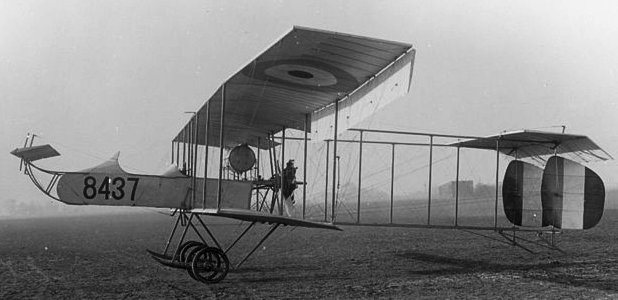
Late Short S.38 of the RAF
Read More/Src
Books
Barnes, C.H. Shorts Aircraft Since 1900. London: Putnam, 1967.Bruce, J.M. British Aeroplanes 1914–18. London: Putnam, 1957.
Goodall, Michael H. The Norman Thompson File. Tunbridge Wells, UK: Air Britain (Historians), 1995.
Ray Sturtivant and Gordon Page Royal Navy Aircraft Serials and Units 1911–1919 Air-Britain, 1992.
Thetford, Owen British Naval Aircraft Since 1912. London: Putnam, 1982.
Links
facebook.com/Short Brothers Kentmilitaer-wissen.de
Short_S.38
flyingmachines.ru
Short_S.27
commons.wikimedia.org
Model Kits
None found yet. Scratchbuiding probably easy.Video
- Lohner E (1913)
- Macchi M3 (1916)
- Macchi M5 (1917)
- Macchi M7 (1918)
- Ansaldo ISVA (1918)
- Short S.38 (1912)
- Sopwith Baby (1916)
- Short 184 (1916)
- Fairey Campania (1917)
- Sopwith Cuckoo (1917)
- Felixstowe F.2 (1917)
- Gotha WD.2 (1914)
- Friedrichshafen FF 33 (1916)
- Albatros W4 (1916)
- Albatros W8 (1918)
- Hanriot HD.2
- Grigorovich M5 (1915)
- Grigorovich M9 (1916)
- Grigorovich M11 (1917)
- IJN Farman MF.7
- IJN Yokosho Type Mo
- Yokosho Rogou Kougata (1917)
- Yokosuka Igo-Ko (1920)
- Curtiss N9 (1916)
- Curtiss H4 (1916)
- Curtiss H12 (1917)
- Curtiss H16 (1918)
- Aeromarine 39
- Vought VE-7
- Douglas DT (1921)
- NAF/Curtiss TS-1 (1922)
- Boeing FB.5 (1923)
- Boeing F4B (1928)
- Vought O2U/O3U Corsair (1928)
- Grumman FF (1931)
- Akron class airships (1931)
- Curtiss F9C Sparrowhawk (1931)
- Curtiss F11C Goshawk (1932)
- Curtiss BF2C Goshawk (1933)
- Blackburn Blackburn (1922)
- Supermarine Seagull (1922)
- Fairey Flycatcher (1923)
- Hawker Horsley (1925)
- Blackburn Ripon (1926)
- Fairey IIIF (1927)
- Fairey Seal (1930)
- LGL-32 C.1 (1927)
- Fokker T.II (1921)
- Fokker T.III (1923)
- Caspar U1 (1921)
- Dornier Do J Wal (1922)
- Rohrbach R-III (1924)
- Mitsubishi 1MF (1923)
- Mitsubishi B1M (1923)
- Yokosuka E1Y (1923)
- Nakajima A1N (1927)
- Nakajima E2N (1927)
- Mitsubishi B2M (1929)
- Nakajima A2N (1930)
- Nakajima A4N (1935)
- CANT 18
WW1
✠ K.u.K. Seefliegerkorps:
 Italian Naval Aviation
RNAS
 Marineflieger
 French Naval Aviation
 Russian Naval Aviation
 IJN Air Service
 USA
USA
Interwar
 Interwar US
 Interwar Britain
 Interwar France
 Interwar Netherlands
 Interwar Germany
 Interwar Japan
 Interwar Italy
- Grumman F2F (1933)
- Curtiss SOC seagull (1934)
- Grumman F3F (1935)
- Northrop BT-1 (1935)
- Consolidated PBY Catalina (1935)
- Grumman J2F Duck (1936)
- Brewster/NAF SBN-1 (1936)
- Curtiss SBC Helldiver (1936)
- Vought SB2U Vindicator (1936)
- Brewster F2A Buffalo (1937)
- Douglas TBD Devastator (1937)
- Vought Kingfisher (1938)
- Curtiss SO3C Seamew (1939)
- K-class Blimps (1939)
- Douglas SBD Dauntless (1939)
- Grumman F4F Wildcat (1940)
- F4U Corsair (NE) (1940)
- Brewster SB2A Buccaneer (1941)
- Grumman TBF/TBM Avenger (1941)
- Consolidated TBY Sea Wolf (1941)
- Grumman F6F Hellcat (1942)
- Curtiss SB2C Helldiver (1942)
- Curtiss SC Seahawk (1944)
- Grumman F7F Tigercat (1944)
- Grumman F8F Bearcat (1944)
- Ryan FR-1 Fireball (1944)
- Douglas AD-1 Skyraider (1945)
- Fleet Air Arm
- Hawker Osprey (1932)
- Fairey Swordfish (1934)
- Blackburn Shark (1934)
- Supermarine Walrus (1936)
- Fairey Seafox (1936)
- Blackburn Skua (1937)
- Short Sunderland (1937)
- Blackburn Roc (1938)
- Fairey Albacore (1940)
- Fairey Fulmar (1940)
- Grumman Martlet (1941)
- Hawker sea Hurricane (1941)
- Brewster Bermuda (1942)
- Fairey Barracuda (1943)
- Fairey Firefly (1943)
- Grumman Tarpon (1943)
- Grumman Gannet (1943)
- Supermarine seafire (1943)
- Blackburn Firebrand (1944)
- Hawker Sea Fury (1944)
- Coastal Command
- Vickers Wellington (1937)
- IJN aviation
- Yokosuka E6Y (1930)
- Aichi D1A "Susie" (1934)
- Mitsubishi A5M "Claude" (1935)
- Nakajima A4N (1935)
- Yokosuka B4Y "Jean" (1935)
- Mitsubishi G3M "Nell" (1935)
- Nakajima E8N "Dave" (1935)
- Kawanishi E7K "Alf" (1935)
- Nakajima B5N "Kate" (1937)
- Kawanishi H6K "Mavis" (1938)
- Aichi D3A "Val" (1940)
- Mitsubishi G4M "Betty" (1940)
- Mitsubishi A6M "zeke" (1940)
- Nakajima E14Y "Glen" (1941)
- Nakajima B6N "Jill" (1941)
- Mitsubishi F1M "pete" (1941)
- Aichi E13A Reisu "Jake" (1941)
- Kawanishi E15K Shiun "Norm" (1941)
- Nakajima C6N Saiun "Myrt" (1942)
- Yokosuka D4Y "Judy" (1942)
- Kyushu Q1W Tokai "Lorna" (1944)
 Luftwaffe
- Heinkel 114 (1935)
- Arado 196 (1937)
- Me109 T (1938)
- Blohm & Voss 138 Seedrache (1940)
 Italian Aviation
- Savoia-Marchetti S.55
- IMAM Ro.43/44
- CANT Z.501 Gabbiano
- CANT Z.506 Airone
- CANT Z.508
- CANT Z.511
- CANT Z.515
 French Aeronavale
- GL.300 (1926-39)
- CAMS 37 (1926)
- Levasseur PL.5 (1927)
- Potez 452 (1935)
- Loire 210 (1936)
- Loire 130 (1937)
- LN 401 (1938)
 Soviet Naval Aviation
- Shavrov SH-2 (1928)
- Tupolev TB-1P (1931)
- Beriev MBR-2 (1930)
- Tupolev MR-6 (1933)
- Tupolev MTB-1 (1934)
- Beriev Be-2 (1936)
- Polikarpov I16 naval (1936)
- Tupolev MTB-2 (1937)
- Ilyushine DB-3T/TP (1937)
- Beriev Be-4 (1940)
 Swedish Naval Aviation
- SAAB B17S
-
 Skoda Š-328V
  R-XIII Idro
 Fokker C.XI W (1934)
 Rogožarski PVT-H (1938)
WW2
 ☍ USNA
- De Havilland Sea Vixen
- Hawker Sea Hawk
- Supermarine Scimitar
- Blackburn Buccaneer
- Hawker Sea Harrier
- Douglas A4 Skyhawk
- Grumman F9F Panther
- Vought F8 Crusader
- McDonnell-Douglas F-4 Phantom-II
- North Am. A5 Vigilante
- TU-142
- Yak 38 forger
☢ Cold War
✧ NATO
Fleet Air Arm
 US Navy
☭ Warsaw Pact
Merch
Seafire Mark 45; HMS Pretoria Castle
Zeros vs its aversaries
Aichi D3A “Val” Junyo
Mitsubishi A5M poster
F4F wildcat
Macchi M5
SBD Dauntless Coral Sea
SBD Dauntless USS Enterprise
SBD-4 CV22