Curtiss H (1917)
 Rcce Flying Boat - 478 built
Origin and Development

Civilian Origins: The Prize
The origin of this flying boat is rooted in the will to develop transatlantic voyages by air prewar, and nitably the famous £10,000 prize challenge issued in 1913 by the famous Daily Mail. It was aimed at the first non-stop aerial crossing of the Atlantic (whatever the plane type). This reflected the enthusiasm for the rapid progresses made in aviation as it was not long ago after the first Channel crossing by Louis Bleriot, just three years earlier. Gleen Curtiss, which just cranked up the reputation of his young company by flying stunts and creating new models at fever pace, took the gauntlet.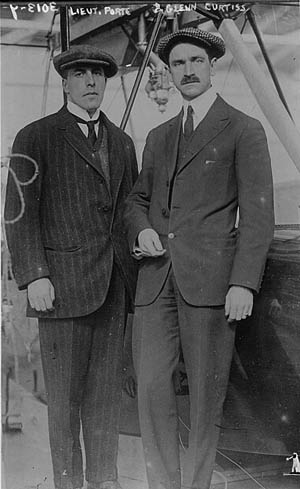 He worked on a model, not on his own will, but after being contacted by American businessman Rodman Wanamaker, which commissioned his company, Curtiss Aeroplane and Motor Company to compete. The Mail described "an aircraft with transoceanic range" and since no airports existed, in America Glenn Curtiss started to work with John Cyril Porte (see the Felixtowe bio about him). The endeavour was not only supported financially but also nationalistically. Porte rearranged the flight plan at Curtiss workshops and created a scaled-up version of the Curtiss M
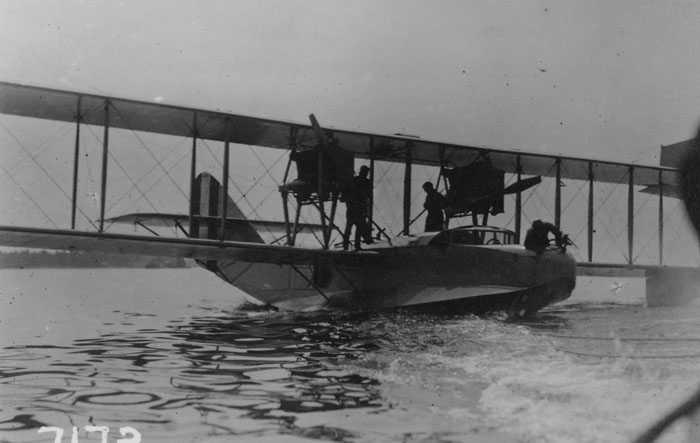
The "Wanamaker Flier" as initially dubbed, was a conventional biplane (see design). It was eventually Named "America", and launched on 22 June 1914 for trials the next day, revealed a serious shortcoming: The nose tended to submerge as engine power increased, ploughing dangerously while taxiing. To counteract this, Curtiss addeed fins to the bow for extra hydrodynamic lift, then large sponsons to add buoyancy. This worked and made for the Curtiss Model H-2. Several prototypes followed, alternating but each time with slightly reworked sponsons. Preparations for the transatlantic crossing restarted and on 5 August 1914 it was scheduled to fly using the full moon. However the outbreak of the war changed everything.
RNAS Interest
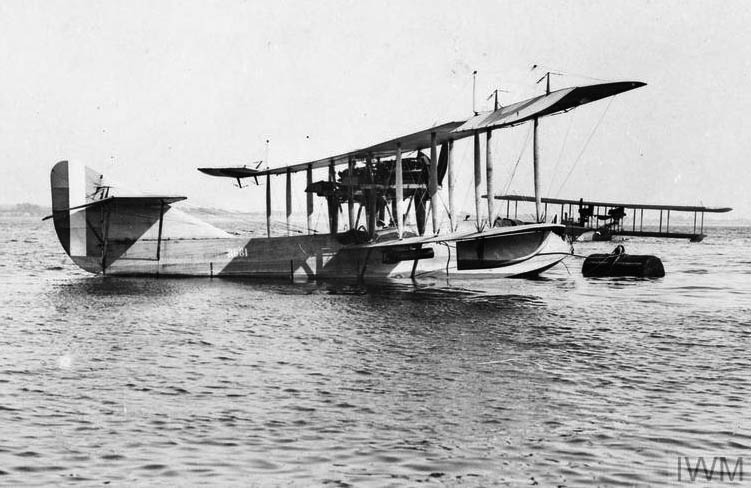
Porte & Hallett on "America", following the launch on Keuka Lake at Hammondsport, June 1914, showing the Curtiss OX-5 engines.
Porte, pilot of the "America" with George Hallett, was recalled to service with the British Royal Navy, but urged the Admiralty by telegram to test and purchase the "America" and later prototyes. By September 1914, both were successfully tested with a British observer present. They were shipped to Britain 30 September on RMS Mauretania. The RN tested thse and ordered 12 similar aircraft, all called the Model H-2 plus four of the model H-4, to be assembled in the UK by Saunders. All were identical to the "America" and called that way in the Royal Navy service. Soon another 50 were ordered. These were quickly drafted for patrol and rescue. 14 were militarized as gun mounts were added under the "H-4" model designation, with only the two prototypes called "H-2". Curtiss factory with this order for 50 H-4s ended producing 64 of the first model.
Soon, the RN came for an evolution and this created a whole lineage of more adaptable and more robust H- models, to reach a staggering total of 500 plus in successive models. Overall, they were physically similar and handled the same, differences being in size or weight with each time improved engines follwong rapid advances in internal combustion. The British Admiralty then started to use them for anti-submarine patrol craft in addition to air-sea rescue roles, finding them so valuable plans were made for more purchases. A parallel development in the UK under supervision of John Cyril Porte led to the "Felixstowe" series, testing better hydrodynamic hull forms, from the F.1 onwards. Its hull form became standard in seaplanes afterwards.
Design of the Curtiss H
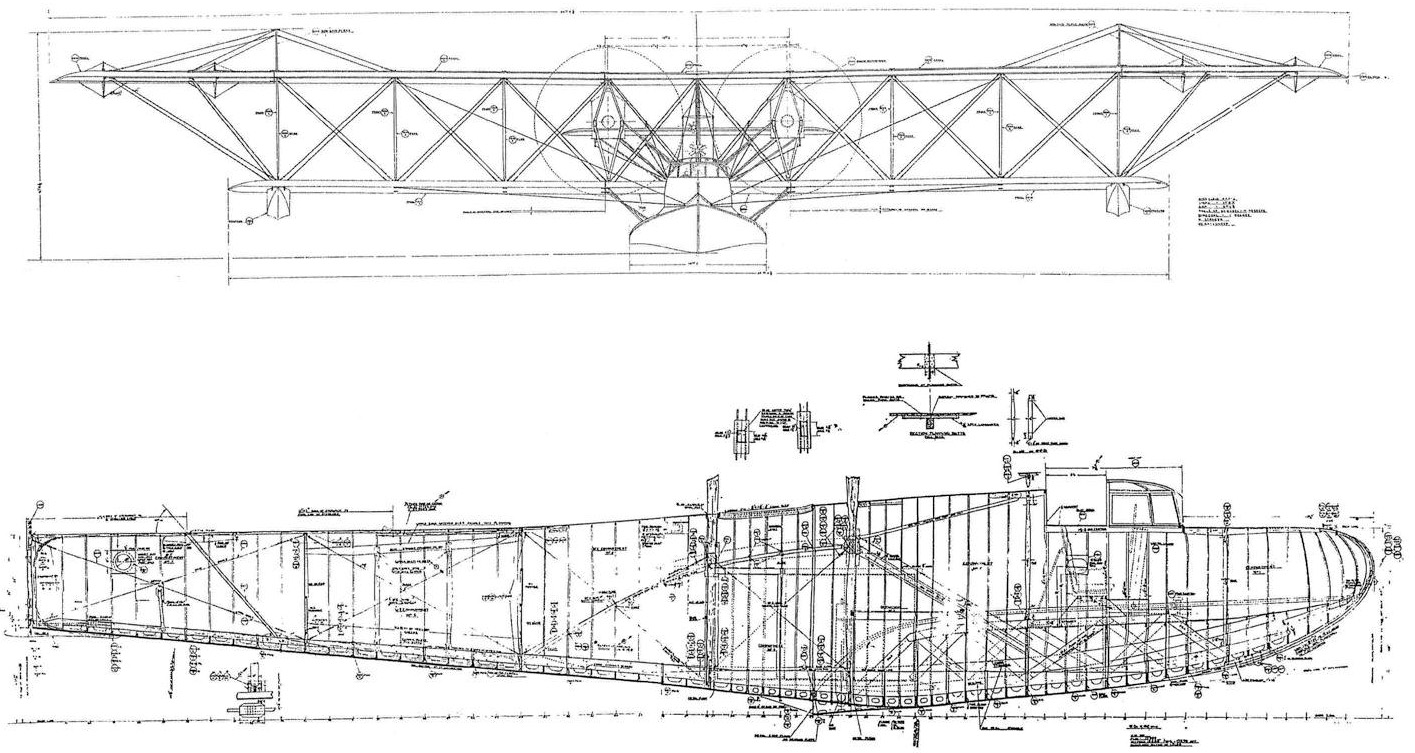
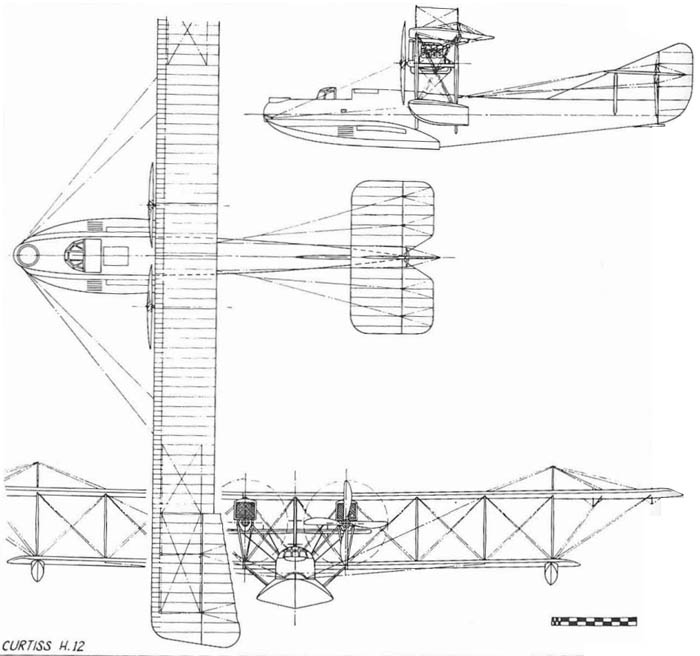
Scheme H12
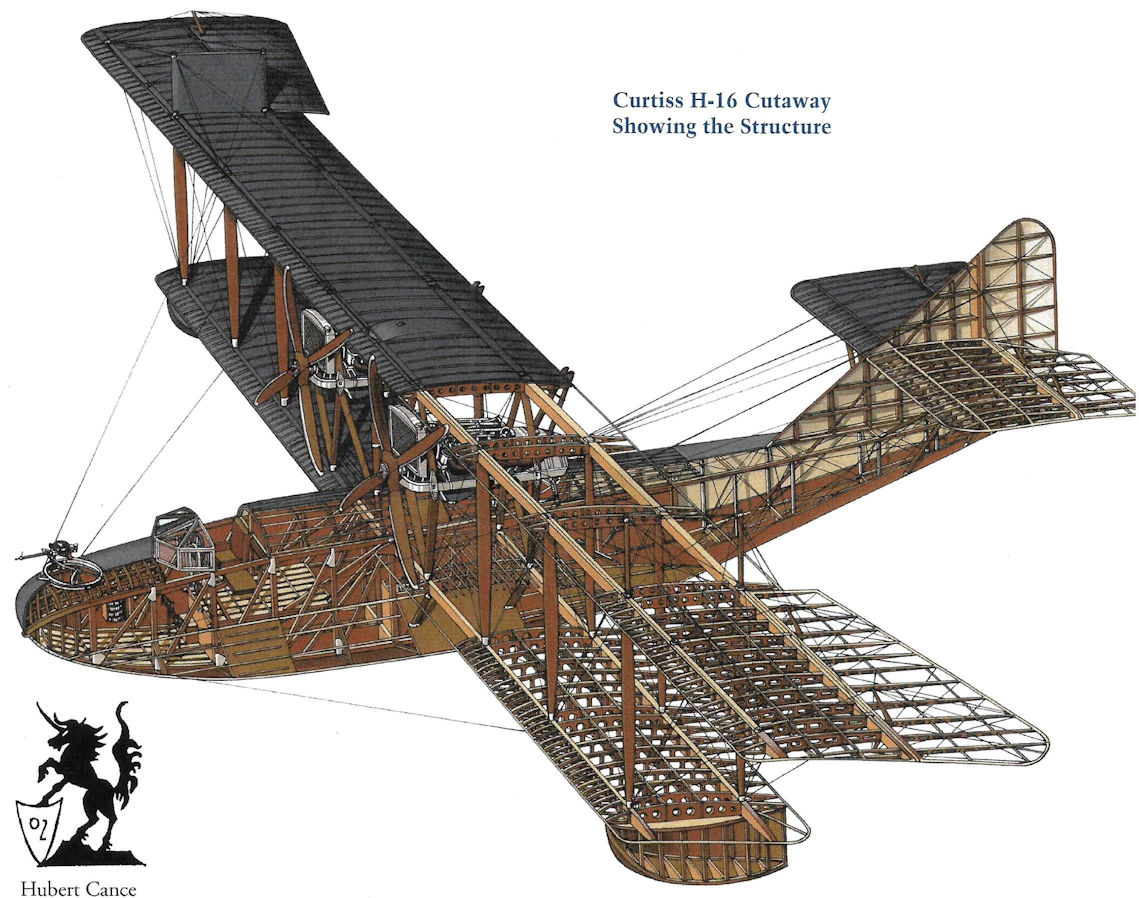
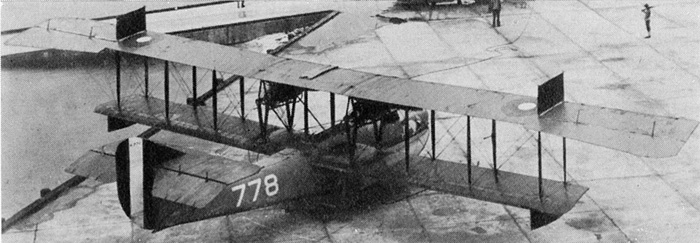
The first H-2 was conventional, as a two-bay biplane with unstaggered wings, unequal span and powered by two tractor engines side by side, above the fuselage (interplane gap). There were wingtip pontoons attached directly below the lower wings. It was considerably larger than earlier Curtiss Biplanes to carry enough fuel and make 1,100 mi (1,770 km) for three crew members in a fully enclosed cabin. After the H4 (62 made), the H5 and H6 remained at paper stage, but the H-7 "Super America" prototype became a much larger model and the standard for next models, testing a large hull and better engines. See a cutaway of the H.16 by Hubert Cance.
The came the military version, the H8, a single prototype tested by the admiralty, leading directly to two series in wartime, the major production types of the Curtiss H: The Model H-12 (Model 6A) was a mass-production version (104 made) with Curtiss V-X-X engines, followed by the H-12A (Model 6B) which was the RNAS version sporting Rolls-Royce Eagle I and the H-12B (Model 6D) with Rolls-Royce Eagle VIII. The USN was interested and ordered in turn the Model H-12L with Liberty engine.
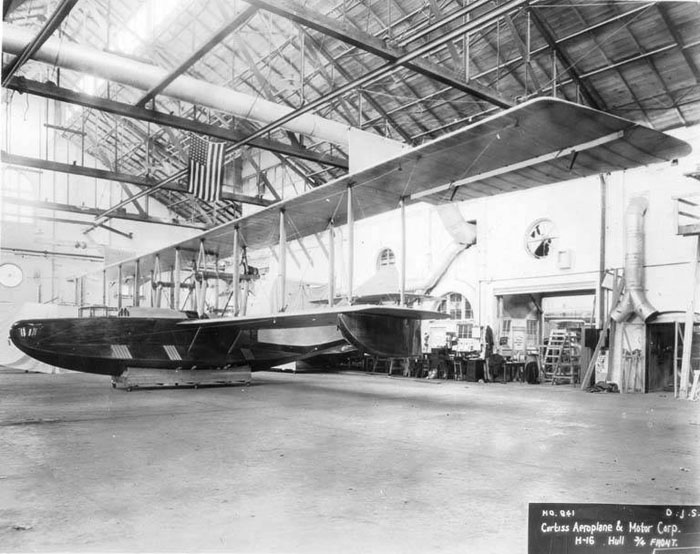
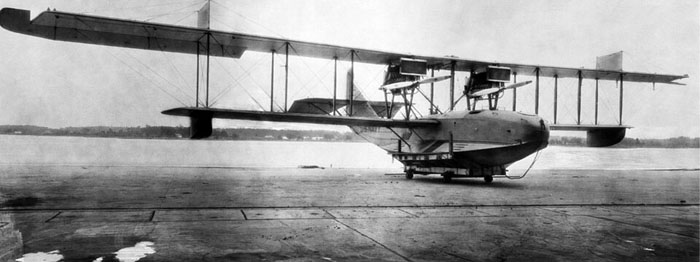
The last evolution and most produced was the Model H-16 (Model 6C), enlarged, with 334 built by Curtiss, and seconded by Naval Aircraft Factory, the state-sponsored aircraft manufacture of the USN. This led to the H-16-1 prototyoe testing pusher engines and the H-16-2 prototype also with pusher engines but revised wing cellule, not adopted either. The Curtiss H-16 became the workhorse of the USN on the Atlantic east coast, whereas the RNAS depended on the H-12 and various Felixtowe series.
General Layout
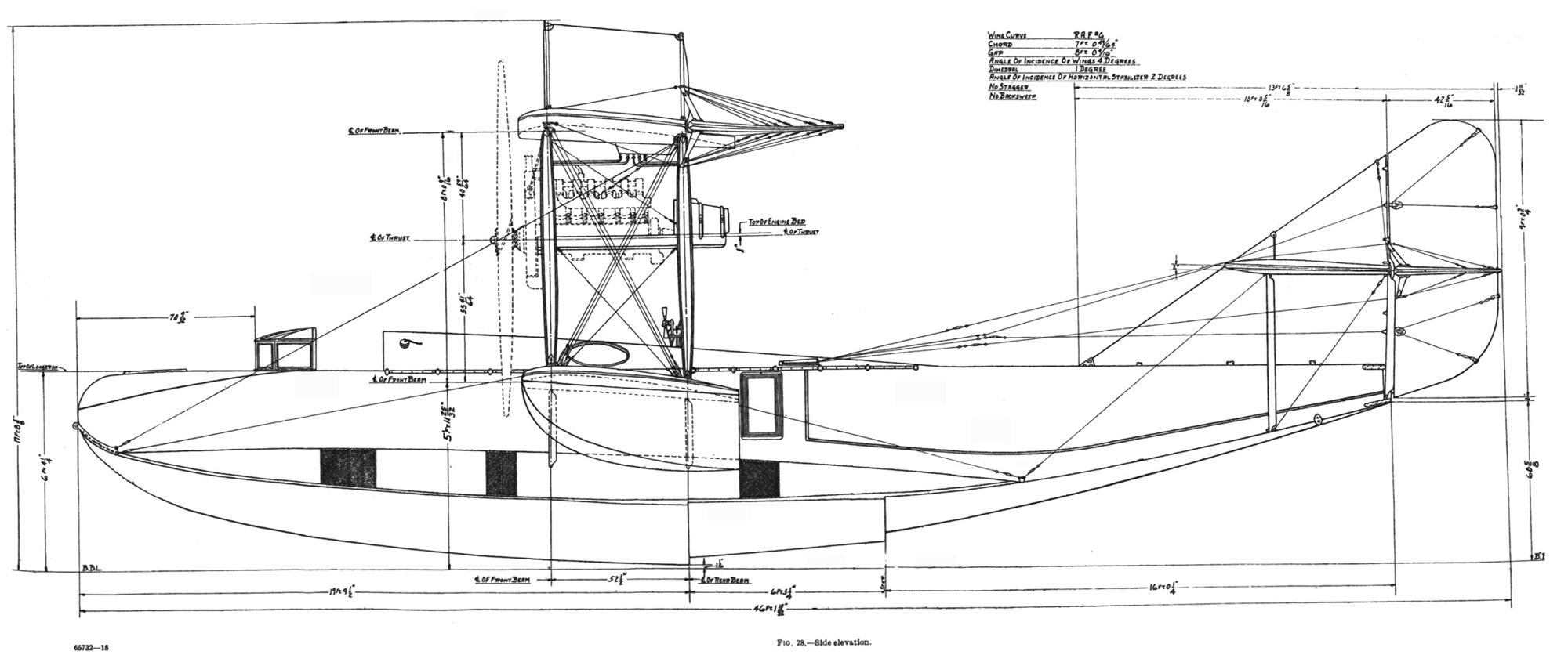
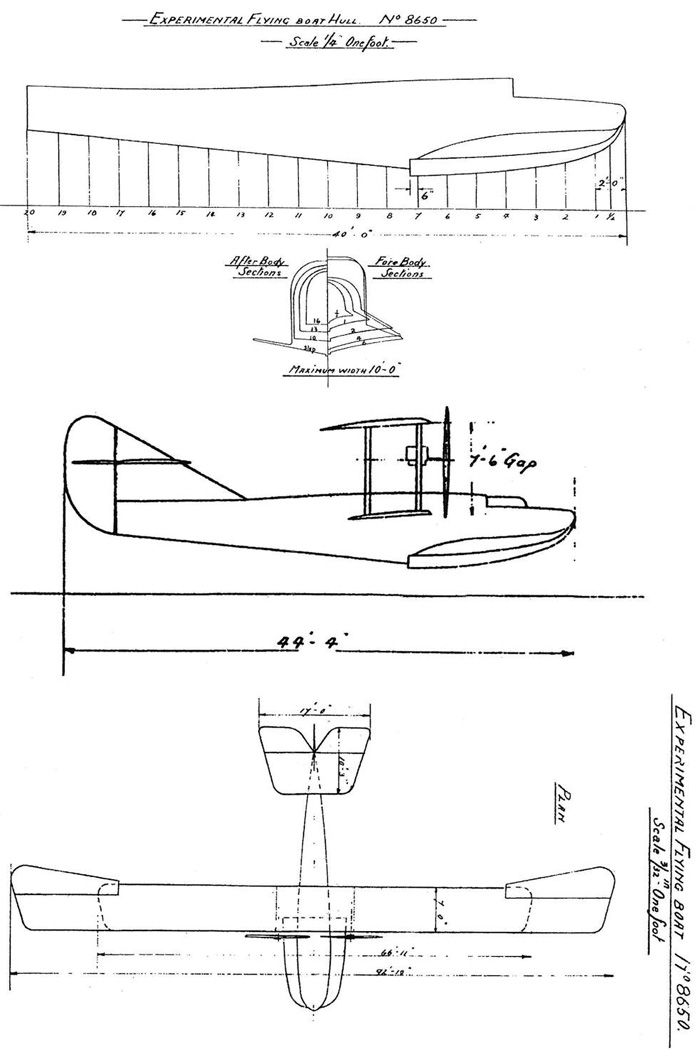
H 16 drawing
The Curtiss H was built in wood with a metal skeleton weighting 390 kgs; with 48.3 kgs of internat and external bracing. The hull was covered by plywood and wood covering panels, 1.2 cm thick for a total weight of 293.7 kg. It had 12 kgs seats, 10 kgs for controls and indicators, 9 kgs for other equipments in cabin, two 744 litre for the main fuel tanks empty, 119 kg and the total weight of the fuselage, light, was 987 kg. The two-bay arrenegemtn made for two equalspan wings, made with a wooden structure braced by metal fittings, weighting with wing covering of doped linen fabric of just 69 kg, albeit the weight of the 232 rib overall represented 350 kg.
As a sesquiplane, the outer part of the upper wing was wider, with large elevons. The upper hull was attached to the lower one with a set of six struts pairs, plus two more in Vee for the engines, and one central. The engine mounts struts weighted 28 kg. The eight spars weight 336 kg together fir an overall unitary wing weight of 755 kg. Per square meter the load was 6.98 kg. The sixteen interplane struts &cabane represented a total of 154.8 kg and the stiffening 9.3 mm cables, over 168 m lenght for 88.8 kg. The large triangular-shaped fin & rudder represented a surface of 9.7 m2 for 69.5 kg. The stabilizer & elevator represented 12.2 m2 for 85.7 kg for a grand total with the wing surfaces and associated bracing of 1,181 kg. The two wooden wintips floats weighted together 76 kg.
Engines

RR Eagle VIII
This varied between models as seen above and below. The first H-12 had Curtiss V-X-X engines. This V8 manufactured in Hammondsport and Buffalo from 1915 powered the R series training seaplanes and landplane. It was supplanted by the 67 kW (90 hp) OX-5 ch powering the famous JN-4D “Jenny” trainer and definitively replaced by the state-sponsored Liberty engine so it was soon phased out. This reciprocating V-type was water-cooled, for a power rating of 134 kW (180 hp) at 1,400 rpm and displacement of 18 L (1099.56 cu in.), Bore and Stroke of 127 mm (5 in.) x 178 mm (7 in.).
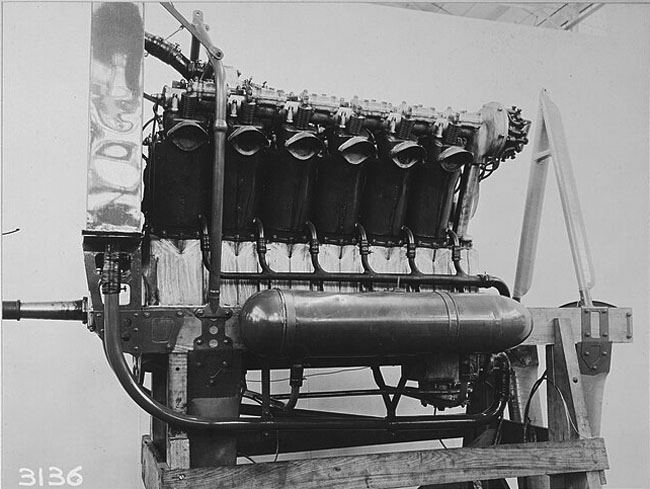
Nacval Aicraft Factory C-1 engine and radiator (NARA)
The RNAS models had the Rolls-Royce Eagle I and VIII. The Eagle was introduced in 1915 to meet British military requirements, powering notably the Handley Page Type O bombers and others. It was a 20 litre engine which developed in the Mark I variant 225 hp. It was soon replaced by the Eagle VIII produced from 1917 to 1922, hich developed 300 hp thanks to extensive modifications and was the most produced, with 3,302 delivered by Derby.
The Liberty engine that powered the late H-12 and H-16 in its US versions was a water-cooled 45° V-12 displacing 1,649 cubic inches (27 L) for an output of 400 hp (300 kW). It started production in 1917, and 20,748 were manufactured until longer after WWI, in variants such as the Liberty L-4, Liberty L-6 and Liberty L-8.
Variants
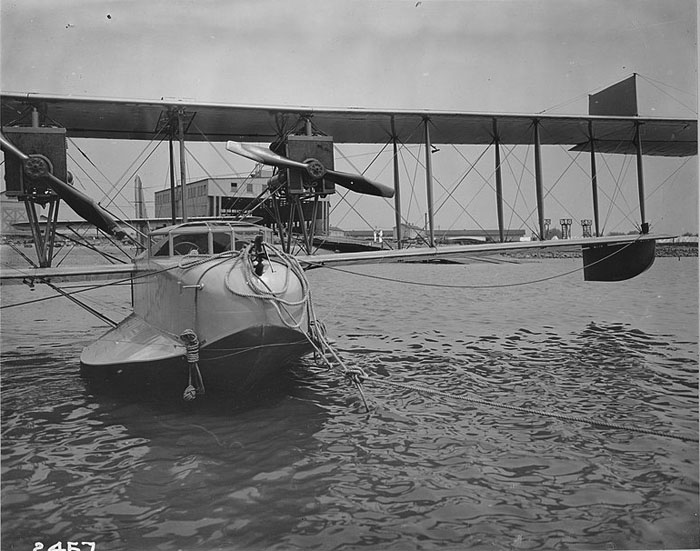
NAF (Naval Aicraft Factory) C1 at her moorings.
- Model H-1 (Model 6) "America" prototypes for transatlantic crossing, two built.
- Model H-2, one prototype built for RNAS testings.
- Model H-4: H-1 modified for the RNAS, 62 built.
- Model H-7: "Super America" prototype
- Model H-8: Enlarged H-4 (one prototype)
- Model H-12 (Model 6A) production H-8 with Curtiss V-X-X engines: 104 built.
- Model H-12A (Model 6B) RNAS version with Rolls-Royce Eagle I
- Model H-12B (Model 6D) RNAS version with Rolls-Royce Eagle VIII
- Model H-12L: USN version with Liberty engine
- Model H-16 (Model 6C) enlarged H-12: 334 by Curtiss and Naval Aircraft Factory.
- Model H-16-1: Model 16 fitted with pusher engines (1 proto)
- Model H-16-2: Same but revised wing cellule (1 proto)
Detailed specs
Curtiss H-12: Length 14,02 m, Wingspan 28,34 m, height 5,09 m and wing area 102,9 m2Weights: Empty 2,880 kg, Gross, TO weight 4,124 kg.
Performances: 149 km/h. Two Rolls Royce Eagle I, 250 hp each.
Crew: Three, three defensive machine guns.
Specs Curtiss H-12A | |
| Crew: | 4 |
| Fuselage Lenght | 46 ft 6 in (14.17 m) |
| Wingspan | 92 ft 8.5 in (28.258 m) |
| Height | 16 ft 6 in (5.03 m) |
| Wing Area: | 1,216 sq ft (113.0 m2), airfoil RAF 6 |
| Empty weight: | 7,293 lb (3,308 kg) |
| Gross weight: | 10,650 lb (4,831 kg) |
| Powerplant: | 2× Rolls-Royce Eagle I V-12: 275 hp (205 kW)* |
| Propeller: | 4-bladed fixed-pitch |
| Maximum speed: | 85 mph (137 km/h, 74 kn) at 2,000 ft (610 m) |
| Climb rate: | 336 ft/min (1.71 m/s) |
| Range: | |
| Service ceiling: | 10,800 ft (3,300 m) |
| Armament - Guns | 4× .303 in (7.7 mm) Lewis flex mts |
| Armament - Bombs | 4× 100 lb (45 kg)/2× 230 lb (100 kg) below wings |
Curtiss H 16

Splendid artwork (pinterest)
The H 16 was a larger seabird with an operational weight of 4,362 kg and operational weight in a bombing mission of 4,782 kg with a bomb load of 420 kg. It had a fuel reserve of 914 kg, enough for 8.15 hours aloft at minimal speed and even had an extra useful load of 193 kg for a max operational weight, fully loaded, 5,889 kg with fuel tanks filled and maximum take-off weight of 5,889 kgs to compared to 4,831 kg for the H-12A. However normal flight time was 6.26 hours per mission.
The H-16 was powered by two Liberty engines (in US service), with a power loading without bombload of 7.91 kg/kW. Together they produced 551.6 kW at 1,950 r.p.m. The manoeuvre load was 1.2g at 1000 m, with a limit load of 2.5 g and ultimate load of 3.8 g, and load factor of 1.2 g. They could do 152 sorties over 950 hours before a significant refit. Normal wing loading was 396 N/m2 with a wing stress of 3 g in operation or up to 170 N/kg at 3g in an emergency manoeuvre. The max. angle of attack before stalling was 9.66° and at max. speed 3.71°. The stalling speed at sea-level was 91 km/h. Max landing speed at sea-level was 109 km/h. Cruise speed was 126 km/h at 62% throttle and the propeller was calculated for 133 km/h. But top speed was 140 km/h at 90% throttle. Oil and fuel consumption was 0.59 kg/Km
climbing speed at sea-level, light, was 279 m/min and average take-off distance at sea-level, 455 m for a lift/drag ratio of 10.12. Max. practical ceiling was 4200 m for 3,885 kg in load and 3,700 m practical with a loaded weight of 4,362 kg in service, and the when fully loaded at 5,777 kg it was limited to 2,300 m. To climb to 1500 m, light, it took 6.22 min. In a dive to escape a fight for example it could reach 329.2 km/h at 1,300 m before recovery and endangering the structure. The load factor at max. angle was 1.93 G. It needed 80 m to make a semi-turn at 500 m but made a full 360° in 13.9 seconds. Operational endurance in taxi mode, was 10.15 hours with 4 crew on board and 613 kg bombload, 100% fuel. Published records were for 8.95 hours with a bomb load (max) of 748 and 88% fuel. The radius was 973 km. Max theoretical range with additional fuel tanks for 2,811 litre was 2,317 km or 1,250 nm. This was less than half-way to the Atlantic in taxi mode (so no return). Over 250 km it could carry a max load of 1,616 kg.
Service & Operators
Service

Curtiss H.12L standard USN Navy grey (pinterest)
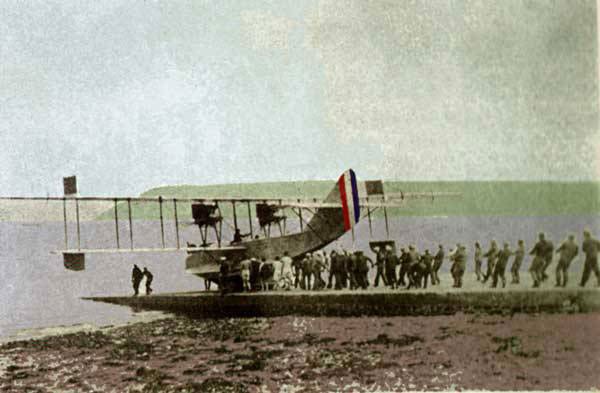
With the RNAS, H-12s and H-16s operated from flying boat stations on the coast in long-range anti-submarine and anti-Zeppelin patrols over the North Sea. A total of 71 H-12s and 75 H-16s were received by the RNAS, and 18 H-12s, 30 H-16s were still active by October 1918. Twenty U.S. Navy H-12s were procured but never left home, used for training, mostly for future H-16 crews. In between they ran anti-submarine patrols from East Coast naval stations. H-16s however were sent to naval based in the UK in mid-1918 but only saw limited service. Navy pilots disliked the H-16 like previous models because in case of a crash landing, the large engines behind them were likely to break loose and severe heads... That complain went to Curtiss that tried to produce pusher prototypes (H-16-1 and 2) but the war ended in between.
The H-16 were also delivered still to the RNAS, receiving no less than 125 (75) H-16, commencing operations over the North Sea also by mid-1918, equipped with Rolls Royce Eagle IV engines. I other sources, 50 were cancelled, 50 placed in storage in the UK and the remaining 25 saw service from coastal bases in the closing months of the war. In USN service they had Liberty engines and were manufactured at the Naval Aircraft Factory in Philadelphia (Pennsylvania), designated as NAF "C". They were historically significant as the first built at this factory, 150 of them. Curtiss built the remaining 124. USN NAF C flying boats were assigned in Britain in NAS Killingholme, and Brest and St. Trojan in France or Queenstown in Ireland.
The Curtiss H remained in service after World War I, some in active USN service, or offered for sale as surplus. On average they were sold at arounf $11,000 apiece which was a third of the contracted cost in wartime. Those remaining in U.S. Navy service received engine upgrades, with more powerful Liberty variants, and were retired in the late 1920s.
Operators
 Brazilian Naval Aviation (likely postwar)
 Canadian Air Forcen two former Royal Air Force H-16 (Imperial Gift)
 Royal Netherlands Naval Air Service: Single Curtiss H-12 postwar
 Royal Naval Air Service, RAF No. 228, 234, 240, 249 Sqn.
 United States Navy (later American Trans-Oceanic Company)
Gallery
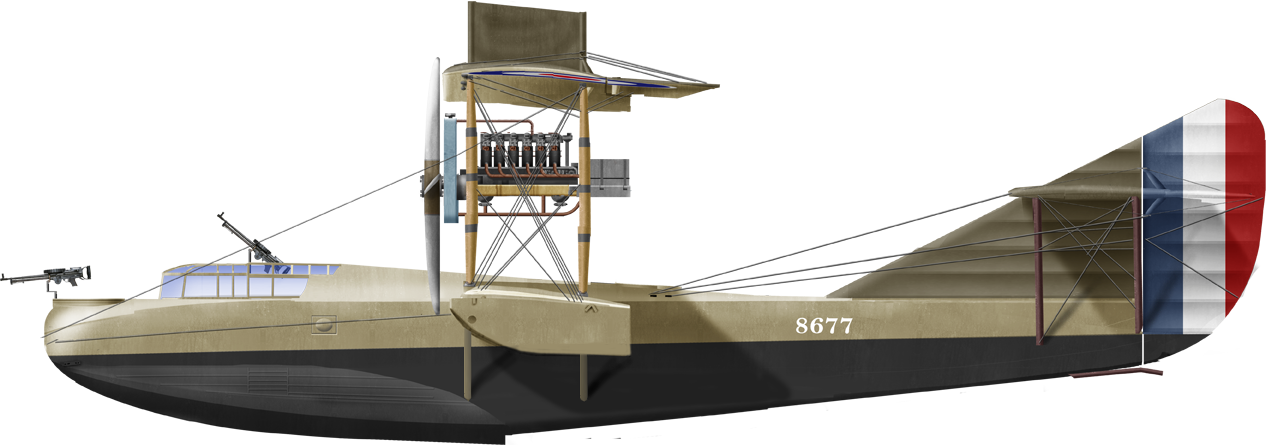
RNAS H-12 assigned to Felixtowe
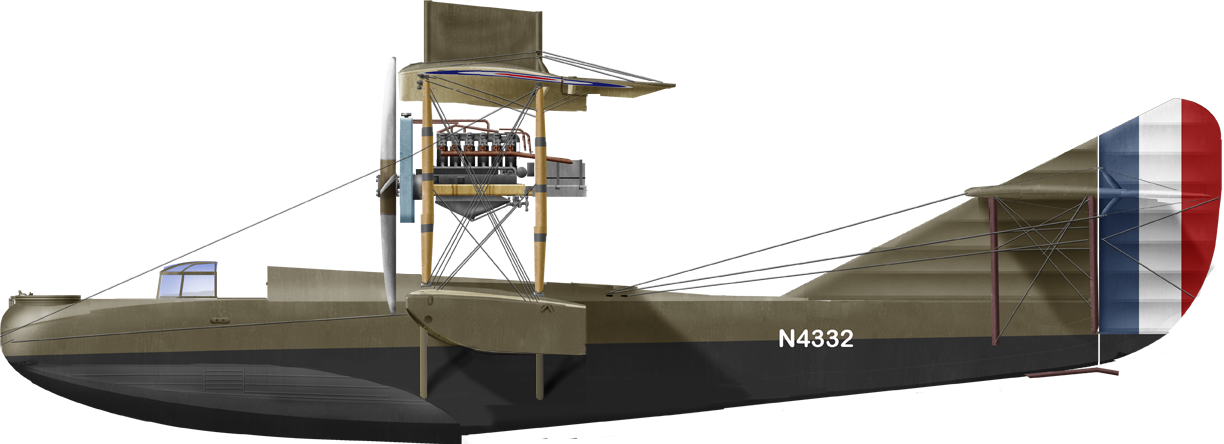
Curtiss H12B assigned in december 1917 to Great Yarmouth
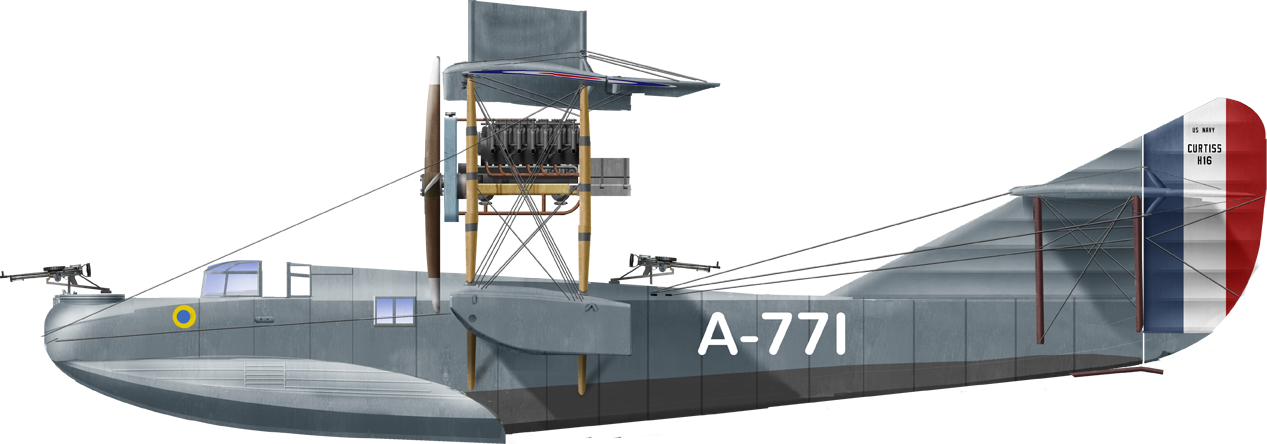
Curtiss H12 of the US Navy, 1918
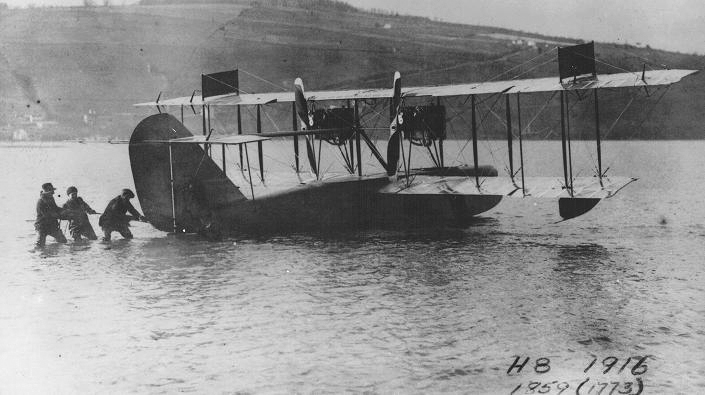
To come: Curtiss America, H4, H16 and variants.
Read More and Sources

"Big Fish", an inventively painted Curtiss H-16 (src aircraftinvestigation.info)
books
Curtiss H.12, Colin A. Owers. Windsock Datafile No. 125. 2007. Albatros ProductionsCurtiss H-16 Roden No. Ro 049 1:72.
links
militaryfactory.comflyingmachines.ru/ H 16
seawings.co.uk Curtiss H 16 plans
history.navy.mil
worldwar1.com
alchetron.com
secretprojects.co.uk
flyingmachines.ru Curtiss H12
aircraftinvestigation.info
key.aero/
aviastar.org Curtiss H.16
wiki Curtiss_Model_H
In canadian Service
aircraftinvestigation.info
airandspace.si.edu
Technical photos
Model Kits
Curtiss HSwings-aviation.ch
modelingmadness.com
Video
- Lohner E (1913)
- Macchi M3 (1916)
- Macchi M5 (1917)
- Macchi M7 (1918)
- Ansaldo ISVA (1918)
- Short S.38 (1912)
- Sopwith Baby (1916)
- Short 184 (1916)
- Fairey Campania (1917)
- Sopwith Cuckoo (1917)
- Felixstowe F.2 (1917)
- Gotha WD.2 (1914)
- Friedrichshafen FF 33 (1916)
- Albatros W4 (1916)
- Albatros W8 (1918)
- Hanriot HD.2
- Grigorovich M5 (1915)
- Grigorovich M9 (1916)
- Grigorovich M11 (1917)
- IJN Farman MF.7
- IJN Yokosho Type Mo
- Yokosho Rogou Kougata (1917)
- Yokosuka Igo-Ko (1920)
- Curtiss N9 (1916)
- Curtiss H4 (1916)
- Curtiss H12 (1917)
- Curtiss H16 (1918)
- Aeromarine 39
- Vought VE-7
- Douglas DT (1921)
- NAF/Curtiss TS-1 (1922)
- Boeing FB.5 (1923)
- Boeing F4B (1928)
- Vought O2U/O3U Corsair (1928)
- Grumman FF (1931)
- Akron class airships (1931)
- Curtiss F9C Sparrowhawk (1931)
- Curtiss F11C Goshawk (1932)
- Curtiss BF2C Goshawk (1933)
- Blackburn Blackburn (1922)
- Supermarine Seagull (1922)
- Fairey Flycatcher (1923)
- Hawker Horsley (1925)
- Blackburn Ripon (1926)
- Fairey IIIF (1927)
- Fairey Seal (1930)
- LGL-32 C.1 (1927)
- Fokker T.II (1921)
- Fokker T.III (1923)
- Caspar U1 (1921)
- Dornier Do J Wal (1922)
- Rohrbach R-III (1924)
- Mitsubishi 1MF (1923)
- Mitsubishi B1M (1923)
- Yokosuka E1Y (1923)
- Nakajima A1N (1927)
- Nakajima E2N (1927)
- Mitsubishi B2M (1929)
- Nakajima A2N (1930)
- Nakajima A4N (1935)
- CANT 18
WW1
✠ K.u.K. Seefliegerkorps:
 Italian Naval Aviation
 RNAS
RNAS
 Marineflieger
 French Naval Aviation
 Russian Naval Aviation
 IJN Air Service
 USA
USA
Interwar
 Interwar US
 Interwar Britain
 Interwar France
 Interwar Netherlands
 Interwar Germany
 Interwar Japan
 Interwar Italy
- Grumman F2F (1933)
- Curtiss SOC seagull (1934)
- Grumman F3F (1935)
- Northrop BT-1 (1935)
- Consolidated PBY Catalina (1935)
- Grumman J2F Duck (1936)
- Brewster/NAF SBN-1 (1936)
- Curtiss SBC Helldiver (1936)
- Vought SB2U Vindicator (1936)
- Brewster F2A Buffalo (1937)
- Douglas TBD Devastator (1937)
- Vought Kingfisher (1938)
- Curtiss SO3C Seamew (1939)
- K-class Blimps (1939)
- Douglas SBD Dauntless (1939)
- Grumman F4F Wildcat (1940)
- F4U Corsair (NE) (1940)
- Brewster SB2A Buccaneer (1941)
- Grumman TBF/TBM Avenger (1941)
- Consolidated TBY Sea Wolf (1941)
- Grumman F6F Hellcat (1942)
- Curtiss SB2C Helldiver (1942)
- Curtiss SC Seahawk (1944)
- Grumman F7F Tigercat (1944)
- Grumman F8F Bearcat (1944)
- Ryan FR-1 Fireball (1944)
- Douglas AD-1 Skyraider (1945)
- Fleet Air Arm
- Hawker Osprey (1932)
- Fairey Swordfish (1934)
- Blackburn Shark (1934)
- Supermarine Walrus (1936)
- Fairey Seafox (1936)
- Blackburn Skua (1937)
- Short Sunderland (1937)
- Blackburn Roc (1938)
- Fairey Albacore (1940)
- Fairey Fulmar (1940)
- Grumman Martlet (1941)
- Hawker sea Hurricane (1941)
- Brewster Bermuda (1942)
- Fairey Barracuda (1943)
- Fairey Firefly (1943)
- Grumman Tarpon (1943)
- Grumman Gannet (1943)
- Supermarine seafire (1943)
- Blackburn Firebrand (1944)
- Hawker Sea Fury (1944)
- Coastal Command
- Vickers Wellington (1937)
- IJN aviation
- Yokosuka E6Y (1930)
- Aichi D1A "Susie" (1934)
- Mitsubishi A5M "Claude" (1935)
- Nakajima A4N (1935)
- Yokosuka B4Y "Jean" (1935)
- Mitsubishi G3M "Nell" (1935)
- Nakajima E8N "Dave" (1935)
- Kawanishi E7K "Alf" (1935)
- Nakajima B5N "Kate" (1937)
- Kawanishi H6K "Mavis" (1938)
- Aichi D3A "Val" (1940)
- Mitsubishi G4M "Betty" (1940)
- Mitsubishi A6M "zeke" (1940)
- Nakajima E14Y "Glen" (1941)
- Nakajima B6N "Jill" (1941)
- Mitsubishi F1M "pete" (1941)
- Aichi E13A Reisu "Jake" (1941)
- Kawanishi E15K Shiun "Norm" (1941)
- Nakajima C6N Saiun "Myrt" (1942)
- Yokosuka D4Y "Judy" (1942)
- Kyushu Q1W Tokai "Lorna" (1944)
 Luftwaffe
- Heinkel 114 (1935)
- Arado 196 (1937)
- Me109 T (1938)
- Blohm & Voss 138 Seedrache (1940)
 Italian Aviation
- Savoia-Marchetti S.55
- IMAM Ro.43/44
- CANT Z.501 Gabbiano
- CANT Z.506 Airone
- CANT Z.508
- CANT Z.511
- CANT Z.515
 French Aeronavale
- GL.300 (1926-39)
- CAMS 37 (1926)
- Levasseur PL.5 (1927)
- Potez 452 (1935)
- Loire 210 (1936)
- Loire 130 (1937)
- LN 401 (1938)
 Soviet Naval Aviation
- Shavrov SH-2 (1928)
- Tupolev TB-1P (1931)
- Beriev MBR-2 (1930)
- Tupolev MR-6 (1933)
- Tupolev MTB-1 (1934)
- Beriev Be-2 (1936)
- Polikarpov I16 naval (1936)
- Tupolev MTB-2 (1937)
- Ilyushine DB-3T/TP (1937)
- Beriev Be-4 (1940)
 Swedish Naval Aviation
- SAAB B17S
-
 Skoda Š-328V
  R-XIII Idro
 Fokker C.XI W (1934)
 Rogožarski PVT-H (1938)
WW2
 ☍ USNA
- De Havilland Sea Vixen
- Hawker Sea Hawk
- Supermarine Scimitar
- Blackburn Buccaneer
- Hawker Sea Harrier
- Douglas A4 Skyhawk
- Grumman F9F Panther
- Vought F8 Crusader
- McDonnell-Douglas F-4 Phantom-II
- North Am. A5 Vigilante
- TU-142
- Yak 38 forger
☢ Cold War
✧ NATO
Fleet Air Arm
 US Navy
☭ Warsaw Pact
Merch
Seafire Mark 45; HMS Pretoria Castle
Zeros vs its aversaries
Aichi D3A “Val” Junyo
Mitsubishi A5M poster
F4F wildcat
Macchi M5
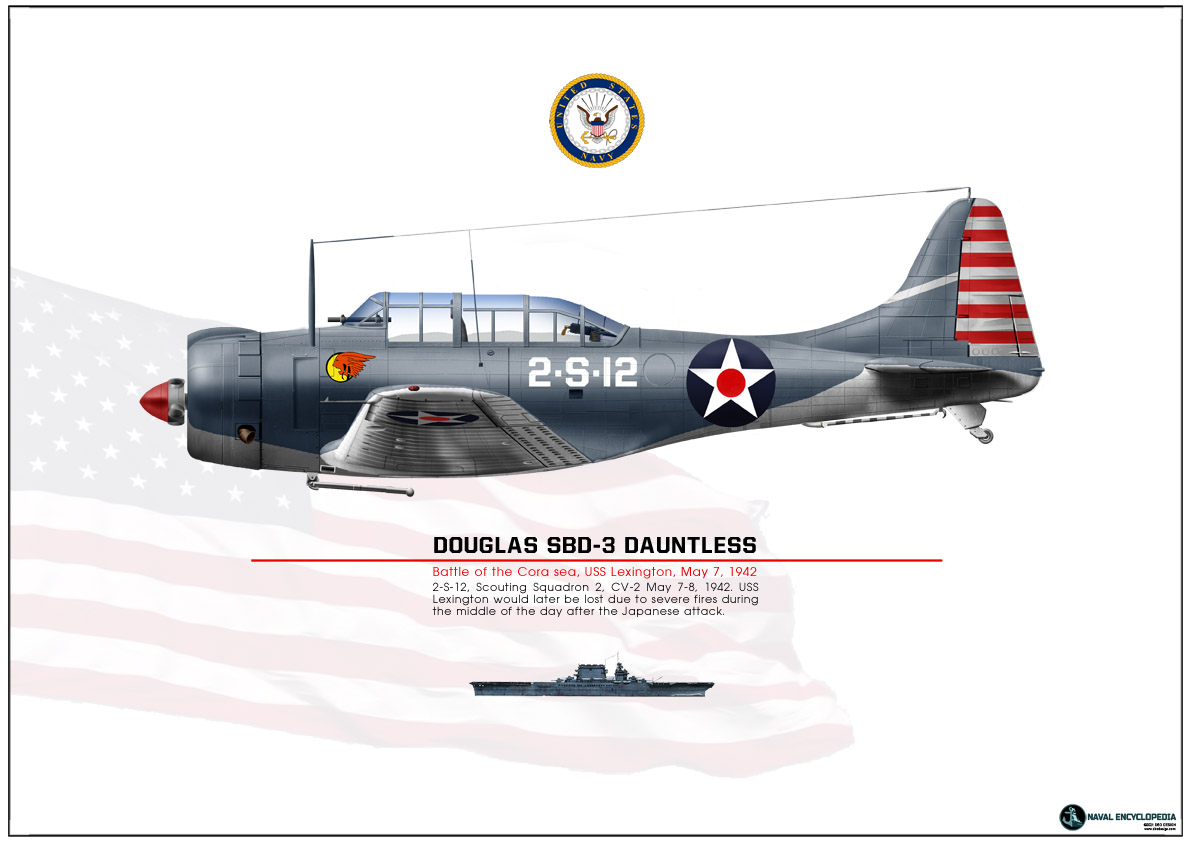
SBD Dauntless Coral Sea
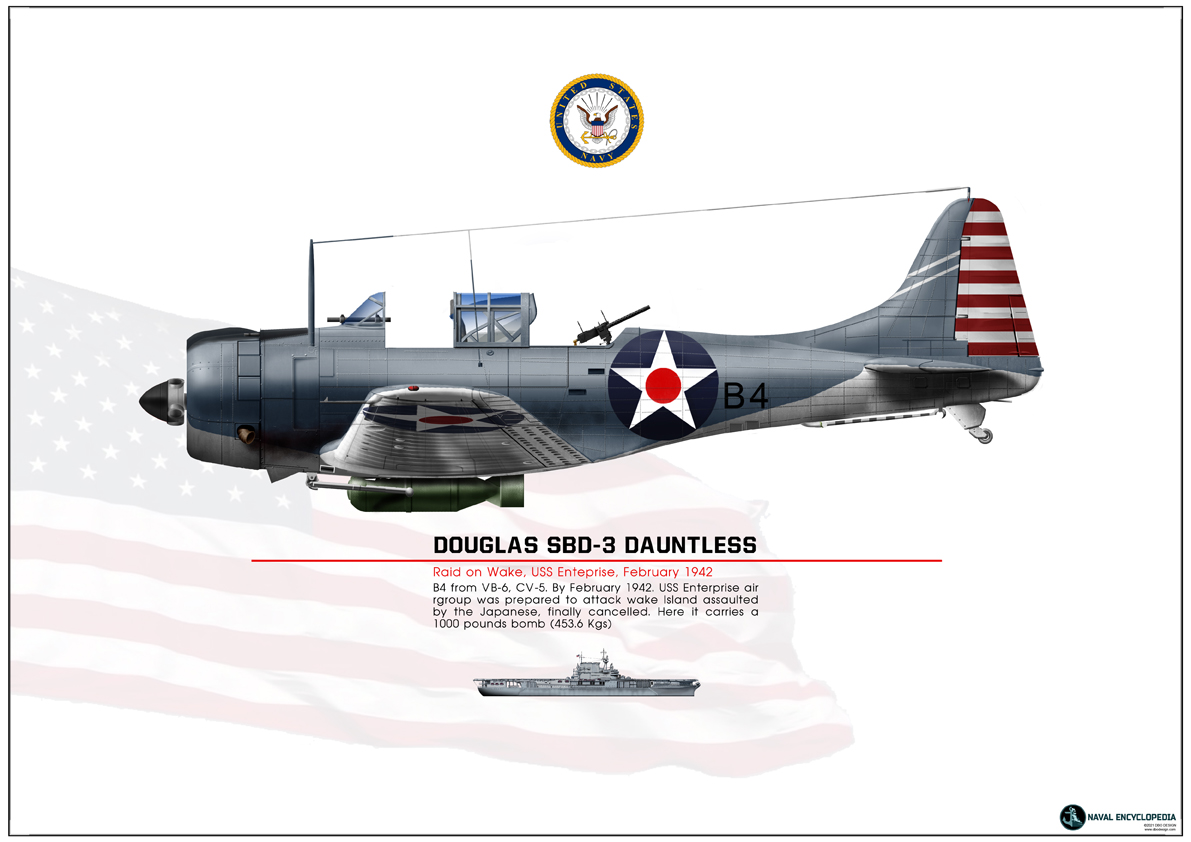
SBD Dauntless USS Enterprise
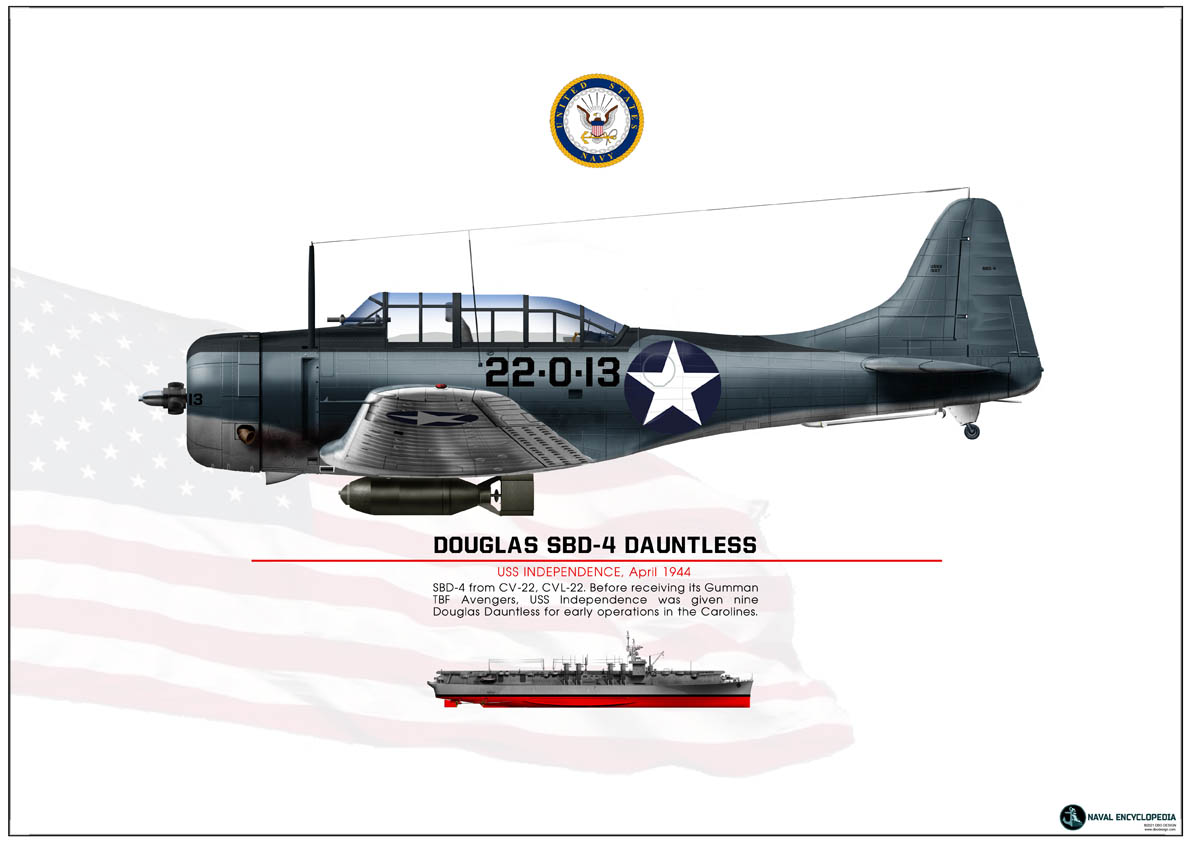
SBD-4 CV22