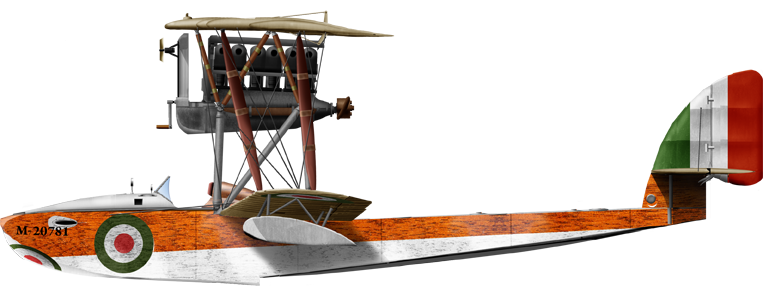
Macchi M7 (1918-30)
 Regia Aeronautica, 100+ built
The last great Macchi seaplane fighter of WWI
The first Italian seaplanes from Macchi were called "Nieuport-Macchi", manufactured in Varese, after captured Austrian Lohner L observation seaplanes. From the L.1 and L.2 came the M.3 single-seat observation biplane in 1916 and performances were remarkable in that category, enough to justify making it a fighter. The end result was the Macchi M.5 from 1917, mass-produced until the end of the war. The M.5 could reach 200 kph, with an high altitude and climb rate, one of very best seaplane fighters of WWI, tested and adopted by the United States Navy and Marine Corps in 1918. In 1918 it completely rused the adriatic skies, and fuelled Macchi further designs, starting with the M.7, a general improvement across the board.Continuous effort to upgrade aircraft capabilities and performance based on ever more powerful engines enabled engineer Alessandro Tonini, who had recently taken up the role of chief designer at Nieuport-Macchi, to propose the adoption of th 250 hp Isotta Fraschini V.6 engine for its new seaplane fighter, tailored to fully exploit the new powerplant. Tonini's design started with the Macchi M.5, but they only shared their appearance, albet sighly more compact. The hull and wing were completly new, and inspired by Hanriot aircraft that the company produced under license. The wing profiles were different as well.
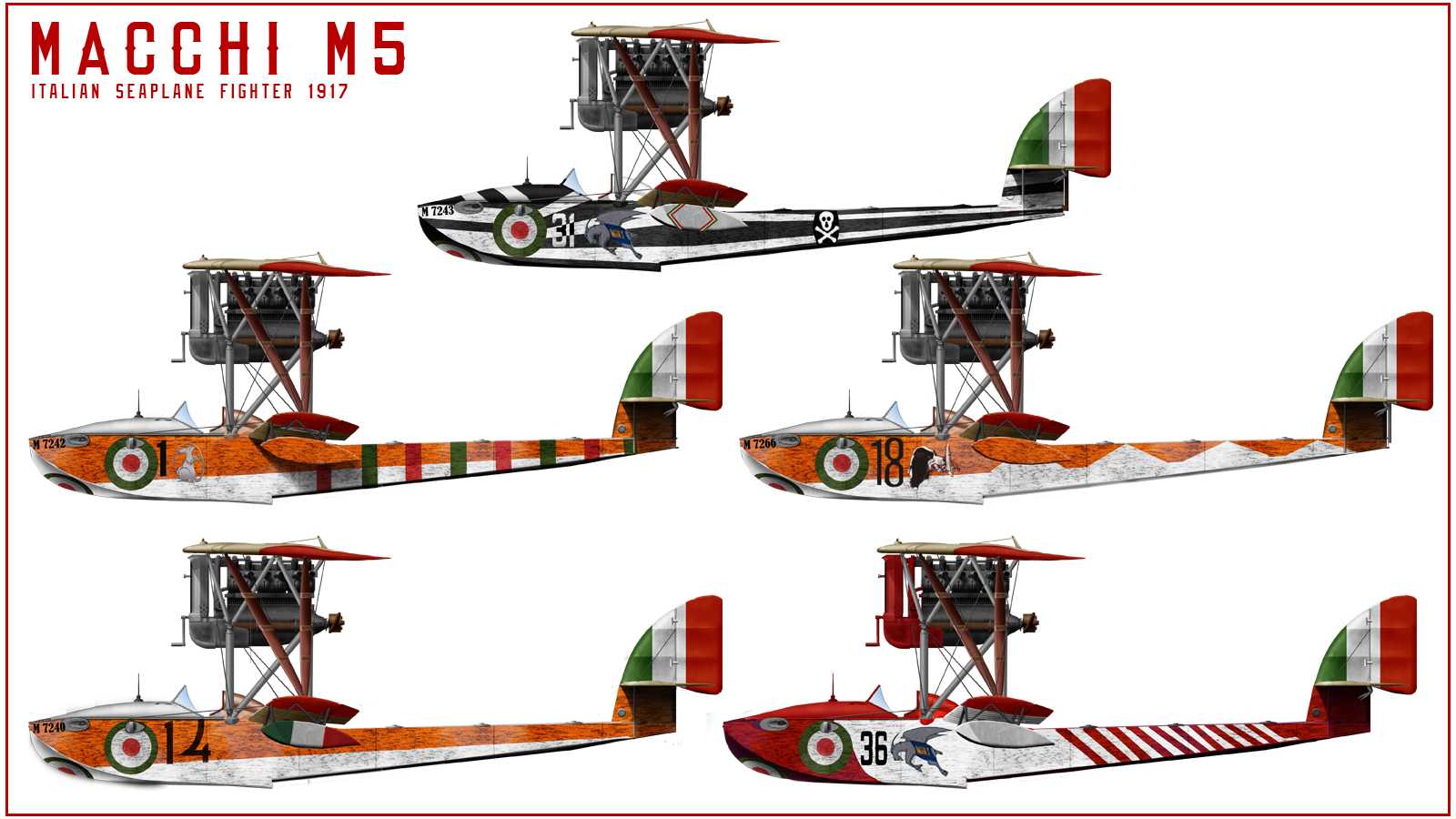
Macchi M5
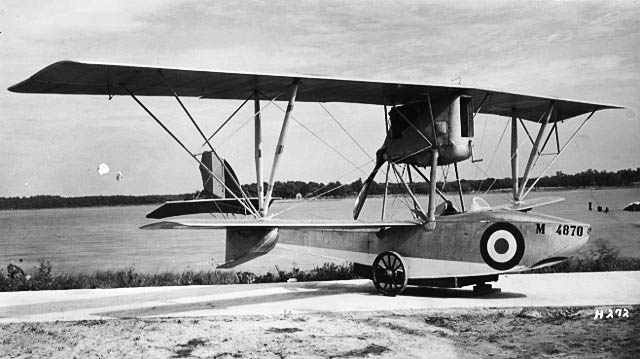
The success of the M3 as fighter in 1917 motivated Nieuport-Macchi engineers to devise a tailored seaplane fighter. This became the Macchi M5, probably one of the world's best seaplane fighter of WWI. The first prototype of the single-seat sesquiplane fighter flew in mid-1917, developed by engineers Buzio and Calzavera. Largely similar to the Macchi M.3, it had a revised tail (Ma) and was futher developed as the M bis and Ma bis. When trying to make it lighter and more powerful, yet with better agility and armament model, this gave birth to the main seaplane fighter of the Aviazione per la Regia Marina during WWI, and a grand total of 244 were produced until the armistice.
Macchi M6
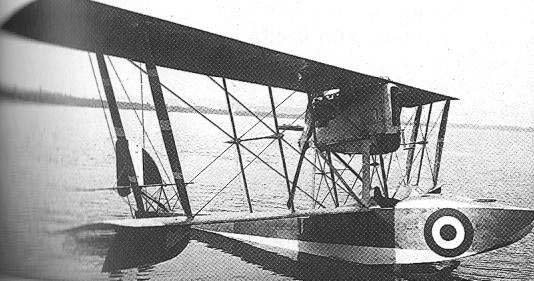
In 1917, Nieuport-Macchi built the M.6, identical to the M.5 in most respects as a single-seat wooden biplane flying boat fighter with plywood and fabric skin, but it was lightened up. It was powered by an Isotta Fraschini V.4B engine rated for 187 hp (139 Kw) on struts above the hull (pusher prop) and cockpit still beneath the radiator, but armed with a single 7.7 mm (0.303-inch) Vickers.
It had however a different wing cellule, more rigid albeit lighter: Interplane Vee struts (to brace the wings or to support the overhanging leading edge of the upper wing) were replaced by parallel steel tube struts. The outermost set of parallel struts were farther outboard and it had additional parallel struts closer to the hull. Comparative trials held against a standard M.5 was to see it provided any advantage over the M.5 and it did not, so that project was abandoned. Instead, Macchi focused on a large, yet lighter model for more range, the M7.
Core Design Principles of the M7
Many design solutions inspired the new design of the M7, and the M6 defined areas of improvements: Its top-speed was sub-par at only 189 km/h (117 mph, 102 kn) for a cruise speed of 152 km/h (94 mph, 82 kn) but the endurance, thanks to large fuel tanks and a more aerodunamic profile overall, was much better at 3 hours versus 2.5 hours for the M5. The choice of a single 7.7-millimeter (0.303-inch) Vickers machine gun was recoignized a bit "light" in aerial combat, when all fighters by late 1917 adopted two MGs as standard. However the structure was very light at 760 kg (1,675 lb) empty, 1,030 kg (2,271 lb) max. at take off. This was a solid base for development, also larger overall than the M5.Alessandro Tonini thus, to improve the M5, decided to take the few successful elements of the M6 and create a larger seaplane than the M5, from 8.08 m (26 ft 6 in) long to 8.15 m (26 ft 8.88 in) on the M6 and back to 8.09 m (26 ft 6.5 in) for the M7, so basically the M7 had the same fuselage. The M5 wingspan of 11.90 m (39 ft 0.5 in) was identical on the M6, but restricted to 9.95 m (32 ft 7.75 in) on the M7, so the engine had to compensate for the loss of sustentation.
The M7 was also heavier than the M5 and M6 to boot at 805 kg (1,775 lb) empty versus 720-760 kgs for the two others. Max take off weight was 1,030 kg (2,271 lb) for the M6 already compared to 990 kg (2,183 lb) of the M5 and reached 1,098 kg (2,421 lb) on the M7 Ter. The basic M7 was probably around 1,050 kgs. Great hopes were placed in its engine. The M5 was powered by an Isotta Fraschini V.4B inline piston engine 119 kW (160 hp), like the M6, but the M7 relied on the new Isotta Fraschini V.6 inline piston engine rather for 194 kW (260 hp), quite a leap in output, ensuring better performances.
The prototype was delivered in July 1918 for tests at the Venice seaplane station. It then started operational trials from November, still assigned to the 260th Squadron. Tests showed it could reach a top speed of 210 km/h, while in straight line, not even diving. This was a world record a the tme for seaplane. This convinced the Regia Marina, via its air corps, to issue a record order for 1,005 of these. However soon the war ended and the order was massively scaled down.
Evolution of the M7
M7 bis
The M7 was so fast it soon appeeared well suite for speed records, and strong enough to perform aerobatic sporting trials, such as in Monaco in 1920, with pilots Zanetti and Morselli. In 1920, Tonini designed the M.7bis, which was a dedicated a racing version of the M.7, in order to participate and win the Schneider Trophy, the major event for seaplanes at the time, but which also soon became THE major even for performance aircraft in general. This also became a newspaper's favorite and PR amplificator for Macchi, Supermarine or Curtiss, always the main contenders.The M.7 was a solid base, on which Tonini developed the bis, which had a lighter structure, further reduced-span wings, no military or naval equipment. Performances rose higher, and thus, five M.7s entered the 1921 competition at Venice. The Italians crushed the competition, won by Giovanni di Briganti, the only one to finish with a recorded average speed of 189.67 km/h. At the August 22 1922 competition at Naples, the M.7bis came in fourth however.
M7 ter
In 1923, a milirary revised variant appeared, partly based on the M.7 bis but with two machine guns and full perational equipment. The M.7ter had a redesigned, bulkier hull forward, revised wing configuration (shorter) and new tail unit. It was manufactured in three different versions like the M.7ter AR, with folding wings to operate from the seaplane-carrier Giuseppe Miraglia. In 1924, six Italian naval squadrons were equipped with the M.7ter and over 100 were built. The aircraft was also used as late as 1940 by civilian flying schools, however it was not a "ww2 aircraft" per se as these models were antiquated and on their last leg. 200 kph in 1940 was hopeless against any opposition.During the First World War, after the m.7 prototype was made and tested, flying its initial tests and delivered to the Venice Seaplane Station, the latter had to be expanded. Originally it had two hangars on the island of Sant'Andrea and Punta Sabbioni. It was kept for operational evaluation until 4 November 1918 as part of the 260th Squadron, and managed to reach 210 km/h or over 113 knots, establishing a world record. This was the fastest seaplane in the world. News reached Rome and soon it was decided to order a symbolic 1,000 of them (1,005 inc. preseries and prototypes). The end of the war cancelled the order, reduced to c70 but delivered at slow pace. With the signing of the Compiègne armistice, deliveries amounted to just three M.7, then seven by February 1919.
Two new versions were developed as seen above, the bis (17, inc. 5 for competition) and three delivered before the end of the war, as well as the ter. The M.7bis featured a concave, monobloc keel. and proved extremely maneuverable, capable of all the current aerobatic maneuvers only land-based aircraft were capable of. The M.7ter was the final and most mature development, and the object of the largest production, a hundred units. Surplus led to sell many M.7 in postwar years as well, which became the first and only seaplane fighters of Brazil, Argentina, Sweden, or Paraguay.
Design
 The M.7 retained the typical appearance of the Macchi seafighters with their central hull configuration, biplane/sesquiplane configuration (shorter lower wing with dihedral, larger upper wing with an angle). The lower wings supported a pair of lower, strutted stabilizing floats. The two upper wings were connected by the central tubular frame in whuch was also mounted the pushed engine, an Isotta Fraschini Asso 200 (Mezzo-Asso) six-cylinder in-line, supported by its own struts. Still the same open cockpit and small sprayscreen. The tailed remained the same, a cruciform, single-fin empennage.
The first M7 of the 1918 series kept he same single-step hull but it was modified later on the M7 ter. The tail still followed the M3 lineage, attached to the fuselage, stenghtened by struts and essentially similar to that of the M5. But the most important change ws the "clipping" made to the wings, with were made shorter, but with a larger surface (the same process happened from the M3 to the M5) and the had even more camber and inclination for better lifting caracteristics at high speeds. The shape and structure was very much inspired from the Macchi M5a bis. But the struts arrangement was the same as in the M6, both in structure and management.
Engine & Perfomances
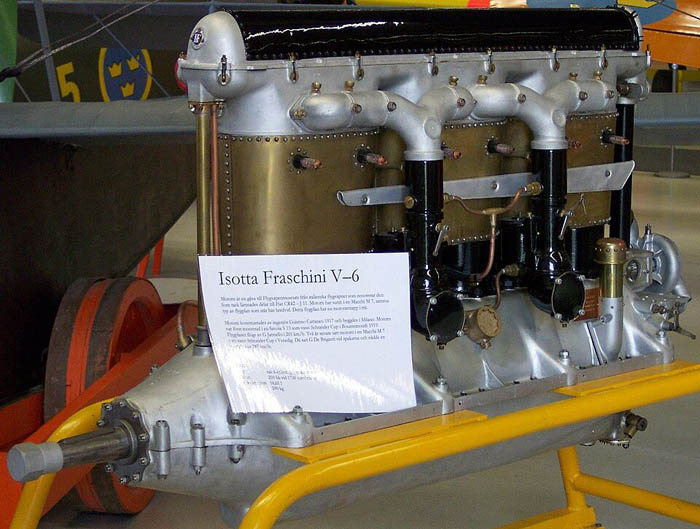
The Isotta Fraschini V.6 was an Italian six-cylinder, water-cooled, in-line piston aero engine. The "V" denoted "Volo" or "flight", and had nothing to do with the cylinder arrangement. Its construction was fairly typical of contemporary aircraft engines, with six cast-iron cylinders in pairs, with common heads. The M7 was likely fitted wth the early V.6 and later retrofitted with the V.6bis. But delivery was limited and it had to compete with the CANT 18, Caproni Ca.4/5/61, Piaggio P.6, Savoia-Marchetti S.57, SIAI S.13/22 already. Bore was 140 mm (5.5 in), stroke 180 mm (7.1 in), for a displacement of 16.6 L (1,013 cu in) and dry weight: 281 kg (619 lb). It was fitted with a Carburettor and was water-cooled. Power output was 186 kW (250 hp) at 1,650 rpm.
Armament:
The Macchi M.5 was designed as a pure fighter and therefore like the M5, and unlike the M6, it was fitted with two Machine guns forward, fixed, and forward-facing: Thes e were .303 British (7.7 mm) Vickers machine guns, a well-known model that needs no introduction. Cartridge bands were provided (around 800 rounds) for both, lodged into the nose. The pilot still could access these in case of a jamming. The M7 ws not fitted to carry bombs, although it might have been in other air forces.Detailed specs
Specs M7 Ter 1919 | |
| Crew: | One pilot |
| Fuselage Lenght | 8.09 m (26 ft 6.5 in) |
| Wingspan | 9.95 m (32 ft 7.8 in) |
| Height | 2.97 m (9 ft 9 in) |
| Empty weight: | 805 kg (1,775 lb) |
| Gross weight: | 1,098 kg (2,421 lb) |
| Powerplant: | Isotta Fraschini V.6 inline piston engine: 194 kW (260 hp) |
| Propellers: | 2-bladed fixed-pitch wooden propeller |
| Maximum speed: | 200 km/h (124 mph, 108 kn) |
| Endurance: | 3 hours |
| Service ceiling: | 7,000 m (23,000 ft) |
| Time to altitude: | 3,000 m (9,843 ft) in 10 minutes |
| Armament | Guns: 2 × 7.7 mm (.303 in) machine guns. |
Exports
Outside the Servizio Aeronautico della Marina poi Forza Aerea della Regia Marina, (a mouhfull for Italian Naval Aviation) mostl used the model ter, as the bis was mostly used for competition, and the initial model was also soon used for training only. Argentina
Used by the Aviación Naval, in research. And roundel in creation.
 Brazil
The model joined the Serviço de Aviação Militar, not the Navy. And roundel in creation.
 Paraguay
Aviación Naval Paraguaya. Number used in research. And roundel in creation.
 Sweden
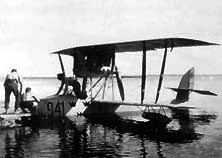 At the end of the First World War, Macchi, intent on securing a supply agreement while the Government just cancelled the main order for 1,000, managed to sign an agreement with the Swedish government. The purchase of the M.7. for Macchi made sense for Seden, as its unique lake-rich terrain would meet the needs of the newly established Marinens Flygväsende (MFV), the air component of the Svenska marinen as well as the Air Force. In the autumn of 1919, a delegation fron Macchi presented a model intended for evaluation with the MFV. It was positive, so Macchi obtained a contract for four, the order being fully fulfilled in 1920. In Sweden, they were assigned to Lake Roxen Base, for operational trials until 1921, to be located afterwards at Boden Fortress (Bodens fästning). However it was not very popular due to tendency to take on water spray during takeoff and landing, leaving crew members icy cold wet. However they performed numerous Training raids over the Baltic Sea.
Macchi M7 n°20781
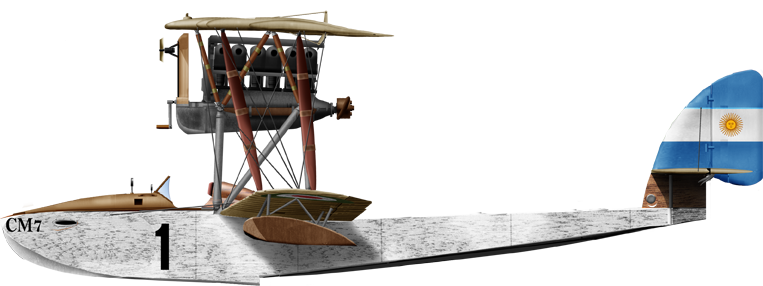
Argentinian M7
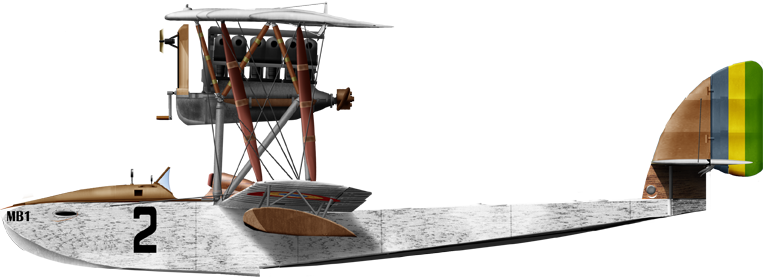
Brazilian M7
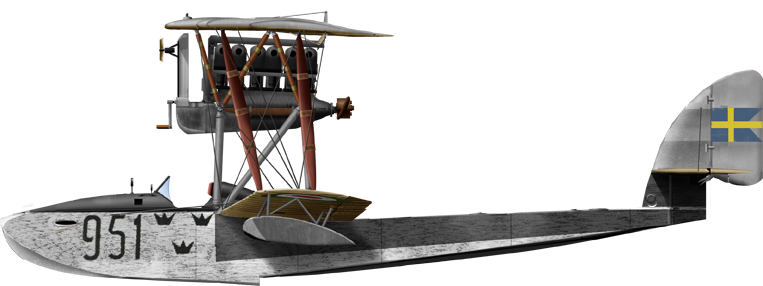
Swedish M7
Next: M7 Ter.
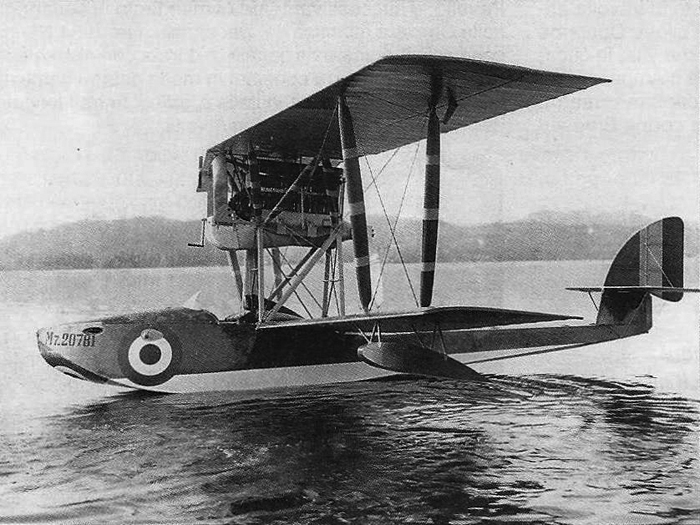
M7 N°20781 of the early batch in Nov.1918
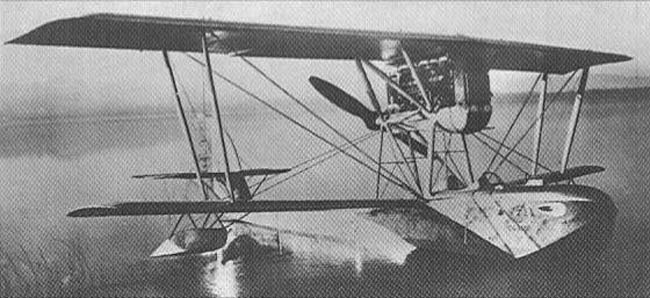
M7 Ter
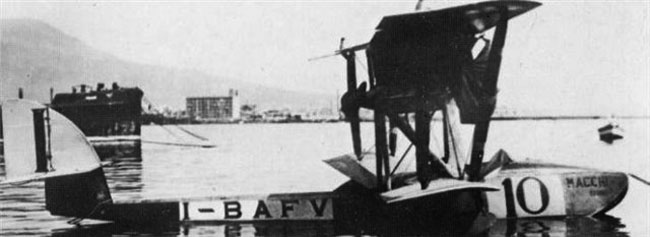
M7 bis Corsa
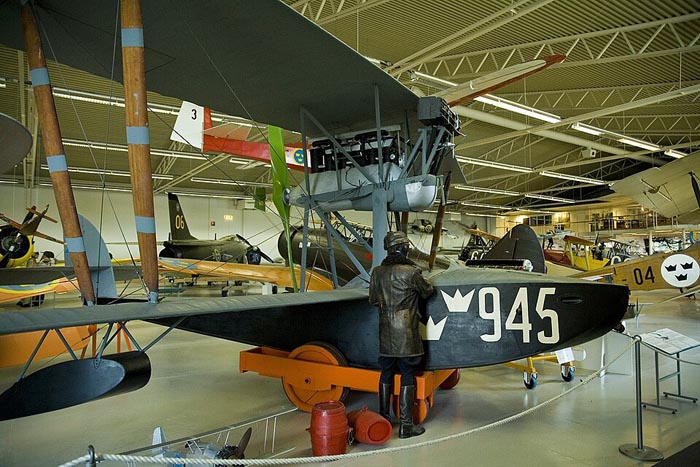
Swedish M7
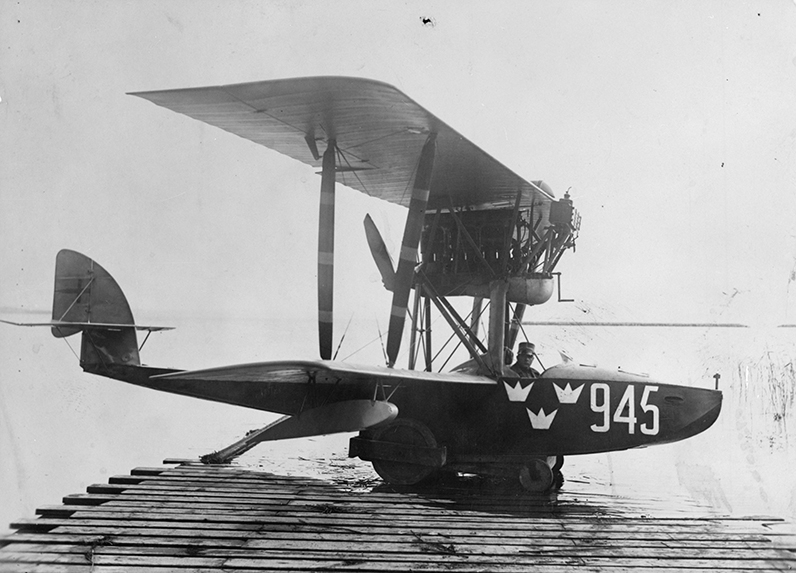
Swedish M7
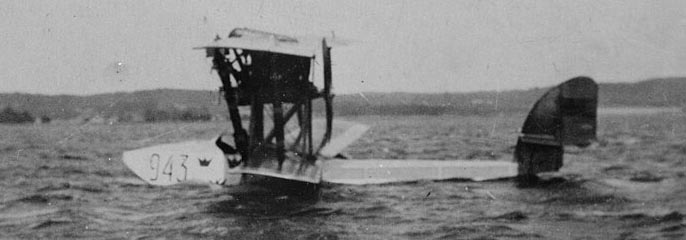
Swedish M7
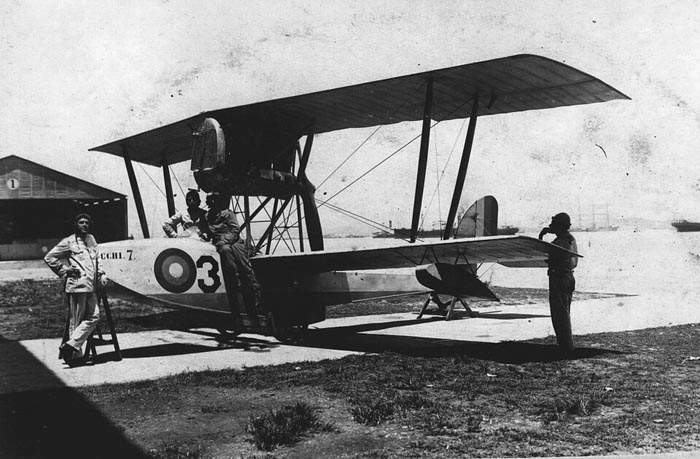
M-7 Aerobote de treinamento Brazil
References

The Illustrated Encyclopedia of Aircraft (Part Work 1982-1985), Orbis Publishing, 1985.
(EN) Michael John H. Taylor, Jane's encyclopedia of aviation, 2ª ed., London, Studio Editions, 1989
I Reparti dell'aviazione italiana nella Grande Guerra, AM Ufficio Storico - Roberto Gentilli e Paolo Varriale, 1999
Gregory Alegi, Il Macchi M.7, in Aeronautica, Nr. 11, Roma, Associazione Arma Aeronautica (AAA), novembre 2012 (Anno LVII)
Marco Gueli, Gli idrovolanti da corsa della Macchi, in Storia Militare, n. 268, Parma, Edizioni Storia Militare June 2016
Windsock Datafile 162, MACCHI M.7
vintageaviationnews.com
en.wikipedia.org
it.wikipedia.org
hydroretro.net
ilfrontedelcielo.it
hyperscale.com
hyperscale.com
stormomagazine.com
airwar.ru
flyingmachines.ru
doz.jp
militaryfactory.com
avrosys.nu
en.wikipedia.org
On scalemates.com
commons.wikimedia.org
- Lohner E (1913)
- Macchi M3 (1916)
- Macchi M5 (1917)
- Macchi M7 (1918)
- Ansaldo ISVA (1918)
- Short S.38 (1912)
- Sopwith Baby (1916)
- Short 184 (1916)
- Fairey Campania (1917)
- Sopwith Cuckoo (1917)
- Felixstowe F.2 (1917)
- Gotha WD.2 (1914)
- Friedrichshafen FF 33 (1916)
- Albatros W4 (1916)
- Albatros W8 (1918)
- Hanriot HD.2
- Grigorovich M5 (1915)
- Grigorovich M9 (1916)
- Grigorovich M11 (1917)
- IJN Farman MF.7
- IJN Yokosho Type Mo
- Yokosho Rogou Kougata (1917)
- Yokosuka Igo-Ko (1920)
- Curtiss N9 (1916)
- Curtiss H4 (1916)
- Curtiss H12 (1917)
- Curtiss H16 (1918)
- Aeromarine 39
- Vought VE-7
- Douglas DT (1921)
- NAF/Curtiss TS-1 (1922)
- Boeing FB.5 (1923)
- Boeing F4B (1928)
- Vought O2U/O3U Corsair (1928)
- Grumman FF (1931)
- Akron class airships (1931)
- Curtiss F9C Sparrowhawk (1931)
- Curtiss F11C Goshawk (1932)
- Curtiss BF2C Goshawk (1933)
- Blackburn Blackburn (1922)
- Supermarine Seagull (1922)
- Fairey Flycatcher (1923)
- Hawker Horsley (1925)
- Blackburn Ripon (1926)
- Fairey IIIF (1927)
- Fairey Seal (1930)
- LGL-32 C.1 (1927)
- Fokker T.II (1921)
- Fokker T.III (1923)
- Caspar U1 (1921)
- Dornier Do J Wal (1922)
- Rohrbach R-III (1924)
- Mitsubishi 1MF (1923)
- Mitsubishi B1M (1923)
- Yokosuka E1Y (1923)
- Nakajima A1N (1927)
- Nakajima E2N (1927)
- Mitsubishi B2M (1929)
- Nakajima A2N (1930)
- Nakajima A4N (1935)
- CANT 18
WW1
✠ K.u.K. Seefliegerkorps:
 Italian Naval Aviation
 RNAS
RNAS
 Marineflieger
 French Naval Aviation
 Russian Naval Aviation
 IJN Air Service
 USA
USA
Interwar
 Interwar US
 Interwar Britain
 Interwar France
 Interwar Netherlands
 Interwar Germany
 Interwar Japan
 Interwar Italy
- Grumman F2F (1933)
- Curtiss SOC seagull (1934)
- Grumman F3F (1935)
- Northrop BT-1 (1935)
- Consolidated PBY Catalina (1935)
- Grumman J2F Duck (1936)
- Brewster/NAF SBN-1 (1936)
- Curtiss SBC Helldiver (1936)
- Vought SB2U Vindicator (1936)
- Brewster F2A Buffalo (1937)
- Douglas TBD Devastator (1937)
- Vought Kingfisher (1938)
- Curtiss SO3C Seamew (1939)
- K-class Blimps (1939)
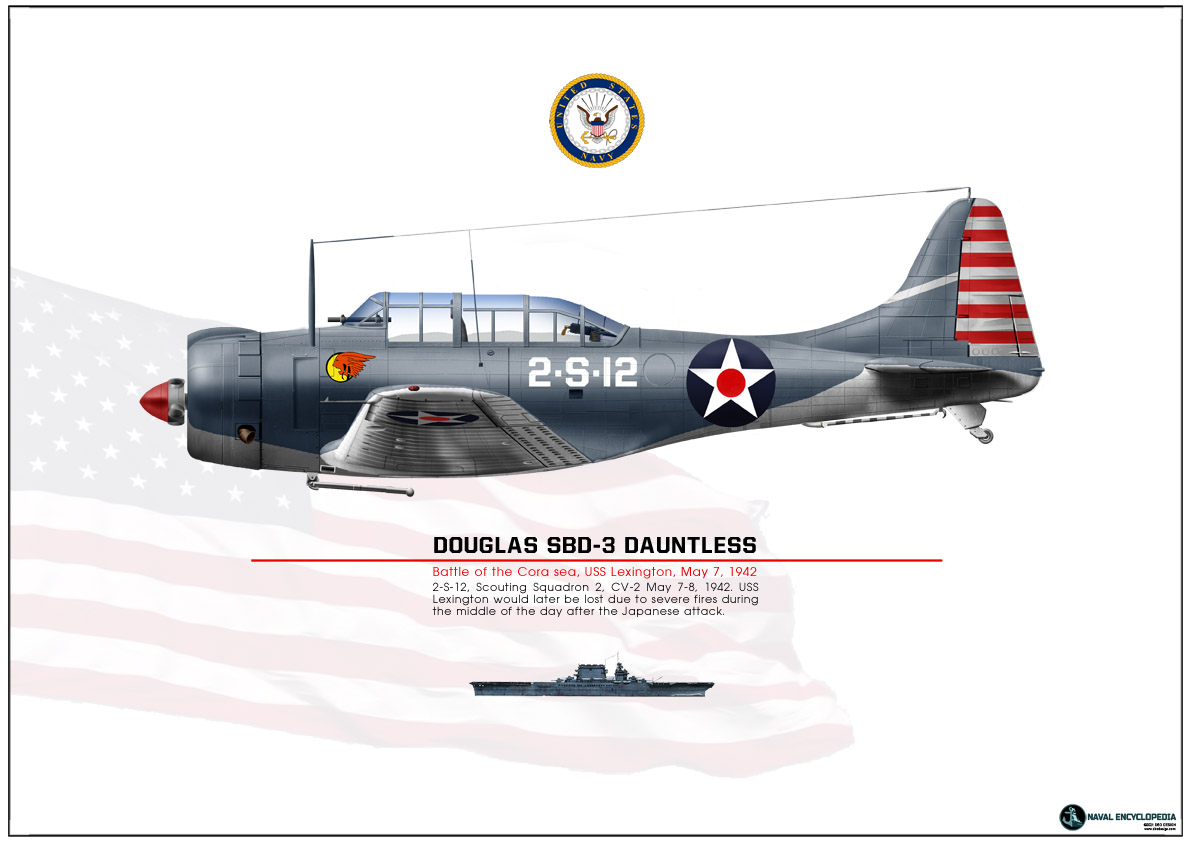
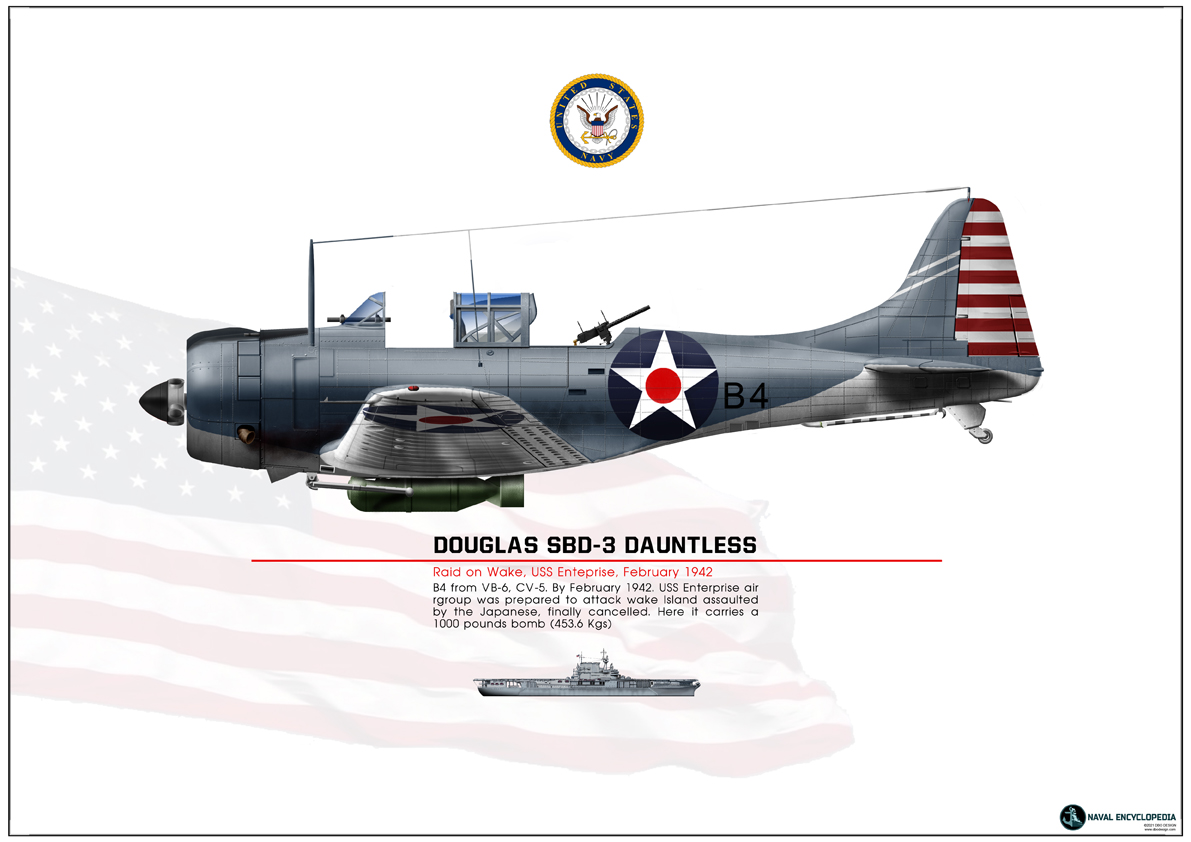
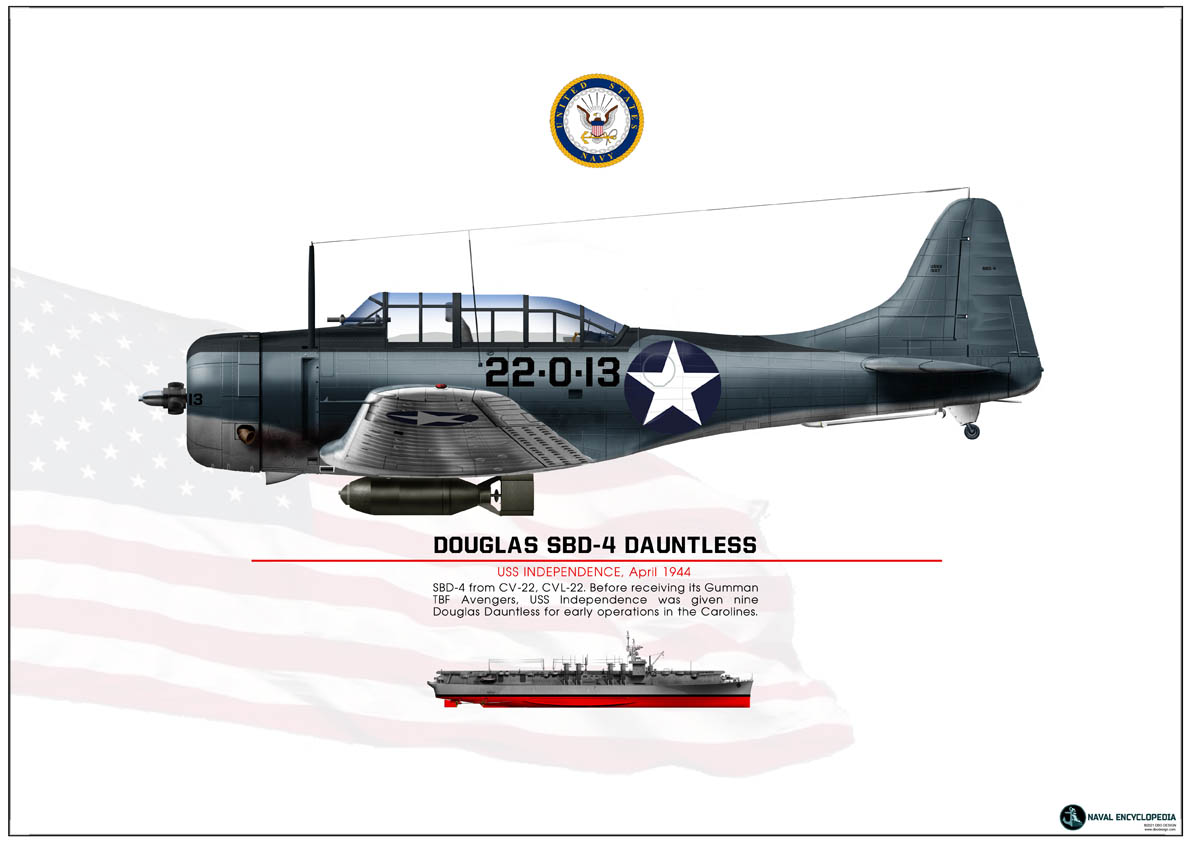
- Douglas SBD Dauntless (1939)
- Grumman F4F Wildcat (1940)
- F4U Corsair (NE) (1940)
- Brewster SB2A Buccaneer (1941)
- Grumman TBF/TBM Avenger (1941)
- Consolidated TBY Sea Wolf (1941)
- Grumman F6F Hellcat (1942)
- Curtiss SB2C Helldiver (1942)
- Curtiss SC Seahawk (1944)
- Grumman F7F Tigercat (1944)
- Grumman F8F Bearcat (1944)
- Ryan FR-1 Fireball (1944)
- Douglas AD-1 Skyraider (1945)
- Fleet Air Arm
- Hawker Osprey (1932)
- Fairey Swordfish (1934)
- Blackburn Shark (1934)
- Supermarine Walrus (1936)
- Fairey Seafox (1936)
- Blackburn Skua (1937)
- Short Sunderland (1937)
- Blackburn Roc (1938)
- Fairey Albacore (1940)
- Fairey Fulmar (1940)
- Grumman Martlet (1941)
- Hawker sea Hurricane (1941)
- Brewster Bermuda (1942)
- Fairey Barracuda (1943)
- Fairey Firefly (1943)
- Grumman Tarpon (1943)
- Grumman Gannet (1943)
- Supermarine seafire (1943)
- Blackburn Firebrand (1944)
- Hawker Sea Fury (1944)
- Coastal Command
- Vickers Wellington (1937)
- IJN aviation
- Yokosuka E6Y (1930)
- Aichi D1A "Susie" (1934)
- Mitsubishi A5M "Claude" (1935)
- Nakajima A4N (1935)
- Yokosuka B4Y "Jean" (1935)
- Mitsubishi G3M "Nell" (1935)
- Nakajima E8N "Dave" (1935)
- Kawanishi E7K "Alf" (1935)
- Nakajima B5N "Kate" (1937)
- Kawanishi H6K "Mavis" (1938)
- Aichi D3A "Val" (1940)
- Mitsubishi G4M "Betty" (1940)
- Mitsubishi A6M "zeke" (1940)
- Nakajima E14Y "Glen" (1941)
- Nakajima B6N "Jill" (1941)
- Mitsubishi F1M "pete" (1941)
- Aichi E13A Reisu "Jake" (1941)
- Kawanishi E15K Shiun "Norm" (1941)
- Nakajima C6N Saiun "Myrt" (1942)
- Yokosuka D4Y "Judy" (1942)
- Kyushu Q1W Tokai "Lorna" (1944)
 Luftwaffe
- Heinkel 114 (1935)
- Arado 196 (1937)
- Me109 T (1938)
- Blohm & Voss 138 Seedrache (1940)
 Italian Aviation
- Savoia-Marchetti S.55
- IMAM Ro.43/44
- CANT Z.501 Gabbiano
- CANT Z.506 Airone
- CANT Z.508
- CANT Z.511
- CANT Z.515
 French Aeronavale
- GL.300 (1926-39)
- CAMS 37 (1926)
- Levasseur PL.5 (1927)
- Potez 452 (1935)
- Loire 210 (1936)
- Loire 130 (1937)
- LN 401 (1938)
 Soviet Naval Aviation
- Shavrov SH-2 (1928)
- Tupolev TB-1P (1931)
- Beriev MBR-2 (1930)
- Tupolev MR-6 (1933)
- Tupolev MTB-1 (1934)
- Beriev Be-2 (1936)
- Polikarpov I16 naval (1936)
- Tupolev MTB-2 (1937)
- Ilyushine DB-3T/TP (1937)
- Beriev Be-4 (1940)
- Swedish Naval Aviation
- SAAB B17S
-
 Skoda Š-328V
  R-XIII Idro
 Fokker C.XI W (1934)
 Rogožarski PVT-H (1938)
WW2
 ☍ USNA
- De Havilland Sea Vixen
- Hawker Sea Hawk
- Supermarine Scimitar
- Blackburn Buccaneer
- Hawker Sea Harrier
- Douglas A4 Skyhawk
- Grumman F9F Panther
- Vought F8 Crusader
- McDonnell-Douglas F-4 Phantom-II
- North Am. A5 Vigilante
- TU-142
- Yak 38 forger
☢ Cold War
✧ NATO
Fleet Air Arm
 US Navy
☭ Warsaw Pact
Merch
Seafire Mark 45; HMS Pretoria Castle
Zeros vs its aversaries
Aichi D3A “Val” Junyo
Mitsubishi A5M poster
F4F wildcat
Macchi M5
SBD Dauntless Coral Sea
SBD Dauntless USS Enterprise
SBD-4 CV22