Akron class Airship Aircraft Carrier (1931)
 US Navy Airships (1931-35), ZRS-4/5, USS Akron, USS Macon

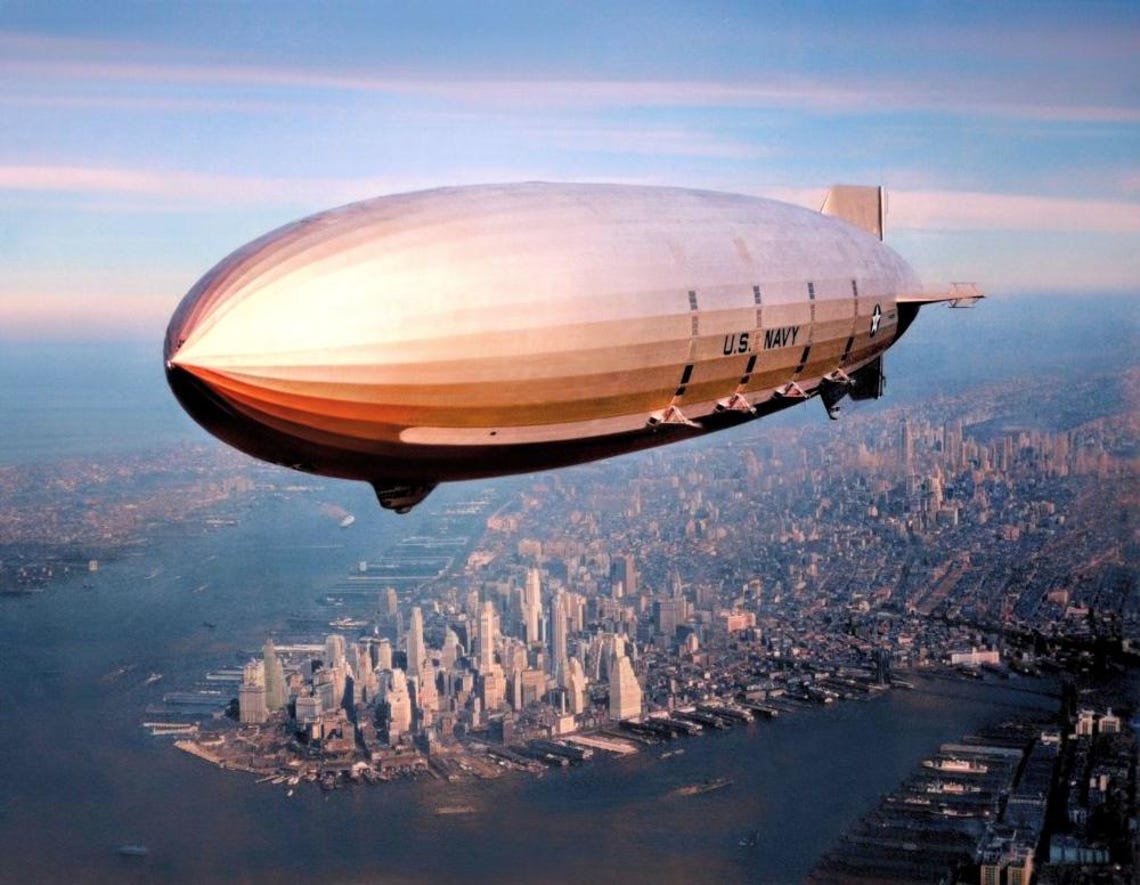
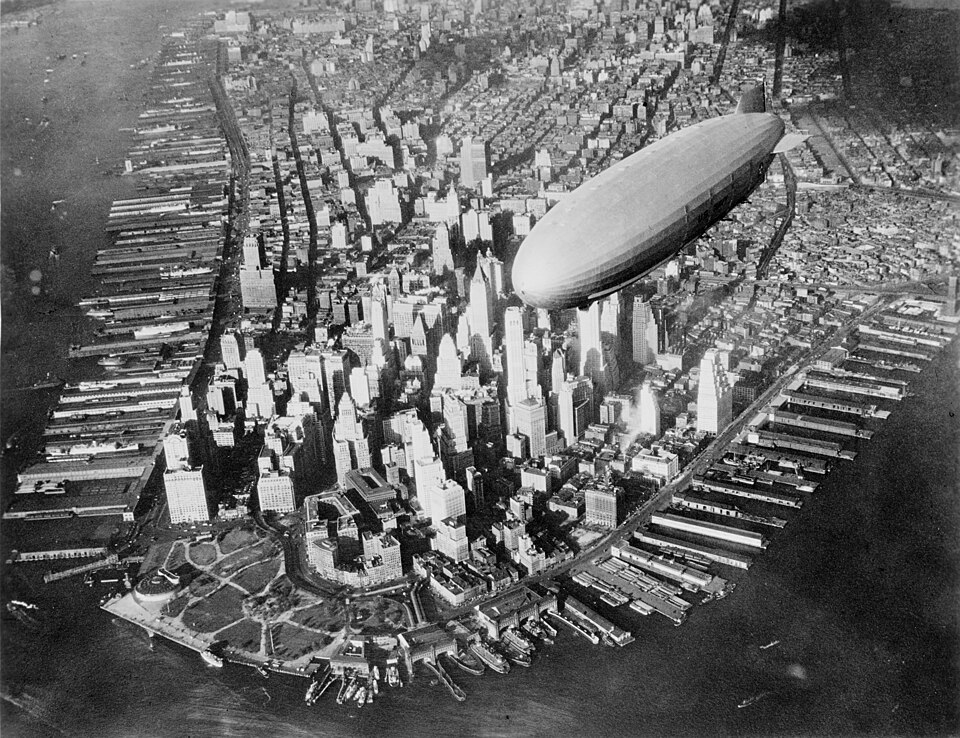
Iconic colorized photo: USS Macon over Manhattan. src pinterest, CC. variant.
Development
The experience of WWI Air War
The idea of a flying aircraft carrier is an old one, so much so that it was barely a decade after the first aircraft carriers were born at the end of WWI, that some proposed to turn the new "dirigibles" or "airships", seeing the kind of air warfare they drew into their own air defence carriers. Back in 1918, Zeppelins used for reconnaissance over the north sea and undrwa for bomb runs over Paris or London had only one protection: Altitude, and the time needed for fighters to climb to it. However as the allies developed new types of incendiary bullets and better, LePrieur style rockets to deal with balloons, it became clear that soon or later, in the interwar or a future conflict given the rapid progrsses in terms of aero engines, already reaching 400 hp and more, airships will not be able to roam the skies with impunity anymore, matched by interceptors that could be meeting them at their altitude on time.Before the advent of radars for example there were already ways to detect approaching aircraft, "big ears" also called directional microphones, whaterve their size and complexity, already allowed trained operators to listen closely and pinpoint the exact location of enemy aircraft by sound alone. Thus a defence could be planned based on this data, and interceptors scrambled to meet their opponents, bombers or airships. Airships had powerful engines but still were the subject of a lot of drag due to their lighter than air structure. Before the Lakehurst catastrophy, they were very much the sexiest concept in the air, largest man-made objects flying, and the object of so much attention for the little number they represented, they became interwar defining cultural icons, still recoignized today.

USS Shenandoah, Nat. Geo 1920.
With their large size, it was envisioned to carry much more than military payloads, ie bombs or depth charges when used over seas. In the interwar new peacetime, Zeppelins that bombed London yesterday now carried passengers in a spartan luxury due to weight saving, but at a price and same amenities that rivalled luxury liners, another icon of their time. Thir military applications were numerous, as their payload was sitll largely superior (several fold) to any bomber of the time, for a speed that was not that far away, and the added bonus to take off and land from anywhere, provided there was equipment to "drop anchor" and be stabilized. For military application, there was the threat of AA fire, fighters... and the weather. Countries developed their own airships, out of national pride, for exploration in some cases, and the Count Ferdinand was happy to oblige, keeping his business alive in the postwar years.

USS Los Angeles (ZR-3) on the deck of USS Saratoga (CV-3) on 28 January 1928. She was by far the Navy's most successful airship.
His skills quickly met the enthusiasm of US military planners, both from the Army Air Corps and of the Navy. Without dviving too deep in the development of US balloon service as it was already treated in depth on the Blimps article, let's say both branches had their own lighter than air park. The US Navy for what we are concerned were interested in the concept of airships postwar, notably for one obvious capacity, or almost limitless reconnaissance. They could roam the Pacific or Atlantic for many hours across greatest distances than any traditional aircraft, apart perhaps flying boats.
 Aside numerous blimps classes, the had its first true USN rigid airship as USS Shenandoah (ZR-1) based on the Zeppelin L-49, built by the NAF (The Navy own Naval Aircraft Factory) completed at NAS Lakehurst. This 680 ft (207.26 m) long airship inflated with helium weighed 36 tons (32,658 kg) with a range of 5,000 mi (4,300 nmi; 8,000 km) at up to 70 mph (61 kn; 110 km/h). On 3 September 1925 over Ohio she broke in two in a severe storm. ZR-2 was next, a Short Brothers, ex-British design, part of the RN R-38 family which was later cancelled, and lost in August 1921. There was also USS Los Angeles (ZR-3) built by Germany as compensation, soon to be the most successful, remaining in service for 7 years, making 330+ flights.

A German Popsi translation of a fantasy Royal Navy Carrier Airship. Note the top flight deck, lift, and secondary forward hook launch system, the two-level hangar and workshop (pinterest) In this depiction, aircraft landed on the top flight deck (which was a potential stability concerns), were retrieved through lifts, to be stored back in the hangar below and launched from trapeze. Date is unclear, but likely in 1932-35 given the style of the aircraft.
However the USN was not done with airship and the size of the USS Los Angeles gave ideas to test for the first time a "parasite fighter" for self-defence. The Navy back in 1926 had the idea of a new type of airship based on the Shenandoah design, but capable each of carrying their own defending squadron.

USS Los Angeles moored on USS Pakota, demonstrating that any airship could be serviced and refuelled anywhere at sea provided there was the right ship, putting forward the idea of a globe-spanning operation.
Genesis of the new Airships
The US Navy already had some knowledge of German airships when in 1917, L 49, was forced down in France after a bombing raid over England, captured virtually undamaged. Allied officers inspected it thoroughly. Next, the US had the idea of obtaining two Zeppelins as part of war reparations. However most were destroyed by their crews in 1919 so as a substitute Germany would build and pay brand new airships to be turned over to the US, then a new one would be built at home. By July 1919, the US Navy placed an order with Naval Aircraft Factory, Philadelphia wich an airship assembled at NAS Lakehurst, New Jersey. It was called FA-1 (Fleet Airship Number 1) and later became ZR-1. However in between the Royal Navy cancelled its own order for four airships from germany and R38 under agreement by October 1919 was resild to the US, and entered service with the USN as ZR-2, completed at Cardington in UK, travelling over the North Sea and making more trials from Howden. However in a test flight by August a structural failure caused her to crash in the Humber Estuary killing all but 5.Still, the US Navy prersisted and had the ZR-1 completed by June 1922 but instead of using hydrogen she would be filled with helium, safer, but very scarce and costly. In fact the US for her purchased most of the world's reserve. ZR-1 was commissioned as USS Shenandoah in October 1923. Meanwhile at Luftschiffbau Zeppelin works LZ 126 was built for the US Navy and became ZR-3, USS Los Angeles when commissioned on November 1924. Again, due to the scarcity of helium, it was agreed she would be filled with the gas already used by Shenandoah for alternative deployments. However the USN had an officer tasked to provide more of the gas. Both Shenandoah and Los Angeles were useful to develop brand new airship tactics with the fleet. The US Navy then formulated the need for two purpose-built, larger airships.
This was a 1924 design from the Bureau of Aeronautics, known as "BuAer Design No. 60". An improvement over the Shenandoah, it became a replacement design after her loss in Ohio by September 1925. A pair of new airships was authorized in June 1926, and Goodyear-Zeppelin Corp. was awarded this contract.
Construction

The construction was set to start by October 1928. The company for them created a brand-new construction and storage hangar, the "Goodyear Airdock" that became in 1929 the largest hangar in history (and still is to this day). Work started then on ZRS-4 as soon as t was completed, as well as ZRS-5. However in between the design changed a lot, and evolved to larger airships tailored to carry their own defensive air group, an idea of the USN linked to progress with aviation and agility, precision of flight.
Akron (ZRS-4) was ordered like her sister on 24 June 1926, "laid down" on 31 October 1929, "launched" on 8 August 1931 and commissioned on 27 October 1931.
Macon (ZRS-5) was laid down next in the same hangar on 1 May 1931, launched on 11 March 1933 and commissioned on 23 June 1933.
The Navy terms meant for "laying down" the first elements of the central, largest sections of the bottom frame were first assembled, the "launch" corresponded to the full wrapping of the structure, partial filling and controlled integrity, ready for full filling. Then the fitting out, was done after full the filling and ne contrils, all the equipments fitted within the nacelled, engines installed and connected, and "air trials" outside the hangar. When the airship's moves, including a high speed test, altitude tests and multiple landings, notably to the NAS airship anchor mast were all performed she was certified, and then officially commissioned in a ceremony. By that stage when USS Macon was commissioned in June 1933, her sister had been unfortunately lost on 4 April off the coast of New Jersey. So the USN still by that stage only had two airships in service, USS Los Angeles and USS Macon. And it was not for long. USS Macon was lost off California on February 1935 (see service).

Design of the Akron class

 There was an inherent risk to award that construction to a "relatively inexperienced" builder as Goodyear-Zeppelin previously worked on flexible balloons, but its association with Zeppelin was recent and the scale and complexity of the new airships was only mirrored on the other side of the Atlantic by the famous LZ 128 Hindenburg, the largest passenger-carrying airship in history, when construction started in 1931. But she was only completed in 1936 and also had an abysmal carrer, being lost in May 1937, a year after her start. Still in between the terrible crash at Lakehurst she flew 63 times over the Atlantic, creating a real competition to liners.
The two Akron class were the first and last large rigid airships designed and built in the US. Goodyear-Zeppelin partnered with Luftschiffbau Zeppelin and German experts went to the US to train employees of Goodyear in airship construction. Luftschiffbau Zeppelin's Chief Stress Engineer Karl Arnstein, also went to the US to further develop designs and techniques nut incidentally this led to many new design ideas for LZ 128 Hindenburg as well, albeit both teams were led by different chief engineers, which came with different solutions. So in no way sould be described the two USN airships as "military versions of the Hindenburg".The US airships were recoignized indeed to used less conservative methods than those employed by chief designer Ludwig Dürr back in Germany, and they were more advanced in many ways despite being started a bit earlier.
General layout
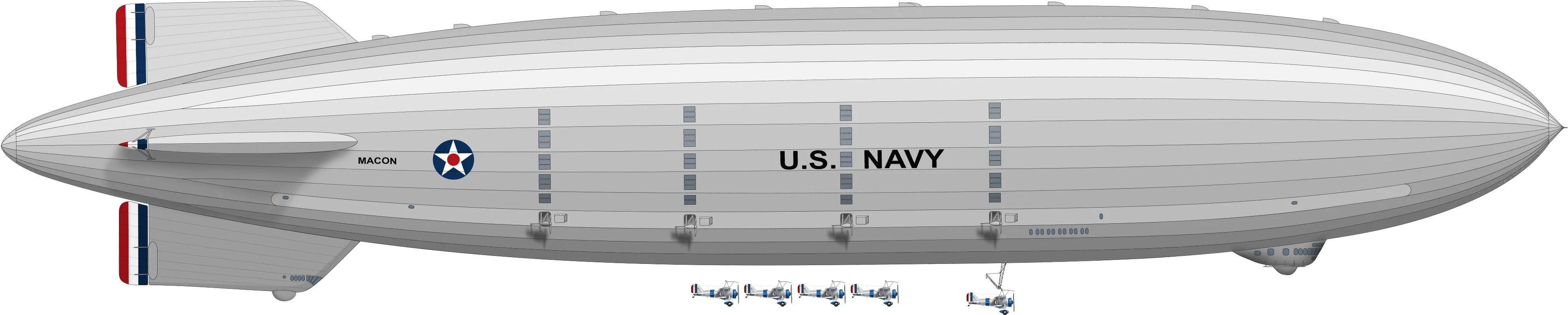
USS Macon with her air group, scr Reddit with some mods.
The main structure indeed called for deep rings and a triple keel, like in a ship. If traditional zeppelins all had main rings made most of the time by a single reinforced girder, there were also unreinforced rings still providing shape but not structural strength in between. Arnstein proposed Goodyear to have the main rings composed of two rings connected by triangular supports all around the circumference. Called "deep rings" they used aviation-king material, duraluminum, and they were spaced further apart as they offered on paper greater strength.
The US Navy accepted this framework to be heavier. Also for extra rigidity, instead of a single structural keel on the underside Arnstein's design three triangular shaped keels. This was notably to provide access to the valves of the gas cells for the central keel. The other two were placed at 45° angles on each side of the bottom to support the engine compartments and crew spaces. This also was pretty unique for the time.
As for the gas cells, they would be filled again with helium rather than hydrogen. She was kept aloft indeed by 12 helium-filled gas cells made from gelatin-latex fabric. The engine compartments would be installed within the hull and not in the usual external power cars. This enabled easier access and reduced drag but might caused both issues of cooling and risks linked to a flameout. But having them grouped inside allowed to anchor the weight centrally and below, making for an excellent stability. There were twelve gas cells made of gelatin-latex fabric. Each housed 541,660 ft3 (15,338 m3) of helium.
Engine and performances

The airship and their massive drag needed no less than eight Maybach VL-2 12-cyl. gasoline-powered engines, the same type used on Zeppelins. Each was rated for 560 hp (418 kW). Their propeller shafts thay could be retracted along with the propellers inside for protection and maintenance while un flight. They emerged externally and their gearbox allowed forward and reverse thrust, even downward thrust for landing and take off. While being rotated this offered "thrust vectoring" for finer control. This was very advanced for the time, an ancestor of modern VTOL propulsion found on the V-22 Osprey. One compromise in the remote placement of the engines, straight line instead of different heights along the length of the hull allowed each to run in relatively "clean" air. It was proposed to stagger their placement but the structure reinforcements proved too heavy and complex to manage.
USS Akron with these engines had 18 ft (5.5 m) two-bladed, fixed-pitch wooden propellers. By June 1932, this was changed for new and more effcetive all metal three-bladed, variable pitch models of the Hamilton type. They were fitted on USS Macon while under construction, and proved their better fuel efficiency. There were also many design improvements to eliminate hull protrusions (and other aerodynamic reifnements, reduction of the overall dead weight by 4 short tons (3,600 kg). This led in the end to reach a top speed of 75.6 knots (140 km/h; 87 mph) in speed trials in August 1933, 3 knots faster than the Navy specifications, 6 knots faster than USS Akron (69 knots (79 mph; 128 km/h) on speed trials).
The advantage of such speed, was to add a margin of safety for the Sparrohawk pilot, well clear of their stalling speed. In operations, many dosages of speed were made to test the ideal cruise for both aircraft. Indeed at full speed, both airships created a lot of turbulences, not ideal to "dock" for the pilots, dangerously close to a massive mass in flight, with a possible venturi effect. Fortunately these pilots were well trained on a dedicated aircraft (see below) and no accidents occured while in flight. There was also a ballast system to keep balance at all times with the possible changes over time (ex. all aircraft sent and fuel partly exhausted) to condense out water vapor from the engine exhaust gases. They worked as a buoyancy compensation ballast.
Armament
Although the airship was to be defended by its own air group, it was not unarmed: There were eight .30-cal. M1919 Browning LMGs placed at several points to defend all angles across the airship: Placed in the nose, dorsal, ventral, and tail areas for 360-degree coverage. They were accesses via internal walkways below the cells.Air Group

After the loss of both airship, the world's largest hangar, still the property of the USN, showing an impressive array of squadrons. Some suggested to add extra levels inside to house far of aircraft. Hangar One (Moffett Federal Airfield) still exist today, preserved as a national monument and largest freestanding structure for 8 acres (32,000 m2; 3.2 ha) surface now part of NASA Ames Research Center. It was restored from December 2025 to March 2026.
For a size of 785 feet or 239 m, a few feet difference with the shorter and contemporary USS Ranger (CV-4) at 769 ft (234.4 m), they carried five trapeze-hooked "parasite fighters" for defence, versus 86 on USS Ranger. The lighter than the air law made this title of "airship carrier", contraction for "airship aircraft carrier" was a bit of a stretch. Probably in part because her own air group was used for reconnaissance or for self defence. The "CAP" or "Carrier Air Patrol" was a well known concept for naval aviation, in short a single fighter group retained at all times in rotation to defend the carrier. However in the case of USS Akron and Macon, this small group of four active, two spares, enabled to have at least two fighters deployed to scout ahead for the fleet, at all times, rotated by the two others which meanwhile went into maintenance and refuelling.
In her case, that air group reduced to just four at best could deploye three at the same time, provided the last one was in maintenance or repairs. As a reconnaissance asset fort the fleet, these airships could indeed fend off the air at 75.6 knots (140.0 km/h; 87.0 mph) when a fleet carrier of that time could do at best 33 knots for a reduced run and 20 knots on average, so almost 1/3 slower. So the doctrine was for these airships to venture out of the battle group and send two of three fighters with a radio to scout in several direction ahead of the fleet at all times. Their radio set was just powerful enough to communicate to the airship, using in turn a much more powerful set, forwarding the information to the fleet's flagship. Or at least this was the theory.
The Hangar
 Her hangar was only 75 ft long, 60 ft wide and 16-foot high (22.9 m × 18.3 m × 4.9 m), it was too small to contain anything else. The hangar was also way too small as well to accomodate an aircraft large and powerful enough to carry a torpedo. So this tiny air group was nothing more by a "plus". In that hangar, the aircraft were hooked under a gantry with a chariot, at the point of balance in the upper wing hook system. There was a floor underneath for the mechanics to maintain it and the ceiling gimble also enabled to lift off an engine for full maintenance, repair or replacement. There was also a small workshop behind. The location of the four spare aircraft formed a "cross" around the large opening below also shaped as a cross for the wing, and with enough space for the trapeze to be folded back if needed. A fifth aircraft was suspended under this trapeze ready to depart. Like the whole structure, the trapeze was made in aluminium and duralumin with a lattice frame. In USS Akron however, structural girders obstructed the two rearmost hangars, so it could not accommodate more than three aircraft when first commissioned. Plans to modify the supports never took place as the airship was lost in 1933.
The Trapeze
 The Trapzer system was quintessential to the way these parasite aicraft could be recovered or released. At first, each aircraft was hung from a trapeze inside the airship's internal hangar, more of less shaped like a square area. The trapeze was lowered beneath the airship, the pilot started the engine and released the hook, and recovered after a short free fall, less dangerous than from a classic aircraft carrier thanks to the altitude. Once its mission was completed, the pilot approached underneath the airship, and managed to engage its hook arm above the upper wing onto the trapeze. Margins were wide, but the pilot had to fight massive turbulence under the airship's belly. Once hooked it was lifted back into the hangar.
The most used model for these techniques, with a model really tauilored for this was the Sparrowhawk. Its most valuable mission was long-range reconnaissance despite being a fighter. It greatly extended the scouting radius, searching vast ocean areas beyond the horizon. Later aircraft even had their wheeled landing gear replaced by an auxiliary fuel tank to increase endurance, the weak point of this design. However it was argued that a fighter could be still useful to defend the airship against enemy attacks, far more than a tailored reconnaissance aircraft. Plus its small size was another advantage for the hangar. See more on reddit.

The Aircraft
Consolidated/NAF N2Y

The Consolidated N2Y-1 was not a combat aircraft like the F9C Sparrowhawk but a two-seat trainer and utility aircraft developed for airships flight operations. They were unarmed, slow, but trained future Sparrowhawk pilots. The base model derived from the civilian Fleet Model 1/2 "Husky Junior" biplane. In 1930 the U.S. Navy ordered six to be modified with a skyhook mounted above the upper wing to engage the trapeze of USS Akron and USS Macon. Powered by a Kinner K-5 radial 115 hp it was capable of 108 mph (174 km/h) for an empty weight of 1,051 lb (477 kg). More at ease with its greater sustentation and lower speed for these recovery operations than the later Sparrowhawk, it first flew on 3–4 May 1932, the first to repeatedly demonstrate launch and recovery operatons from USS Akron and validating the trapeze concept.
Based on detail modifications the better designed hook and suspension system was refined for the Curtiss F9C Sparrowhawk. Only after mastering procedures with this model with an instructor, the pilots transitioned to the single-seat F9C fighter. The N2Y also acted as the airship's utility aircraft if carried onboard, often as the fifth aircraft. It transported personnel, messages, small cargo between the airship and naval bases, acting as "running boats". It was also the practical workhorse for the airship squadrons. In 1930–1932 they were Assigned to USS Los Angeles (ZR-3) and USS Akron (ZRS-4) and resumed operations after 1933 on USS Macon (ZRS-5) until 1935. Surviving ones remained used as utility aircraft with conventional fleet units, including aircraft carriers. Today there is one preserved at the National Naval Aviation Museum in Pensacola, Florida.
F9C Sparrowhawk
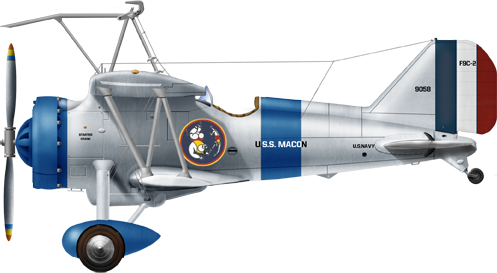
The F9C Sparrowhawk was a parasite fighter, small and provided with an upper wing hook, suspended stowage and release system to be carried, launched, and recovered in flight by the USS Macon and Akron. It first flew on 12 February 1931 and was produced in small numbers with a Wright R-975 Whirlwind radial engine and armed with two .30 calibre Browning MGs in the nose. Top speed was c280 km/h (175 mph) and it was at the limit of airworthiness at the speed to which the two airships evolved to be recovered.
The flying trapeze system was everything in its use and lessons taken with the NAF N2Y were taken in account in the F9C design. In some case, since the aircraft on paper did not needed an undercarriage, as it could stay suspended by its hook system at all time, the wheeltrain could be replaced by an external fuel doubling its range.
After Akron was lost in a storm in April 1933, the surviving Sparrowhawks were transferred to USS Macon and they took part in fleet exercises and scouting missions until her own loss in February 1935. Four went down with her, leaving the few extra spare aircraft in storage. It became the only parasite fighter reaching genuine operational service. The latter McDonnell XF-85 Goblin fof example was kept at prototype stage. One surviving Sparrowhawk is now at the Smithsonian National Air and Space Museum.
The Spy Basket
 The spy Basket was sessentially an observation post profiled as an airborne fuel tank. Thus small, aerodynamic gondola was suspended from the ship by a 3,000-foot (910 m) line, allowing observation of any enemy formation while remaining hidden within cloud cover. The basket could also be used as a lift to retrieve downed pilots, albeit it was never done in exercises. The grave pendulum issue observed when first tested on USS Akron, cancelled further use for good. It disappeared with Akron and Macon had none.
⚙ Akron class specs. | |
| Gross Weight | 403,000 lb (182,798 kg) |
| Volume | 6,500,000 cu ft (180,000 m3) |
| Length | 785 ft (239 m) |
| Height | 146.5 ft (44.7 m) |
| Diameter | 132 ft 11 in (40 m) |
| Engines | 8× Maybach VL II V12 560 hp (420 kW) |
| Top Speed, sea level | 73 kn (84 mph, 135 km/h) |
| Cruise Speed | 43 kn (50 mph, 80 km/h) |
| Range | 9,190 nmi (10,580 mi, 17,030 km) at 50 miles per hour (80 km/h) |
| Ceiling | 19,200 feet (5,852 meters) |
| Armament | 8x .30-cal. M1919 Browning LMGs |
| Air Group | 4x F9C Sparrowhawk (+1 spare), see notes |
| Crew | 60 |
Operational History
 The primary role of both airship was long-range reconnaissance for the fleet. Their advantage over ship-based observation seaplanes was that the latter had a limited range and ceiling, whereas an airships as large as these, could make 9,190 nmi (10,580 mi, 17,030 km) at 50 miles per hour (80 km/h). That range rivalled and even bested the ships they worked for. A Tennessee class battleship for example, typical of the battle fleet, could only reach 8,000 nmi (15,000 km; 9,200 mi) at 10 knots (19 km/h; 12 mph).
So long before satellites, these two airships gave the USN an unprecedented long range and endurance, patrolling far beyond visual range. This was especially useful in the Pacific, with its great expanses between US strong points like the Californian coast, Alaska, Guam, Midway and Hawaii. It must be recalled that the Kido Butai that attacked Pearl Habrour in 1941 was looked for by ships and seaplaned but went through anyway. Thanks to the presence of extra parasite aircraft onboard, this on paper triple the reconnaissance range of an airship with a patrol area demultiplied by the range of the Sparrohawk, 297 mi (478 km, 258 nmi).
However, discussions went on as seen above on how to best use the embarked air group. The Navy at first wanted a close fighter protection with the airship itself providing the scouting right over the enemy. That led to the development of the Curtiss F9C Sparrowhawk, a small biplane parasite fighter best suited for close defense indeed, not for reconnaissance. But exercises by 1933 and 1934 showed how much the airship was vulnerable to enemy carrier fighters and shipborne AA fire as well, making progresses. An officers faction led by Charles E. Rosendahl (CO of Los Angeles and Akron) argued they still could be used for scouting themselves, a tactical evolution applied on USS Akron and then Macon. The Sparrowhawk traded for this their landing carriage for an external fuel tank for 30 US gallons and obtained a RDF equipment (radio set) of longer range. They were supposed to push their own 200 miles circles from the ship in either direction.
At some point the Fleet N2Y-1 two-seat trainer and utility aircraft carrying VIPs and officers frolm bnaval bases to the airship in flight could also operate as a 5th utility aicraft in the air group. But by 1934, USS Macon started to used instead more modern, modified Waco UBF two-seaters, called by the Navy XJW-1. Two airships also for the Navy meant at first, one for each coast, with facilities at NAS Sunnyvale and later NAS Moffett Field in California for the West Coast and NAS Lakehurst in New Jersey for the east Coast.
This both airships never operated together. It was theorized that if a war was ro break out on either coast, both would be reunited. USS Akron in addition was lost just over three weeks after the launch of USS Macon. The cost of $7.825 million (equivalent to $142 million in 2025) or $5.375 million for Akron and $2.45 million exploitation for Macon between 1929 and 1933 made them among the costiest "ships" in the Navy between the helium filling (costiest gas on earth at the time) and their massive amount of duralumin use.
USS Akron ZRS-4 (1931)
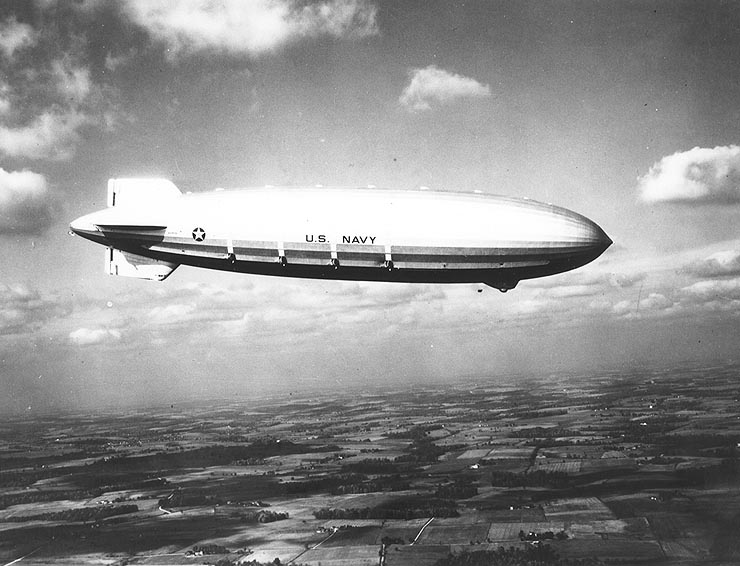
USS Akron's launch, after a construction started in November 1929, was a national-side very public affair on 8 August 1931. USS Akron was launched, meaning floated free of the hangar floor after being fully filled, and christened by Lou Henry Hoover, First Lady. Her maiden flight took place around Cleveland on next 23 September. Secretary of the Navy Adams and Rear Admiral Moffett were on board. In all she performed 10 trial flights, notably a 2,000-mile (3,200 km) journey over 48 hours to St. Louis, Chicago, and Milwaukee. On 21 October, she left for her final east coast deployment base at Lakehurst Naval Air Station (NAS). Her O was Commander Charles E. Rosendahl, already experienced with USS Los Angeles. On Navy Day, 27 October 1931, she was officially commissioned for the Navy, having completed all its qualifications flights, but no airborne parasite aircraft trials yet.
She made, like any USN ships, her shakedown cruiser from 2 November 1931, to the south along the eastern seaboard, down to Washington, DC. On 3 November, landed and then took 207 passengers to demonstrate their capability in emergency high-speed airlift of troops, like US Marines. She also passed the 300 hours aloft mark, and made a 46-hour endurance flight to Mobile, Alabama and back, via the valleys of the Mississippi and Ohio Rivers at lower altitude to also test that capability. But the Navy still wanted to "play" with this new toy and its old ones, and on the morning of 9 January 1932, she left Lakehurst to join the Atlantic Fleet Scouting force on a search exercise, a good demonstration of her reconnaissance capabilities. She flew to the coast of North Carolina, before headeing across the Atlantic to locate "red" destroyers, bound for Guantánamo Bay.
As planned they were located and shadowed until they reach destination, reporting all their movements. On 10 January, she went on but had to be content with bad weather and headed toward the Bahamas, then northwesterly bynight, changed course to the southeast and at 09:08 on 11 January she spotted again USS Raleigh and 12 destroyers and a second group of destroyers. The whole exercise was a "qualified success". It was argued that it could have been even better with her own radio detection-finding equipment on board and scout planes, still not operational. She tracked this fleet over more than 3,000 mi (4,800 km)n a performance juged remarkable, far superior to any aicraft in existence at the time.
Later, USS Akron was mobilized for the more "serious stuff", by planning to take part in Fleet Problem XIII. However she had an accident at Lakehurst on 22 February 1932 when taken from her hangar, her tail came lost moorings and the wind blew her to the ground. The lower fin needed repair as well as ground-handling fittings. She was not operational before the spring making a fight on 28 April with Rear Admiral Moffett and SecNav Adams aboard. To prevent more tail damaged a turntable with walking beam on tracks, using the same system as electric mine locomotives was installed s that she could be exctracted from her smaller hangar at Lakehurst. Next she tested her spy basket, with sandbags aboard, but it oscillated so violently it started to act as a spinner for the whole airship and had to be pulled back in emergency lest the cable was cut off. A some point her balancing was almost as high as her mothership. Albeit a ventral stabilizing fin was added it was never used again.
However so far their flying aircraft carrier capacity had not been demonstrated. On 3 May 1932, USS Akron over the coast of New Jersey, with Rear Admiral George C. Day as well as the Board of Inspection and Survey on board tested the trapeze, a first was performed by a Consolidated N2Y trainer and the prototype Curtiss XF9C-1 Sparrowhawk bot piulot from the ground up to the airship and back by Lieutenant D. Ward Harrigan and Lieutenant Howard L. Young. Both at first made only trapeze hops and releases, then full recovery and re-launches. Both pilots started to write the book on never tested techniques. The next day this was assisted by the House Committee on Naval Affairs. Later qualified, USS Akron left Lakehurst on 8 May for the West Coast via the eastern seaboard to Georgia, across the southern Gulf Coast, over Texas and Arizona but while underway to Sunnyvale, California, she arrived at Camp Kearny in San Diego on 11 May to test a free mooring attempt. However unlike east coast condiditons, here the helium gas had been warmed by sunlight so she had excess lift in addition to be lightened by 40 short tons after her initial trip.
Due to untrained crews, the mooring cable was cut to avert a catastrophic nose-stand when she started to lift upwards, nose down. The untrained land seamen were brought alift for some, one even fell from 15 ft (4.6 m), remarkably only suffering a broken arm, but three others were carried further high. Akron's CO war aware of this but still could not tame his airship down and knew at any point the men could let go by exhaustion so he tried to find a water body in proximity, but there was none. Eventually, both Aviation Carpenter's Mate 3rd Class Robert H. Edsall and Apprentice Seaman Nigel M. Henton plunged to their deaths. Susprisingly the most resilient was Apprentice Seaman C. M. "Bud" Cowart. He held in a way to secure his line by using his legs, torso and arms in a way to preserve fatigue and remain firmly in place, despite the stress. The row line still could be accesses from belly hatches in some places, so the crew remarkably managed to retrieve the cable and save the man an hour later. Akron then moored at Camp Kearny before proceeding to Sunnyvale. Footage appears in "Encounters with Disaster" (1979) by Sun Classic Pictures.
Then USS Akron made a tour of West Coast cities, showing the flag as far north as the Canada border and back to California for a Navy exercise wit the Pacific Scouting Fleet. She left afterwards Sunnyvale on 11 June 1932 back to Lakehurst on the east coast, on a return trip marred by bad weather, and forced to cross the mountains. She arrived on 15 June after a "sometimes harrowing" voyage. She had repairs and test flights afterwards, ten searched in July the yacht Curlew off Bermuda, later discovered off Nantucket. She then resumed "trapeze" tests with her air group. Admiral Moffett saw them on 20 July, with a N2Y-1. They were cust short by a severe storm. The summer of 1932 saw more tests of the "trapeze" and this time with her full complement of Curtiss F9C-2s. By then she had a new CO, Commander Alger Dresel. On 22 August, however her tail fin was fouled by a beam in Hangar No 1, a premature order for towing but she was quickly repaired. She managed to make more flights over the Atlantic over three months and tested with the F9C-2. Notably she tested a "CAP" or constant air patrol with a rotation of two aircraft patrolling and her flanks. On 18 November 1932, she launched three Cusrtiss across a sector 100 miles wide for the first time.
After last operations in 1932, she was ready for extended exercises with the fleet and by the afternoon of 3 January 1933, CO Frank C. McCord relieved Dresel as the latter was to taje command of USS Macon, almost completed. Akron headed for Florida, refuelled as NAS Opa-locka near Miami, then to Guantánamo Bay, using an extra N2Y-1s making the "taxi" to ferry inspecting officers back and forth from the airfield. She then headed for Lakehurst, had a two-week overhaul and the crew had a leave for Xmas. In January when back, operations were marred by poor weather. In March, she trained with her F9C-2s and made a show the flag overfly of Washington, DC on 4 March 1933, the very day Franklin D. Roosevelt first took the oath of office as President. Roosevelt was a former sailor and nany minister, and supporter of the Navy in general. On 11 March, Akron left Lakehurst for Panama via Opa-locka and reached Balboa. There, her crew looked for a potential air base site for her, mid way between the coasts. She returned via Opa-locka and trained her gun crews, with her N2Y-1s towing targets. She arrived on 22 March.
On the evening of 3 April 1933, she cast off from the mooring mast for a mission off New England, this time to caliobrate a new and powerful radio direction finder station. Rear Admiral Moffett was on board with Commander Henry Barton Cecil, as well Commander Fred T. Berry of NAS Lakehurst, Lieutenant Colonel Alfred F. Masury (US Army Reserve as guest of the admiral) as well as the vice president of Mack Trucks, strong proponent of the airship's civilian use. Unbeknownst to all, this was her last flight. At 19:28, Akron encountered fog and severe weather. While over Barnegat Light in New Jersey it only worsened and at 22:00, without any meteorological knowledge of what was coming, they were flying stright into one of the most violent stormfronts over the North Atlantic states in 10 years.
The crew was soon terrified by lightning, heavy rain, almost a black sky and falling visbility to practically zero. This did not impreove by night, fying on instruments. At 00:15 USS Akron started a rapid nose-down descent to 1,100 feet (340 m) and ballast was dumped, so she stabilized at 700 feet (210 m) then regained 1,600 feet (490 m). But while still amidst the whirlpools of the front, she went through another massive pressure drop and made a second violent descent at 14 feet per second (4.3 m/s). "Landing stations" was signalled o, board, and all braced for the worst as she balanced herself and started to descend tail-down until the lower fin struck the sea, then was dragged under. She managed to "bounced" off but the nose dived in turn and she stalled, and crashed. The duralumin was heavy enough to sink in the storm. It's unclear if the had to time to send a SOS by radio, but her crash was witnessed.
The nearby German merchant ship Phoebus saw her lights descending at 00:23 and altered course to investigate. They were certain of an airplane crash when at At 00:55, XO, Lt Cdr Herbert V. Wiley was pulled out, followed by three more men. Chief Radioman Robert W. Copeland however died aboard Phoebus due to frigid temperatures. It wa snot until Lt. Commander Wiley regained consciousness that Phoebus looked for more survivors, with all boats laid down for over five hours. Next, alerted by Phoebus, Navy blimp J-3 arrived to search as well but crashed, loosing her two men crew. Next on site was the U.S. Coast Guard cutter Tucker at 06:00, taking survivors from Phoebus on board. Other ships arrived to comb the area, including the heavy cruiser Portland, destroyer Cole, Coast Guard cutter Mojave, Coast Guard destroyers McDougal and Hunt and two Coast Guard aircraft. Later the fishing vessel Grace F tried to recover bodies, all men being dead by drowning and hypothermia. The crew indeed was never issued life jackets, as they had a single life raft but the crash was too fast to have it deployed. The crash of USS Akron was the largest death toll for a single airborne asset at 73 dead, three survivors.
Her loss started to spell the end for airship in the U.S. Navy, especially after its most enthusiast support, Rear Admiral William A. Moffett, was among the dead. President Roosevelt made a discourse about this "national disaster". This became also the deadliest airship crah in US history, even, with Hindenburg later (36). USS Akron was the true "titanic of the skies". After this crash when it was learned the crew was not given any life jacket, this became mandatory for future airship operations, now split between USS Los Angeles and USS Macon. The lifejacket scandal and resolution allowed Macon after she crashed in turn by 1935 so see 70 of the 72 crew saved. Akron disappeared before suitable tactics had the time to evolve, as well as airship techniques of navigating, controlling, and coordinating its own airborne scouts.
Besides the life jackets she was handicapped as well by her inadequate radio equipment. Her Curtiss were also ill-suited for radio communications, still primitive at the time. The press and many politicians and army or air force officers saw these crashed as failure. In fact even the Navy's Bureau of Aeronautics was reluctant to auyhotized any more of the same and the loss of Hindenburg in 1937, albeit a civilian issue definitively interred any prospects for more. Many underline both crashs as a failure, without taking in account all what USS Akron accomplished and was revolutionary at the time.
USS Macon ZRS-5 (1931)
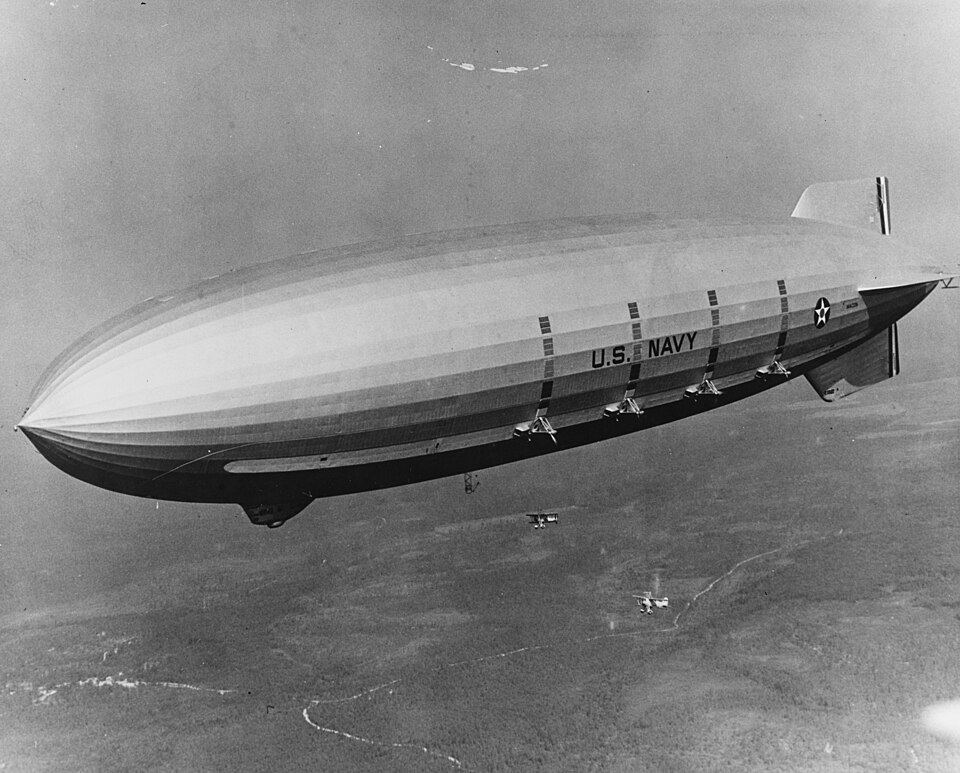
Construction of USS Macon started at Goodyear Airdock in October 1931, she was christened on 11 March 1933 by Rear Admiral Moffett's wife. She made her first flight trial on 21 April and was commissioned much later on 23 June. She departed Lakehurst for her shakedown cruise the same day and on 7 July, while cruising along Long Island Sound, her air group, repainted from USS Akron to her, came aboard for the first time for series of trials with already experienced pilots.
On 12 October, USS Macon departed Lakehurst for NAS Moffett Field in California (recently renamed after the admiral's death in USS Akron's crash), which was planned as her permanent home base. Between November 1933 and January 1934, USS Macon started a brutal cycle of exercises with the fleet. She was "shot down" by carrier-based aircraft and AA fire, showing her limitation. In May, she returned to the east coast for the 1934 fleet problem in the Carribean. In July, she had a training including an attempt to intercept cruisers such as USS Houston, taking President Roosevelt on vacation to Hawaii. Until December 1934, saw saw more exercises, developing new new tactics of an "aircraft carrier", her air group alternating reconnaissance and fighter patrol under a short notice.
In that exercise, with her Curtiss deployed separately in recce, one spotted the aircraft carrier USS Saratoga and keep shadowing her for hours, just rotating aircraft on site while being kept at a safe distance from Saratoga's aviation. USS Macon also marked the position of the crews of two aircraft lost at sea before a rescue. In early 1935, she took part in further exercises. On 12 February, while back from Moffett Field without one stabilizer, lost, she made a forced landing in the sea off Point Sur. This destroyed her structure and she sank, bringing down two men trapped inside, but the whole crew had life jackets and the water temperature was milder than for Akron, so all were rescued and survived.
Possible succession: The ZRCV (1937)

The loss of USS Akron, Macon and Shenandoah, decommissioned of USS Los Angeles on 30 June 1932 left the USN without any airship. Indeed, the rapid evolution of aviation led to more prospects, albeit these airships filled a capacity that was hard to match. The concept of a rigid airship used as an aircraft carrier led naval planners to considering their use in a more offensive way. The next logical step was of course to developed an air group... of dive bombers.
Hence the ZRCV concept, designed by CP Burgess in 1937. This behemoth, planned for a 9.55 million ft3 (270,000 m3) capacity was tailored to carry no less than nine Douglas-Northrop BT-1 dive bombers. Another idea was the replacement of the internal Maybach by external Allison V-1710 engnes rated for 750 hp, eight tota, placed by pairs in external nacelles and mated on a common shaft. This solved the issue of balance, cooling and exhaust gases that plagued the former airships. At 273 meters long (897 feet) they would have been also the world's longest airships, and largest man-made military moving objects before the Midway class carriers.
Instead of the cramped, central hangar, there were individual berthing spaced under a trapze for each of the nine dive bombers, stacked underbelly. This had the advantage of a massive individual release, perfect for squadron operations. However given the weight of those bombs it's unlikely they would be back to be resuplied on board, and rather land on another carrier in the area, and take off while its own dive bomber squadron was already away. Still, the idea went nowhere due to the opposition of President Roosevelt, ordering a limitation on the size of airships. From now one, only safer balloons or "blimps" would be used by the Navy.
Src/Read more about the Akron class:

Hayward, John T., VADM USN (August 1978). "Comment and Discussion". United States Naval Institute Proceedings.
Robinson, Douglas H. (1973). Giants in the Sky: History of the Rigid Airship. Henley-on-Thames, England: Foulis
Richard K. Smith: The Airships Akron & Macon: Flying Aircraft Carriers of the United States Navy.
Grossnick, Roy A., ed. (1986). Kite Balloons to Airships: The Navy's Lighter-than-air Experience (PDF). Washington, DC January 2015.
FALSE-FAILED Innovation By GREG. WILMOTH
airships.net los angeles
airships.net the akron class
carrierbuilders.net
USNI: The Macon: Last Queen of the Skies
warfarehistorynetwork.com
airships.net shenandoah
airshipsonline.com
simpleflying.com
warhistoryonline.com
airships.net Akron class
history.navy.mil
nationalinterest.org
airshipsonline.com
uss shenandoah
airships.net macon wreck
en.wikipedia.org
laboiteverte.fr
Model kit
Video
- Lohner E (1913)
- Macchi M3 (1916)
- Macchi M5 (1917)
- Macchi M7 (1918)
- Ansaldo ISVA (1918)
- Short S.38 (1912)
- Sopwith Baby (1916)
- Short 184 (1916)
- Fairey Campania (1917)
- Sopwith Cuckoo (1917)
- Felixstowe F.2 (1917)
- Gotha WD.2 (1914)
- Friedrichshafen FF 33 (1916)
- Albatros W4 (1916)
- Albatros W8 (1918)
- Hanriot HD.2
- Grigorovich M5 (1915)
- Grigorovich M9 (1916)
- Grigorovich M11 (1917)
- IJN Farman MF.7
- IJN Yokosho Type Mo
- Yokosho Rogou Kougata (1917)
- Yokosuka Igo-Ko (1920)
- Curtiss N9 (1916)
- Curtiss H4 (1916)
- Curtiss H12 (1917)
- Curtiss H16 (1918)
- Aeromarine 39
- Vought VE-7
- Douglas DT (1921)
- NAF/Curtiss TS-1 (1922)
- Boeing FB.5 (1923)
- Boeing F4B (1928)
- Vought O2U/O3U Corsair (1928)
- Grumman FF (1931)
- Akron class airships (1931)
- Curtiss F9C Sparrowhawk (1931)
- Curtiss F11C Goshawk (1932)
- Curtiss BF2C Goshawk (1933)
- Blackburn Blackburn (1922)
- Supermarine Seagull (1922)
- Fairey Flycatcher (1923)
- Hawker Horsley (1925)
- Blackburn Ripon (1926)
- Fairey IIIF (1927)
- Fairey Seal (1930)
- LGL-32 C.1 (1927)
- Fokker T.II (1921)
- Fokker T.III (1923)
- Caspar U1 (1921)
- Dornier Do J Wal (1922)
- Rohrbach R-III (1924)
- Mitsubishi 1MF (1923)
- Mitsubishi B1M (1923)
- Yokosuka E1Y (1923)
- Nakajima A1N (1927)
- Nakajima E2N (1927)
- Mitsubishi B2M (1929)
- Nakajima A2N (1930)
- Nakajima A4N (1935)
- CANT 18
WW1
✠ K.u.K. Seefliegerkorps:
 Italian Naval Aviation
 RNAS
RNAS
 Marineflieger
 French Naval Aviation
 Russian Naval Aviation
 IJN Air Service
 USA
USA
Interwar
Interwar US
 Interwar Britain
 Interwar France
 Interwar Netherlands
 Interwar Germany
 Interwar Japan
 Interwar Italy
- Grumman F2F (1933)
- Curtiss SOC seagull (1934)
- Grumman F3F (1935)
- Northrop BT-1 (1935)
- Consolidated PBY Catalina (1935)
- Grumman J2F Duck (1936)
- Brewster/NAF SBN-1 (1936)
- Curtiss SBC Helldiver (1936)
- Vought SB2U Vindicator (1936)
- Brewster F2A Buffalo (1937)
- Douglas TBD Devastator (1937)
- Vought Kingfisher (1938)
- Curtiss SO3C Seamew (1939)
- K-class Blimps (1939)
- Douglas SBD Dauntless (1939)
- Grumman F4F Wildcat (1940)
- F4U Corsair (NE) (1940)
- Brewster SB2A Buccaneer (1941)
- Grumman TBF/TBM Avenger (1941)
- Consolidated TBY Sea Wolf (1941)
- Grumman F6F Hellcat (1942)
- Curtiss SB2C Helldiver (1942)
- Curtiss SC Seahawk (1944)
- Grumman F7F Tigercat (1944)
- Grumman F8F Bearcat (1944)
- Ryan FR-1 Fireball (1944)
- Douglas AD-1 Skyraider (1945)
- Fleet Air Arm
- Hawker Osprey (1932)
- Fairey Swordfish (1934)
- Blackburn Shark (1934)
- Supermarine Walrus (1936)
- Fairey Seafox (1936)
- Blackburn Skua (1937)
- Short Sunderland (1937)
- Blackburn Roc (1938)
- Fairey Albacore (1940)
- Fairey Fulmar (1940)
- Grumman Martlet (1941)
- Hawker sea Hurricane (1941)
- Brewster Bermuda (1942)
- Fairey Barracuda (1943)
- Fairey Firefly (1943)
- Grumman Tarpon (1943)
- Grumman Gannet (1943)
- Supermarine seafire (1943)
- Blackburn Firebrand (1944)
- Hawker Sea Fury (1944)
- Coastal Command
- Vickers Wellington (1937)
- IJN aviation
- Yokosuka E6Y (1930)
- Aichi D1A "Susie" (1934)
- Mitsubishi A5M "Claude" (1935)
- Nakajima A4N (1935)
- Yokosuka B4Y "Jean" (1935)
- Mitsubishi G3M "Nell" (1935)
- Nakajima E8N "Dave" (1935)
- Kawanishi E7K "Alf" (1935)
- Nakajima B5N "Kate" (1937)
- Kawanishi H6K "Mavis" (1938)
- Aichi D3A "Val" (1940)
- Mitsubishi G4M "Betty" (1940)
- Mitsubishi A6M "zeke" (1940)
- Nakajima E14Y "Glen" (1941)
- Nakajima B6N "Jill" (1941)
- Mitsubishi F1M "pete" (1941)
- Aichi E13A Reisu "Jake" (1941)
- Kawanishi E15K Shiun "Norm" (1941)
- Nakajima C6N Saiun "Myrt" (1942)
- Yokosuka D4Y "Judy" (1942)
- Kyushu Q1W Tokai "Lorna" (1944)
 Luftwaffe
- Heinkel 114 (1935)
- Arado 196 (1937)
- Me109 T (1938)
- Blohm & Voss 138 Seedrache (1940)
 Italian Aviation
- Savoia-Marchetti S.55
- IMAM Ro.43/44
- CANT Z.501 Gabbiano
- CANT Z.506 Airone
- CANT Z.508
- CANT Z.511
- CANT Z.515
 French Aeronavale
- GL.300 (1926-39)
- CAMS 37 (1926)
- Levasseur PL.5 (1927)
- Potez 452 (1935)
- Loire 210 (1936)
- Loire 130 (1937)
- LN 401 (1938)
 Soviet Naval Aviation
- Shavrov SH-2 (1928)
- Tupolev TB-1P (1931)
- Beriev MBR-2 (1930)
- Tupolev MR-6 (1933)
- Tupolev MTB-1 (1934)
- Beriev Be-2 (1936)
- Polikarpov I16 naval (1936)
- Tupolev MTB-2 (1937)
- Ilyushine DB-3T/TP (1937)
- Beriev Be-4 (1940)
 Swedish Naval Aviation
- SAAB B17S
-
 Skoda Š-328V
  R-XIII Idro
 Fokker C.XI W (1934)
 Rogožarski PVT-H (1938)
WW2
 ☍ USNA
- De Havilland Sea Vixen
- Hawker Sea Hawk
- Supermarine Scimitar
- Blackburn Buccaneer
- Hawker Sea Harrier
- Douglas A4 Skyhawk
- Grumman F9F Panther
- Vought F8 Crusader
- McDonnell-Douglas F-4 Phantom-II
- North Am. A5 Vigilante
- TU-142
- Yak 38 forger
☢ Cold War
✧ NATO
Fleet Air Arm
 US Navy
☭ Warsaw Pact
Merch
Seafire Mark 45; HMS Pretoria Castle
Zeros vs its aversaries
Aichi D3A “Val” Junyo
Mitsubishi A5M poster
F4F wildcat
Macchi M5
SBD Dauntless Coral Sea
SBD Dauntless USS Enterprise
SBD-4 CV22