Norwegian Naval Aviation
 c100 seaplanes
Over 50,000 islands (skerries) forming a natural inner coastal route — the Indreleia — sheltered from the open sea. All this made aviation, despite the climate, quite important to ensure a correct reconnaissance and deployment of naval assets where it mattered, when it mattered, to defend the most important cities. This was true well before 1940 and so Norway developed also a healthy network of fortifications, some going back well before the 1905 split with Sweden (Kalmar Union).
Norwegian Context 1914-1945

Akerselven ved Bentse Bruk, håndkolorert dias fra 1900
Although Norway remained neutral during World War I, the war strongly affected the country as it depended heavily on international trade and shipping. Norwegian merchant ships transported goods across Europe and the Atlantic. German submarine warfare caused heavy Norwegian shipping losses. Wartime shortages led to rationing, inflation, and social tension. At the same time, Some shipowners became very wealthy from wartime trade (“war profiteers”). Workers and poorer citizens faced rising food prices and unemployment. These tensions helped strengthen the labor movement and socialist politics.
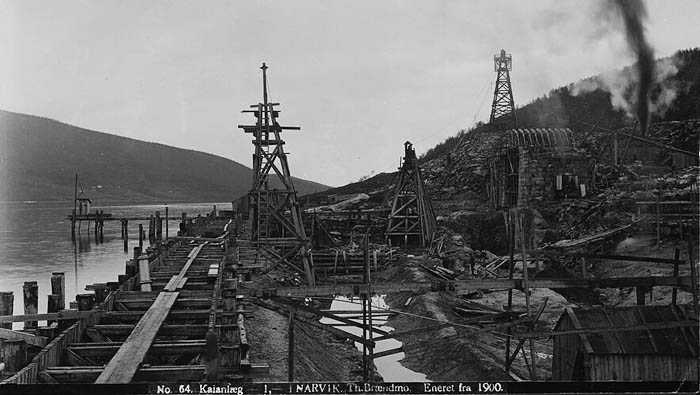
Narvik in 1900
After the war, Norway experienced Economic instability, Labor strikes and class conflict, high unemployment during the Great Depression. Important developments included the rise of the Labour Party which became increasingly influential by advocating workers’ rights, social welfare and democratic reforms. By the 1930s, Norway was moving toward the foundations of the modern welfare state. Norway was still partly rural, but industrialization expanded thanks to Hydroelectric power, modernized shipping and fishing indutries, and manufacturing. Urbanization increased as people moved to cities for work.
Norway in World War II: Invasion by Germany on 9 April 1940 and Occupation. Despite a brave attempts to stop the Kriegsmarine (sinking of Blucher and other events), the Norwegian Navy was no match. An allied operation was launched to counter this, but it was derailed by the invasion of the low countries in May. Both expeditionary forces were re-embarked and sent to defend France. This left only years of Occupation for the Norwegians. The Norwegian government and royal family fled north and later to Britain. Vidkun Quisling attempted a coup and collaborated with the Nazis. King Haakon VII became an important symbol of resistance because he refused to cooperate with the occupiers. Norwegians participated in underground newspapers, sabotage operations and intelligence work for the Allies. One famous action was the sabotage of heavy water production at Vemork, which disrupted German nuclear research.
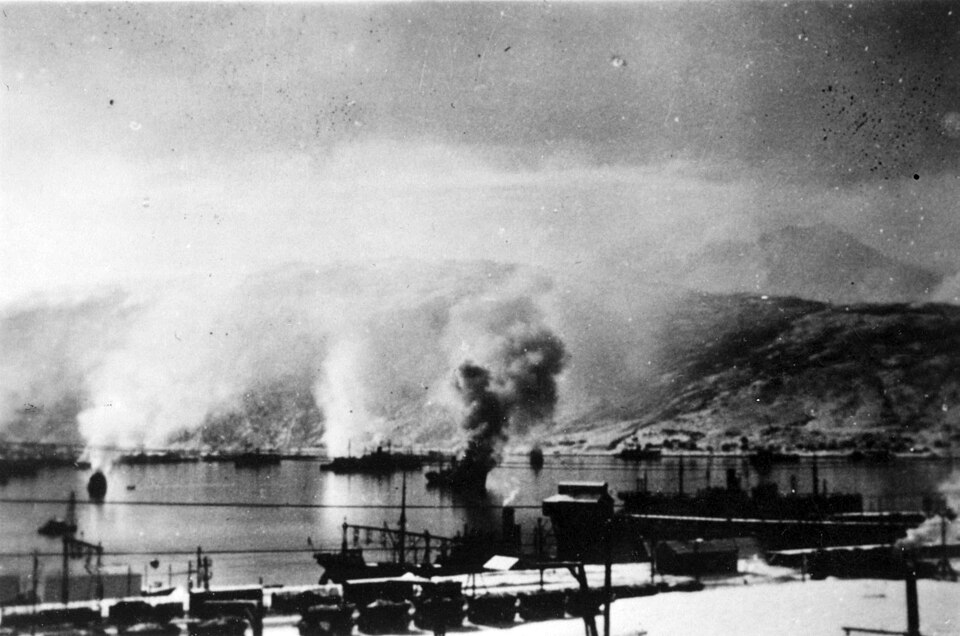
Battle of Narvik April 1940: The port and some ships on fire.
Still, food and goods were rationed, political opposition was suppressed and Jews in Norway were persecuted and deported. Germany surrendered in May 1945, and Norway was liberated by Allied forces. After the war, Collaborators were prosecuted, national unity and reconstruction became priorities. Support grew for democracy, welfare policies, and international cooperation. The wartime experience also strengthened Norway’s later alignment with Western democracies and eventually membership in NATO in 1949.
Norway in the Cold War:

Key regions strategically: Northern Norway (Finnmark & Troms) were The most critical. Directly bordering Russia's Kola Peninsula, they are the home to the Russian Northern Fleet and a massive concentration of nuclear submarines and ballistic missile submarines (SSBNs). NATO access to this region, or denial of it, is among the most consequential questions in European defence. The GIUK Gap (Greenland-Iceland-UK Gap) placed Norway, at the northeastern end of this chokepoint, at a critical advantage for its airbases and naval facilities, essential for NATO surveillance of Russian submarine sorties into the Atlantic. Andøya and Evenes air stations are critical nodes. Svalbard, the Norwegian archipelago 400 miles north of the mainland. She was demilitarised under the 1920 Svalbard Treaty (Norway administers, but cannot fortify). Russia maintains a settlement at Barentsburg. A persistent grey zone.
Strategic Implications for Defence
1. The Kola Problem
The Russian Kola Peninsula hosts the largest concentration of naval power in the Arctic — Northern Fleet headquarters at Severomorsk, SSBN bases at Gadzhiyevo and Olenya, and air bases with long-range aviation. Norway is Russia's only land neighbour in this region. Defending Finnmark means defending NATO's direct window onto Kola.2. Terrain as both shield and trap
The fjords and mountains make Norway extraordinarily difficult to invade conventionally — narrow valleys, few roads, bridges easily demolished. But the same terrain makes rapid reinforcement equally hard. NATO pre-positioning and rapid airlift (primarily US Marines rotating through Trøndelag) is critical precisely because reinforcing by land in wartime is slow.3. The coastal corridor problem
The inner coastal route (Indreleia) is a strategic asset — it allows ships to move along the coast sheltered from open-sea threats. But it also means an adversary controlling key island chokepoints could interdict Norwegian coastal traffic. Coastal defence — historically Norway's strength with anti-ship missiles — is central to the concept.4. Air power geography
Norway's main air bases — Bodø, Evenes, Ørland — are spread along the coast. Evenes (in northern Norway) is being upgraded specifically as a maritime patrol base for the P-8 Poseidon, extending NATO's ASW reach into the Barents Sea. The distances involved mean basing location is decisive — fighters operating from southern bases cannot meaningfully defend Finnmark without tanker support.5. The Alliance dependence question
Norway's own armed forces are capable but small — roughly 23,000 active personnel. The defence concept is explicitly built around host nation support: receiving, staging, and integrating allied reinforcements rapidly. This is why infrastructure (ports, fuel storage, roads, airfields) is treated as a defence priority almost on par with weapons.6. Arctic dimension
Climate change is opening the High North in ways that increase strategic competition. Longer ice-free seasons in the Barents Sea extend Russian naval operating time and increase the strategic value of Norwegian Arctic infrastructure and surveillance.About Norwegian Military Aviation
There is a rich and largely untold story, that started by donated biplanes in 1912, to Mosquito strike operation by 1945, the 1940 campaign and Norwegian pilots in exile working with the allies.The Birth of Norwegian Military Aviation (1912–1939)
 Military flights started on 1 June 1912, when the first aircraft, HNoMS Start, was bought with public donations by the public, it was piloted by Hans Dons, the second in command of Norway's first submarine HNoMS Kobben, with naval and patriotic fervor, and an almost improvisational spirit. Before 1944, the air force was divided into two entirely separate services, the Norwegian Army Air Service (Hærens Flyvevaaben) and the Royal Norwegian Navy Air Service (Marinens Flyvevaaben). They reported to their respective services, had different aircraft, different bases, and different doctrines, but this split would have serious consequences in 1940.
The Navy established its main flight base at Horten, and in 1915 set up its own aircraft factory and flying school. Until 1940, most aircraft belonging to both services were domestic designs or built under licence, with the main bomber/scout of the Army Air Service being the Dutch-designed Fokker C.V. These versatile two-seat machines, often fitted with skis for winter operations, formed the core of the Army's observation squadrons. The Navy's main aircraft was the Marinens Flyvebaatfabrikk MF.11, a domestically designed biplane floatplane used for coastal patrol and reconnaissance, but already obsolete by the late 1930s (see below, the full lineage).
As war seemed imminent in the late 1930s, more modern aircraft were acquired from abroad, for the air force like twelve Gloster Gladiator fighters, six Heinkel He 115 floatplane from Germany. The He 115 purchase from Germany was striking as they were ordered in 1937–38 before the political situation made the source of the order deeply awkward. Considerable orders were also placed with American companies in the months before the invasion, the most important being two orders for the comparatively modern Curtiss P-36 Hawk monoplane fighter.
The Norwegian Campaign, April–June 1940

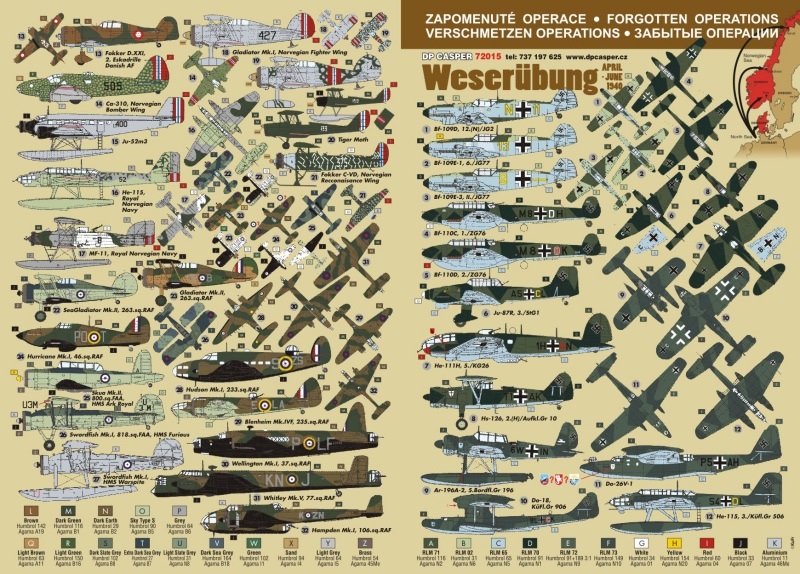
When the Germans launched their attack on 9 April 1940, the Norwegian air forces consisted of two separate units — modest in size, with few aerodromes mainly situated in coastal areas. No aircraft was properly equipped with offensive equipment such as bombsights, and the aircraft were generally neither properly armed nor truly suitable for a fighter role. Despite this, there was fierce resistance. Seven Gladiators from Jagevingen (the fighter wing) defended Fornebu airport against the attacking German forces with some success — claiming two Bf 110 heavy fighters, two He 111 bombers, and one Ju 52 transport. The wing lost two Gladiators to ground strafing while rearming on Fornebu, and one in the air, shot down by future Experte Helmut Lent, injuring the sergeant pilot. The Fokker C.V biplanes conducted reconnaissance missions during the invasion and claimed victories against German bombers and fighters — a remarkable achievement for an already antiquated type against the Luftwaffe.

A famous Norwegian Fokker C.V used from April to June 1940. 15 C.Ve (1929-31) and 28 C.Vd (1932-39) were built under licence as the Haerens Flyvevaaben. It could carry 250 kgs of bombs.
The retreat and escape: After the withdrawal of allied forces, the Norwegian government ceased fighting and evacuated to the United Kingdom on 10 June 1940. Only aircraft of the Royal Norwegian Navy Air Service had the range to fly from their last remaining bases in Northern Norway to Britain. Among those that reached the British Isles were four of the German-built Heinkel He 115 seaplane bombers. A captured Arado Ar 196 from the German heavy cruiser Admiral Hipper was also flown to Britain for evaluation.
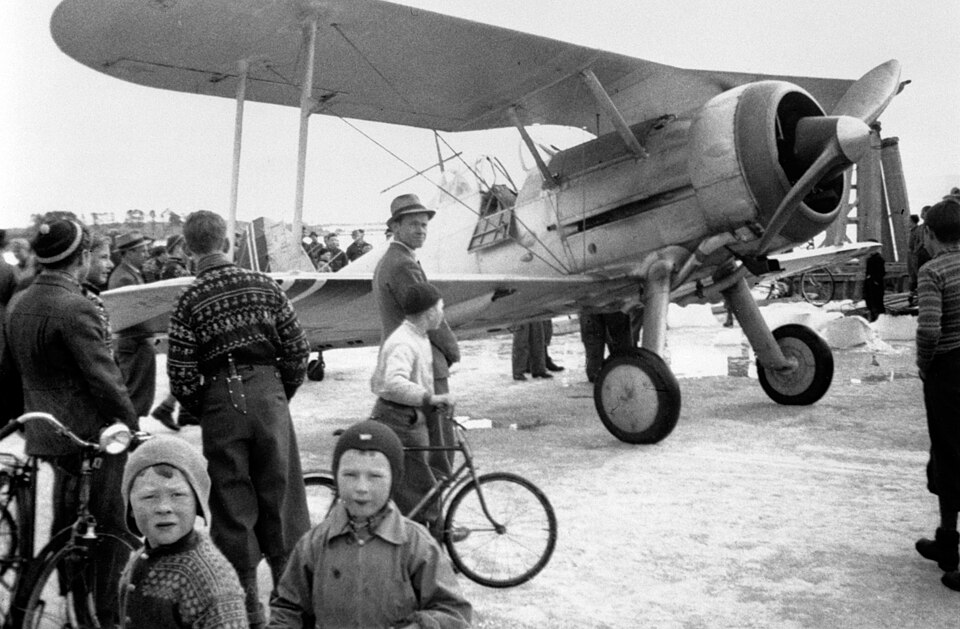
Gloster Gladiator fighter after emergency landing on the ice on the Mjøsa on 9 April 1940, with many spectators. The plane belonged to the Fighter Wing stationed at Fornebu. It was evacuated to Hamar via Steinsfjorden, and later flown by Dag Krohn. Then flown to Brumunddal, and ended up on Vangsmjøsa. The longest surviving Norwegian Gladiator.
For the Army Air Service aircraft the only option was Finland, where the planes would be interned rather than fall into German hands — in all, two Fokker C.V.s and one de Havilland Tiger Moth made it across the border.
Exile Operations from Britain (1940–1945)
"Little Norway" — The Training Base: In the autumn of 1940, a Norwegian training centre known as "Little Norway" was established next to Toronto Island Airport, Canada. It became the pipeline that kept Norwegian squadrons in the field — training pilots in North America then feeding them into RAF-integrated units in Britain. An order for 36 Curtiss Hawk 75A-8 fighters placed before the invasion was fulfilled to Little Norway, where they were used for pilot training until the USAAF took over the aircraft under the designation P-36G.The Fighter Squadrons — 331 and 332
No. 331 Squadron was formed on 21 July 1941 at RAF Catterick, initially flying Hawker Hurricanes before transitioning to Spitfire Mk Vs in late 1941 and upgrading to Mk IXs by 1943 for high-altitude intercepts and escort duties.No. 332 Squadron followed in January 1942. Together they formed 132 (Norwegian) Wing, operating as part of RAF Fighter Command and later the 2nd Tactical Air Force. Between them, 331 and 332 Squadrons scored 180 confirmed aerial kills, 35 probables, and over 100 damaged. Combined losses were heavy: 131 aircraft lost and 71 pilots killed.
No. 331 Squadron was described by the British Embassy in Oslo as the highest-scoring fighter squadron in south England during the war, having defended London from 1941. Its RAF code prefix was "FN" — For Norway. On 22 April 1945, both 331 and 332 Squadrons converted to Spitfire Mk IXe and Mk XVI at RAF Dyce, Scotland, in preparation for return to Norway after liberation.
The Maritime Squadrons — 330 and 333
330 Squadron was the first exile unit to form. Established on 25 April 1941 from Norwegian naval personnel, its mission was to guard the North Atlantic and protect convoys from the USA, Canada, and Britain to Murmansk. It was initially equipped with Northrop N-3PB torpedo-bombers operating from Akureyri, Iceland from July 1941, before relocating to Oban, Scotland in January 1943 and re-equipping with Short Sunderland flying boats.333 Squadron was established in May 1943, equipped with Catalina flying boats and de Havilland Mosquito fighter-bombers operating from Woodhaven, Scotland. The Mosquito element specialised in anti-shipping strikes along the Norwegian coast — attacking German convoys hugging their former home coastline. On 10 May 1945, the Mosquito element of 333 Squadron was split off to form a third separate maritime unit — 334 Squadron. This new squadron operated Mosquitos on operations along the Norwegian coast until the end of the war, then moved to Gardermoen as Norway was liberated.
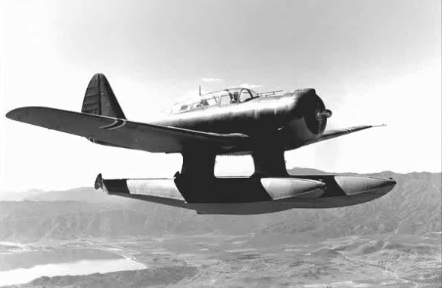
The Northrop N-3PB — A Uniquely Norwegian Aircraft
Worth highlighting separately: Norway ordered 24 Northrop N-3PB floatplanes on 12 March 1940 — barely three weeks before the invasion — to replace the obsolete MF.11. None were delivered before 9 April, but when they became operational with 330 Squadron in May 1941, they flew anti-submarine and convoy escort from Reykjavík, Iceland. Built to Norwegian specifications in the US, the N-3PB was one of very few aircraft designed specifically for a small Allied nation's requirements.
The Merger and Liberation — 1944–1945
The Royal Norwegian Air Force was formally established by royal decree on 1 November 1944, merging the Army and Navy air services into a single unified force for the first time — ending the divided command structure that had hampered the 1940 campaign. By 8 May 1945, 335 Norwegians had lost their lives serving in the exile air forces. The squadrons flew home to a liberated Norway, carrying their RAF-era numbers and battle honours that the RNoAF still bears today — 331 and 332 Squadrons now fly F-35As, the direct institutional descendants of the Spitfire wings that defended London.NATO era
The Royal Norwegian Air Force (RNoAF / Luftforsvaret) is small but punching well above its weight — and it's in the middle of the most significant modernisation in its history. Norway became the first F-35 partner nation to fulfil its full program of record, completing delivery of all 52 F-35A Lightning IIs in April 2025. This is strategically significant in several ways:On 6 January 2022, the F-35 officially took over the Quick Reaction Alert mission, making Norway the first country in the world to field a fighter fleet entirely composed of fifth-generation aircraft.
Cold War Norwegian Maritime Administration
Norwegian F-35s have been training to operate from highways and unimproved runways at dispersed locations — a direct response to the vulnerability of fixed bases to precision strikes. Two jets operated from a road strip in Finland in September 2023. The jets have already been used operationally — in March 2025, two F-35As launched from Evenes to intercept and shadow two Russian Tu-142 Bear F maritime patrol aircraft operating off the Troms coast. Kongsberg's Joint Strike Missile (JSM) is integrated into the F-35 platform — a Norwegian-developed weapon that can be carried internally, preserving stealth, and used against both ships and land targets. A uniquely Norwegian contribution to the aircraft's capability.Basing Structure
The structure is built around Ørland as the main operating base for the fighter force and Evenes for maritime patrol and QRA duties. A national Control and Reporting Centre at Sørreisa provides critical air surveillance and command functions for both national and NATO purposes:-Ørland (central Norway) — main F-35 base, NASAMS air defence
-Evenes (northern Norway) — QRA detachment, P-8A Poseidon base, forward deployment for F-35s
-Gardermoen — C-130J Hercules tactical airlift
-Bardufoss — helicopter consolidation hub, mountain base, F-35 underground shelters
The underground/mountain basing at Bardufoss is noteworthy — Norwegian F-35s have been photographed operating from the underground complex there, a Cold War-era hardening concept being revived in the current threat environment.
Maritime Patrol
The P-8A Poseidon has replaced the venerable P-3 Orion. 333 Squadron at Evenes operates 5 P-8A Poseidons in the ASW, maritime patrol, ELINT, and electronic warfare roles. This is arguably Norway's single most strategically valuable aviation asset for NATO — watching the Barents Sea and tracking Russian submarine movements from the Kola Peninsula into the Atlantic. Evenes was specifically chosen and upgraded to push the P-8 as far north as possible.Tactical Airlift & Special Missions
The Norwegian C-130J Super Hercules are based mostly from Gardermoen tactical airlift, for special operations support. The April 2024 Strategic Defence Plan announced the intention to acquire one additional C-130J to increase capacity Maritime Administration. Norway participates in the NATO A330 MRTT tanker pool based at Eindhoven — providing aerial refuelling capability without owning a dedicated tanker fleet outrightNorwegian Helicopters
This has been a troubled area. Norway ordered NH90s for naval frigate operations and coast guard duties, but in June 2022, Norway terminated the NH90 contract, claiming the supplier could not deliver combat-capable aircraft to the required standard. All NH90s are being returned to the manufacturer. Norway is now searching for a replacement naval helicopter. For search and rescue, the AW101 "SAR Queen" is the current platform. In January 2026, Norway decided to acquire two additional AW101s and establish Tromsø as a new SAR base — pushing coverage further into the High North. The Bell 412 handles utility/army support roles at Bardufoss.Air Defence
Air defence is maintained via NASAMS (National Advanced Surface-to-Air Missile System) — ironically a Norwegian-American co-development by Kongsberg and Raytheon that has become one of NATO's most widely used medium-range air defence systems. The 2024 Strategic Defence Plan proposes increasing NASAMS batteries to 6, plus adding 2 batteries of layered air defence with ballistic missile capability (Patriot or a new long-range NASAMS variant).Marinens Flyvebaatfabrikk


Marinens flyvebaatfabrikk (established 26 May 1915 in Horten, closed 1 October 1972) was a Norwegian aircraft factory that made around 130 aircraft from 1915 to 1940. It was co-located with the Norwegian Navy's air force, at Karljohansvern, Horten. Together with Kjeller Flyfabrikk, this was one of the two country's first aircraft manufacturers. The first arrived from Germany on 1 August 1912. First Norwegian aircraft ever. By 1913 it was converted by the factory into a seaplane. In 1914, Roald Amundsen donated his Farman MF.7 seaplane, which became the basis for the factory's first aircraft, the MF1.
In May 1915, the factory was formally established and in 1914-1939, manufactured in sucession the MF1, MF2, MF3, MF4, MF5, MF6, MF7, MF8, MF9, MF10, MF11 and MF12, with the last five designed by factory manager Johan Høver. Several were also built under license: The Sopwith Baby and Hansa-Brandenburg. In 1938, 86 employees worked here. However in 1940, the facilities were captired and later expanded by the Germans for their own production. Postwar this became Hortens Flyfabrikk, subordinated to the Air Force with Kjeller Flyfabrikk. But it mostly made only maintenance on Catalinas and other seaplanes. Around 1955, there were still 70 workers there, expanded to 270 in 1965 when it was subordinated to the Navy's main shipyard, but a crisis ensured a 20% annual reduction until closure in 1972.
List
- Marinens Flyvebaatfabrikk M.F.1 Floatplane (Patrol) 1915: 5 built
- Marinens Flyvebaatfabrikk M.F.2 Floatplane (Patrol) 1916: 3 built
- Marinens Flyvebaatfabrikk M.F.3 Floatplane (Patrol) 1917: 4 built
- Marinens Flyvebaatfabrikk M.F.4 Floatplane (Trainer) 1918: 6 built
- Marinens Flyvebaatfabrikk M.F.5 Floatplane (Patrol) 1919: 9 built
- Marinens Flyvebaatfabrikk M.F.6 Floatplane (Trainer) 1921: 2 built
- Marinens Flyvebaatfabrikk M.F.7 Floatplane (Trainer) 1923: 2 built
- Marinens Flyvebaatfabrikk M.F.8 Floatplane (Trainer) 1924: 8 built
- Marinens Flyvebaatfabrikk M.F.9 Floatplane (Fighter) 1925: 10 built
- Marinens Flyvebaatfabrikk M.F.10 Floatplane (Trainer) 1929: 4 built
- Marinens Flyvebaatfabrikk M.F.11 Floatplane (Patrol) 1932: 29 built
- Marinens Flyvebaatfabrikk M.F.12 Floatplane (Trainer) 1939: 1 Prototype
Marinens Flyvebaatfabrikk M.F.1 (1915)
To be completed soon
Marinens Flyvebaatfabrikk M.F.2 (1916)
To be completed soon
Marinens Flyvebaatfabrikk M.F.3 (1917)
To be completed soon
Marinens Flyvebaatfabrikk M.F.4 (1918)
To be completed soon
Marinens Flyvebaatfabrikk M.F.5 (1919)
To be completed soon
Marinens Flyvebaatfabrikk M.F.6 (1921)
To be completed soon
Marinens Flyvebaatfabrikk M.F.7 (1923)
To be completed soon
Marinens Flyvebaatfabrikk M.F.8 (1924)
To be completed soon
Marinens Flyvebaatfabrikk M.F.9 (1925)
To be completed soon
Marinens Flyvebaatfabrikk M.F.10 (1929)
To be completed soon
Marinens Flyvebaatfabrikk M.F.11 (1932)
To be completed soon
Marinens Flyvebaatfabrikk M.F.12 (1939)
To be completed soon
Sopwith Baby (1918)
This was the first and only seaplane fighter of the Norwegian Naval Aviation. Built under linence in 1918 and used until 1925; 8 total (F.100, F.102, F.104, F.110, F.114, F.118 etc.). F.100 and F.102 (on Tordenskjold) assisted in the search for Roald Amundsen and Umberto Nobile in 1928.
Hansa-Brandenburg W.33 (1920)
Ued from 1920 to 1928 these 30 reconnaissance seaplanes included the F.14, F.18, F.22, F.24, F.32, F.36, F.38, F.56, F.58 etc. Two of these assisted Amundsen in 1923. F.56 and F.58 flown by Finn Lutzow-Holm and Hjalmar Riiser-Larsen Horten-Kirkenes-Horten 1922. F.18 and F.22 brought to Svalbard to assist Roald Amundsen who flew his N-25 in 1926. Two years later they searched with F.36 and F.38 (on Hobby) for the same Amundsen. W.33 was also used on the Norvegia expeditions 1929-30. The remaining 11 built at Kjeller Flyfabrikk with the name Kjeller F.F.8 Make III.
Douglas DT-2 B (1925)
Torpedo bombers were purchased to create a single squadron from the US, in service from 1925 to 1936: Seven in all, six deployed, one in reserve.
Heinkel He 115

Due to rising tensions in Europe, the Norwegian Ministry of Defence ordered six He 115Ns for the Royal Norwegian Navy Air Service (RNoNAS), on 28 August 1939. The first arrived from 14 July until 13 November 1939 to replace the Douglas DTs and Marinens Flyvebaatfabrikk M.F.11s. The Norwegians signed another order for six more in December 1939, but deliveres were stopped with Operation Weserübung on 9 April 1940.
F.50, F.52, F.54, F.56, F.58 and F.60 were spread along the coast from Sola and Flatøy (South) to Skattøra NAS off Tromsø (north) so when the German invasion commenced, F.60, at Hafrsfjord near Stavanger was captured but two Luftwaffe He 115s, and then retook by an improvised militia of Norwegian riflemen at Ørnes, Glomfjord, Nordland and police officers from Brønnøysund. These two ex-Luftwaffe aircraft has ran out of fuel and had to make emergency landings on 10 April. They joined the six already operational, manned by Norwegian aircrews for the duration of the campaign.
Seven were employed against German or German-controlled ships slike HNoMS Uller as well as providing ground support to the offensive on Narvik. On 14 April, three attacked German Ju 52s at Gullesfjordbotn airfield. Four then flet to UK before the 10 June and another escaped to Finland, Lake Salmijärvi, Petsamo. A sixth was lost over the North Sea. The last were made unserviceable, abandoned at Skattøra, but repaired and flown by the Germans afterwards.
Read More and Sources
erje Thorbjørnsen (red) (2016) Horten Flyfabrikks siste år 1945-1965. Lokalhistorisk Senter, Horten
links
The Luftwaffe in Norwayno.wikipedia.org Marinens_flyvebaatfabrikk
nb.no
nb.no
borreminne.hive.no
borreminne.hive.no
borreminne.hive.no
Høver M.F.11, Arild Kjaeraas - Profiles in Norway Nr. 2
Model Kits
The Høver M.F.11 on scalemates.comVideo
- Lohner E (1913)
- Macchi M3 (1916)
- Macchi M5 (1917)
- Macchi M7 (1918)
- Ansaldo ISVA (1918)
- Short S.38 (1912)
- Sopwith Baby (1916)
- Short 184 (1916)
- Fairey Campania (1917)
- Sopwith Cuckoo (1917)
- Felixstowe F.2 (1917)
- Gotha WD.2 (1914)
- Friedrichshafen FF 33 (1916)
- Albatros W4 (1916)
- Albatros W8 (1918)
- Hanriot HD.2
- Grigorovich M5 (1915)
- Grigorovich M9 (1916)
- Grigorovich M11 (1917)
- IJN Farman MF.7
- IJN Yokosho Type Mo
- Yokosho Rogou Kougata (1917)
- Yokosuka Igo-Ko (1920)
- Curtiss N9 (1916)
- Curtiss H4 (1916)
- Curtiss H12 (1917)
- Curtiss H16 (1918)
- Aeromarine 39
- Vought VE-7
- Douglas DT (1921)
- NAF/Curtiss TS-1 (1922)
- Boeing FB.5 (1923)
- Boeing F4B (1928)
- Vought O2U/O3U Corsair (1928)
- Grumman FF (1931)
- Akron class airships (1931)
- Curtiss F9C Sparrowhawk (1931)
- Curtiss F11C Goshawk (1932)
- Curtiss BF2C Goshawk (1933)
- Blackburn Blackburn (1922)
- Supermarine Seagull (1922)
- Fairey Flycatcher (1923)
- Hawker Horsley (1925)
- Blackburn Ripon (1926)
- Fairey IIIF (1927)
- Fairey Seal (1930)
- LGL-32 C.1 (1927)
- Fokker T.II (1921)
- Fokker T.III (1923)
- Caspar U1 (1921)
- Dornier Do J Wal (1922)
- Rohrbach R-III (1924)
- Mitsubishi 1MF (1923)
- Mitsubishi B1M (1923)
- Yokosuka E1Y (1923)
- Nakajima A1N (1927)
- Nakajima E2N (1927)
- Mitsubishi B2M (1929)
- Nakajima A2N (1930)
- Nakajima A4N (1935)
- CANT 18
WW1
✠ K.u.K. Seefliegerkorps:
 Italian Naval Aviation
 RNAS
RNAS
 Marineflieger
 French Naval Aviation
 Russian Naval Aviation
 IJN Air Service
 USA
USA
Interwar
 Interwar US
 Interwar Britain
 Interwar France
 Interwar Netherlands
 Interwar Germany
 Interwar Japan
 Interwar Italy
- Grumman F2F (1933)
- Curtiss SOC seagull (1934)
- Grumman F3F (1935)
- Northrop BT-1 (1935)
- Consolidated PBY Catalina (1935)
- Grumman J2F Duck (1936)
- Brewster/NAF SBN-1 (1936)
- Curtiss SBC Helldiver (1936)
- Vought SB2U Vindicator (1936)
- Brewster F2A Buffalo (1937)
- Douglas TBD Devastator (1937)
- Vought Kingfisher (1938)
- Curtiss SO3C Seamew (1939)
- K-class Blimps (1939)
- Douglas SBD Dauntless (1939)
- Grumman F4F Wildcat (1940)
- F4U Corsair (NE) (1940)
- Brewster SB2A Buccaneer (1941)
- Grumman TBF/TBM Avenger (1941)
- Consolidated TBY Sea Wolf (1941)
- Grumman F6F Hellcat (1942)
- Curtiss SB2C Helldiver (1942)
- Curtiss SC Seahawk (1944)
- Grumman F7F Tigercat (1944)
- Grumman F8F Bearcat (1944)
- Ryan FR-1 Fireball (1944)
- Douglas AD-1 Skyraider (1945)
- Fleet Air Arm
- Hawker Osprey (1932)
- Fairey Swordfish (1934)
- Blackburn Shark (1934)
- Supermarine Walrus (1936)
- Fairey Seafox (1936)
- Blackburn Skua (1937)
- Short Sunderland (1937)
- Blackburn Roc (1938)
- Fairey Albacore (1940)
- Fairey Fulmar (1940)
- Grumman Martlet (1941)
- Hawker sea Hurricane (1941)
- Brewster Bermuda (1942)
- Fairey Barracuda (1943)
- Fairey Firefly (1943)
- Grumman Tarpon (1943)
- Grumman Gannet (1943)
- Supermarine seafire (1943)
- Blackburn Firebrand (1944)
- Hawker Sea Fury (1944)
- Coastal Command
- Vickers Wellington (1937)
- IJN aviation
- Yokosuka E6Y (1930)
- Aichi D1A "Susie" (1934)
- Mitsubishi A5M "Claude" (1935)
- Nakajima A4N (1935)
- Yokosuka B4Y "Jean" (1935)
- Mitsubishi G3M "Nell" (1935)
- Nakajima E8N "Dave" (1935)
- Kawanishi E7K "Alf" (1935)
- Nakajima B5N "Kate" (1937)
- Kawanishi H6K "Mavis" (1938)
- Aichi D3A "Val" (1940)
- Mitsubishi G4M "Betty" (1940)
- Mitsubishi A6M "zeke" (1940)
- Nakajima E14Y "Glen" (1941)
- Nakajima B6N "Jill" (1941)
- Mitsubishi F1M "pete" (1941)
- Aichi E13A Reisu "Jake" (1941)
- Kawanishi E15K Shiun "Norm" (1941)
- Nakajima C6N Saiun "Myrt" (1942)
- Yokosuka D4Y "Judy" (1942)
- Kyushu Q1W Tokai "Lorna" (1944)
 Luftwaffe
- Heinkel 114 (1935)
- Arado 196 (1937)
- Me109 T (1938)
- Blohm & Voss 138 Seedrache (1940)
 Italian Aviation
- Savoia-Marchetti S.55
- IMAM Ro.43/44
- CANT Z.501 Gabbiano
- CANT Z.506 Airone
- CANT Z.508
- CANT Z.511
- CANT Z.515
 French Aeronavale
- GL.300 (1926-39)
- CAMS 37 (1926)
- Levasseur PL.5 (1927)
- Potez 452 (1935)
- Loire 210 (1936)
- Loire 130 (1937)
- LN 401 (1938)
 Soviet Naval Aviation
- Shavrov SH-2 (1928)
- Tupolev TB-1P (1931)
- Beriev MBR-2 (1930)
- Tupolev MR-6 (1933)
- Tupolev MTB-1 (1934)
- Beriev Be-2 (1936)
- Polikarpov I16 naval (1936)
- Tupolev MTB-2 (1937)
- Ilyushine DB-3T/TP (1937)
- Beriev Be-4 (1940)
 Swedish Naval Aviation
- SAAB B17S
-
 Skoda Š-328V
  R-XIII Idro
 Fokker C.XI W (1934)
 Rogožarski PVT-H (1938)
WW2
 ☍ USNA
- De Havilland Sea Vixen
- Hawker Sea Hawk
- Supermarine Scimitar
- Blackburn Buccaneer
- Hawker Sea Harrier
- Douglas A4 Skyhawk
- Grumman F9F Panther
- Vought F8 Crusader
- McDonnell-Douglas F-4 Phantom-II
- North Am. A5 Vigilante
- TU-142
- Yak 38 forger
☢ Cold War
✧ NATO
Fleet Air Arm
 US Navy
☭ Warsaw Pact
Merch
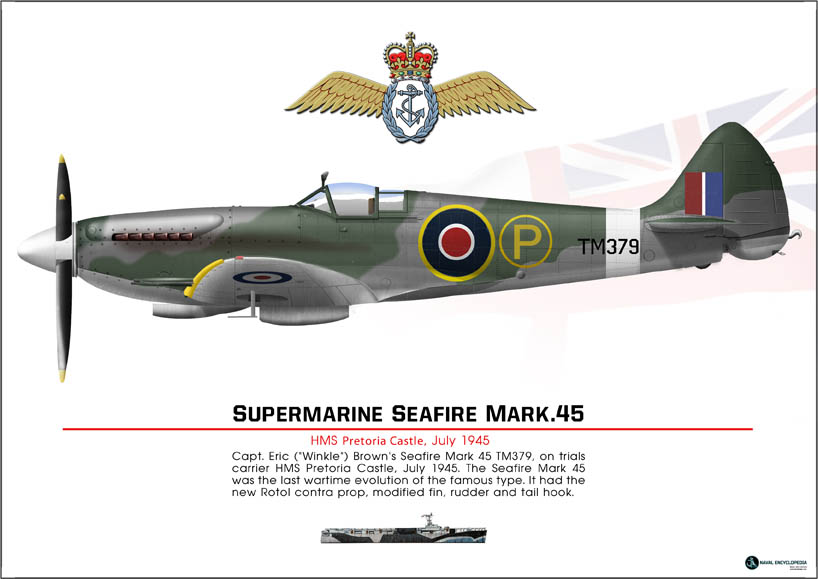
Seafire Mark 45; HMS Pretoria Castle
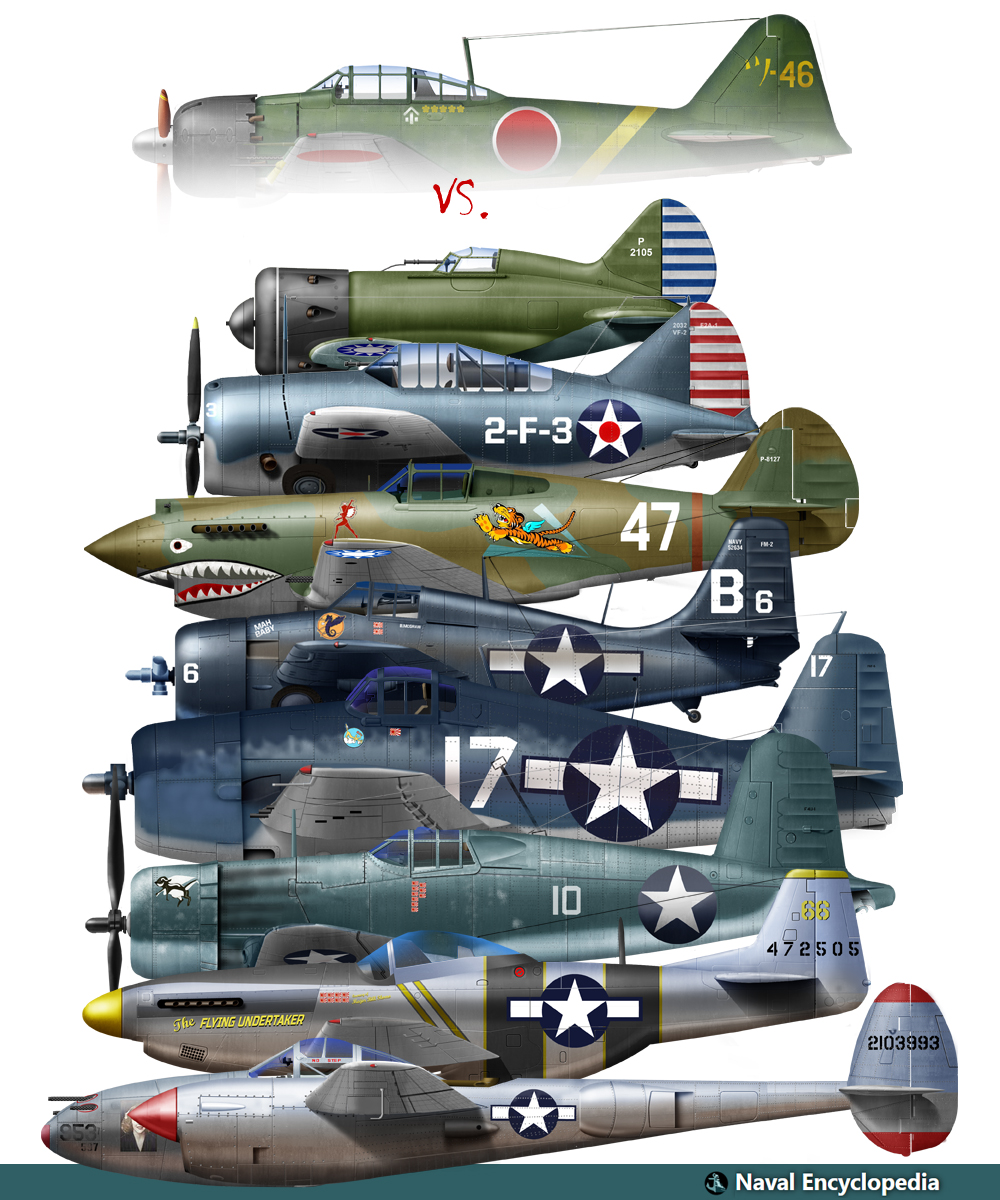
Zeros vs its aversaries
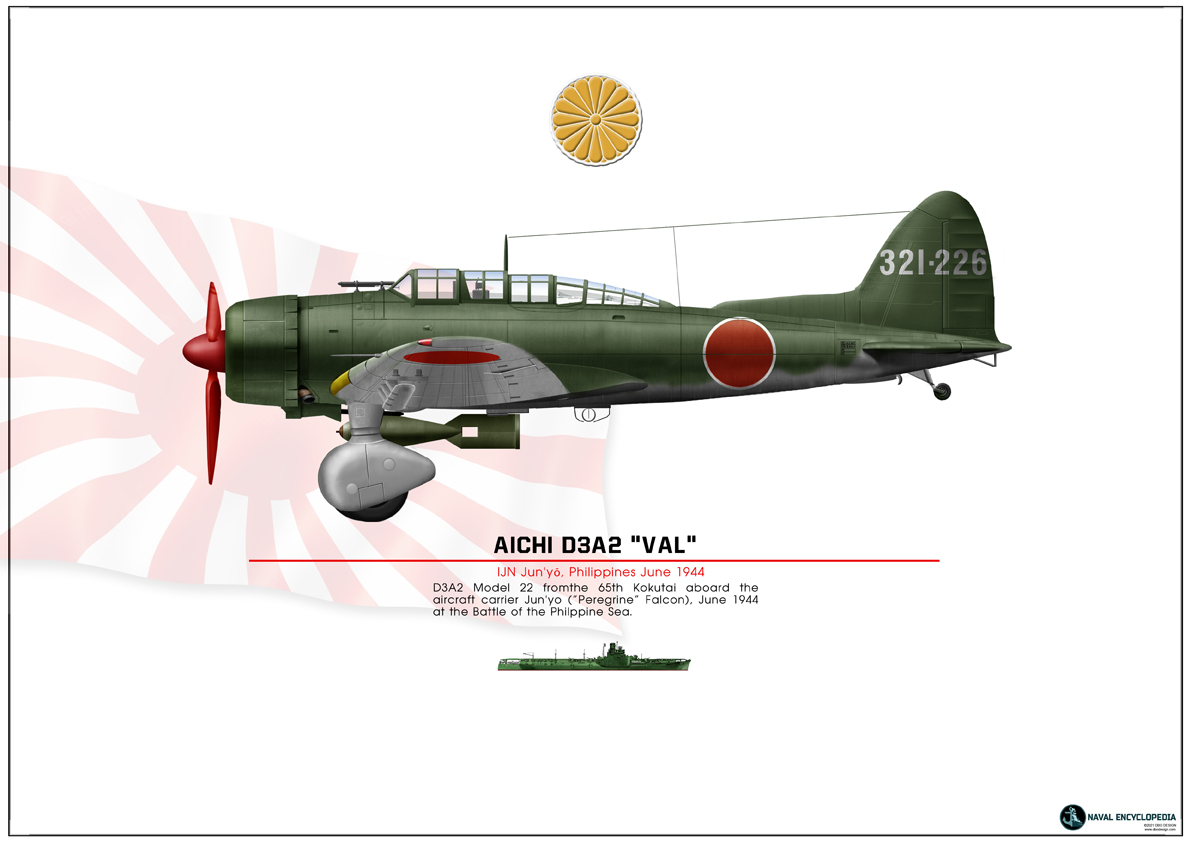
Aichi D3A “Val” Junyo
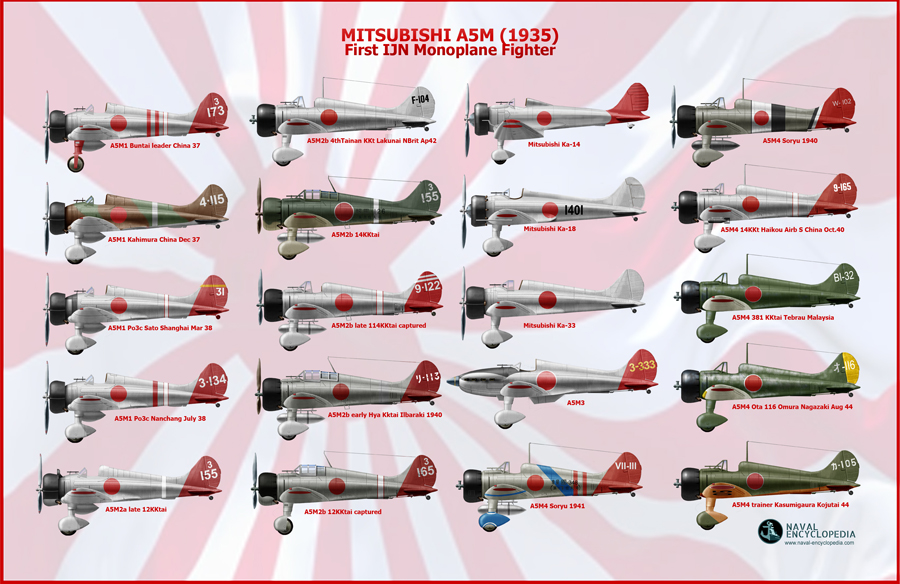
Mitsubishi A5M poster
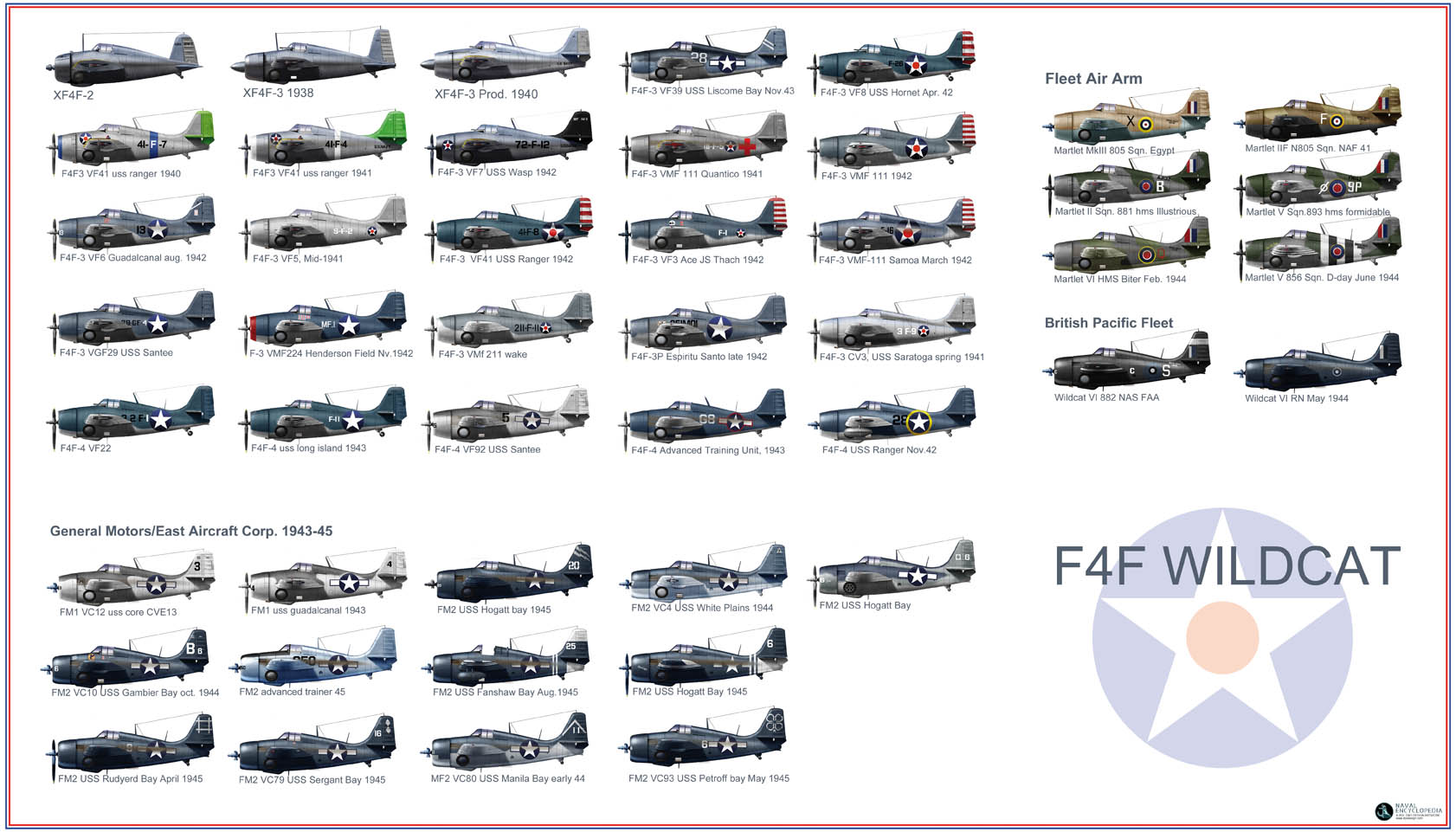
F4F wildcat
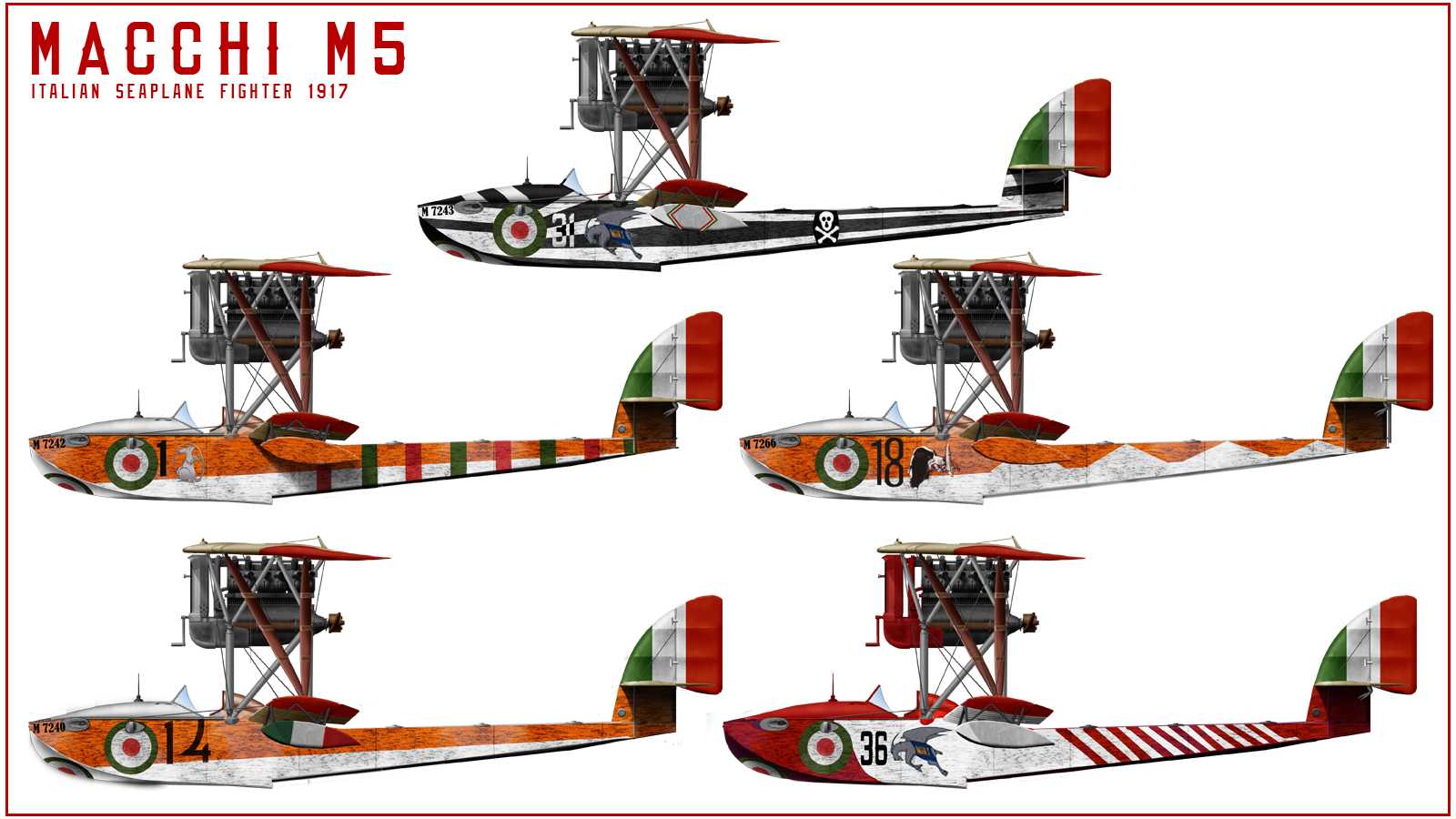
Macchi M5
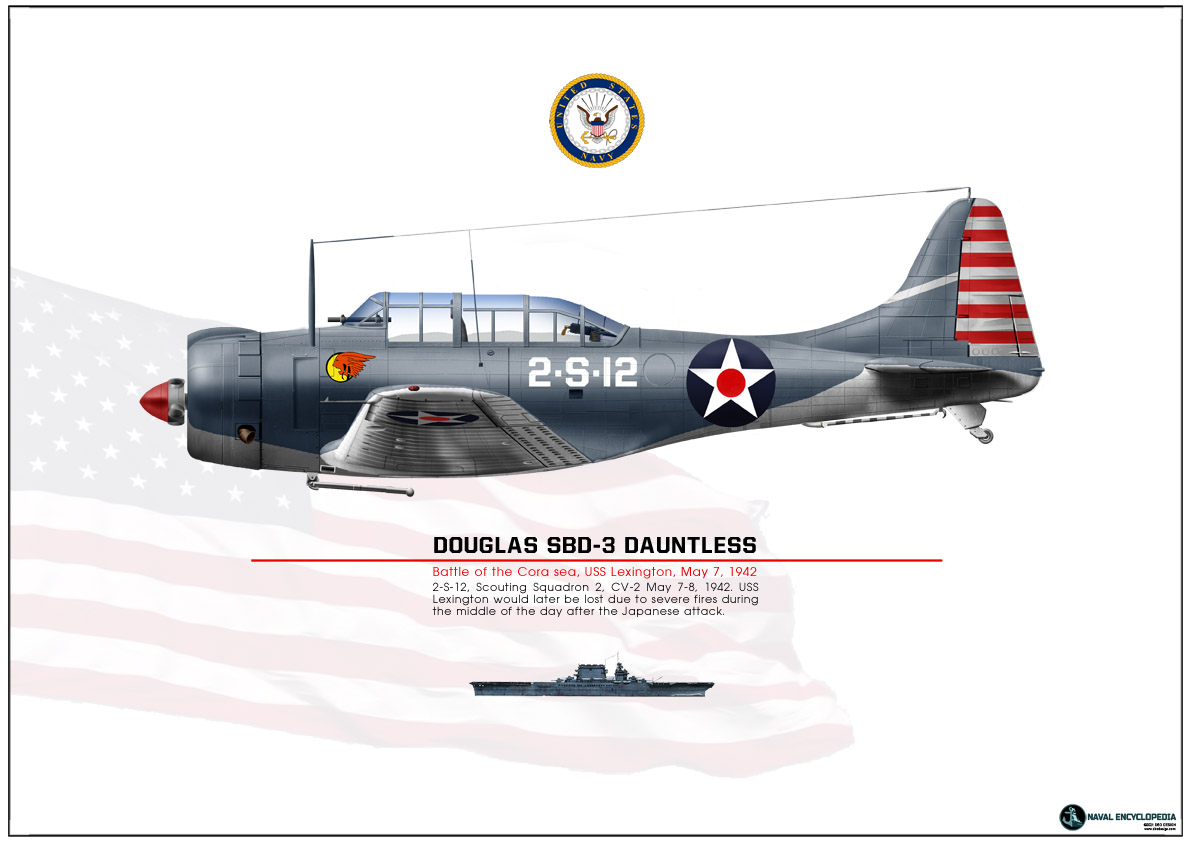
SBD Dauntless Coral Sea
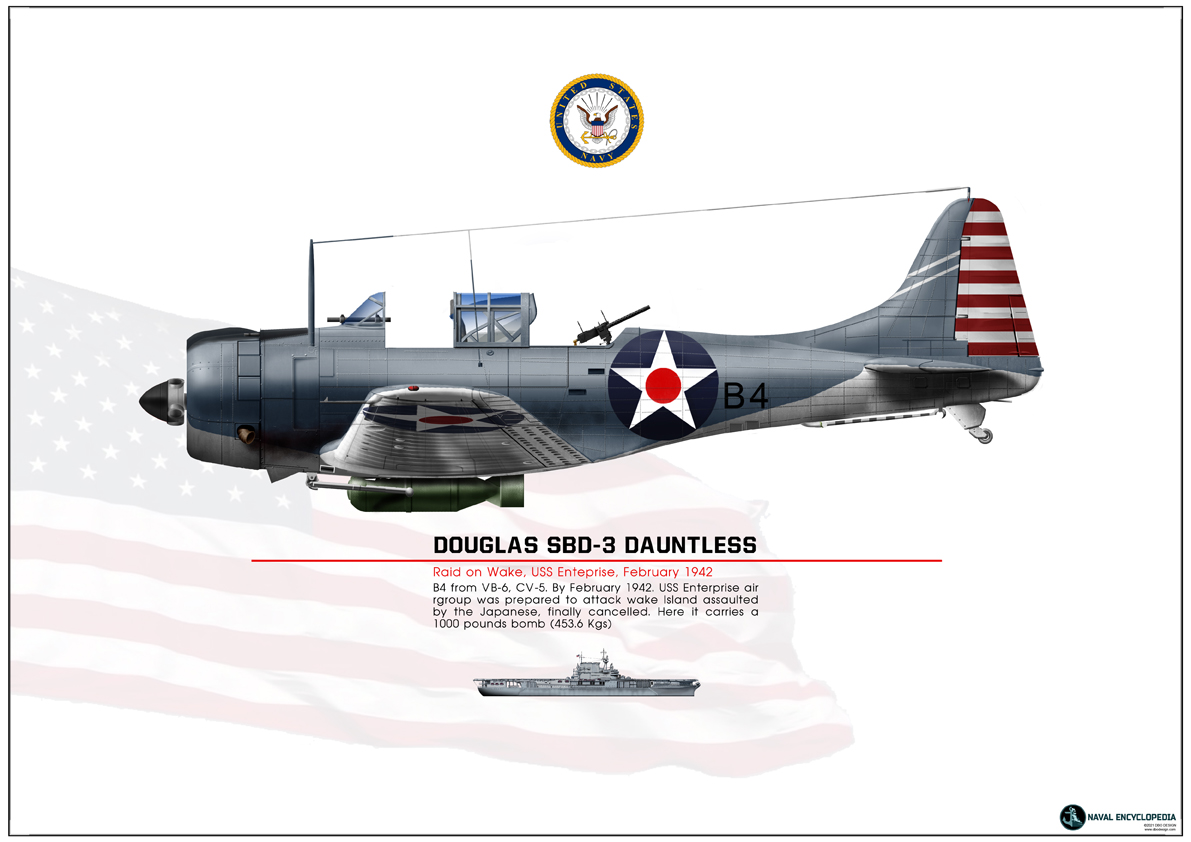
SBD Dauntless USS Enterprise
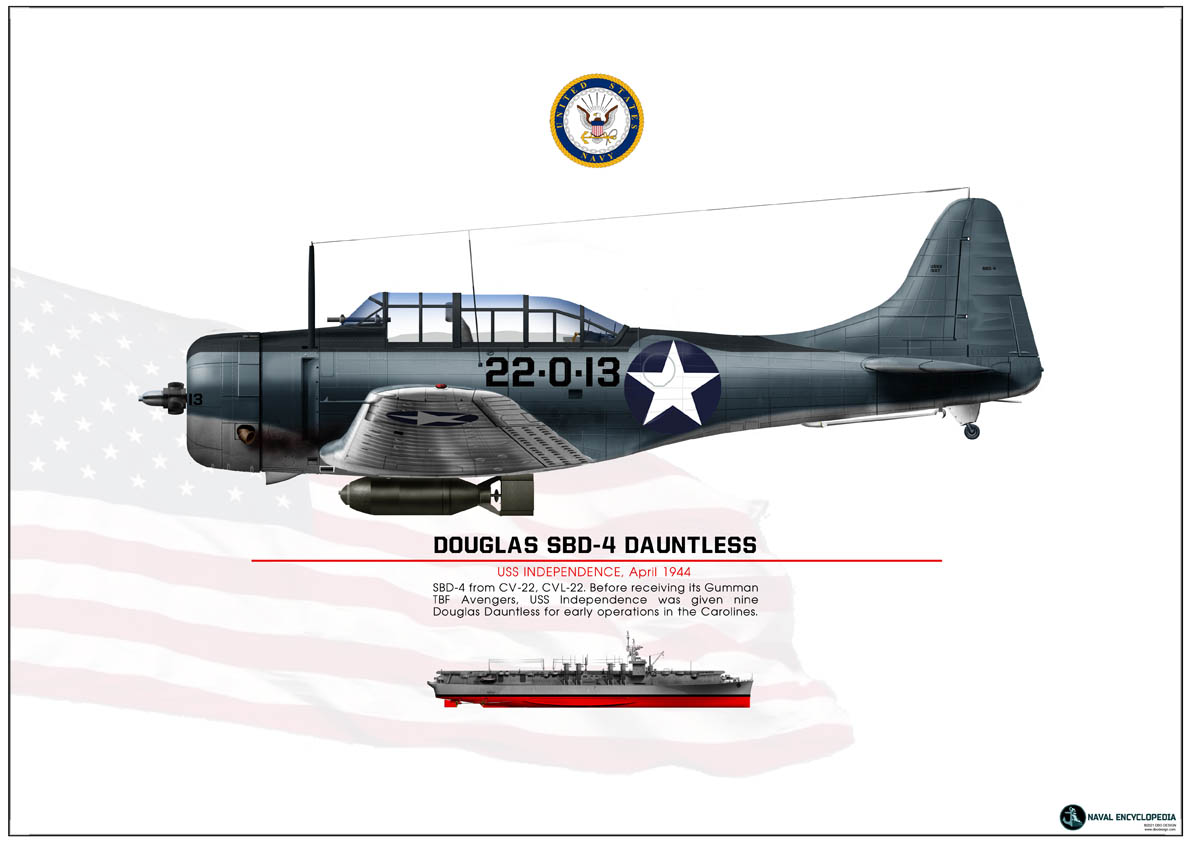
SBD-4 CV22