Marinens Flygväsende
 c200 seaplanes or land-based naval aircraft

Hawker Osprey in Swedish Service on HMS Gotland, Svenska Marinen's only aviation cruiser.
General Context: Sweden from 1900 to 1918
Sweden's Maritime Challenges
As a Nordic country located on the Scandinavian Peninsula in Northern Europe, its geography strongly shapes its economy, security, and maritime strategy: Sweden has a long coastline, for over 3,000 km along the Baltic Sea and Gulf of Bothnia. It has thousands of islands surround cities like Stockholm and Gothenburg, creating both defensive advantages and navigational complexity. It has also the borthern Arctic connection through Lapland and access to the Barents/Nordic area. Major islands such as Gotland and Öland are strategically important in the Baltic Sea. It also has dense forests and lakes, an inland terrain limiting easy east-west transport corridors and favouring seaplanes (like in Canada). Its cold climate means seasonal ice affecting northern ports and shipping routes.Sweden depends heavily on maritime trade because much of its imports and exports move through Baltic shipping lanes. The Baltic Sea is effectively Sweden’s economic lifeline. Danish Straits linking the Baltic to the North Sea, Gulf of Finland routes, Arctic and North Atlantic access, Baltic energy and communication infrastructures. The Baltic Sea is geographically narrow, shallow, and crowded, making maritime operations difficult. For the Swedish Navy and its air branch, this means the protection of shipping lanes, monitoring Russian naval activity, and the risk of blockades in narrow chokepoints. The Baltic Sea itself creates operational challenges with its shallow waters, Low salinity (“brackish” water), seasonal sea ice and dense island networks, narrow navigation channels. All this favored the air assets, provided the weather was mild.
Sweden's Geopolitical History 1900-1918
 Between 1900 and 1918, Sweden experienced a major geopolitical transition. It moved from being a cautious regional power with memories of empire toward a neutral industrial state trying to avoid entanglement in European great-power conflict. This period was shaped by the dissolution of the union with Norway, rising nationalism across Europe, rapid industrialization and competition among Germany, Russia, and Britain. In World War I Sweden considered it was no longer a great power, but memories of the Swedish Empire still influenced political thinking. It already had lost Finland to Russia in 1809 and adopted a long-term policy of neutrality during the 19th century. The country remained tied economically and culturally to Germany. Russia was viewed as the primary strategic threat.
Sweden’s geopolitical concerns centered on Baltic Sea security, Russian expansion, Scandinavian stability and Protection of trade routes. Industrialization accelerated rapidly during this era, especially in Steel, Timber, Engineering and Shipbuilding. This economic growth increased Sweden’s strategic importance in Northern Europe.
Between 1900 and 1918, Sweden experienced a major geopolitical transition. It moved from being a cautious regional power with memories of empire toward a neutral industrial state trying to avoid entanglement in European great-power conflict. This period was shaped by the dissolution of the union with Norway, rising nationalism across Europe, rapid industrialization and competition among Germany, Russia, and Britain. In World War I Sweden considered it was no longer a great power, but memories of the Swedish Empire still influenced political thinking. It already had lost Finland to Russia in 1809 and adopted a long-term policy of neutrality during the 19th century. The country remained tied economically and culturally to Germany. Russia was viewed as the primary strategic threat.
Sweden’s geopolitical concerns centered on Baltic Sea security, Russian expansion, Scandinavian stability and Protection of trade routes. Industrialization accelerated rapidly during this era, especially in Steel, Timber, Engineering and Shipbuilding. This economic growth increased Sweden’s strategic importance in Northern Europe.
The end of the Kalmar Union

The Dissolution of the Sweden–Norway Union (1905) certainly was one of the most important geopolitical events was the peaceful breakup of the union between Sweden and Norway in 1905. The union had existed since 1814, but Norwegian nationalism steadily increased during the late 19th century. It happened when Norway demanded greater independence in foreign affairs and political negotiations failed. Norway declared dissolution of the union in 1905.
Sweden mobilized militarily but ultimately accepted separation peacefully. King Oscar II accepted the settlement to avoid war. It prevented conflict in Scandinavia, strengthened the idea of Nordic peaceful diplomacy, but conversely Sweden lost direct influence over Norway’s Atlantic coastline. Scandinavian cooperation became more voluntary rather than imperial. The peaceful resolution became internationally significant because Europe at the time was increasingly militarized.
Sweden and the Great Power Rivalries

Before World War I, many Swedish elites admired the German Empire. Connections included Strong trade ties, Cultural and academic links, Military influence, and Shared concern about Russia. German military organization strongly influenced Swedish officers and defense planning. However, Sweden avoided formal alliances. With Russia and its Empire, it remained Sweden’s primary security concern. Reasons included that Russia controlled Finland after 1809. Russian naval expansion in the Baltic worried Sweden and the Russification policies in Finland alarmed Swedish opinion. Fear existed that Russia might dominate Scandinavia. Swedish geopolitics during this period often revolved around maintaining balance against Russian influence.
United Kingdom was important mainly as a naval power, reliable trade partner and guarantor of Baltic maritime balance. Britain’s naval dominance indirectly protected Scandinavian trade routes. Sweden tried to maintain good relations with Britain while avoiding commitments against Germany. Defense Debates and Internal Politics saw two major camps emerging:
The Conservatives wanted stronger military spending, feared Russia, favored closer orientation toward Germany.
Liberals and Social Democrats preferred social reform over militarization, supported neutrality and worried about aristocratic military influence.
A famous political crisis occurred in 1914 with Conservative groups organized the “Peasant Armament March.” King Gustaf V publicly supported stronger defense spending. This triggered a constitutional conflict over royal political power. The crisis showed how international tensions were affecting domestic Swedish politics.
Sweden During World War I (1914–1918)

When World War I began, Sweden declared neutrality. However, neutrality was complicated. Sweden officially stayed out of the war, but many elites sympathized with Germany. Trade relations pulled Sweden in multiple directions. Britain controlled sea access through naval blockade systems. Germany dominated parts of Baltic trade. Sweden had to navigate pressure from both sides. The war created major problems: Shipping disruptions, food shortages, inflation, trade restrictions and Naval mine dangers in the Baltic Sea. Swedish merchant shipping became increasingly risky due to submarine warfare and blockades. Relations with Germany evolved as Swedish leaders considered closer cooperation with Germany, especially against Russia. But Sweden ultimately avoided entering the war because military was not fully prepared, public opinion was divided, leaders feared economic collapse and neutrality benefited trade and survival.

The Russian Revolution and the Finnish Question in 1917–1918 changed the deal: The collapse of the Russian Empire dramatically changed Sweden’s geopolitical environment. Finland declared independence in 1917, Civil war erupted in 1918. Sweden worried about revolutionary instability spreading northward and provided limited support to Finnish White forces but avoided direct large-scale intervention. Finland’s independence meant Russia was pushed farther from Sweden’s borders, a new buffer state emerged across the Baltic and Scandinavian geopolitics entered a new era. By 1918 and at end of World War I, Sweden had preserved neutrality, avoided military devastation, strengthened industrial capacity and experienced democratic reforms while being more cautious about great-power politics. The war reinforced several long-term Swedish geopolitical principles of Armed neutrality, of a strong coastal defense in which naval aviation played its role, Baltic strategic awareness and avoidance of binding alliances (as shown by the start of the war). It led also to Economic pragmatism. Meanwhile, Aviation was born before and during the war, with both army and navy branches created.
Swedish Naval Aviation 1914-1918
From Ballooning to Aviation
The beginnings were, like for nother nations in lighter than air with a number of military balloons built. The first initiative was from a civilian explorer; On July 11, 1897, the gas balloon “Örnen” takes off from Danskön, Spitsbergen, with Salomon August Andrée. It was never found again. But the army was soon interested.The Fästningsballong (1898) was the first Swedish military aircraft, working for the Army. Then came the first class of ballons, the army and navy Drakballong m/09 with five built in 1909, derived from the German Parseval-Sigsfeld Drachenballon also dubbed the "flying sausage". In 1909, Sweden would purchase five Drachenballons from Germany to use for their military. The type would be named the Drakballong m/09, with three going to the Royal Swedish Army and two going to the Royal Swedish Navy. Two m/09s would be sent to the Swedish Balloon Corp stationed in Frosunda for training.
The Swedish Royal Navy would purchase a barge from Britain and convert it into a balloon carrier. The ship would be designed to house and operate the two m/09s the navy operated and was named Ballongfartyget No 1. Sweden would continue to use the m/09 until 1926. This was the very first naval air asset of Sweden. It served in WW1 as well.
Also in parallel, was built the "Kronan" in 1909, or Kulballong m/09, named after the company that built them, but also the flagship of the Swedish Navy in the Baltic Sea in the 1670s. These were two spherical balloons used by the Coastal Artillery (KA 1) in Vaxholm, so the Navy, with a capacity of 650 m3 hydrogen gas. The army meanwhuile used the single Drakballong typ Ä named after its designer, the French Army Captain, Albert Caquot ad an improvement of the older Parseval-Sigsfeld Drachenballon, manufactured in Germany and purchased in 1921, used by the Army's Balloon Company at Frösunda. It had a volume of about 800 m3. More types were used in the interwar (see later).
Swedish Early Naval Aviation
The Navy, sooon understood the advantages of the aeroplane for reconnaissance at sea over the few ballons that were operated from 1909. An aircraft was completely independent of the wind and could span great areas, delivering reports to bases or ships in short short time. So the Swedish Navy got its first aircraft in December 1911, a few months before the Army, amazingly. This was however a donation, only use to demonstrate its usefulness. Politicians completely ignored naval aviation, and so the development of this embryonic corps depended on further donations from individuals and organizations. In 1913 at last, a special Aviation Corps called the ”Marinens Flygväsende (MFV) was founded in Stockholm, assorted by a flying school established at the Fortress of Oscar-Fredriksborg, then at Hårsfjärden naval base. These were all French models, Bleriot land-based model, as well Nieuport and Donnet-Leveque seaplanes.
As the first world war started, this soon became a challenge for the MFV which had to enforce Swedish Neutrality over many hundred mile sof coastline with just a few aircraft to its disposal. Pilots had no experience in flying in bad weather or winter, airframes were fragile and needed frequent repairs. Still aircrews and the ground personnel managed to keep these in constant, rotating neutrality guard. Merchant ships were flew over to ensure their remained safe, others looked for for mines and foreign warships that might encroach on Sweden's own waters. When it happened, these aeroplanes needed to daringly impose their will by signalling and aggressive manoeuvers, and force them to leave Swedish waters. Swedish Naval aviators never fired any weapons at anger all these time, even so they were all unarmed, but using personal pistols or flare pistols.
Swedish WWI Naval Aircraft
The full list includes the following: -Nyrop 2 (Bleriot XI) (N:r 1), 1911–1913 and until 1916-Nieuport IV.M, 1 in service 1913–1918
-Donnet-Leveque; 2 active 1913–1918
-Farman HF.23: 2 active 1913–1917
-SW 11 (Farman HF 23): 7 purchased, in service 1914–1920.
Late war/ Post war
-Thulin B: 2 active 1915–1917-TDS Farman HF 23, 2 active 1917–1920
-Thulin G: 5 active in 1917–1922
-SW 17 (SAF H-2), 4 made, never entered service.
Thulin B (1914)
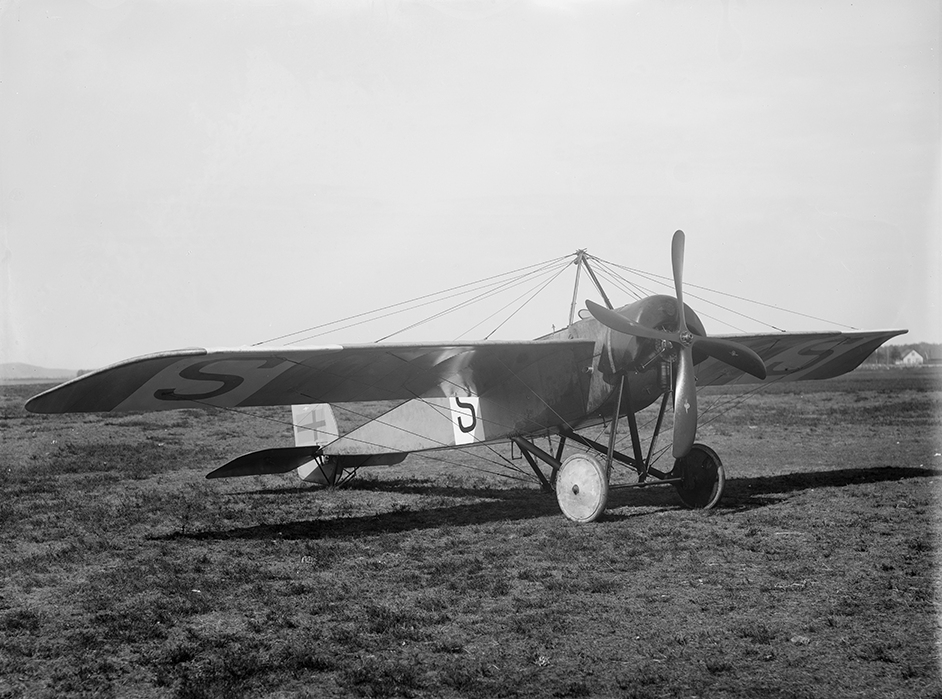
Enoch Thulin visited the “Salon Aeronautique” in Paris by December 1913 to buy a modern aircraft and replace the old Blériot XI “Nordstjernan” owned by Carl Cederström and donated to the Army, after which he made the Thulin A, a replica. He settled on the Morane-Saulnier M.S .3L while in Paris, popularized by aviator Brindejonc des Moulinais across Europe that summer and showcased at Stockholm and Copenhagen, so Thulin already had an idea of this model. Note the photos of for the latter Thulin D but is the only Thulin aicraft Creative Commons licenced photos; Enich Thulin famously flew the first purchased from Villacoublay to Sweden himself, a M.S.3G with a 80 hp Le Rhône engine, with all the licenced rights for the plane and engine in April 1914; and landed safely in Landskrona. From August 1914 it was purchased and used by the Army as N°5. see also

The Morane Saulnier MS 3G also called Thulin B was the first home grown mode, from the company named after the Swedish pioneer aviator Enoch Thulin, founder of ”AB Enoch Thulins Aeroplanfabrik” (AETA). In 1914 he obtained the license rights to build aircraft and engines of several French designs. The model B was a copy of the Morane Saulnier MS 3G, but modified with floats. Two were presented to the Svenska Marinen, accepted and purchased, obtaining the Navy registrations M I delivered in 1915 and M II in 1916 respectively. Both had a small valiant 90 hp rotating Gnome engine for 110 km/h, also made unde AETA under the name ”Thulin A”. Both served on the south coast of Sweden and both struck by accidents, written off in September 1917. Two more were sold to the Danish Army with land undercarriage, of the Thulin B type of which eight were made total in his small workshop. Four were used at Thulin’s Flying School at Ljungbyhed.
Thulin G (1917)
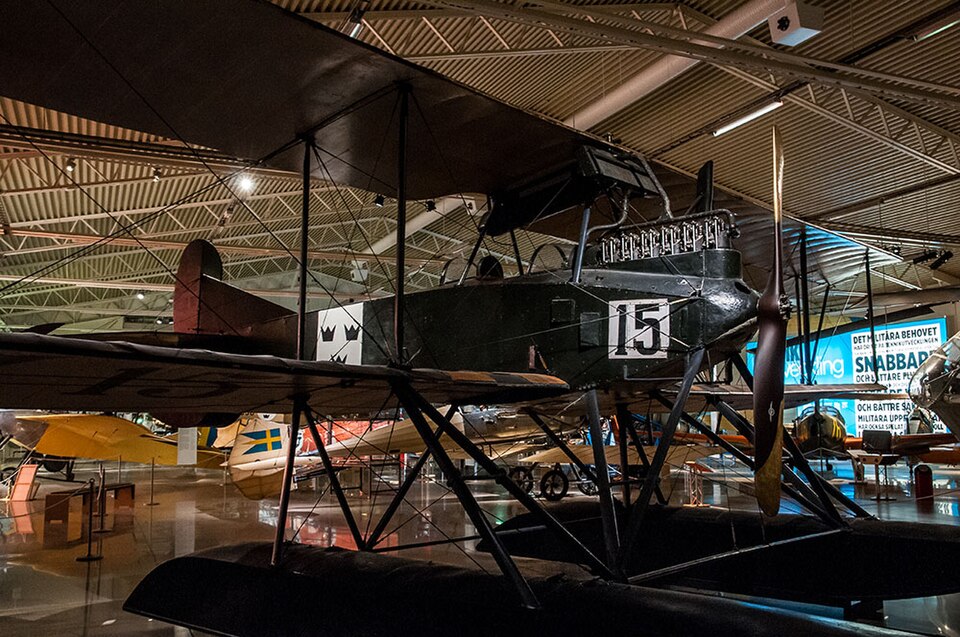
The Thulin G was the main seaplane of the Swedish Navy from 1917 until the end of the war. Also manufactured by AB Thulinverken, it was a two-seat biplane of conventional configuration licenced from the Albatros B.II. There were an observer and a pilot in separate cockpits in tandem and the upper wing was supported by 12 struts, four supports. It was powered by an inline engine in the nose and had a 2-bladed wooden propeller. The exhaust gases were led via a manifold above the upper wing. It had two floats with a broad surface and excellent buyancy and stability. In all five Type G and two Type GA aircraft (Training) were built for the Swedish naval aviation, in service until 1922. All but two were lost in accidents and an hangar fire.
Sodertelje SW.17 (1918)
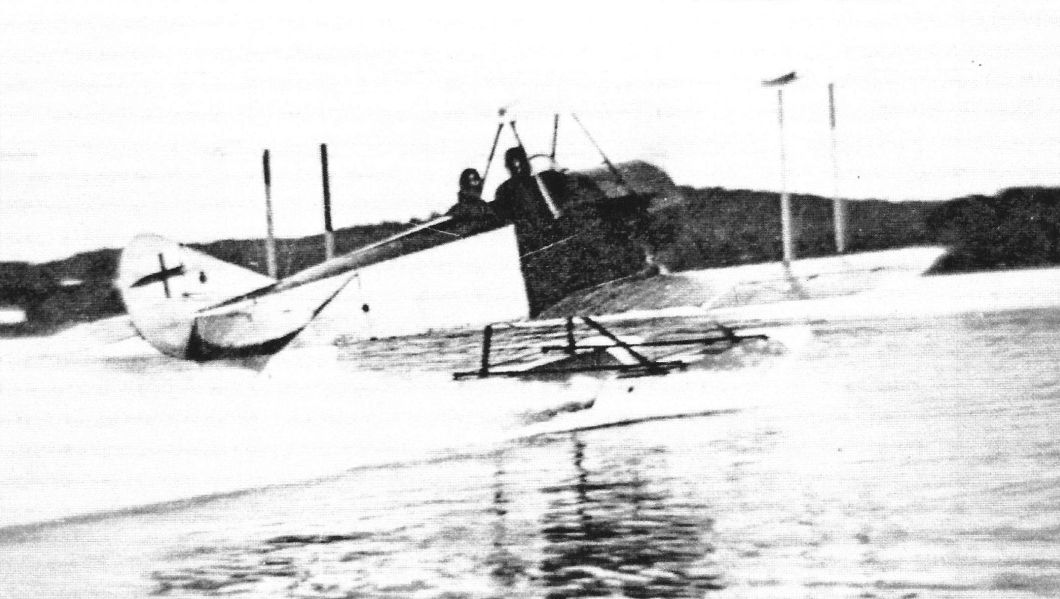
Designed by Lars Fjallback, the SAF H 2/SW 17 was a twin-float biplane quite close to the Sopwith Baby. It followed a requirement for four small flying boats on February 5,1916, to be delivered no later than May 5. However SAF merged with Sodertalje Verkstader and the contract was formally taken over, the name changed to SW 17. In July 1916, it made its maiden flight at Bjorkudden near Sodertalje. Its 80 h.p. Thulin A rotary engine made it underpowered, performaces well below expectations. Plus flights at Karlskrona showed poor flight characteristics. It was tested with skis and ended with a redesigned upper wing. It was never accepted for service, contract cancelled on March 31,1917. They were rfesold to the Royal Danish Army Air Service under an export licence signed on November 2, 1917, delivered incomplet, two later completed, flying in January 1918. One crashed in May 1918. The remainder two were not even completed and scrapped in turn. The SW 17 measured 7,10 m for a wingspan of 8,06 m, height of 2,9, wing area of 23 m2 and a top speed of 108 km/h.
General Context: Sweden from 1919 to 1939
Between 1919 and 1939, Sweden transformed from a constitutional monarchy with limited democracy into one of Europe's most stable democratic and social-democratic states. The period was marked by political reform, economic change, and a commitment to neutrality. Democratization in 1919 had the parliament approving universal and equal suffrage for women and men. Other constitutional changes were completed in 1921, and the election became the first in which women could vote and stand for office. Five women were also elected to parliament, making Sweden a pioneer in Europe. These reforms established Sweden as a full parliamentary democracy.
T2: Twelve Heinkel He 115 were ordered in 1938 and delivered to Sweden in 1939, based in Hägernäs near Stockholm.
King Gustaf V remained head of state, but political power increasingly rested with parliament. Governments changed frequently during the 1920s, with Liberals, Conservatives, and Social Democrats sharing power. Despite political instability, democratic institutions remained strong and extremist movements gained far less support than in many European countries. Sweden experienced significant industrial growth during much of the 1920s.Major industries included steel, timber, paper, engineering, telecommunications, and manufacturing. Urbanization accelerated as Sweden moved from a largely agricultural society toward a modern industrial economy.
The Great Depression after 1929 cause the Rise of Social Democracy. The crisis causing unemployment and labor unrest but in 1932, the Social Democratic Party won power under Per Albin Hansson. Hansson promoted the idea of the "Folkhemmet" (People's Home)—a society based on social welfare, cooperation, and economic security. The government introduced public works programs and economic reforms that helped reduce the effects of the Depression. Employers and trade unions increasingly resolved conflicts through negotiation rather than confrontation. The 1938 Saltsjöbaden Agreement established principles of cooperation between labor and business. This became a foundation of the modern Swedish welfare state and labor-market system.
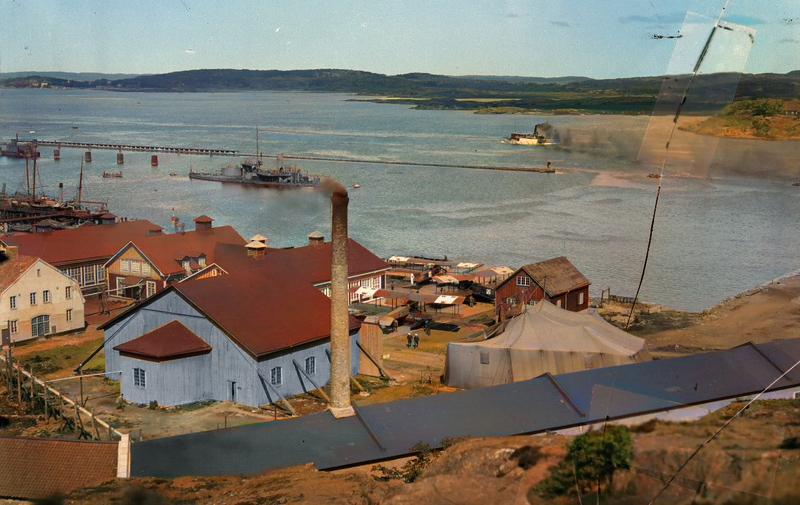
Göteborg's Naval Air Station in the interwar
Foreign Policy and Neutrality: Sweden remained outside military alliances and pursued a policy of neutrality. The country supported international cooperation through the League of Nations during the 1920s and early 1930s. As tensions rose with the growth of Nazi Germany, Sweden strengthened its defenses in 1936 while maintaining neutrality. By 1939 Sweden was a stable democracy with Social Democrats dominating politics. The foundations of the welfare state had been laid. The country was industrialized and relatively prosperous. Sweden declared neutrality and prepared to stay out of the coming war. This was reflected in the many new programs launched for the Air Force (with the creations of SAAB), the land force, and the Navy. There was a moderate fear of invasion, first from the USSR during the winter war (Sweden famously refused to let pass allies troops in support), and later from Germany after the April 1940 invasion of Denmark and Norway.
Global: The state of Swedish Military Aviation


Swedish military aviation underwent a major transformation between the end of World War I and the outbreak of World War II. During these years, Sweden evolved from having small army and navy air units into an independent air force with modern aircraft and a growing domestic aviation industry. A major milestone was the establishment of the Swedish Air Force on 1 July 1926. Before 1926, the Swedish Army operated an aviation branch of the Army and the the Swedish Navy also operated its own air service. Aircraft were used mainly for reconnaissance, artillery spotting, and coastal patrols. The 1925 Defence Act merged these aviation arms into a single independent air force, making Sweden one of the earlier countries to create a separate air service.
In the 1920s, Sweden relied heavily on foreign designs and imports. Important models included the Fokker C.V reconnaissance and light bomber aircraft, Heinkel HD 24 trainers and Jaktfalken fighters, one of the first significant indigenous Swedish fighter designs. Most aircraft were fabric-covered biplanes, reflecting contemporary technology. Expansion During the 1930s: The rise of militarism in Europe caused Sweden to reconsider its defense posture. Defense spending remained relatively modest until then, many aircraft were becoming obsolete and the air force was small compared with those of major European powers. After the rise of Adolf Hitler and growing international tensions, Sweden began a gradual rearmament program.
The 1936 Defence Act significantly expanded Aircraft procurement, Pilot training, Airfield construction, and Anti-aircraft defenses. The "Hawker Hart Era" was one of Sweden's most successful interwar aircraft, British-designed, designated B 4 in Swedish service and used for eberything, from reconnaissance, bombing to fighter tasks. The B 4 entered service after an original that was considered as world's best light bombers when introduced. Performances were close or superior to many fighters of the time. It was built locally and remained in Swedish service well into World War II. Sweden also operated Hawker Osprey floatplanes for the Navy, imported and license-built.

But interwar years saw the rise of Sweden's domestic aviation industry. After AB Svenska Järnvägsverkstädernas Aeroplanavdelning, Svenska Aeroplan Aktiebolaget was founded in 1937. SAAB was created largely because Sweden recognized that wartime conditions might make foreign aircraft purchases difficult. This decision proved crucial during World War II, when Sweden increasingly relied on domestically designed aircraft. Swedish planners expected that any future war would threaten Major cities, Industrial centers, Baltic Sea communications so the air force focused on, Reconnaissance Coastal defense, Fighter interception and protection of Swedish neutrality. Unlike Germany, Britain, or France, Sweden did not need to develop a strategic bombing force. In 1939 the Swedish Air Force had roughly 300 combat and support aircraft. Many were still biplanes. Monoplanes were beginning to arrive but were not yet widespread. This force was stronger than it had been a decade earlier but remained modest by European standards and would have been eaten alive by the Luftwaffe. Nevertheless, the foundations had been laid for the rapid expansion of Swedish air power during the war years.
Interwar Swedish Naval Aviation
The effort started on the continuation of the great war, with the Navy (Svebska Marinen) no longer possesing its own aviation branch. In 1926 as the Air Force was created as independent arm, the consequece was the forced merging of the navy branch into it. Meaning it was now tributary of the major needs, those of the land forces. However the Navy still had a say in the requirements made in its name by the Swedish Air Force.Specific Tasks and Assets of Swedish Naval Aviation

Swedish naval aviation played an important role during the interwar as conditions remained challenging, with a long coastline, numerous islands, strategic position in the Baltic Sea which made maritime reconnaissance a vital defense task. Although the independent Swedish Air Force was created in 1926, naval aviation traditions and missions continued to influence Swedish military aviation throughout the period. Before 1926 the Swedish Navy maintained its own service of Seaplanes and flying boats, coastal reconnaissance aircraft and artillery-spotting aircraft for naval forces. The creation of the Swedish Air Force in 1926 merged the Army and Navy air arms into a single service, under the centralized military aviation "Flygvapnet". Naval missions remained a major responsibility, Patrolling coastal waters, monitor shipping routes, conduct reconnaissance over the Baltic Sea, support the fleet and coastal artillery.
These missions emphasised the Importance of Seaplanes as Sweden had no aircraft carriers, no overseas commitments, only one small seaplane-launching cruiser and yet still demaning tasks dictated by its geography, noth coastal and inland, that made floatplanes and flying boats a prime asset. In addition of Coastal surveillance they could perform fleet reconnaissance and gunnery spotting, Ice reconnaissance in winter (skins replacing floats), Search and rescue. They operated from coastal stations, sheltered bays, and harbors, making them well suited to Sweden's geography.
Key aircraft included the Heinkel HD 16, HD 24 for reconnaissance and training duties, the versatile Fokker C.V adapted for several roles and became one of Sweden's most important interwar military aircraft types. But also the more modern and powerful Hawker Osprey of the mid-1930s a more modern generation of naval reconnaissance aircraft and became one of the most capable maritime aircraft in Swedish service before World War II. These were all floatplanes though, and the task of maritime bombardment and torpedo attacks was now taken over by land planes, shared with the Air Force for the Army, but operated from dedicated squadron from shore bases. Full list below.
Early Interwar Models
- Thulin GA: 2 in service (1919–1921)
- Friedrichshafen FF.33L: 2 in service 1918–1920
- Friedrichshafen FF.33E: 3 in service 1918–1929
- Friedrichshafen FF.49C: 2 in service 1919–1924
- Sablatnig FF.49C: 2 in service 1919–1926
- TDS Friedrichshafen FF.33 5 in service 1921–1929
- Macchi M.8 1 tested 1919–1922
- Savoia S.13 4 in service 1919–1924
- Supermarine Channel II: 1 tested 1921–1922
- Fairey IIID: 1 tested 1924–1925.
- Caspar S.I (Heinkel HE 1): 4 in service 1921–1929.
- Heinkel HE 1: 8 in service 1923–1929
- Heinkel S.II 5 in service 1924–1934
- Heinkel HE 4: 1 tested and in service 1926–1931
- Heinkel HD 14: Only tested, not in service
- Albatros B.IIa: 5 in service 1920–1929
- Avro 504K: 5 in service 1924–1928
- LVG C.VI: 2 in service 1921–1923
- Heinkel HE 3: 2 in service 1925–1927
More balloons
In the interwar, Sweden also tried other models, which are the following:-Fältballong m/23 ”Alto-Basso” (Kite "field" balloon, model 1923).
-Kulballong m/23 (Spherical balloon, model 1923)
-Fältballong m/30 och m/32 (Kite balloon model 1930 and model 1932 for the Swedish artillery)
-Fältballong m/30 och m/32 (Kite balloon, model 1930 and model 1932)
-Kulballong m/30 (Spherical balloon, model 1930 for the Swedish artillery troops)
WW2 Swedish Naval Aviation

Coastal Defense Strategy
Sweden's naval aviation doctrine focused on defending the Baltic approaches, Stockholm archipelago, Major naval bases and its own Merchant shipping routes. Aircraft were expected to detect enemy naval movements early and provide intelligence to both naval commanders and coastal artillery units. The mission was defensive rather than offensive. Sweden did not seek to project power abroad; instead, naval aviation was intended to support neutrality and territorial defense. Air Stations included Coastal air stations, Seaplane bases, Maintenance facilities and pilot training programs, with many bases located near key naval facilities and strategic waterways. The combination of naval aviation, coastal artillery, and the fleet formed an integrated coastal-defense system designed to make any invasion of Swedish waters difficult.
Sweden used the land-based Caproni CA.133 for coastal reconnaissance, it was also made under licence.
Rearmament in the Late 1930s as tensions increased in Europe led Sweden to strengthen its armed forces and the 1936 defense reforms provided resources for more aircraft procurement, better pilot training, Improved maritime reconnaissance capability and Expanded coastal defense planning. Although Sweden's naval aviation remained relatively small compared with the maritime air forces of Britain, Germany, or Japan, it was modernizing steadily by 1939. By that time maritime reconnaissance was one of Flygvapnet's most important missions. Modern floatplanes such as the Hawker Osprey supplemented older aircraft. Sweden possessed a capable coastal surveillance system for protecting its neutrality. The interwar period established the organizational structure, doctrine, and aviation industry that would allow Sweden to rapidly expand maritime air operations during the Second World War while remaining officially neutral.
The sharing is exemplified by the modern SAAB B17S floatplane adapted form the Dive Bomber, first SAAB important model. Two-engine bombers like the Junkers 86K, used as land-based antiship torpedo bomber or the more modern He 114A and He 115 (locally known as the T-2) capable also of attacking with a torpedo if needed showed the Sweden was well equipped to deal with an invading naval force underway if needed, after its reconnaissance models had spotted and identified, located this force. Sweden in case of a repeat of Weserübung was far better equipped and prepared
WW2 Models in Service
S5 (Heinkel He 5 ”Hansa” 1927-1945)

First monoplane in service with the Swedish AF, this cantilever all-metal model from Heinkel really was all Sweden needed to boost its naval reconnaissance force. Called the ”Hansa” there were many variants designated S 2, S 3 and S 4, over a decade. In all, 40 Hansas were built in Sweden:
-The S 5 was a copy of the Heinkel He 5/s from Svenska Aero AB (controlled by Heinkel): 4 in 1927. Bristol Jupiter VI-A 450 hp.
-The S 5A (He 5/t) was a 3-seater of 1927-32, 10 delivered with a HF radio set, 450 hp Bristol Jupiter VI-A engine, 2x 8 mm MGs
-The S 5B (He 5/t), 1 prototype from CFV in 1933. 600 hp Nohab Mercury My VI-A engine (licenced Bristol Pegasus I)
-The S 5C (He 5/t T.B). Townend-ring, new cockpit design, new tail, short floats, 600 hp Nohab Mercury My VI-A engine: 9 delivered 1934-1936 by CVV.
-The S 5D (He 5/t) Nohab Mercury My VII-A 675 hp +3b metal prop: 4 delivered by CVV 1936-1937. 2x 8mm LMGs
Typically they had one 7,9 mm machine-gun fixed forward, one in a flexible mounting at the rear for about 12,2 m and a Span of 16,8 m.
The case of HMS Dristigethen
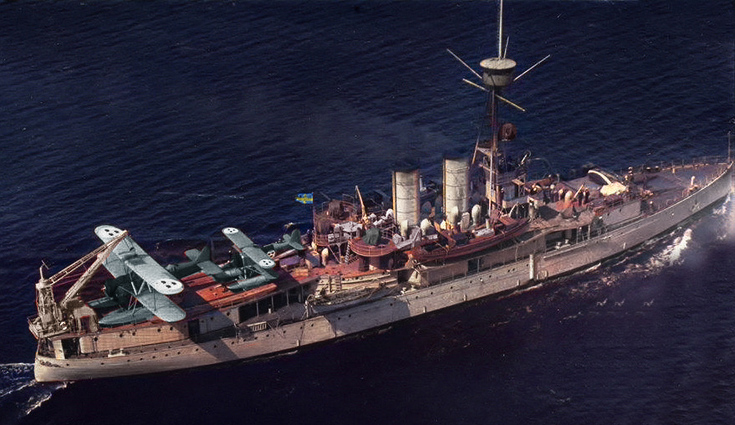
In 1927, it was decided to convert HSwMS Dristigheten into a depot ship for the floatplanes of the Swedish Coastal Fleet’s aviation. The 21 cm cannons and light artillery was removed and four the 15.2 cm (6 inches) cannons were later landed to be reused by Swedish auxiliary cruisers used during WWII. The new focus was on air defense, with four 7.5 cm m/15-23 models and four 8 mm machine guns m/14-29. A new superstructure was also constructed, extending over the entire stern, including workshops. Its roof also had parking space for floatplanes, lifted by a crane mounted at the far aft. There was no catapult, so the planes were simply lowered at sea for taking of. In 1939, these were Fairey IIIs. She could operate 2-3 seaplanes T1 Heinkel HD 16, or the T4 Heinkel HD 19.
S9 (Hawker Osprey) (1935)

The Hawker Osprey was adopted a bit "by default" as the Swedes knew and built already locally its close cousin, the Hart. It was chosen for a very specific task: To equip Sweden's brand new aircraft cruiser (the only aircraft carrier Sweden ever had) HMS Götland. This light cruiser had its entire aft part converted to carry and operate seaplanes, in order to screen for the fleet.
The singular HSwMS Gotland was designed during the interwar as a jack of all trades, built on a shoestring budget, typical of the post-1929 crisis state of military budgets across europe. A bit like the Dutch Tromp class built afterwards, she was supposed to fill many roles at once. Sweden remaining neutral, HSwMS Gotland never met the chance to test her metal in WW2, probably for the best, but at least was the first to spot the Bismarck… She remained an interesting design that was never repeated (before helicopters became a thing): The Flygpanskryssare. She operated her seaplanes until converted to an AA cruiser in 1944 and was still around after another refit in 1953-54 until decommissioned in 1956 and stricken in 1960.

However the question of her air group back in 1927 when she was discussed, was open, as the eight aicraft she was about to carry (one on catapult ready to go, 2-4 more on deck to take her place, 3 or more in the hangar) had to answer a draconian set of requirements. For this, the S5 Hansa had no folding wings and could not fit. t's in Britain that the ideal model was found, with folding wings and sufficient performances in range. The Hawker Osprey was a derivative of the Hart, the Swedish Air Force already operated, as a light bomber. Four Hawker-built were purchased, powered by a Bristol Pegasus IM2 radial piston engine and delivered in 1934 and after evaluation, 42 built under licence by AB Götaverken with a NOHAB Pegasus IU2 engine from Trollhättan. It was the same but with floats, and purchased in Britain, but this version had a 600 horsepower (450 kW) Swedish-built NOHAB Bristol Mercury radial piston engine, plus interchangeable wheel and float landing gear. Only six were built as the S 9, until 1944, they were then passed on training from shore bases.


The cruiser Gotland, only aviation cruiser of Sweden and operating the type.
The S.9 was made of steel and aluminium tubes covered with canvas and fitted with Short Bros. aluminium floats and foldable wings, convertible wheel landing gear. The forward fuselage ad a full aluminium plating and the cownling was NACA profiled. The wings were covered with ply and impregnated canvas and the observer/radio operator and MG-gunner was turned to the tail. After 1944, three ended as target towing aircraft, wiht land undercarriages. They measured 9,64 m long for a wingspan of 11,28 m and weighted 2.450 kg. fpr a top speed of 230 km/h. This was a shame that only six were procured, because the cruiser could carry up to 11 of these. Those on the quarterdeck were moved around on trolleys and rails to the catapult that was traversed inline to take on a new model, then turned traversally to launch, operated by compressed air. To be retreived, they land on water as she ship executed a circle manoeuver to "break waves" and create a short-lived pocket of calmer seas. It closed to be lifted aboard by a crane. Tests of a ”drag sail” towed behind the ship for recovery were also done but not adopted as the ship had to stop for this to work. In practice, they rarely returne dot the cruiser once launched but gained a shore base or a covered bay along the coast.
T 3 (Junkers Ju 86K 1939-1947)

The first standard medium bomber of Germany, before the legendary HE 111 and Do 17, was the Ju 86, a true trailblazer. Studied from 1933, tested in 1934-35 and approved in 1936, c900 were made for the Luftwaffe, and it proved extremely successful at export (Austria, Bolivia, Chile, Hungary, Portugal, Romania, South Africa (you saw that right), Spain, not even spealing of the civilian variant, as at the time this was the initial model when officially presented. Sweden also adopted it. Locally it was called the B3. Technically the 1936 B3 (Ju 86K) could be used for naval bombing, albeit they belonged to the Army. Same could be said from the 1944 B 18 to replace them and made by SAAB, as a later torpedo bomber version, T 18B, was ordered...
The Navy however got the T3. In 1944 indeed, Wing F 17 at Kallinge (Ronneby, south coast) was formed under Command of Col. Torsten Rapp, later would Supreme Commander of the Swedish defence. His goal was string co-operation with the Navy for anti-ship support, with the model modified to carry a standard naval 53 cm diameter torpedo. Navy officers were invited to take part in the crew as air observers. Albeit the new squadron was scheduled to operate the SAAB T 18B, it was delayed, so a stopgap was filled by modifying the B3 as a torpedo bomber. Fifteen B 3B and thirteen B 3D in all were transferred from F 1. That version had two 905 hp Polish made Bristol Mercury XII under licence, made by SAAB. Twelve in all wete fitted with torpedo and mine-launching gear.

They were ready for operation by the spring of 1945. The usual payload was a torpedo m/41 of 850 kg, warhead 180 kg or the m/F:9 mine of 900 kg, paradropped. All 12 modified T3 entered the 3rd (Yellow) Squadron at F 17. Meanwhile the less powerful (880 hp engine) B 3Bs remaining were only fitted to drop the n/F:7 mine and entered the 2nd (Blue) Squadron. However they also could carry a torpedo. However this was only for attacks and usually they flew reconnaissance missions over the Baltic. The defensive armament was three 7,9 mm MGs on flexible mountings. By 1945 standards they were slow at 350 km/h. They were replaced as soon as the T.18B was available.
S12 (Heinkel He 114B-1 1941-1949)
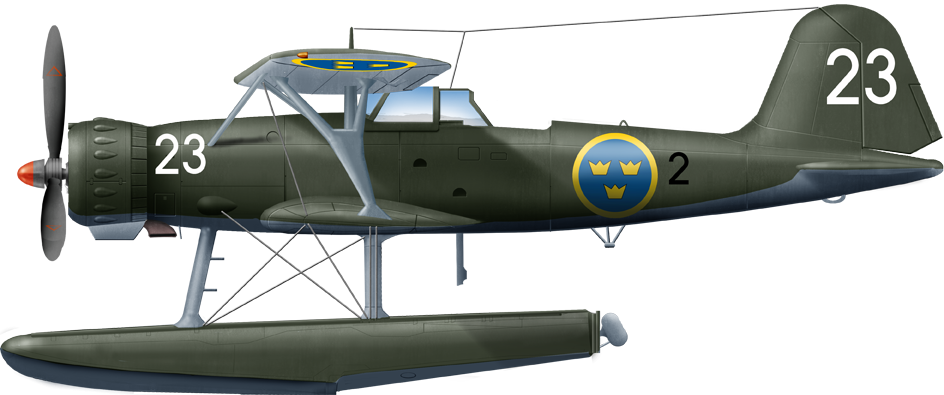
The S 12 was a modern reconnaissance aircraft of the Swedish Air Force which only stayed active for three years. It was the Swedish Heinkel He 114A, which flew at Warnemünde in 1938 by future General Nils Söderberg and the company proposed it for purchase. Its origin was a 1935 project from the German Reichsluftfahrtsministerium to replace the He 60 floatplane. Three competitors were contracted (Ar 95, Fw 62 and the He 114, with the latter chosen). This odd biplane, was an extreme sesquiplane, as its lower wing was very short and elliptical so it was mid-way with a high wing monoplane. The top wing had N-struts and interplane of Y-struts, two floats and a gunner/observer, facing rearwards. Trials in 1936 were poor and fixes were made, but not enough to cure its take-off and landing issues in heavy sea. This however was more of an issue in the North sea than the Baltic, which suited especially the conditions off Swedish coastline.
Almost refused for is faults, it was cleared for export, and among others, sold to Sweden as the He-114B-1, with 12 ordered in November 1939 under the designation S 12 (for "Spaning", Reconnaissance) and a further 27 purchased some later. However with the invasion of April 1940, deliveries stopped, these orders were requisitioned by the Luwftaffe, leaving Sweden with none. However later, an agreement was found, and twelve used and dismantled ones were delivered to the Workshops at Västerås, having a complete overhaul before service and entering the 2nd Squadron, Wing F 2 at Hägernäs. They had a BMW 132 K engine rated for 830 hp of 330 kph, and were defended by a MG.34 7,9 mm. With the new SAAB S 17BS entering frontline service, S 12 ended in training from 1943 and some were lost. In 1945, the six remaining ended as target tugs.
T 1 (Heinkel HD 16 1928-1939)

HD.16 from pinterest, showing a torpedo.
The Swedish Navy tested Heinkel models already by 1925-1926 like the HD 14. However it did not matched its requirements. Heinkel improved it and by February 1928, presented the HD 16, tested in Germany later that year and followed by modifications asked for. When approved, they flew to Sweden, and served as the "T 1" N°20 and 21 (later 220, 221 and by 1931 2120 and 2121). The engine was a 14-cyl. Armstrong Siddeley Leopard twin radial rated for 675 hp and for the Navy their great adavantage was to carry a 45cm 800 kgs Swedish torpedo type m/17. For defence it had a ring-mounted 7,7 mm LMG from the rear seat of the tandem, and also acting as observer. They trained pilots to the art of airborne torpedo attacks, the first retired in 1938 and the other in 1939. It was slow, grossly underpowered, and called the ”the Summer House” with a wingspan of 18 m and length of 13 m for a max TO weight of 4,47 tons.
T 2 (Heinkel He 115 1939-1952)

The T 1 procured the experience of airborne torpedo attacks to the Navy, but also clearly showed any of such models needed more power. One solution was a twin-engine model, and so another Heinkel design wa slooked after in 1938, the He 115. Twelve A-2 were ordered by the summer of 1938, delivered to Wing F 2, Hägernäs in April-October 1939 as the "T 2" numbers 101-112. Six more were ordered but never delivered in 1940. Six were also operated by Norway before the German Luftwaffe took all remaining order after september 1939. The He 115 was robust and more powerful than the HD.16, but still slow (and it was a floatplane, so drag a plenty) for a weak defensive armament. The Swedish 115 A-2 had two BMW 132 K engines rated each for 850 hp later replaced by licence manufactured Pratt & Whitney Hornet. Its advantage was to carry a torpedo m/38 or m/41 or two 250 kg bombs. Trials were successful and in service they played their part in the neutrality guard. Apart torpedo attacks, and as a bomber, it was trialled to work with the fleet in smoke screening or long range reconnaissance. Attrition took five of them in WW2.
After the 9 April 1940, Germany occupied Denmark and Norway, and then dictated demands to Sweden, that were refused, leading to a crisis. From then on was a fear of invasion and the more immediate threat was no longer USSR in the Eastn but their southern neighbour. T 2s left Hägernäs for Gålö, south of Stockholm for example and the base was expanded, and benefited the presence of the Dristigheten and Rane as floating accommodations and AA cover ships. The base of Märsgarn, south of Gålö was also developed, as well as Gryt and Loftahammar. Seaplanes could be deployed there and benefited from a good camouflage. Those retained at F 2 Hägernäs were used for training until 1945. The T2 was considered obsolete in 1946.
Dornier 24

The Dornier 24 replaced the Do-18 from 1937, with three engines in a tractor configuration rather than two in a push-pull one. This all-metal high wing monoplane neeeds no introduction. It was the German Catalina, except not having amphibious capabilities. 279 were manufactured until 1945 and it was widely exported. Sweden on its part purchased none, but on 31 October 1944, a German Do 24 (CM+RY of Seenotgruppe 81) made a forced landing in neutral Sweden, was impounded and eventually bought, and remained in Swedish service until 1952.
Saab B16A

Swedish designations: B 16, S 16, T 16, and Tp 16. Sweden required new types in 1938 and looked for a twin engined bomber as interim replacement for the Ju 86 (B 3) before the new Saab 18 was fully developed. After September 1939, procurement to Germany was no longer an option. It also led to the cancellation of an order for sixteen 16 Bréguet 694s, whereas an order for Dornier Do 215s also fell through. Sweden turned then to Italy, still neutral and just like a contract for the Navy, acquisring two former destroyers and two recent torpedo boats, that turn ugly when Italiy entered the war and they were already underway to Sweden, later immobilized by the British (Pislander Affair) at least aicraft could fly. So the Sweded showed the Caproni Ca.313, and signed a contract for 54 on 20 August 1940, and more for a total of 84 for 39,900,000 Swedish kronor, even, so Italy was already at war since June. To go with them Sweden also purchased Fiat CR.42 biplanes and Reggiane Re.2000 monoplane fighters, all ferried between 1940 and 1941.
However in service, the SAAB B16A, as these Caproni were locally modified, were less durable than expected. Attrition took its toll and between 1940 and 1943, 23 crashed in F 3, F 7 and F 11 squadrons. Three more were shot down by German fighters on 18 and 23 May 1944. Soon they "enjoyed" the nickname of 'flying coffins'. They were also prone to engine fires, especially as Sweden used the highly senstive special fuel "Bentol" that contained alcohol, due to fuel shortage in Sweden. The coating of the floats (cork) melted away and this also corroded the fuel tanks, cauisng leakages and fires. When the Swedes started to use them for dive bombing, the structure did not hold up. On 10 June 1942, one crashed in a dive when the wings failed. It ws also discoevred that most parts had poor manufacturing standard. A modification programme solved many issues, but the model was obsolete by 1940 and almost none were flying after 1944, especially as the new T18B entered service. 12
SAAB B17BS

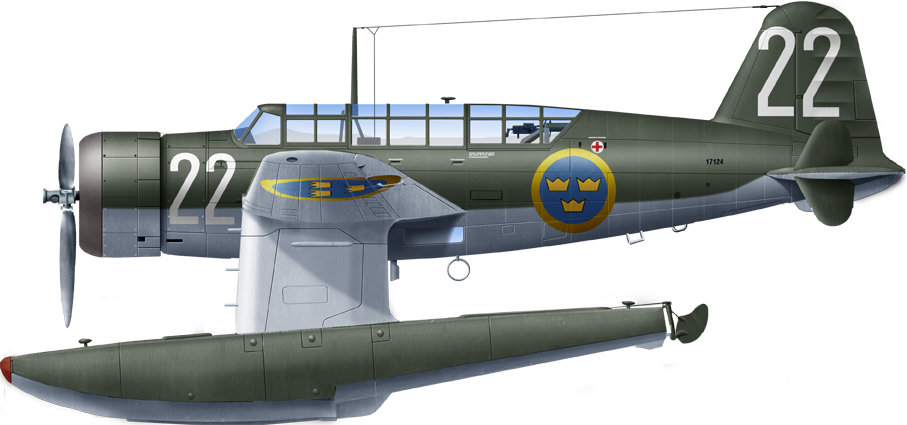
Alongside the SAAB B17 dive bomber that was partly deployed in coastal bases to work in coordination with Navy fortifications, the Navy obtained the SAAB 17BS floatplane version. The SAAB 17 was related to the former ASJA L10, inspired in turn by the Northrop 8-A 1. This was the first SAAB model, a land-based dive bomber and multirole cantilever all-metal model, to make Sweden independent from imports. A floatplane version called SAAB 17 BS was decided upon in 1942 as a replacement for the 1926 Svenska Aero S 5, licence-made Heinkel HE 5. Like the 17 B version it was powered by a licenced NOHAB Pegasus XXIV rated for 980 hp. Performances were not stellar, and it needed extra stabilization, but it proved extremely robust and 38 were manufactured in 1943-44 for the needs of the Svenska Marinen, active with F 2 Hägernäs naval support unit, until 1948. It was not replaced.
SAAB T18B

The SAAB 18, the "Swedish Do 17" needed to replace for the Navy the B 3 (Junkers 86K) for strategic reconnaissance and torpedo bombing. It first flew in July 1942 by SAAB’s test pilot Claes Smith. The bomber was adopted as the B 18 and reconnaissance model S 18, with the torpedo carrier T 18B ordered last. It was powered by copies of the Pratt & Whitney Twin Wasp STW C-3 engine rated for 1.065 hp. The bomb or torpedo load was 1.400 kg in the internal bomb bay and external hardpoints for eight 50 kg bombs.
It was defended by one fixed, one ring-mounted light MG. The first unit took delivery in September 1943. Later they were upgraded to the Daimler-Benz DB 605 engine license-built by Svenska Flygmotor AB, rated 1.475 hp each. The first B18B was delivered in October 1945, fitted with the new bomb-sight BT9 and capable of carrying rockets and having two forward 13 mm autocannons. In 1949 ejection seats were fitted and the production ended with 120 manufactured. They were operational in 1945-49 at Wing F 1 Västerås.
Being the latest variant, some 62 T 18Bs were built and assigned to TB Wing F 17, Ronneby in 1947-1948. They all had the late DB 605 engines. Torpedo launching proved problematic and this tactic was abandoned in 1947. They were all reconverted as Bombers, never used served as torpedo aircraft. One tested the 57 mm Bofors L/50 in the bomb bay (40 shells) plus two 20 mm autocannons in the nose. The were also tested to carry the antiship missile RB 04.
Next stop: The Cold War Swedish Naval Aviation

During the Cold War, Swedish naval aviation (Marinflyget, or Navy Air Arm) was relatively small, but it played an important role in Sweden's strategy of defending its long coastline and territorial waters against incursions—especially from the Soviet Union. Sweden remained officially neutral, but its military planning was heavily focused on countering a possible Soviet attack. Main missions were Anti-submarine warfare (ASW), especially after repeated submarine incidents in Swedish waters, like U-137 near Karlskrona in 1981. By the 1980s Sweden conducted extensive ASW operations against suspected foreign submarines (not just Soviet). It operated naval helicopters with dipping sonar and hydrophones, depth charges, lightweight torpedoes and surface-search radar on some variants. They could rapidly investigate sonar contacts and coordinate with surface ships and coastal defenses but relatively close to shore.
Major models included the HKP 1 (Vertol 44), HKP 2 (Alouette II) 13 purchased as well as the HKP 4 (Boeing Vertol 107/Kawasaki KV-107) whih became the backbone of Swedish naval helicopter operations from 1970 onward. It was equipped for serious ASW work. There was also the HKP 6 (Bell 206) with naval versions that could be armed with torpedoes and depth charges and participated in anti-submarine operations. Some even dropped live depth charges during real ASW incidents in the 1980s.
Swedish naval aviation was organized into helicopter squadrons based on both the east and west coasts. Unlike many NATO navies, Sweden did not operate aircraft carriers or large shipborne air groups. Naval aviation was almost entirely helicopter-based and worked closely with Surface combatants, Submarines, Coastal artillery, Coastal Ranger units (Kustjägarna) for defending Sweden's archipelagos and coastal waters rather than projecting power overseas. A notable feature of Swedish Cold War defense planning was the division of labor between the Navy and the Air Force. The Swedish Air Force handled most long-range maritime strike missions using aircraft such as the Saab Lansen and later the Saab 37 Viggen armed with anti-ship missiles. Naval aviation focused on coastal surveillance, submarine hunting, transport, and rescue...
The never was Swedish Aircraft Carrier (1946)
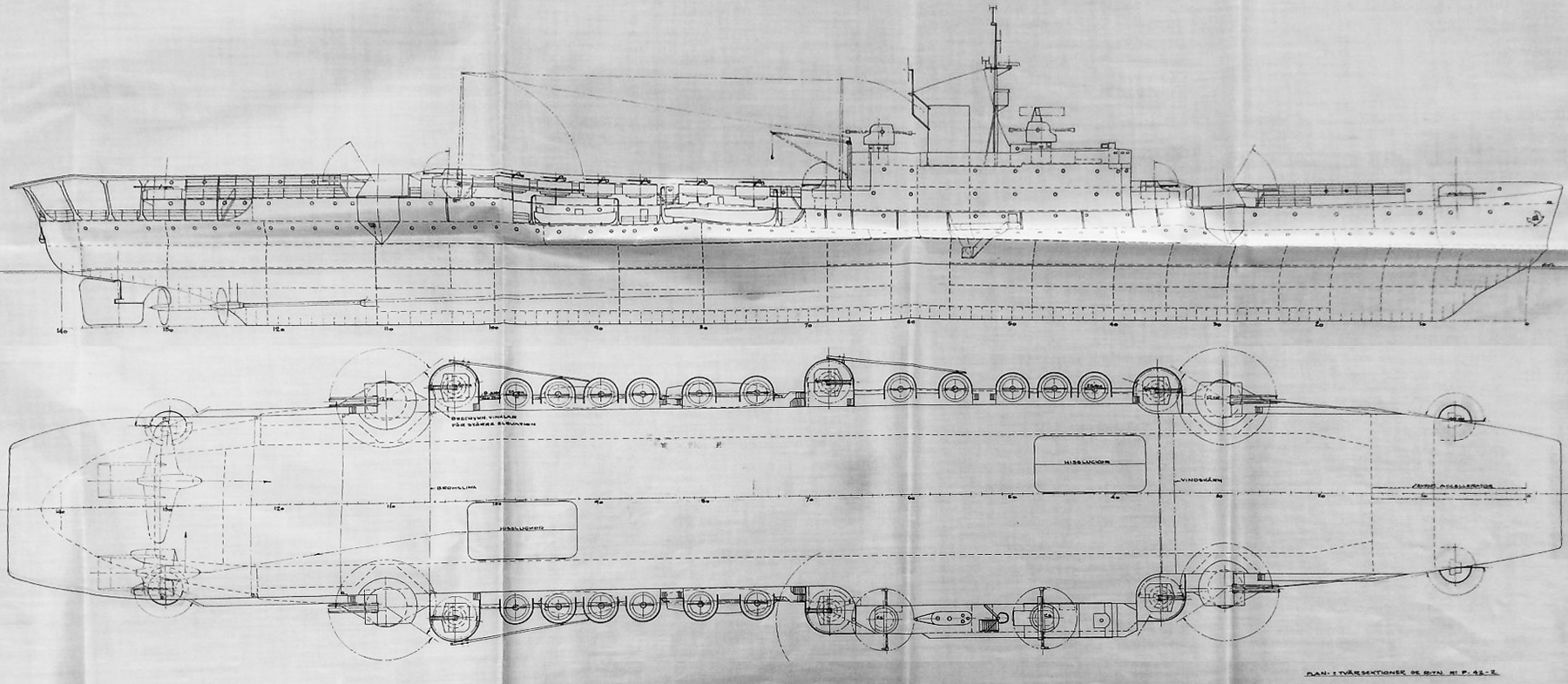
A topic that can only start with the projected "hangarkryssare" (hangar cruiser) allegedly projected to aletrnate, and later replace the Gotland as a true aircraft carrier. It would have been equipped with De Havilland Sea Vampire jets likely licenced-made by SAAB. A few drawings dated in May 1946. It was very small, slow (fleet operations limited) and had an icebreaker bow. Flying jets would have been a challenge at that size. According to a short article by Bo H. Hallenius is from Warship International, N°1, 1979, "HMS Ornen" already had been proposed as a carrier in 1925 before it was decided to build the Gotland. The hard truth is that such a carrier was unneccessary for the Baltic. Most aircraft had the range necessary to cover it after 1946. Anway a set of 1:200 plans was released for consideration by the naval staff dated 28 May 1946. 1

Specs:
Length overall 148.2 m, designed waterline length 140 m, overall deck beam 28.4 m and waterline beam 20 m, sesign draft 5.5 m.Displacement, standard: 7800 tonnes, full load: 8100 tonnes
Powerplant unknown, likely similar to the one on the Tre Kronor class cruiser for 28,000 shp and 25 knots.
Protection: 75 mm waterline belt+ 25 mm torpedo long. bulkheads, 25 + 50 mm deck.
Armament: 8x 12 cm guns in twin turrets, 16x 40mm Bofors (single and twin mountings), 17x 25mm autocannons.
Aircraft carried: 20 de Havilland Sea Vampire or Saab JA21.
Crew: 535 men
Read More and Sources
Svenska vingar: Svenska militära flygplan och helikoptrar, Bo Widefeldt & Åke Hall, s. 9-13links

avrosys.nu
marinkamraterna.se
fht.nu
forum.flyghistoria.org
soldf.com
ka3kamratforening.se
Marinens Flygväsende
Marinflyg_(Sverige)
Swedish_Air_Force
hangarkryssare 1946-2
Portal on Swedish Aviation
Swedish seaplanes and naval models list
Model Kits
SAAB SB17B Tarangus 1:48, Marivox 1:72Saab B-18A Kora Models 1:72
Junkers Ju 86K-5/T 3B Kora Models 1:72
- Lohner E (1913)
- Macchi M3 (1916)
- Macchi M5 (1917)
- Macchi M7 (1918)
- Ansaldo ISVA (1918)
- Short S.38 (1912)
- Sopwith Baby (1916)
- Short 184 (1916)
- Fairey Campania (1917)
- Sopwith Cuckoo (1917)
- Felixstowe F.2 (1917)
- Gotha WD.2 (1914)
- Friedrichshafen FF 33 (1916)
- Albatros W4 (1916)
- Albatros W8 (1918)
- Hanriot HD.2
- Grigorovich M5 (1915)
- Grigorovich M9 (1916)
- Grigorovich M11 (1917)
- IJN Farman MF.7
- IJN Yokosho Type Mo
- Yokosho Rogou Kougata (1917)
- Yokosuka Igo-Ko (1920)
- Curtiss N9 (1916)
- Curtiss H4 (1916)
- Curtiss H12 (1917)
- Curtiss H16 (1918)
- Aeromarine 39
- Vought VE-7
- Douglas DT (1921)
- NAF/Curtiss TS-1 (1922)
- Boeing FB.5 (1923)
- Boeing F4B (1928)
- Vought O2U/O3U Corsair (1928)
- Grumman FF (1931)
- Akron class airships (1931)
- Curtiss F9C Sparrowhawk (1931)
- Curtiss F11C Goshawk (1932)
- Curtiss BF2C Goshawk (1933)
- Blackburn Blackburn (1922)
- Supermarine Seagull (1922)
- Fairey Flycatcher (1923)
- Hawker Horsley (1925)
- Blackburn Ripon (1926)
- Fairey IIIF (1927)
- Fairey Seal (1930)
- LGL-32 C.1 (1927)
- Fokker T.II (1921)
- Fokker T.III (1923)
- Caspar U1 (1921)
- Dornier Do J Wal (1922)
- Rohrbach R-III (1924)
- Mitsubishi 1MF (1923)
- Mitsubishi B1M (1923)
- Yokosuka E1Y (1923)
- Nakajima A1N (1927)
- Nakajima E2N (1927)
- Mitsubishi B2M (1929)
- Nakajima A2N (1930)
- Nakajima A4N (1935)
- CANT 18
WW1
✠ K.u.K. Seefliegerkorps:
 Italian Naval Aviation
 RNAS
RNAS
 Marineflieger
 French Naval Aviation
 Russian Naval Aviation
 IJN Air Service
 USA
USA
Interwar
 Interwar US
 Interwar Britain
 Interwar France
 Interwar Netherlands
 Interwar Germany
 Interwar Japan
 Interwar Italy
- Grumman F2F (1933)
- Curtiss SOC seagull (1934)
- Grumman F3F (1935)
- Northrop BT-1 (1935)
- Consolidated PBY Catalina (1935)
- Grumman J2F Duck (1936)
- Brewster/NAF SBN-1 (1936)
- Curtiss SBC Helldiver (1936)
- Vought SB2U Vindicator (1936)
- Brewster F2A Buffalo (1937)
- Douglas TBD Devastator (1937)
- Vought Kingfisher (1938)
- Curtiss SO3C Seamew (1939)
- K-class Blimps (1939)
- Douglas SBD Dauntless (1939)
- Grumman F4F Wildcat (1940)
- F4U Corsair (NE) (1940)
- Brewster SB2A Buccaneer (1941)
- Grumman TBF/TBM Avenger (1941)
- Consolidated TBY Sea Wolf (1941)
- Grumman F6F Hellcat (1942)
- Curtiss SB2C Helldiver (1942)
- Curtiss SC Seahawk (1944)
- Grumman F7F Tigercat (1944)
- Grumman F8F Bearcat (1944)
- Ryan FR-1 Fireball (1944)
- Douglas AD-1 Skyraider (1945)
- Fleet Air Arm
- Hawker Osprey (1932)
- Fairey Swordfish (1934)
- Blackburn Shark (1934)
- Supermarine Walrus (1936)
- Fairey Seafox (1936)
- Blackburn Skua (1937)
- Short Sunderland (1937)
- Blackburn Roc (1938)
- Fairey Albacore (1940)
- Fairey Fulmar (1940)
- Grumman Martlet (1941)
- Hawker sea Hurricane (1941)
- Brewster Bermuda (1942)
- Fairey Barracuda (1943)
- Fairey Firefly (1943)
- Grumman Tarpon (1943)
- Grumman Gannet (1943)
- Supermarine seafire (1943)
- Blackburn Firebrand (1944)
- Hawker Sea Fury (1944)
- Coastal Command
- Vickers Wellington (1937)
- IJN aviation
- Yokosuka E6Y (1930)
- Aichi D1A "Susie" (1934)
- Mitsubishi A5M "Claude" (1935)
- Nakajima A4N (1935)
- Yokosuka B4Y "Jean" (1935)
- Mitsubishi G3M "Nell" (1935)
- Nakajima E8N "Dave" (1935)
- Kawanishi E7K "Alf" (1935)
- Nakajima B5N "Kate" (1937)
- Kawanishi H6K "Mavis" (1938)
- Aichi D3A "Val" (1940)
- Mitsubishi G4M "Betty" (1940)
- Mitsubishi A6M "zeke" (1940)
- Nakajima E14Y "Glen" (1941)
- Nakajima B6N "Jill" (1941)
- Mitsubishi F1M "pete" (1941)
- Aichi E13A Reisu "Jake" (1941)
- Kawanishi E15K Shiun "Norm" (1941)
- Nakajima C6N Saiun "Myrt" (1942)
- Yokosuka D4Y "Judy" (1942)
- Kyushu Q1W Tokai "Lorna" (1944)
 Luftwaffe
- Heinkel 114 (1935)
- Arado 196 (1937)
- Me109 T (1938)
- Blohm & Voss 138 Seedrache (1940)
 Italian Aviation
- Savoia-Marchetti S.55
- IMAM Ro.43/44
- CANT Z.501 Gabbiano
- CANT Z.506 Airone
- CANT Z.508
- CANT Z.511
- CANT Z.515
 French Aeronavale
- GL.300 (1926-39)
- CAMS 37 (1926)
- Levasseur PL.5 (1927)
- Potez 452 (1935)
- Loire 210 (1936)
- Loire 130 (1937)
- LN 401 (1938)
 Soviet Naval Aviation
- Shavrov SH-2 (1928)
- Tupolev TB-1P (1931)
- Beriev MBR-2 (1930)
- Tupolev MR-6 (1933)
- Tupolev MTB-1 (1934)
- Beriev Be-2 (1936)
- Polikarpov I16 naval (1936)
- Tupolev MTB-2 (1937)
- Ilyushine DB-3T/TP (1937)
- Beriev Be-4 (1940)
 Swedish Naval Aviation
- SAAB B17S
-
 Skoda Š-328V
  R-XIII Idro
 Fokker C.XI W (1934)
 Rogožarski PVT-H (1938)
WW2
 ☍ USNA
- De Havilland Sea Vixen
- Hawker Sea Hawk
- Supermarine Scimitar
- Blackburn Buccaneer
- Hawker Sea Harrier
- Douglas A4 Skyhawk
- Grumman F9F Panther
- Vought F8 Crusader
- McDonnell-Douglas F-4 Phantom-II
- North Am. A5 Vigilante
- TU-142
- Yak 38 forger
☢ Cold War
✧ NATO
Fleet Air Arm
 US Navy
☭ Warsaw Pact
Merch
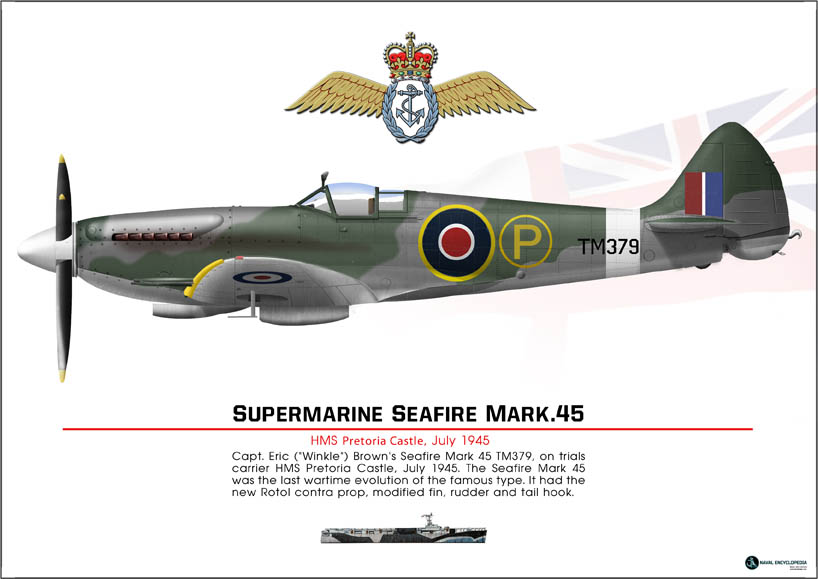
Seafire Mark 45; HMS Pretoria Castle
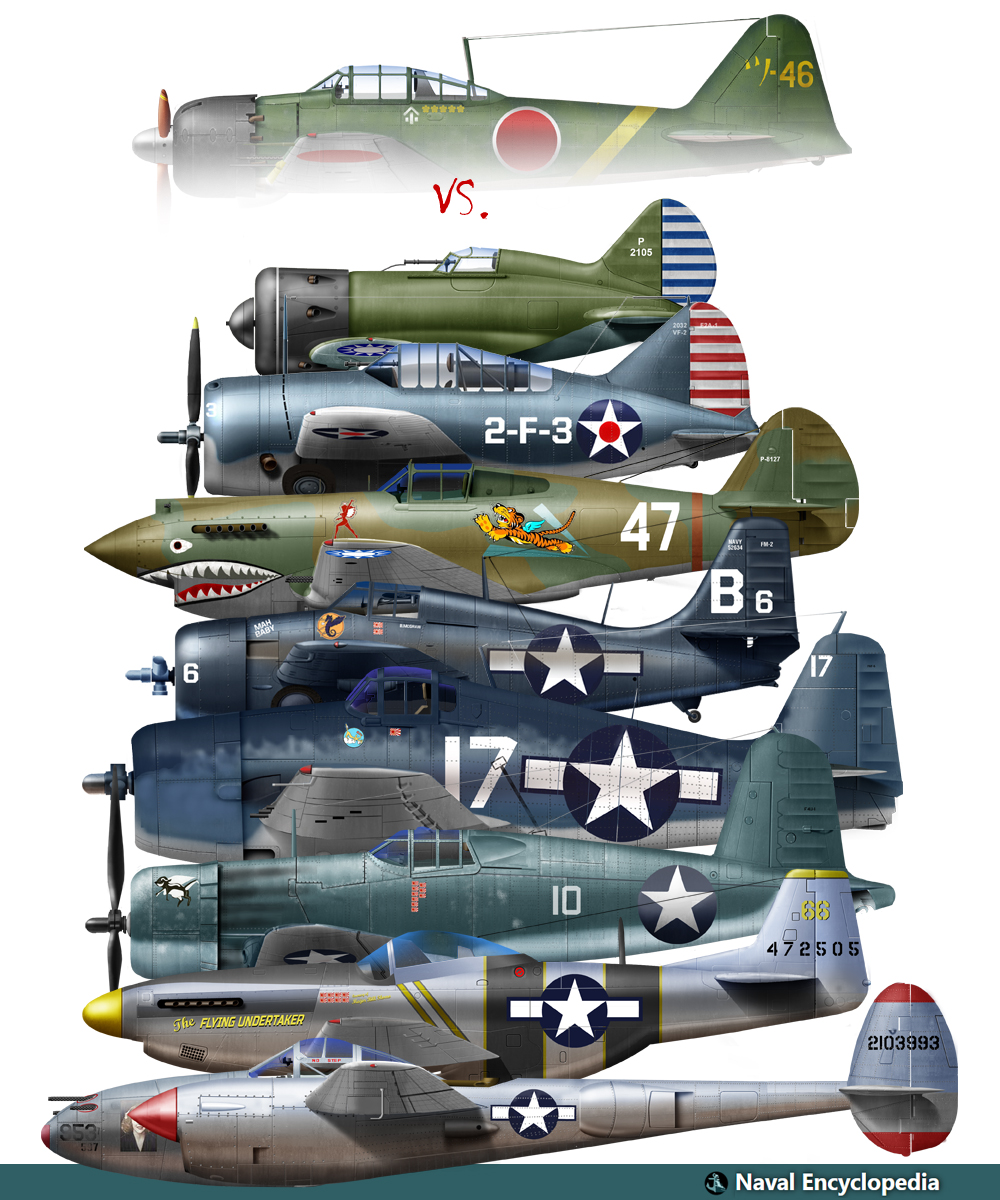
Zeros vs its aversaries
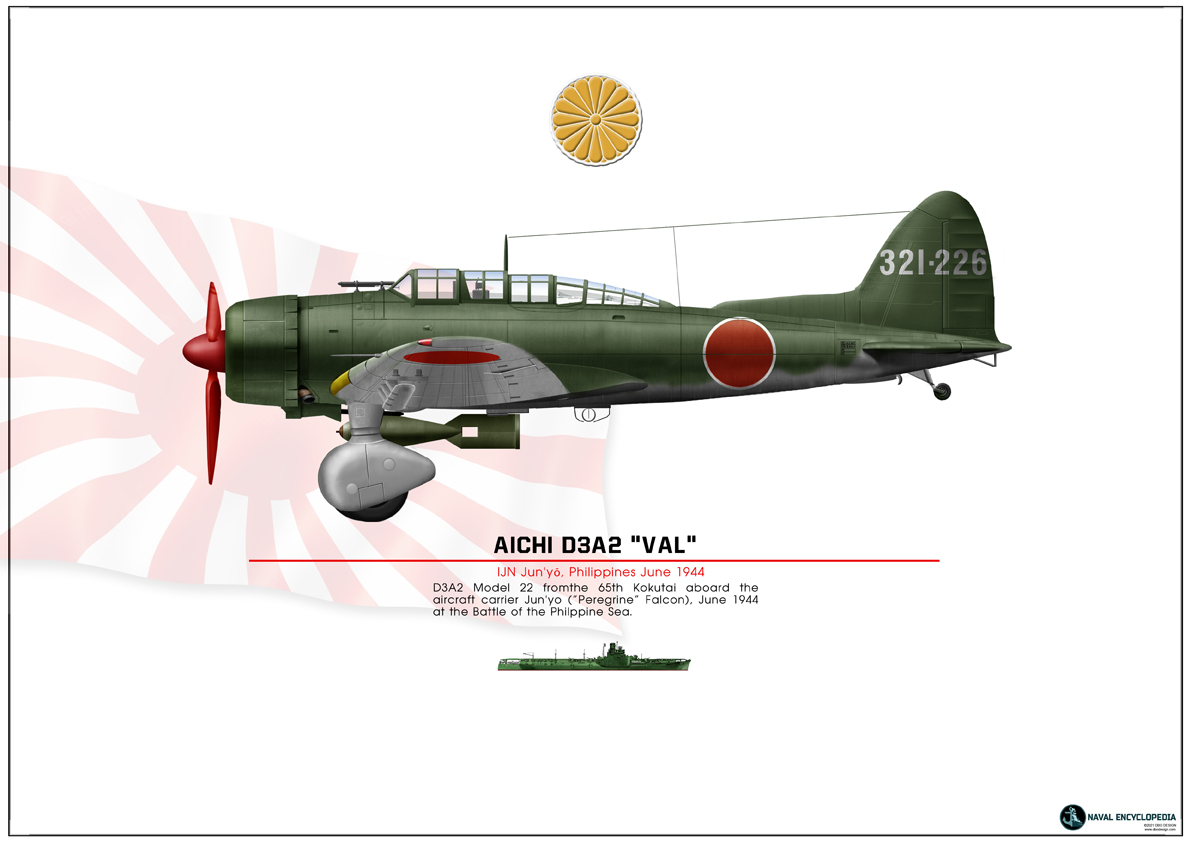
Aichi D3A “Val” Junyo
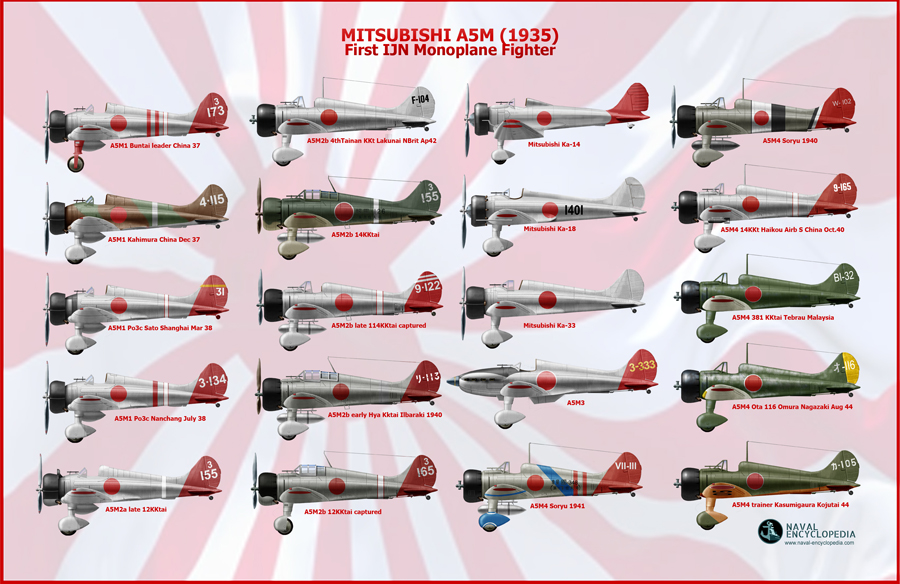
Mitsubishi A5M poster
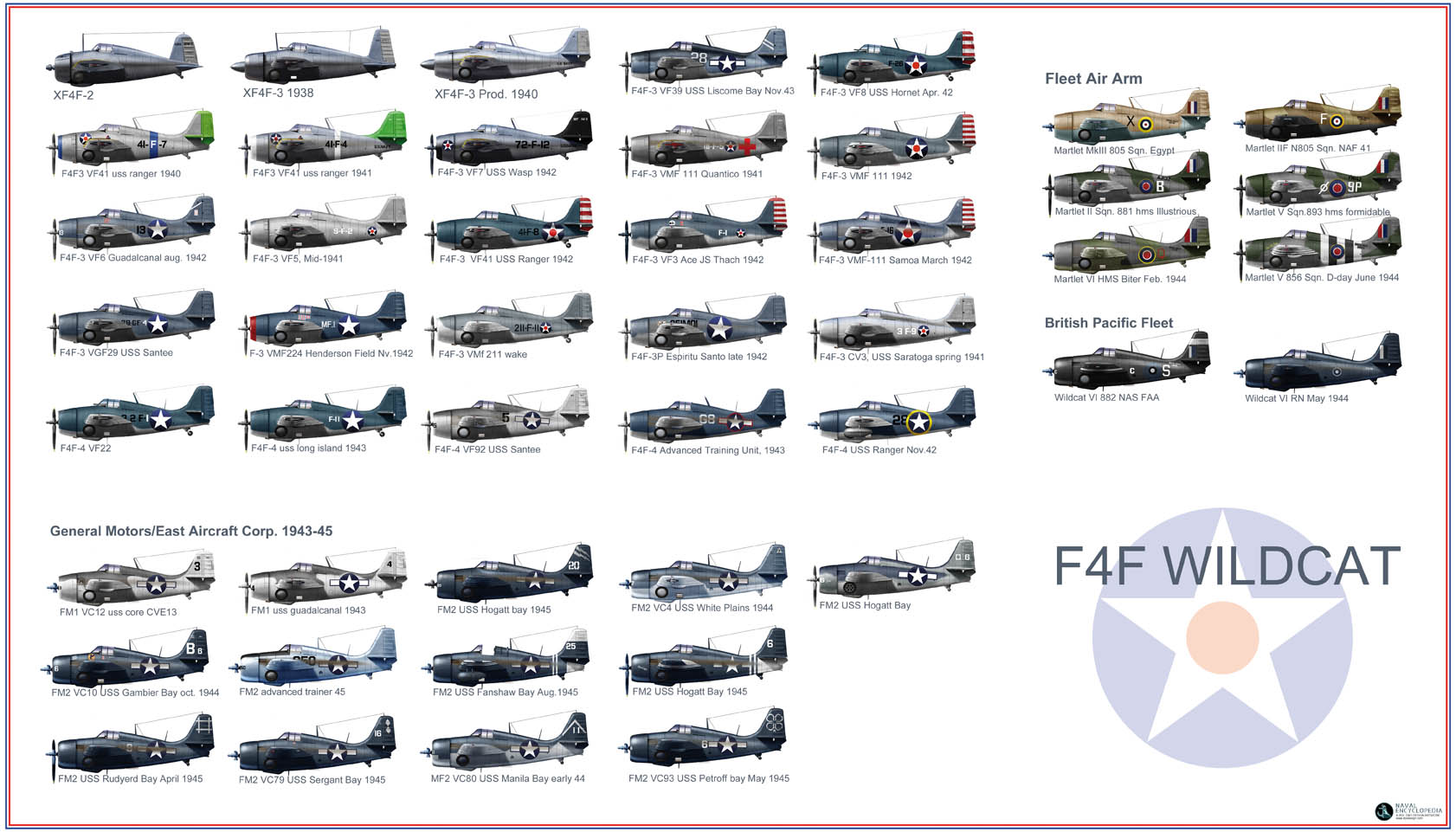
F4F wildcat
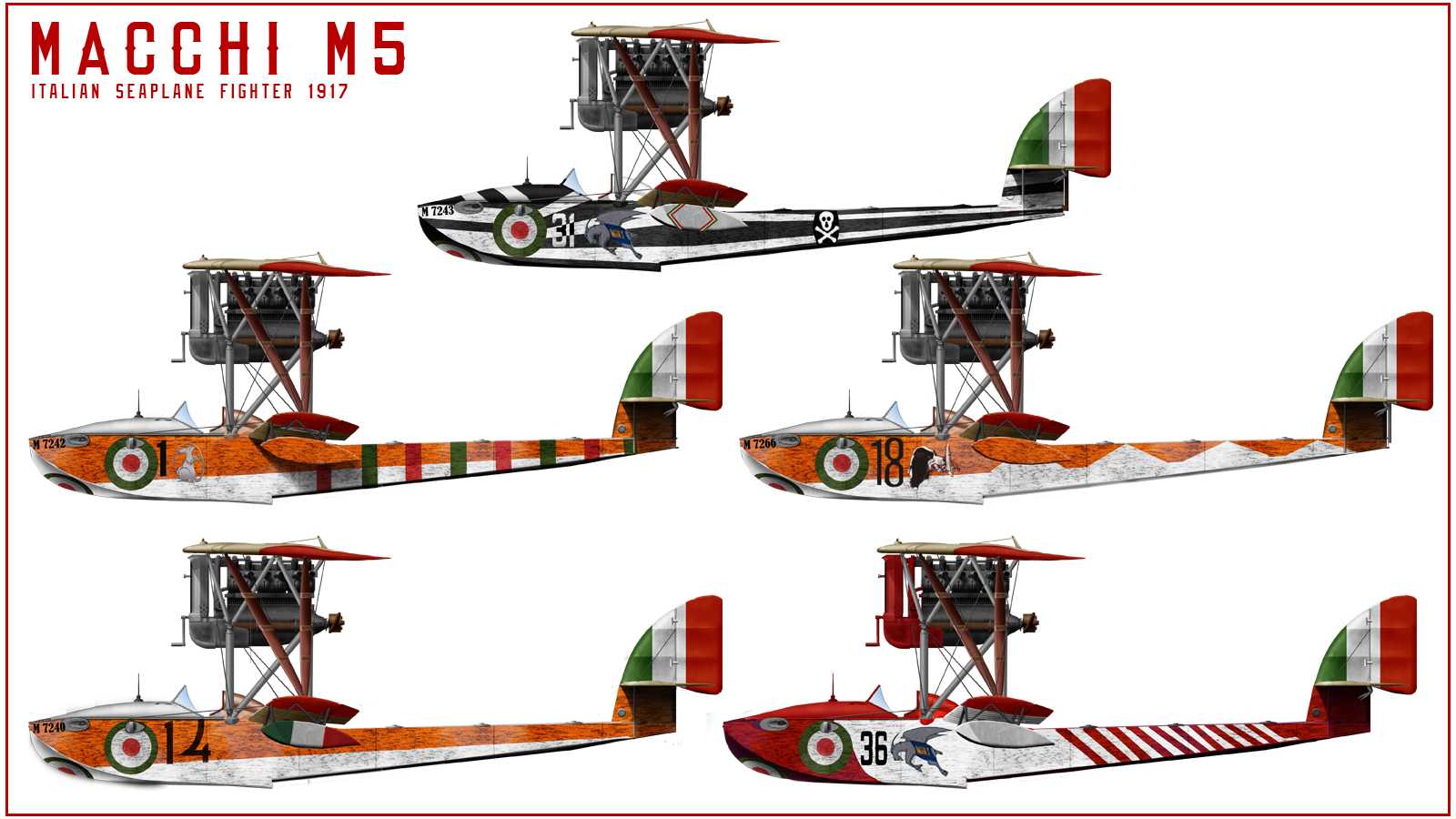
Macchi M5
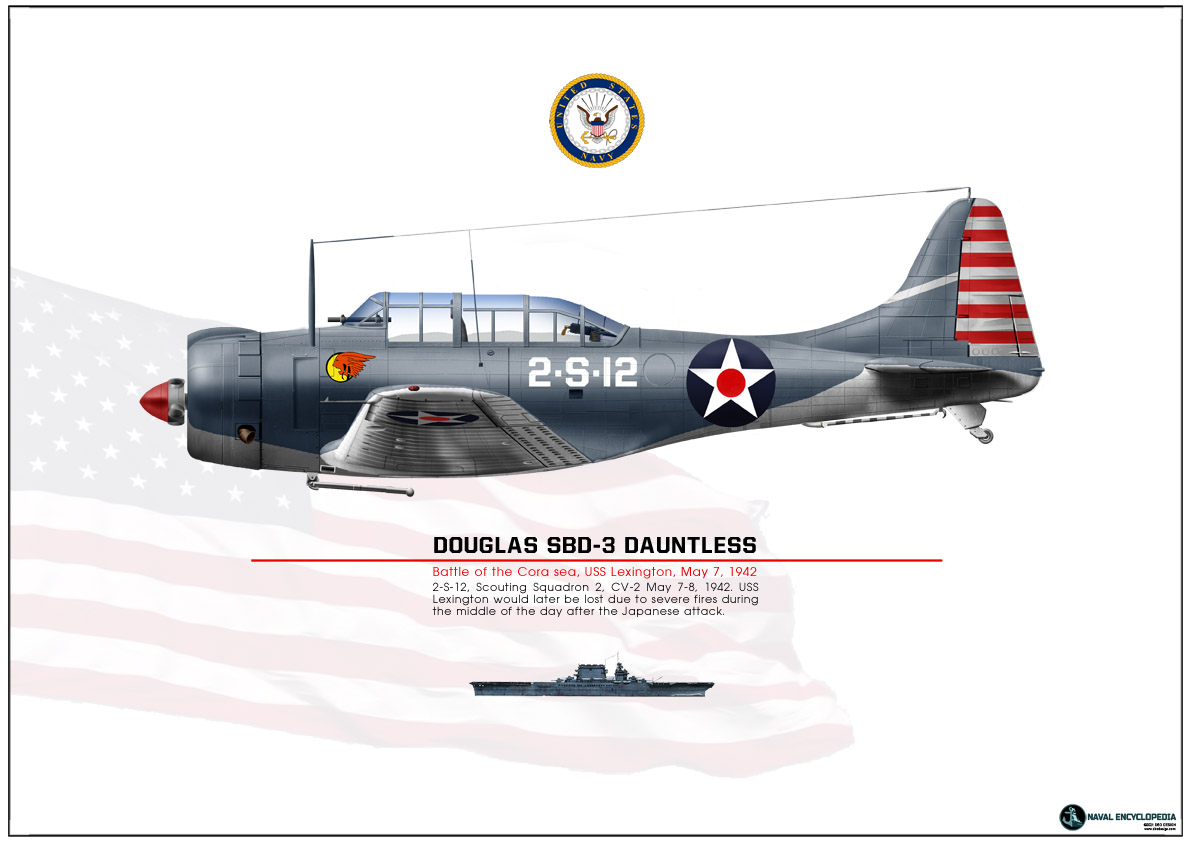
SBD Dauntless Coral Sea
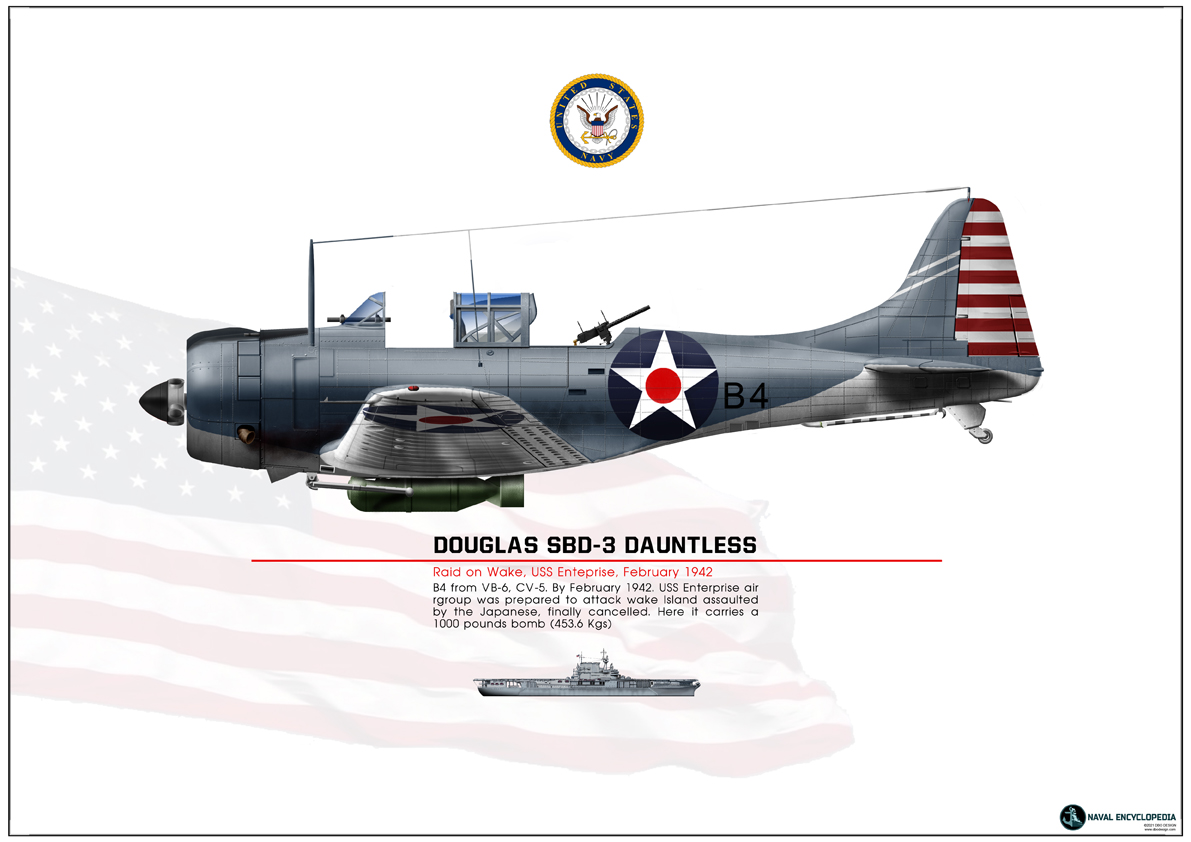
SBD Dauntless USS Enterprise
SBD-4 CV22