USN Blimps (1916-67)
 US Navy, WW2 and Interwar types, and 134 K-class built 1939-55.
Develoment
Introduction
The story of US Navy Blimps could trace back its origin to 1861. Lighter than air vessels (naval analogies were used from the very start) could also trace back their origin in France's Montgolfier brothers, paper makers turned hot air balloon makers with a first human flight in 1783. But it's in the XIXth. Century with the use of canvas balloons really took off, pun intended. The History of military ballooning preceded that of aviation by nearly a century. In fact, as far back as the Chinese mythical three kingdoms romance, tells of giant Kongming lanterns to do military signals were reported, and it was real enough that the west discovered them during the Battle of Legnica, Mongol invasion of Poland in 1241. After the Montgolfier brothers, the French became pioneer in military ballooning, with the new revolutionary authorities creating the French Aerostatic Corps, which was put to good use for reconnaissance at the Battle of Fleurus in 1794. The following year, at the Siege of Mainz as well. However it was disbanded by Napoleon in 1799. Use for naval warfare was formulated, yet not implemented.Albeit Napoleon consider their use to invade Britain (which would have been the first airbone assault in history), it's only by 1854 than serious tests were made again, and the type took its definitive shape. Given its French heritage, it is called often an "Aerostat". Napoleon III used some manned by Eugene Godard in 1859 against the Austrians. Godard's aerial reconnaissance balloons were also used in the war 1870. The Austrians used one over Venice in 1849. But it's really in the American Civil War that it was instrumentalized and deployed en masse for the first time, with Abraham Lincoln convinced to create the Union Army Balloon Corps, organized by Prof. Thaddeus S. C. Lowe. Some were employed also by the Corps of Topographical Engineers, making accurate maps for the Union. General Irvin McDowell deployed his "USS Enteprise" (so well before star trek) at the Battle of Bull Run, to oversee the battlefield, dropping dispatches or colored signal flags to indicate orders. Later, S. C. Lowe also created the Forward Artillery Observer (FAO), directing artillery fire via flag signals.
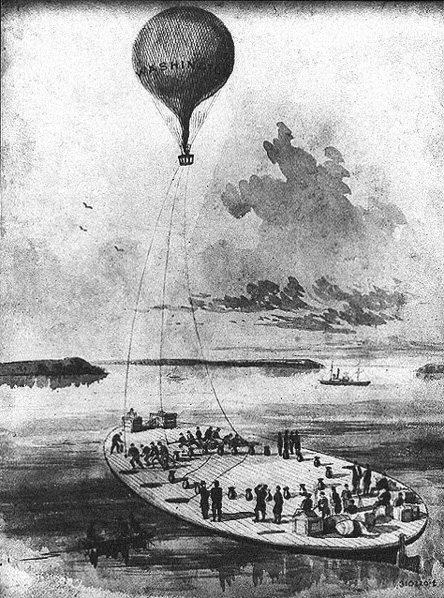
USS George Washington Parke Custis, the world's first "aircraft carrier", more correctly a riverine balloon tender, 1861-65. She measured 120 ft (37 m) for a beam of 14 ft 6 in (4.42 m) and 5 ft 6 in (1.68 m) draft, way too shallow for naval use. She was towed by the armoured riverine steamer USS Coeur de Lion. Lowe ascended with Gen. Daniel E. Sickles and others off Mattawomen Creek to observe Confederate forces on the Virginia and reported on the 12th enemy camp fires and the construction of batteries at Freestone Point.
The very first "naval" use of an aerostat, was over the converted coal barge "George Washington Parke Custis" towed down the Potomac, Lowe's Balloon was used for observation on land, powered by two gas generators, spotting enemy concentrations through heavily forested peninsula. This made this barge the great-granddaddy of all aircraft carriers. It proved important for the whole Peninsula Campaign. The Confederate soon had their own, made of colored silk dress-making material, but few flights were made due to shortage of gas, over Richmond, Virginia by Edward Porter Alexander. However there was no proper naval use in this war. Ballooning remains a US Army thing only, mostly for map making in the remainder of the decades. Famous gun maker John A. Dahlgren also experimented with large observation balloons.
Balloons were used also in Paraguay in 1867, by Brazil, but also by the British in 1862-71, and an establishement created at Woolwhich in 1878. In 1888, a School of Ballooning was established at Chatham, in Medway, for land and naval applications, before it was moved to Stanhope Lines, Aldershot in 1890 with permanent units attached to the Royal Engineers establishment, not yet ot the Royal Navy. The site became the hub for pre-WWI air operations in Britain, in continuous use in WWI, which was of course the great crucible for the use of balloons and airships. British use of balloons included the expeditions to Bechuanaland and Suakin in 1885 and Second Boer War (1899–1902). In the Great war, models such as the German Parseval-Siegsfeld type and French Caquot type dirigible became widespread. The Germans pioneered the use of their Zeppelin dirigibles for airbone reocnnaissance and attack for the Kaiserliches Marine. Barrage balloons, widely known as "blimps" and their busting tactics by the allies or entente pilots, using notably incendiary rockets for the first time, are part of these operations.
US Navy use of airships and balloons in WW1
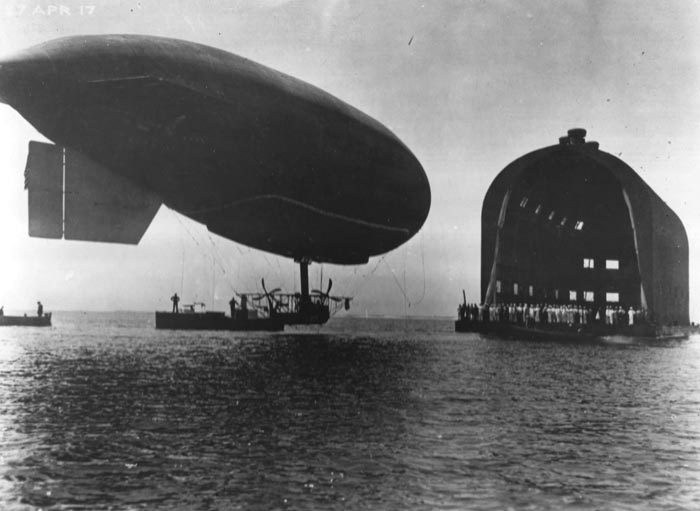
USS DN1, the first USN airship, tested in April 1917 with her floating hangar and tender at Pensacola. Ctsy of the New England Air Museum, Windsor Locks, CT.
The Navy created its own lighter-than-air program with the first dirigible built, USS DN-1, awarded to the Connecticut Aircraft Com. in June 1915. "D" was for dirigible, "N" for non-rigid and "1" as the first airship registered on its naval book and commissioned. During construction the Navy authorized construction of a hangar, completed in early 1916. DN-1 was only deployed after trials and test at Pensacola, Florida, by December, but not ready before April 1917, just as the US entered the war. Many issues had to be solved, and she was severely in one of her tests, never repaired, and this ended there. However, the Bureau of Construction and Repair (BuC&R) planned already another class as she was still in construction.

Back to April 1916 already, the General Board wanted an equivalent of zeppelins or assimilated crafts to be tested. The program starte At Akron, Ohio, recoignized for its favourable weather for such tests, and soon integrated non-rigid airships, free balloons, and kite balloons. It was soon realized their use tethered to a ship was an issue at several levels. However the British showed how kite balloons used in conjunction with seaplanes and flying boats could be used for ASW patrols, they proved ideal to detect submarines underwater, far easier to spot than from a ship. They could also report minefields. Most airship patrols on the US side started with the east coast and soon proved a success against German submarines. These types were the following:
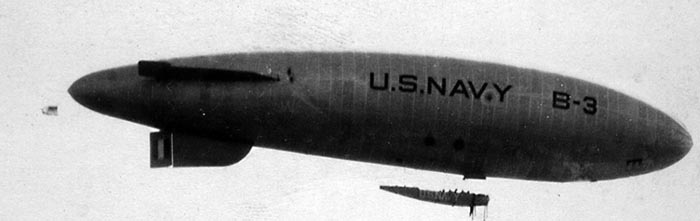
Goodyear USS B-3, 1917 - U.S. Naval History and Heritage Command Photograph
B-Series: British design influence. They were used for ASW patrols from mid to late 1917.
C-Series: Coastal patrols and convoys craft, first flew on September 30, 1918. Production Cancelled.
Observation Kites (ZK): Tethered from ships and stations or towed to station by observation planes, 117 produced.
Spherical Ballons (ZF): No identification pennant but procurement order numbers, used for training.
After the war was over, development took off as the Navy contracted Goodyear for larger airships and new hangars. Soon, in the 1920s, Goodyear sold three blimps called the E-, F- and H-, briefly used for training roles and finally the twin-engine J-type airship in 1922, using the rare, expensive but fireproof Texas helium. Four of the J-types were retained in use, until 1940 for J-4, used all along for training. It had a sky-blue camouflage envelope paint and ballasted ladder to allow crewmen to transit in and out from ships if moored.
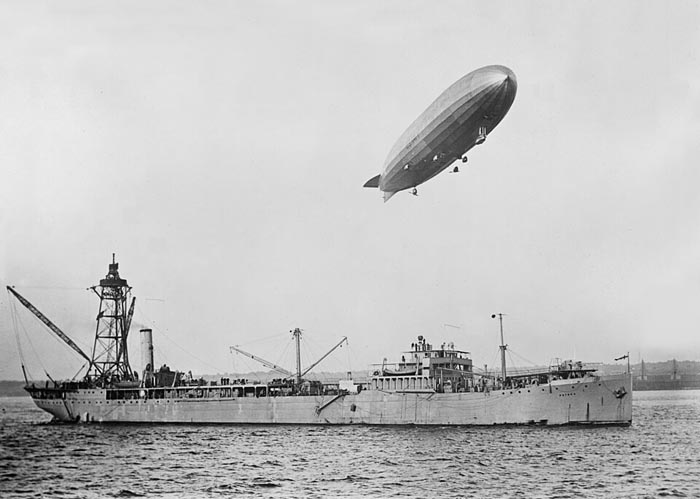
USS Shenandoah over its tender USS Pakota in 1924-25.
The first true USN rigid airship was USS Shenandoah (ZR-1), inflated with helium, based on the Zeppelin L-49 and built by the NAF and completed at Naval Air Station Lakehurst. It was 680 ft (207.26 m) long, weighed 36 tons (32,658 kg) with a range of 5,000 mi (4,300 nmi; 8,000 km) at up to 70 mph (61 kn; 110 km/h). But on 3 September 1925, while flying over Ohio, she was broke in tow by a severe storm, killing half the crew. Next were ZR-2 and then USS Los Angeles (ZR-3) built by Germany as compensation for the loss of two airships during the war. She was the most successfl, remaining in service for 7 years, making 330+ flights.

But the most famous remains USS Akron and Macon, based on the Shenandoah design but capable each of carrying their own defending squadron of Curtiss fighters. They would remain the first and last flying aircraft carriers. However again, USS Akron was lost in 1933 off New Jersey (storm again, killing 73), USS Macon off Santa Barbara Islands (83 killed). Of course, the Lakehurst catastrophy, with the loss of Hindenburg, the largest commercial airship ever built, in May 1937, was like the final thunderstruck for airships. This highly mediatic "Titanic of the skies" proved once and for all the type was not safe (yet). On its part, the Navy by then decided to focus exclusively on non-rigid types, still dirigibles, still called the "blimps", for the same missions as in 1917-18.
WW2 use of Blimps
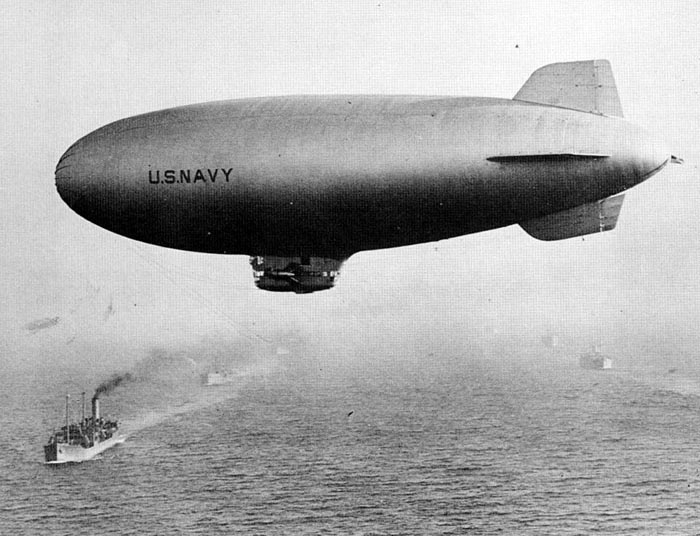
USS K-110 over a convoy during the Second World War. From Grossnick, Roy A. (1986) Kite Balloons to Airships... the Navy's Lighter-than-Air Experience, Washington, D.C.: Government Printing Office.
Balloons also were at last used at sea by the US Navy for anti-submarine work. The idea was formulated by the US Navy in 1936, after the disasters that were the USN experience with airships. However they were planned much earlier, all the way back to 1928. However the financial crash and deep depression that followed marred these plans as the Navy struggled to obtain a single pressure airship per year. Congressional funding limitations were indeed crippling. K-1 was created by the Naval Aircraft Factory, still, using a J-type envelope and it demonstrates a food preservation of gaseous fuel.
Goodyear K-2
Later the Navy purchased an off-the-shelf Goodyear blimp in 1935, designated G-1. Then another in 1937, designated L-1, albeit funding was cut for these. Nevertheless the Navy prdered and "improved K-1" or "K-2", delivered by late 1938. They had no compatibility with the Army TC-13 and 14. When U-boats came back to the Americas by late 1941 already, there were no blimps available to chase them down. However with the attack on Pearl Harbor, the Navy had at last an envelope to order more of these. This became the improved "K-class".So as seen above, in 1937, K-2 was ordered from Goodyear, same as their civilian L-1, Goodyear’s standard advertising and passenger blimp. K-2 was the pre-production prototype for the K-class and it flew at Akron, still the main naval air base for these airships, in Ohio, on December 6, 1938. She was delivered at NAS Lakehurst on December 16 and entered the Navy register. The envelope had a capacity of 404,000 ft³ (11,440 m³). It was thus the largest USN blimp up to that time. She was flown as a prototype and testing new equipment and techniques, retained for training but making still a few including combat patrols in 1942-44 on the East Coast. K-2 was powered by two standard aviaiton Pratt & Whitney Wasp R-1340-16s engines, which displaced 1,344 cubic inches (22 L), bore and stroke were both 5.75 in (146 mm) for 550 hp (410 kW).
Goodyear ZNP-K (1941)
On October 24, 1940, the Navy awarded a contract for six more airships, K-3 to K-8 as the "Goodyear ZNP-K". These were designed for patrol/escort when delivered by late 1941 until early 1942. The first took part in the "quasi-war" at sea, making a U-turn in direction of a convoy, radio-guided all the way, patrolling above, and then escorting it back to port. K-3 to K-8 had only minor modifications, like the engines upgraded to the Wright R-975-28s. The K-3 cost $325,000. Their engine/propeller combination proved excessively noisy and was replaced in later K-ships with slightly modified Pratt & Whitney engines. Original designation were followed by the sequential suffix number, like USS ZNP-K-3 to ZNPK-8 but in everyday K-numbers were used.Goodyear ZPK series (1942)
A series of orders for more K-class blimps followed: Twenty-one improved models (K-9 through K-30) were ordered on 14 October 1942. The envelope size of K-9 through K-13 was increased to 416,000 ft³ (11,780 m³).Goodyear ZP2K series (1943)
On 9 January 1943, 21 more blimps (K-31 through K-50) were ordered. The envelope was now 425,000 ft³ (12,035 m³).Goodyear ZP3K series (1943)
The final contract were awarded in mid-1943, for 89 airships. Four were later canceled. The remaining ones had the numbers K-51 through K-136. K-136 however was never assigned as she replaced K-113, destroyed in a fire.Goodyear ZP4K series (1953)
The war has ended in between, so these ones were delivered in 1953, retaining the 527,000 cu ft (14,900 m3) envelope volume but now 266 ft (81.08 m) long and re-designated ZSG-4 in 1954. K-class blimps were used in tropical regions of the Pacific or the Mediterranean and this urged the need for greater volumes to offset the loss of lift due to high ambient temperatures. Goodyear addressed thus created the M-class blimp 50% larger. But this regards the cold war section.Design of the the K-class
General layout
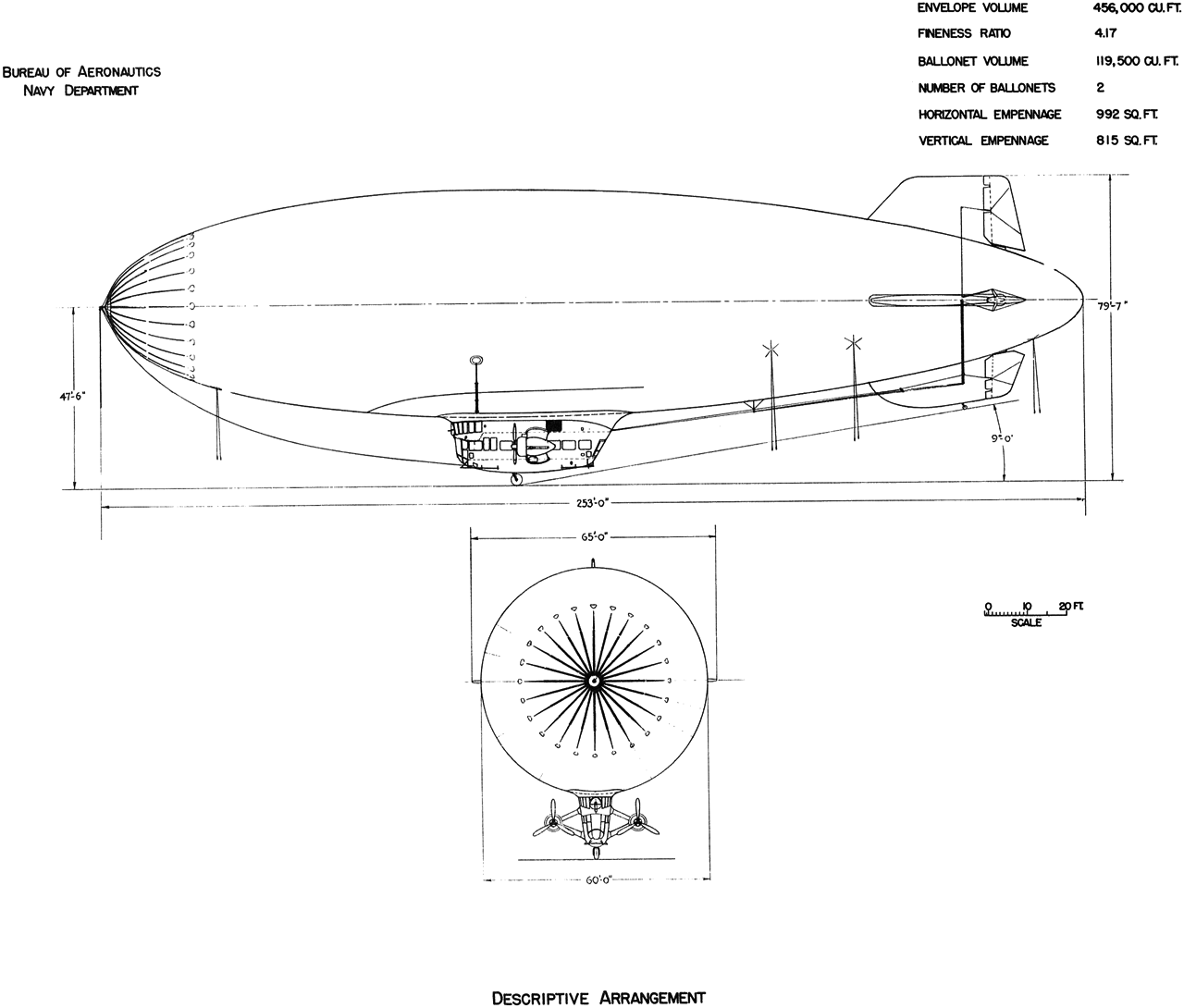
3-view line drawing of the Goodyear ZSG-2, 1 January 1949.
The K-class were airships were pretty classic in their general shape, drived from a long lineage of interwar blimps by Goodyear. The overall envelope was not reinforced in any way internally, albeit there was external bracing. Forward there was a tip with a hook and cables, plus roller to be towed or attached to a mooring mast or bollard. The forward structure was rigidified still by thin, flexible aluminium bracing bars and cables. The underside was also rigidified in order to not stretch the envolope too much when supporting the nacelle below. The tail remained flexible and rounded, but with inflated semi-rigid (simple aluminium framing for the shape) upper tail and rudder, lower tail and rudder, and ailerons. All could be used for direction, by sets of cables running all the way down to the nacelle. Each rudder was attached to the end cable at two points.
The was another attachement point for towing/tethering mid-way forward,and the long cable for the nose cable was attached to a releasing hook under the nacelle's belly. The latter was aerodynamically shaped, and comprised forward two "decks", one half-deck just below the envelope, glassed, for seated or crouched observers, and the main navigation bridge below with a helmsman's post, followed by the main fuselage body comprising a radio set table post, a radar post, of fitted, a map table, and armament post (both for the target acqisition and release of depht charges) and a defensive MG post at the tail for a 0.50 in (12.7 mm) M2 Browning machine gun. It could be placed as well on the upper forward observer post. The crew comprises usually a command pilot (acting Navy sub-Lieutnenant as well as two co-pilots, a navigator and an, airship rigger, ordnanceman, two mechanics, and two radiomen.
The nacelle could be equipped also with a projector for night operations underneath. It was protected forward by a guard strut bar, and more handlebars were located at its lower part. It was equipped with inflatable bags and the regulatory navy infloatable boat plus provisions and flare guns. When used on land on a carrier deck, the nacelle had a single axial main wheel mid-way undeberlly, and a small tail wheel under the lower tail aft. The lower deck in the nacelle comprised stocks of food and a small battery to operate the radio as backup for the engines. The engines were connected to the nacelle via a "V" type attachement with wing-shaped struts.
Military Payload
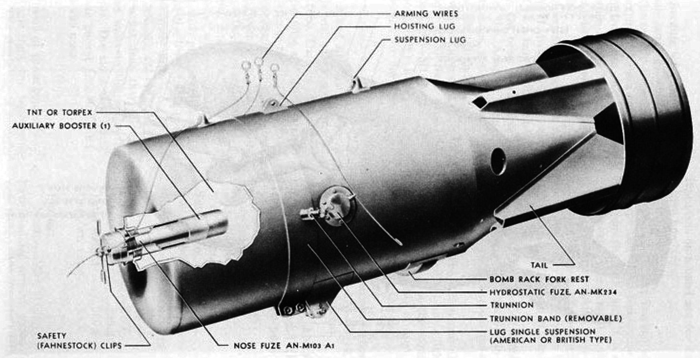
The lower strut-wings had rack points for four 350 lb (160 kg) AN-Mk 47 depth charges, the K-class blimps main military payload against U-boats. These were not very powerful, but a precise drop and near-miss was alone to rupture a pressure hull. Setup was to be made electrically from the inside of the nacelle by the weapon's operator (or bombardier) so these DCs were very much tailored for airships. It was also called the AN-MK 47. The useful core of the weapon was its hydristati fuze AN Mark 234 which determined the depth to detonate if matching the setup. But it could be setup for a direct hit as well with its nose fuse AN M103 A1. They shared most elements wit the Mark 44 or Mark 17 Mod 2, apart the nose, which was flat for these Mark 47. The latter and the Mark 41 were quite close.
Engine and performances
K2 was powered by two Pratt & Whitney R-1340-16 for 500 hp each, which seemed not enough, and thus from the K-3 onwards, they were replaced by Wright R-975-28s. The latter were part of the R-975-20 series only made of airships. They developed 300 hp (220 kW) and several types of propellers were tested to reduce vibrations. From the K-9 series onwards, their original Pratt & Whitney engines returned, with the good propeller type found at last. The model was improved in between, to the final R-1340-AN-2 radials, 425 hp (317 kW) each, giving the right amount of power not to stress too much the soft structure.As for performances were concerned, the K-9 series onwards (ZP2K) had a top speed of 78 mph (125 km/h, 68 kn), a cruise speed of 58 mph (93 km/h, 50 kn) and a range of 2,205 mi (3,537 km, 1,916 nmi), well enough to reach the middle Atlantic and back, or the Mediterranean, but not enough for Pacific Operations. The endurance was remarkable of course compared to any patrol aircraft, at 38 hours 12 minutes. For this, the small nacelle was well equipped.
⚙ ZP2K specifications | |
| Length | 251 ft 8 in (76.73 m) |
| Diameter | 57 ft 10 in (17.63 m) |
| Volume | 425,000 cu ft (12,043 m3) |
| Useful lift payload | 7,770 lb (3,524 kg) |
| Engine | 2x Pratt & Whitney R-1340-AN-2 radials , 425 hp (317 kW) each |
| Top Speed, sea level | 78 mph (125 km/h, 68 kn) |
| Cruise Speed | 58 mph (93 km/h, 50 kn) |
| Range | 2,205 mi (3,537 km, 1,916 nmi) |
| Endurance | 38 hours 12 minutes |
| Ceiling | Unknown |
| Armament | 1× .50 in (12.7 mm) M2 HMG, 4× 350 lb (160 kg) AN-Mk 47 DCs |
| Crew | 9-10 |
Operational History
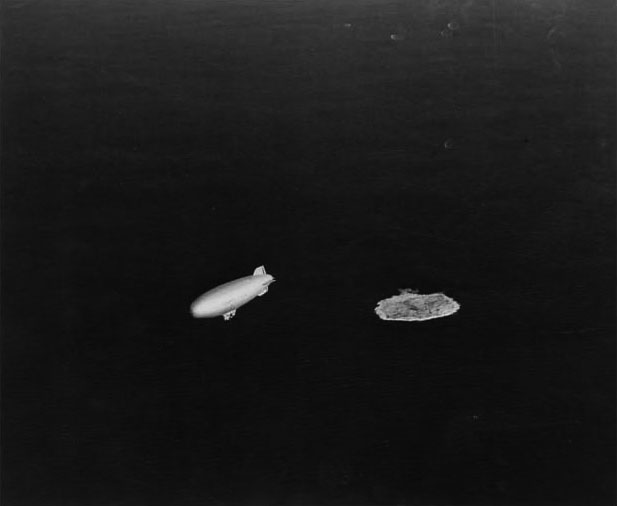
K-class after dropping a DC on a suspected U-Boat. See the src below.
World War II started with five different airship classe in inventory, but justified by the drastic expansion of patrols in the north south Atlantic and then the Mediterranean after Operation Torcj in November 1942, with a few based in the Pacific, and gradual transfer after May 1945. The Navy kept two squadrons after 1945 for training, search and rescue as well as observation and photography missions. But their main task in wartime was anti-submarine warfare. The 40ft control car (or nacelle) had all the communications and instrumentation for night flying and started to carry the ASG radar for this in 1943, with a range of 90 mi (140 km) as well as WW2 sonobuoys, and a magnetic anomaly detection (MAD) system.

USS Langley underway off Cape Henry, Virginia, United States, 6 Oct 1943; note SNJ aircraft on flight deck and K-class airship from Lighter Than Air Squadron ZP-14 overhead (pinterest)
On 1 June 1944, two K-class of Airship Patrol Squadron 14 (ZP-14) made a full transatlantic crossing, the first by non-rigid airships. K-123 and K-130 left South Weymouth in Michigan on 28 May 1944, flew for 16 hours to Naval Station Argentia in Newfoundland and from it, flew 22 hours to Lajes Field, Terceira Island, Azores, refuelling and taking off again for a 20-hour flight to Craw Field, Port Lyautey (Kenitra), in French Morocco. K-109 & K-134 and K-112 & K-101 did the same on 11 and 27 June 1944 for nighttime operations and complement daytime FAW-15 aircraft, a mix of PBYs and B-24s using magnetic anomaly detection around the Straits of Gibraltar. ZP-14 airships were then used for minespotting and minesweeping in Mediterranean ports, escort missions. They were seen overhead notably for the one sailing for the Yalta Conference in early 1945. By late April 1945, K-89 and K-114 left NAS Weeksville, North Carolina via the southern transatlantic route to NAS Bermuda in the Azores then Port Lyautey on 1 May to replace the airships of ZP-14.
In complmement to their MAD system, the K-ships fly low and slow or even hover, greately helping detection of enemy submarines. Other were used for SAR mission, sometimes dropping a cable to recue a downed aviator or sailor, dragged on board. The usual mooring system was a 42 ft (12.8 m) triangular mooring mast light enough to be placed on a trailer and moved around by a tractor. Advanced bases like at Lakehurst had permanent mooring masts of the stick type. However a large ground crew was needed always to moor the airship to the mast.

These airships had a low risk, albeit U-Flak could be deadly and they were a nice, large target. Despite of this a single K ship was lost to enemy action, on 18 July 1943, shot down by U-134, in the Straits of Florida. The crew was rescued 8 hours later. 5 weeks later, U-134 was sunk in turn. Another burned after an accident. In 1947, Goodyear acquired K-28, used for commercial advertising as "Puritan", until April 1948 as it was too large and costly to operate. Deflated, in storage at Goodyear's Wingfoot Lake, Suffield it was sold back to the Navy.
Cold War Legacy

Navy L-ships at Naval Air Station Moffett Field were used for training patrol crews that operated K and M class blimps equipped with radar and depth bombs to hunt surfaced submarines. National Archives and Records Administration, 80-G-K-1472
Several K-class were operated by the Navy to observe nuclear weapon effects, in the Nevada tests Site at Operation Plumbbob (1957). K-40, K-46, K-77 and K-92 were destroyed in Project 5.2 Franklin and Stokes to determine how well a ZSG-3 airship could handle a nuclear detonation and establish safe escape distances in case of using nuclear tactical depht charges in antisubmarine warfare, the "Lulu" (W-34) nuclear depth charge.
In April 1954, designation changed and by 1954 the ZP2K blimps became ZSG-2 and following-up. The US Navy ordered in 1951 a new blimp for the Korean War designated ZP4K/ZSG-4, first delivered in June 1954, 15 built. In 1955 the ZP5K/ZS2G-1 followed, for 15 more built and featuring an inverted “Y” tail. Meanwhile the US military also developed high-altitude ballooning programs for nuclear detection and surveillance: Project Mogul, Genetrix and Moby Dick as well as working on the E77 balloon bomb as an explosive-delivery system. Genetrix was a CIA operation using apparent meteorological research surveillance balloons by the hundreds, flying over China, Eastern Europe, the Soviet Union, manufactured by General Mills and operating from 30,000 to over 60,000 feet to avoid interception, but this change when new SAM missiles were introduced. Eventually most ended shot down by Soviet air defenses and they drew protests. The CIA replace this program by the U-2 and later Blackbird before satellites replaces them all.
But for the Navy, new airborne (like helicopters) and radar surveillance system put an end to the airship story. On 21 June 1961, the Secretary of the Navy announced he was going to terminate the Navy’s lighter-than-air program. The last flight of a naval airship occurred on 31 August 1962. However other actors continued like for the Fulton surface-to-air recovery system (STARS) individual recovery system from an aircraft. From 1966 they were also used for the Land Attack Cruise Missile Defense Elevated Netted Sensor System or JLENS. Some were used as recently as by US and coalition military forces in Iraq and in Afghanistan.
 The by 2019, the US Southern Command commissioned new surveillance 25 balloons from Raven Industries under project COLD STAR (Covert Long-Dwell Stratospheric Architecture) to navigate using AI, harvest complex data, used to detect narcotic traffickers, but later for full military service, used for datalink nodes, ISR, tracking or even weapons carriers. DARPA and others worked on the Adaptable Lighter-Than-Air (ALTA) program, using a doppler laser, but it was handled by the U.S. military.
Surviving Navy airships counts the follwing: A Goodyear ZNP-K K-28 Control Car at the New England Air Museum, K-22 Control car under restoration at Moffett Field Museum (Santa Clara County). And the K-47 Control car is at the National Naval Aviation Museum in Pensacola, Florida in ZP3K configuration (decommissioned 1956).
Gallery:
Illustration
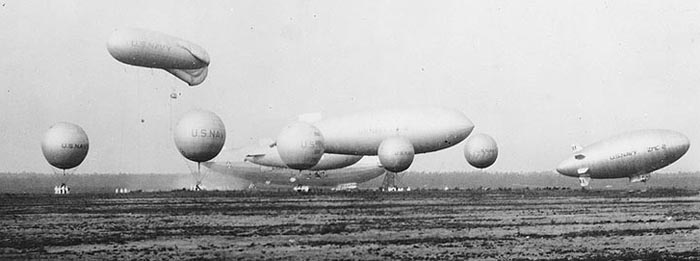
A presentation of USN airships in the late 1930s
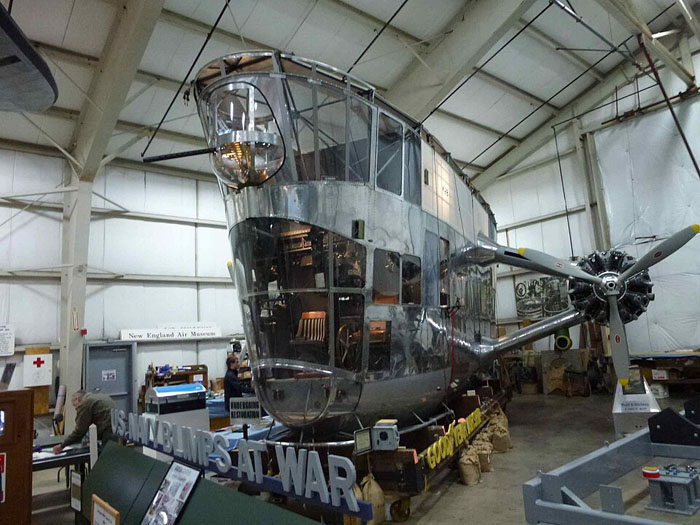
Preserved Goodyear ZNP-K Control Car
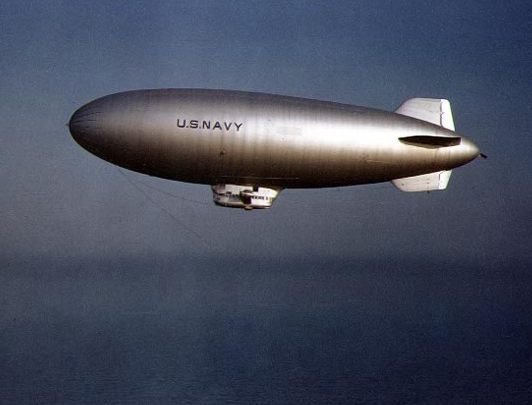
K-Type Blimp K139 in 1953.


Note: All the latter from pinterest.
Src/Read more
Althoff, William F. (1990). Sky Ships. New York: Orion Books.Althoff, William F. (2009). Forgotten weapon: U.S. Navy airships and the U-boat war. Annapolis NIP
Shock, James R. (2001). U.S. Navy Airships 1915–1962. Edgewater, Florida: Atlantis Productions.
Vaeth, J. Gordon (1992). Blimps & U-Boats. Annapolis, Maryland: US Naval Institute Press.
airships.net
USN K-Type Airships Pilot's Manual (PDF).
K-class_blimp
FB k-class blimp drops a depthcharge
scribd.com/ DC
bulletpicker.com/ DC Mk.41
naval-airships.org wwi-post-war-era
history.navy.mil/
connecticuthistory.org
history.navy.mil
History of military ballooning
List of airships USN
USS George Washington Parke Custis
Video
Video: THE STORY OF THE GOODYEAR AIRCRAFT COMPANY IN WWII AIRPLANES & BLIMPS- Lohner E (1913)
- Macchi M3 (1916)
- Macchi M5 (1917)
- Macchi M7 (1918)
- Ansaldo ISVA (1918)
- Short S.38 (1912)
- Sopwith Baby (1916)
- Short 184 (1916)
- Fairey Campania (1917)
- Sopwith Cuckoo (1917)
- Felixstowe F.2 (1917)
- Gotha WD.2 (1914)
- Friedrichshafen FF 33 (1916)
- Albatros W4 (1916)
- Albatros W8 (1918)
- Hanriot HD.2
- Grigorovich M5 (1915)
- Grigorovich M9 (1916)
- Grigorovich M11 (1917)
- IJN Farman MF.7
- IJN Yokosho Type Mo
- Yokosho Rogou Kougata (1917)
- Yokosuka Igo-Ko (1920)
- Curtiss N9 (1916)
- Curtiss H4 (1916)
- Curtiss H12 (1917)
- Curtiss H16 (1918)
- Aeromarine 39
- Vought VE-7
- Douglas DT (1921)
- NAF/Curtiss TS-1 (1922)
- Boeing FB.5 (1923)
- Boeing F4B (1928)
- Vought O2U/O3U Corsair (1928)
- Grumman FF (1931)
- Akron class airships (1931)
- Curtiss F9C Sparrowhawk (1931)
- Curtiss F11C Goshawk (1932)
- Curtiss BF2C Goshawk (1933)
- Blackburn Blackburn (1922)
- Supermarine Seagull (1922)
- Fairey Flycatcher (1923)
- Hawker Horsley (1925)
- Blackburn Ripon (1926)
- Fairey IIIF (1927)
- Fairey Seal (1930)
- LGL-32 C.1 (1927)
- Fokker T.II (1921)
- Fokker T.III (1923)
- Caspar U1 (1921)
- Dornier Do J Wal (1922)
- Rohrbach R-III (1924)
- Mitsubishi 1MF (1923)
- Mitsubishi B1M (1923)
- Yokosuka E1Y (1923)
- Nakajima A1N (1927)
- Nakajima E2N (1927)
- Mitsubishi B2M (1929)
- Nakajima A2N (1930)
- Nakajima A4N (1935)
- CANT 18
WW1
✠ K.u.K. Seefliegerkorps:
 Italian Naval Aviation
 RNAS
RNAS
 Marineflieger
 French Naval Aviation
 Russian Naval Aviation
 IJN Air Service
 USA
USA
Interwar
Interwar US
 Interwar Britain
 Interwar France
 Interwar Netherlands
 Interwar Germany
 Interwar Japan
 Interwar Italy
- Grumman F2F (1933)
- Curtiss SOC seagull (1934)
- Grumman F3F (1935)
- Northrop BT-1 (1935)
- Consolidated PBY Catalina (1935)
- Grumman J2F Duck (1936)
- Brewster/NAF SBN-1 (1936)
- Curtiss SBC Helldiver (1936)
- Vought SB2U Vindicator (1936)
- Brewster F2A Buffalo (1937)
- Douglas TBD Devastator (1937)
- Vought Kingfisher (1938)
- Curtiss SO3C Seamew (1939)
- K-class Blimps (1939)
- Douglas SBD Dauntless (1939)
- Grumman F4F Wildcat (1940)
- F4U Corsair (NE) (1940)
- Brewster SB2A Buccaneer (1941)
- Grumman TBF/TBM Avenger (1941)
- Consolidated TBY Sea Wolf (1941)
- Grumman F6F Hellcat (1942)
- Curtiss SB2C Helldiver (1942)
- Curtiss SC Seahawk (1944)
- Grumman F7F Tigercat (1944)
- Grumman F8F Bearcat (1944)
- Ryan FR-1 Fireball (1944)
- Douglas AD-1 Skyraider (1945)
- Fleet Air Arm
- Hawker Osprey (1932)
- Fairey Swordfish (1934)
- Blackburn Shark (1934)
- Supermarine Walrus (1936)
- Fairey Seafox (1936)
- Blackburn Skua (1937)
- Short Sunderland (1937)
- Blackburn Roc (1938)
- Fairey Albacore (1940)
- Fairey Fulmar (1940)
- Grumman Martlet (1941)
- Hawker sea Hurricane (1941)
- Brewster Bermuda (1942)
- Fairey Barracuda (1943)
- Fairey Firefly (1943)
- Grumman Tarpon (1943)
- Grumman Gannet (1943)
- Supermarine seafire (1943)
- Blackburn Firebrand (1944)
- Hawker Sea Fury (1944)
- Coastal Command
- Vickers Wellington (1937)
- IJN aviation
- Yokosuka E6Y (1930)
- Aichi D1A "Susie" (1934)
- Mitsubishi A5M "Claude" (1935)
- Nakajima A4N (1935)
- Yokosuka B4Y "Jean" (1935)
- Mitsubishi G3M "Nell" (1935)
- Nakajima E8N "Dave" (1935)
- Kawanishi E7K "Alf" (1935)
- Nakajima B5N "Kate" (1937)
- Kawanishi H6K "Mavis" (1938)
- Aichi D3A "Val" (1940)
- Mitsubishi G4M "Betty" (1940)
- Mitsubishi A6M "zeke" (1940)
- Nakajima E14Y "Glen" (1941)
- Nakajima B6N "Jill" (1941)
- Mitsubishi F1M "pete" (1941)
- Aichi E13A Reisu "Jake" (1941)
- Kawanishi E15K Shiun "Norm" (1941)
- Nakajima C6N Saiun "Myrt" (1942)
- Yokosuka D4Y "Judy" (1942)
- Kyushu Q1W Tokai "Lorna" (1944)
 Luftwaffe
- Heinkel 114 (1935)
- Arado 196 (1937)
- Me109 T (1938)
- Blohm & Voss 138 Seedrache (1940)
 Italian Aviation
- Savoia-Marchetti S.55
- IMAM Ro.43/44
- CANT Z.501 Gabbiano
- CANT Z.506 Airone
- CANT Z.508
- CANT Z.511
- CANT Z.515
 French Aeronavale
- GL.300 (1926-39)
- CAMS 37 (1926)
- Levasseur PL.5 (1927)
- Potez 452 (1935)
- Loire 210 (1936)
- Loire 130 (1937)
- LN 401 (1938)
 Soviet Naval Aviation
- Shavrov SH-2 (1928)
- Tupolev TB-1P (1931)
- Beriev MBR-2 (1930)
- Tupolev MR-6 (1933)
- Tupolev MTB-1 (1934)
- Beriev Be-2 (1936)
- Polikarpov I16 naval (1936)
- Tupolev MTB-2 (1937)
- Ilyushine DB-3T/TP (1937)
- Beriev Be-4 (1940)
 Swedish Naval Aviation
- SAAB B17S
-
 Skoda Š-328V
  R-XIII Idro
 Fokker C.XI W (1934)
 Rogožarski PVT-H (1938)
WW2
 ☍ USNA
- De Havilland Sea Vixen
- Hawker Sea Hawk
- Supermarine Scimitar
- Blackburn Buccaneer
- Hawker Sea Harrier
- Douglas A4 Skyhawk
- Grumman F9F Panther
- Vought F8 Crusader
- McDonnell-Douglas F-4 Phantom-II
- North Am. A5 Vigilante
- TU-142
- Yak 38 forger
☢ Cold War
✧ NATO
Fleet Air Arm
 US Navy
☭ Warsaw Pact
Merch
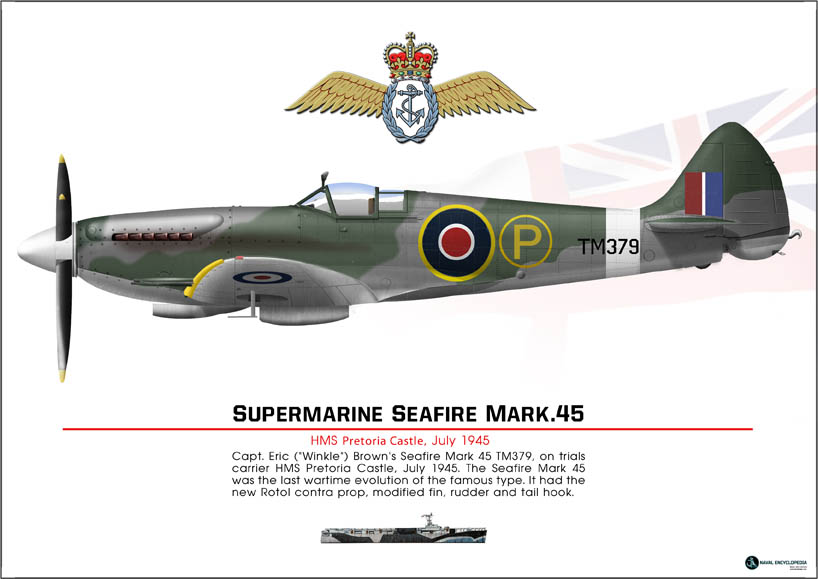
Seafire Mark 45; HMS Pretoria Castle
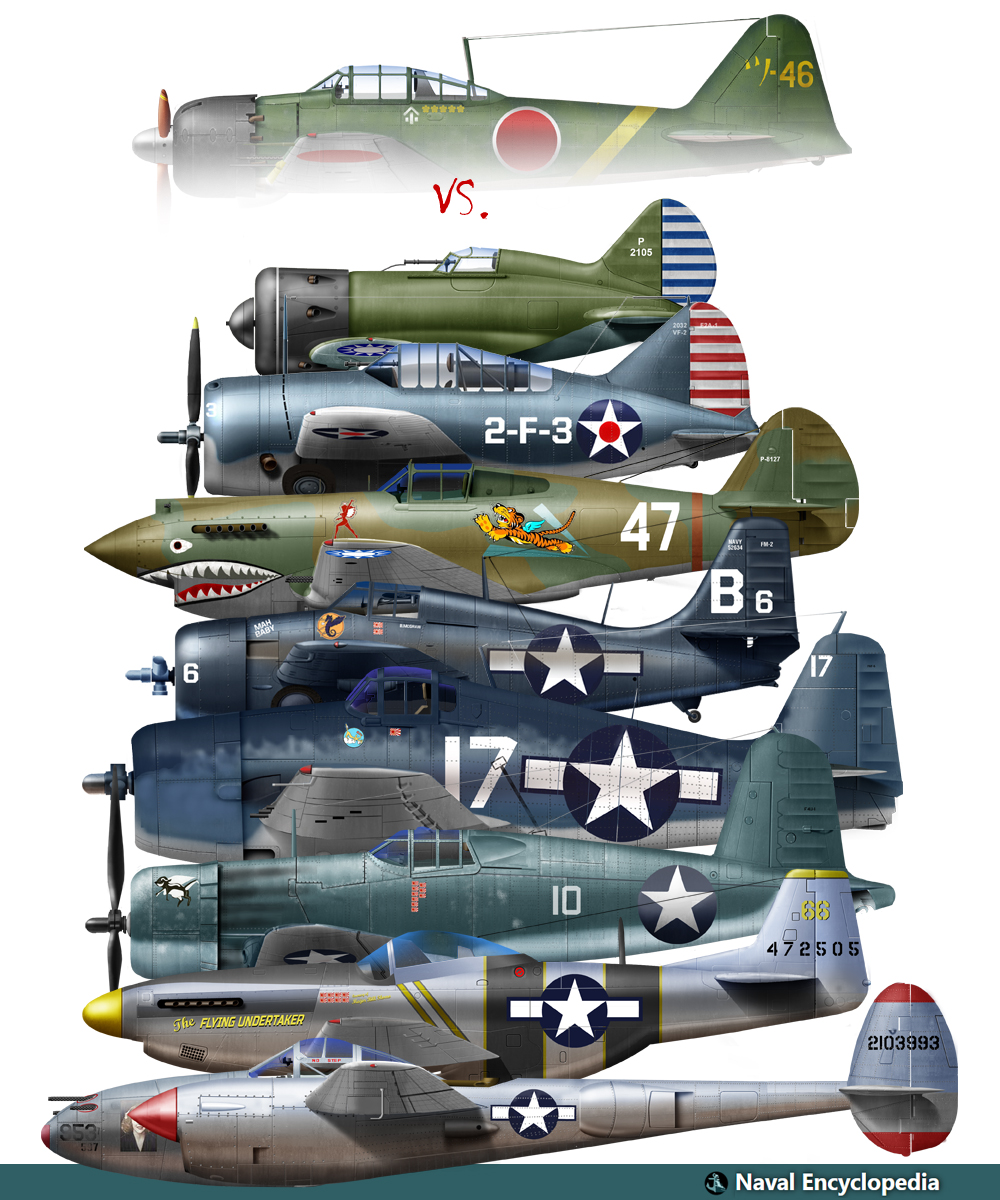
Zeros vs its aversaries
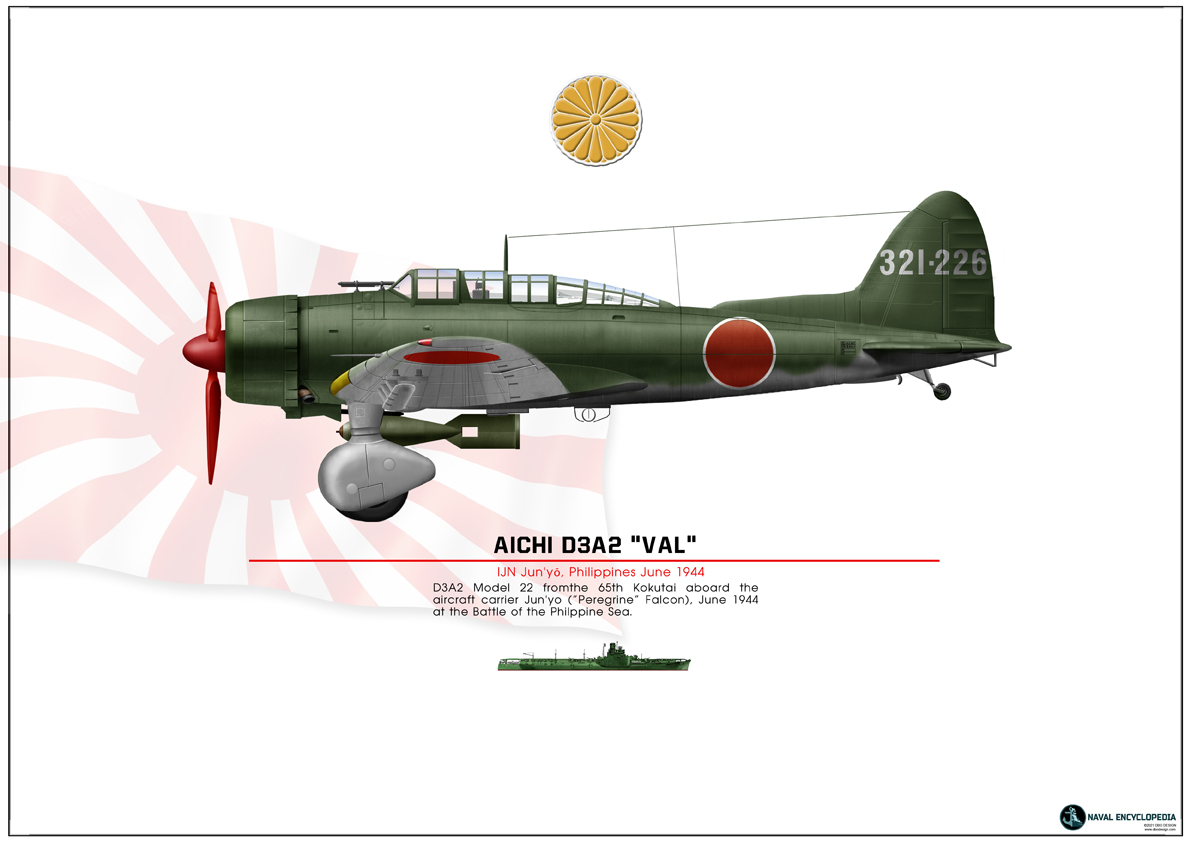
Aichi D3A “Val” Junyo
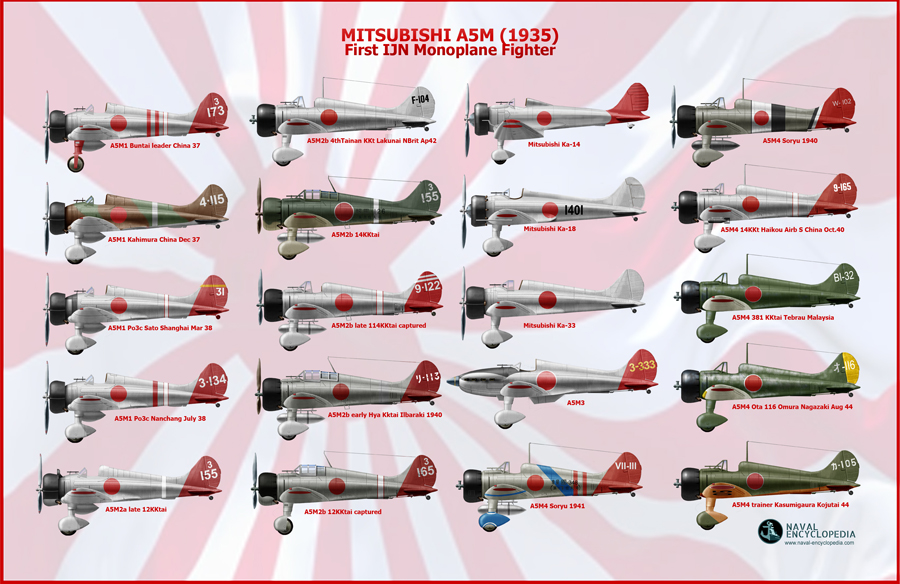
Mitsubishi A5M poster
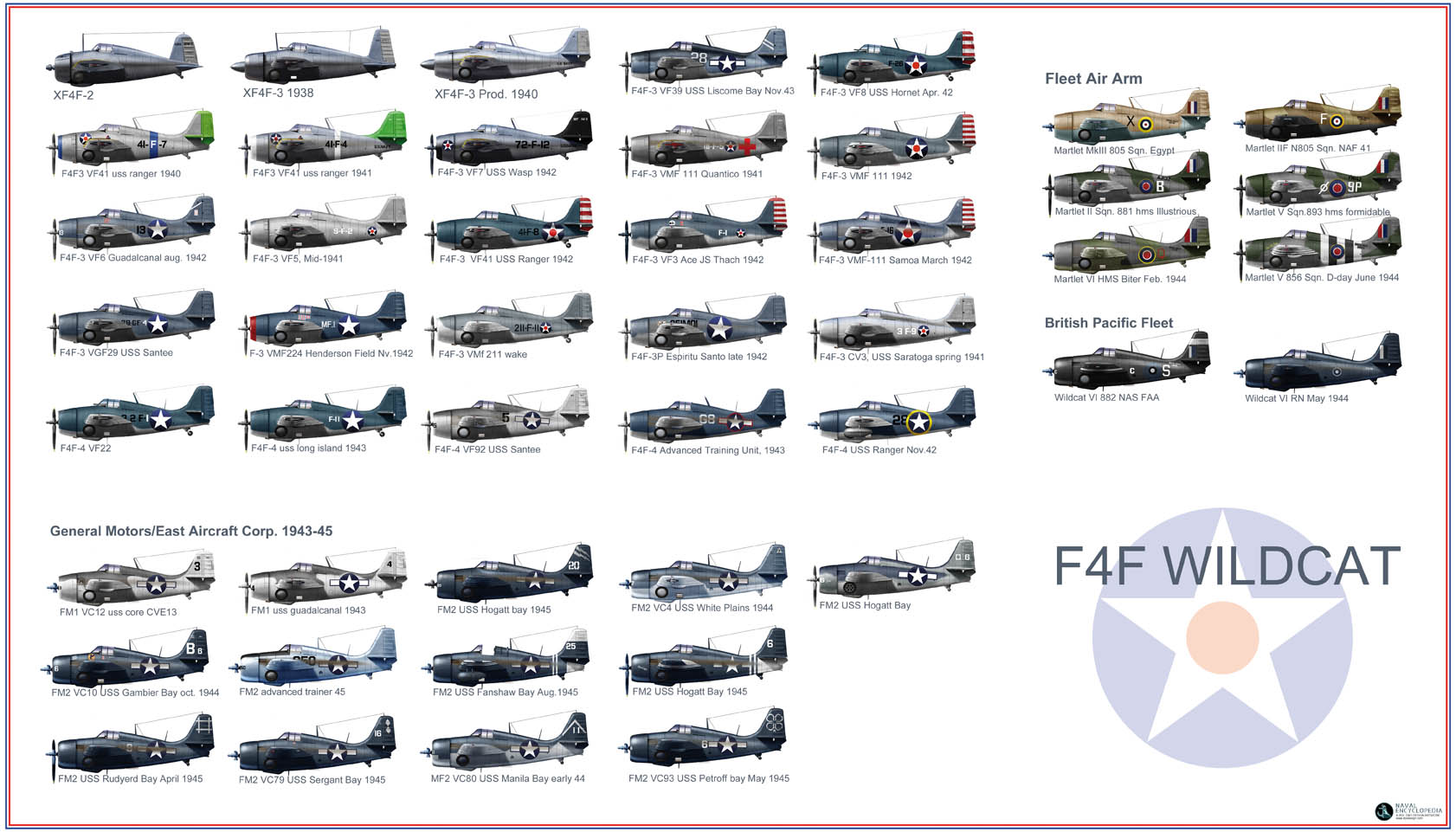
F4F wildcat
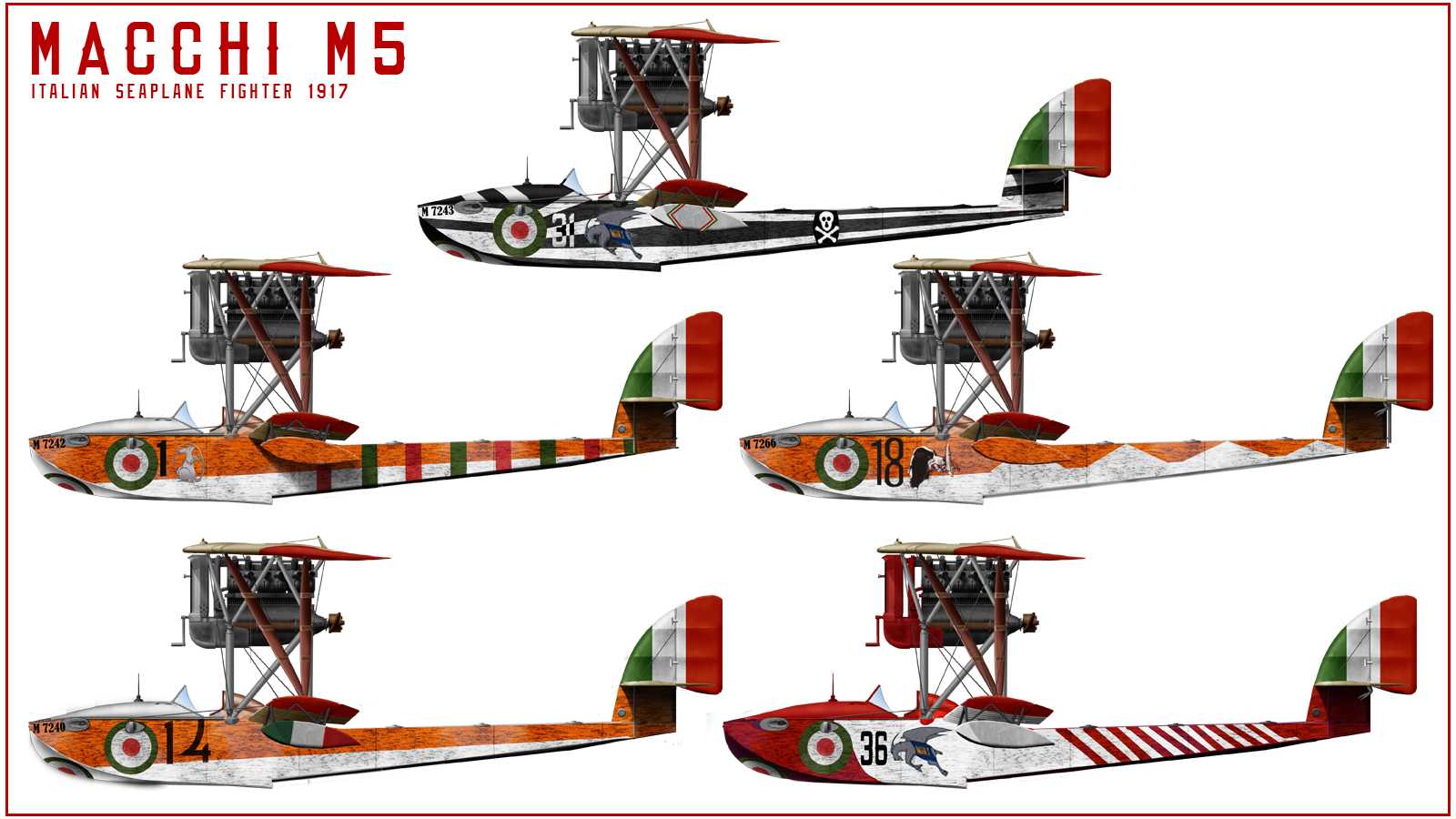
Macchi M5
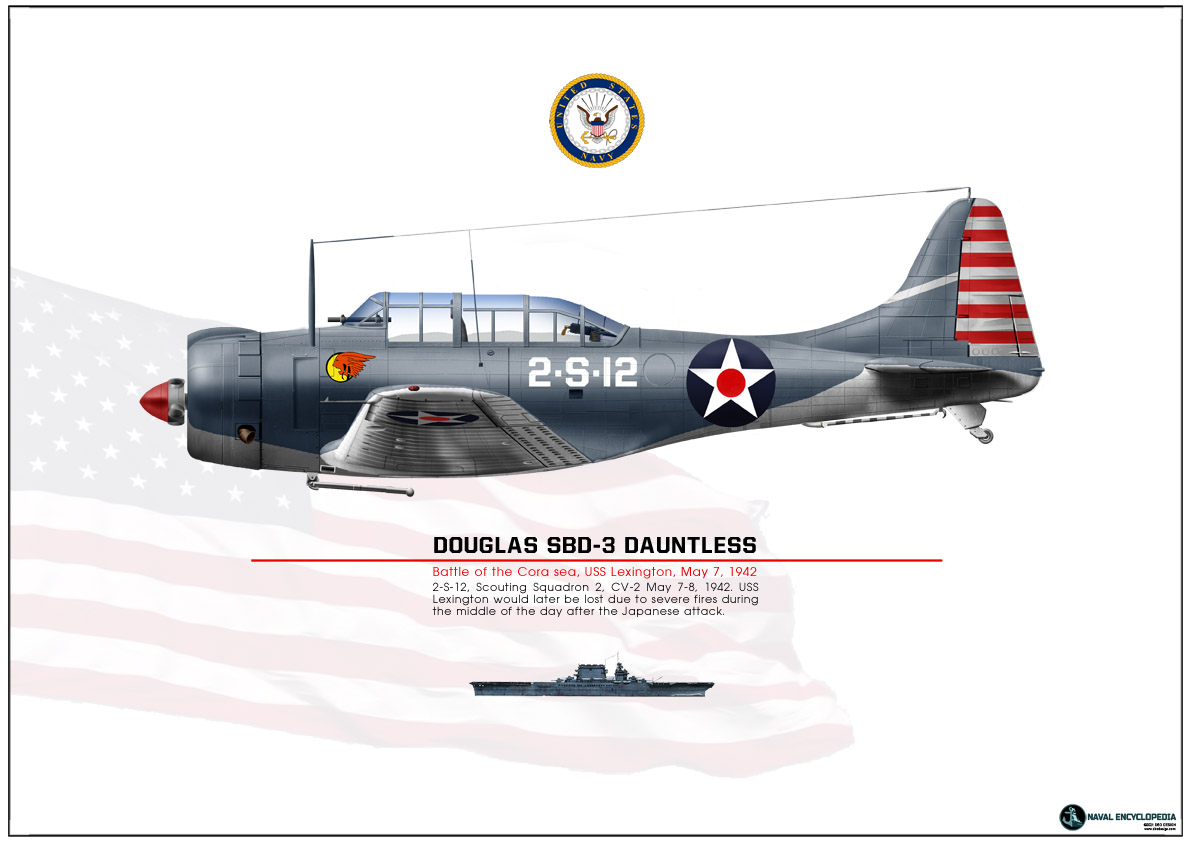
SBD Dauntless Coral Sea
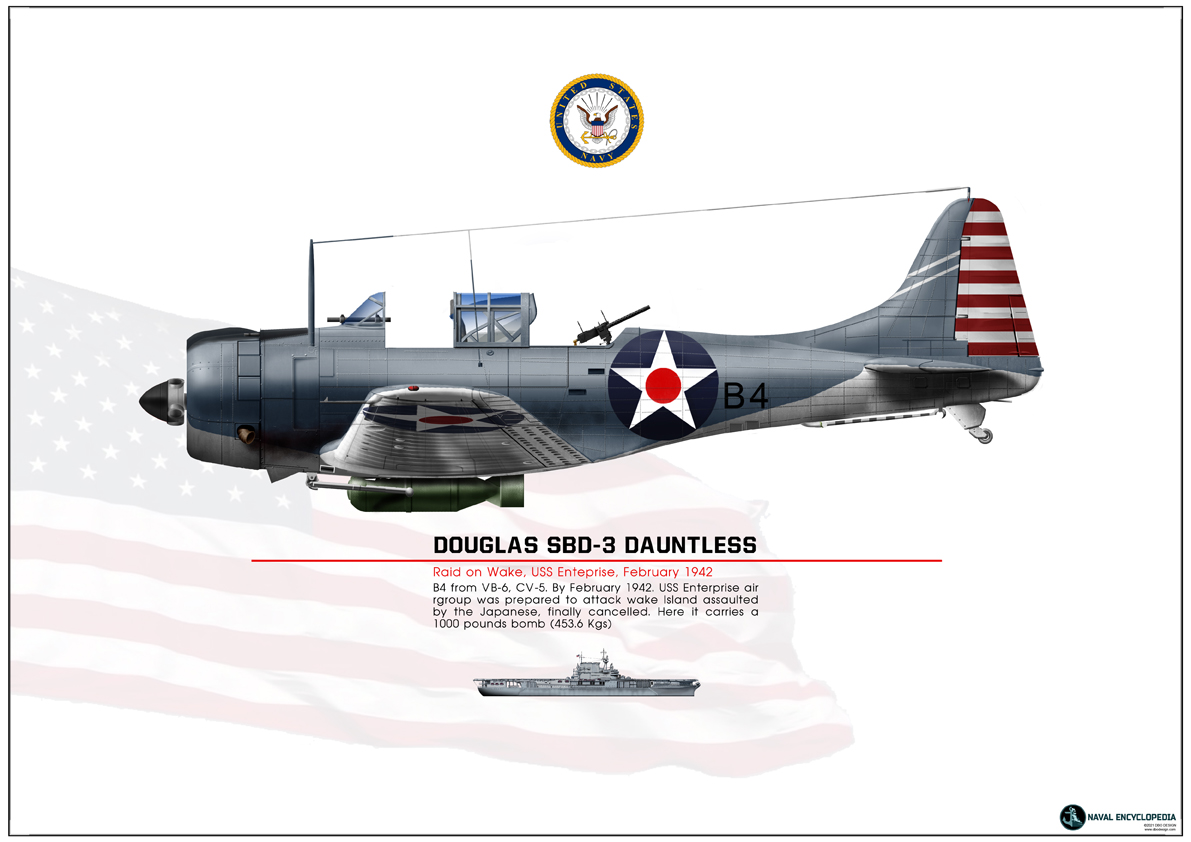
SBD Dauntless USS Enterprise
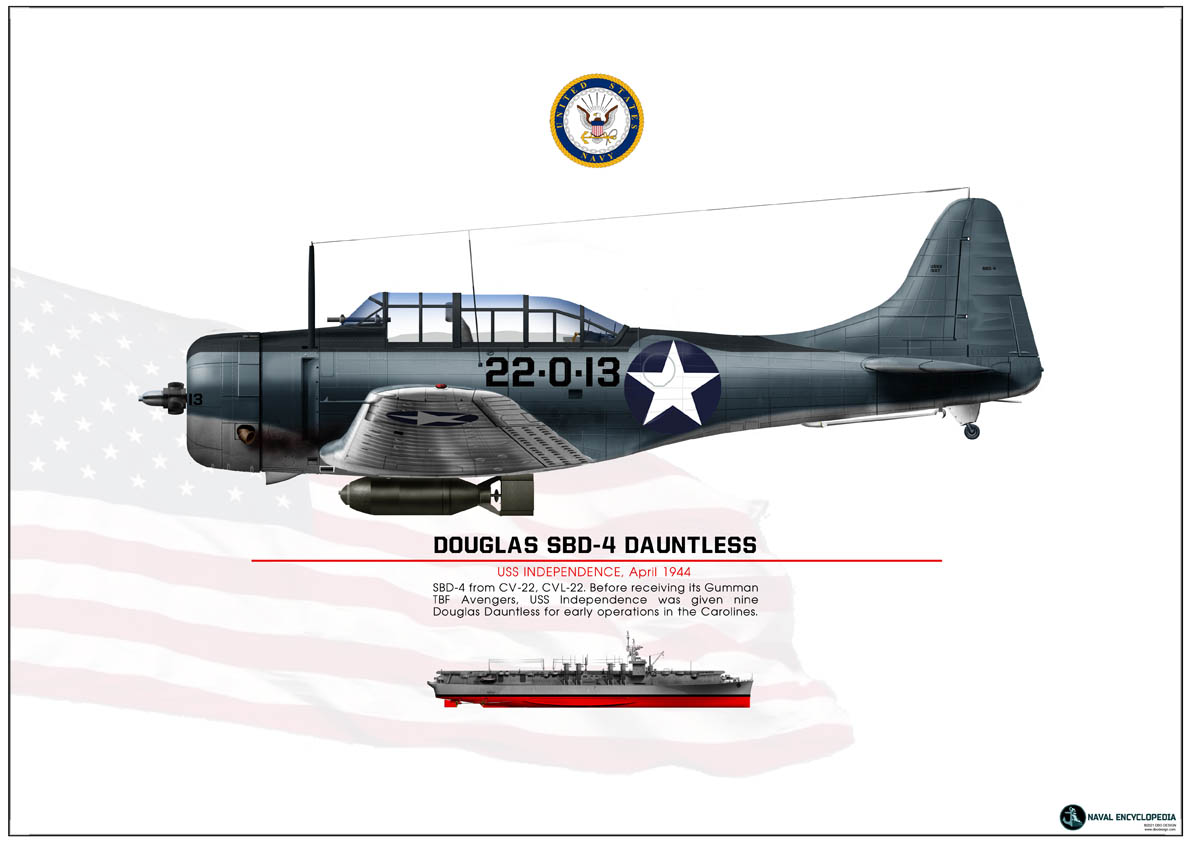
SBD-4 CV22