Dewoitine HD.730 (1940)
 Aéronautique Navale: 3 built (1940)
Development
About Dewoitine and the Navy
"Avions Dewoitine" was a prominent French aircraft manufacturer, founded by aviation pioneer Émile Dewoitine in 1920, in Toulouse, Southern France. The company earned a major reputation for pioneering all-metal construction methods and developing some of the most influential commercial airliners and fighter aircraft used during the interwar period and World War II. At first the company tried to produce high-performance military monoplanes but found no domestic success limited due to a post-WWI surplus. Instead it exported its models to Switzerland, among othersn such as the D.27 parasol fighter. The company also expanded into Commercial Airliners, all cantilveler all-metal designs like the D.332 "Émeraude" trimotor and long-range D.338 flying to French Indochina.At last success was there with the D.500 series as primary fighter of the French Air Force in the mid-1930s, first with a nose-mounted 20mm cannon. The Dewoitine D.332 was also the main parasol monoplane training fighter. In 1937, the company caught by forced defence reforms was nationalised, absorbed by SNCAM (Société Nationale de Constructions Aéronautiques du Midi). With new assets and funding it was able to develop arguably the best warbird France ever had (the Arsenal VG33 remained mostly at prototype stage). The Dewoitine D.520 however was not ready before early 1940, and despite being the only one capable of wining against a Bf 109E there was only one squadron on the frontline. After the Armistice, factories were ordered to manufacture German aircraft components. Émile Dewoitine fled to South America postwar and a new reorganisation integrated its facilities into Sud-Aviation, at the root of what became Airbus in the late 1970s.
Dewoitine designed several models for naval aviation, including carrier fighters and floatplanes. There was for example a Dewoitine D.501 variant used for naval carrier operations and the D.750 torpedo bomber prototype. The company also produced the Dewoitine D.501/D.376 which as a cannon-armed variant of the D.500 series, also navalized for the carrier Béarn and future Joffre class in construction. The folding-wing D.376 was a parasol fighter effectively procured to the Aéronavale for the Béarn and active for a few years.
Otherwise there was the Dewoitine D.750 twin-engine torpedo bomber prototype, built specifically for carrier operations for the futre Joffre class fleet carriers. It only reached the prototype stage before the June 1940 armistice. And there was a floatplane, the Dewoitine HD.730 and later HD.780, both being reconnaissance and floatplane derivatives designed for catapult launch from surface warships, both being cancelled or scrapped following the French defeat in 1940 albeit three preseries of the the former were effectively delivered. Here is this story:
Origin of the Program
The Dewoitine HD.730 was a very modern seaplane (compared to what the Aeronavale flew in 1937). Indeed, it was designed to answer the specification A50, calling for a light, catapult-launched scout and observation floatplane (category SB) to operate from warships. The HD.730 (HD meaning, Hydravion (floatplane) Dewoitine) was designed by a team led by Emile Dewoitine at the SNCAM or recently created Société Nationale de Constructions Aéronautiques du Midi. The latter followed the decision of the new Air Minister Pierre Cot which following the victory of the left-wing Popular Front in 1936, nationalized the French aeronautical landscape in order to modernize production, from scattered small workshop to US or Soviet style mass production facilities. It derived from a low of Nationalization of Military Industries in general. This was in order to reach the numbers necessary to rebuild and modernize the Air Force and face a rearming Germany since 1935.SNCAM integrated all facilities of Dewoitine, notably those of Saint-Éloi et Saint-Martin-du-Touch. It was later consolidated into SNCASE (Société Nationale de Constructions Aéronautiques du Sud-Est) in early 1941. But back in 1937, the small team able to answer this requirement was looked upon favourably because of its cutting-edge models. Two prototypes of the HD.730 were ordered from the Toulouse plant after the project was accepted. The SNCAM completed them by March 19, 1938. They were later transported to the plant at Marignane for final assembly, and the first prototype flew from the Berre Lake in February 1940, the traditional site to test new floatplanes and flying boats for navy qualifications and acceptance.
Design of Dewoitine HD.730
General Layout
This was an all-metal, low-wing monoplane featuring an inverted gull wing folding over the floats, in order to facilitate shipboard storage. It had twin tail fins, which was unusual for that size but excellent for stability. The gull wing configuration was a sensible choice to allow improving air flow relative to the bulky fairings covering the struts between the fuselage and floats. Each float also was divided into compartiments to control flooding in case of puncture. This also a way to make the fuselage lower compared to the floats and reduce air resistance.The two-man crew—pilot and observer—sat in tandem under an enclosed canopy. The observer was armed with a flexibly mounted machine gun, while a fixed machine gun was operated by the pilot. It must be said that despite the links between Dewoitine and Switzerland, providing the bulk of its interwar parasol fighters (D.27 series) and importing elements of the Hispano-Suiza engine, the HD.730 had no relations to the Swiss EKW C-36. The latter created by Eidgenoessische Konstruktionswerkstaette was a single-engined monoplane with a crew of two and multirole land-based model more alike a Sturmovik. They only shared their inline engine and "H" tail.
The HD.730 was all-metal, it had an aluminium structure wrapped in stressed duralumin skin however all movable control surfaces were fabric covered. The floats were attached to the wings by cantilever pylons that can be removed and replaced by a traditional undercarriage, explaining also the gull wings. The pilot inside the greenhouse was seated forward, having access to a wing-mounted forward-firing Darne 7.5 mm light machine gun with 300 rounds (firing outside the propeller's arc). The Observer/Radio/Navigator/Tail-Gunner was seated behind, with a rotating seat to access both to his radio and map table, or pivot to face rearwards and access to the defensive 7.5 mm Darne LMG on a flexible mount also with 300 rounds. The observer also had access to a camera facing down, mounted vertically.
The single-spar stressed-skin wing was divided into five sections with a center one integral with the fuselage, then four folding sections, some immediately outboard of the floats folding vertically then the extreme outboard panels folding to meet above the fuselage. This made for a short span ideal to take as little a space as possible, either to fit in existing Marine Nationale's hangars, or in optional land-based version, to fit in the carrier Béarn's lifts, hangar, or those of the Joffre in construction.
Powerplant and Performances
It was powered by a 220 hp Renault 6Q-03 six-cylinder, air-cooled, inverted, in-line engine. It was driving a two-bladed Ratier-1759 electric airscrew. It had two fuel tanks in the wing center section, for a total capacity of 63.4 gal (240 l), making for a range of 1,350 km. Top speed otherwise was 230 km/h for the first prototype with the Renault engine, but it was found on trials quite sluggish. It had a ludicrous climb rate and could only reach a ceiling of 5,100 m, not enough to escape heavy AA gun fire, or potential enemy fighters.⚙ Dewoitine HD.730 specs. 1st proto. | |
| Empty Weight | 1,173 kg |
| Gross Weight | 1,870 kg |
| Lenght | 9.75 m |
| Wingspan | 12.60 m |
| Height | 3.10 m |
| Wing Area | 20.00 m2 |
| Engine | Renault 6Q-03 220 HP |
| Top Speed | 230 km/h |
| Cruise Speed | 187 km/h |
| Range | 1,000 km |
| Ceiling | 5,120 m |
| Armament | 7.5 mm Darne fwd, +1 7.5mm Darne rear. 8x 10 kgs bombs |
| Crew | 2: Pilot, Observer |
Fate
The first prototype flew in February 1940, the second in May. Tests were not favourable as it was found underpowered. It was proposed that the 40 first be remotorized with a 261 kW (350 hp) Béarn 6D engine. All fell apart at the Armistice of June 22. However since it was in the "free zone" under the new Vichy Regime, development continued. There was a brand new prototype modelled around the new Béarn 6D, 350 hp inline engine, called the HD.731.01, with a much shorter wingspan or 10.21 m (vs 12.60 m). But to be produced under still a German supervision, it as officially registered as an "hydravion colonial de liaison commerciale" or "commercial colonial liaison seaplane". The method of folding wings was revised, and simplified with just two folding points. The new wing's entire trailing edge had slotted flaps and ailerons. The fuel was now entirely housed in a single 63.4 gal (240 l) tank, port side of the wing center section, and aft of the main spar.The HD.731.01 made its maiden flight piloted by Marcel Doret over 40 minutes in March 1941 and it was modified at Mazargues plant. The float axis for example was changed from 2 to 4°. It made another flight on April 22, 1941, but after seven and 2 hr 20 min airborne tests it was modified again, with new tail plane attachment points, increased elevator chord new endplate fins and rudders. Tests resumed on June 30. But on July 4, it flew a last time after which the wing had to be increaseed for its area. However renewed tensions forbade such important modifications so it was disassembled and stored.
After this, SNCAM merged with SNCASE. The two prototypes were transferred from Mazargues to Marignane on June 20 for re-assembly. The first prototype, with its longer sapan, was remotorized in turn by the same 350 hp Béarn 6D and renamed -02. Flight trials with HD.730-02 resumed on September 2. The tail fins were enlarged. It flew again on September 16, and gained a central fin. Flights resumed again until the 27th but eventually its engine was seized by the authorities under Italian orders for evaluation. The new plant was indeed under their own occupation area. A replacement engine was awaited and its cowling was redesigned, as well as the floats made longer, the central fin reworked and a third rudder installed, all was ready by November 24. However where it was Italian control commission forbade further trials. It was placed storage at Vitrolles by December 18 and later so was the HD.730-01.
Work resumed after August 1944 and liberation. The 02 now had its triple fins replaced by a single fin and rudder assembly. It had Mercier ailerons fitted to the outer wing panels for larger flap span. HD.730-02 resumed flights at last by July 21, 1945, was transferred to SNCASE plant at Berre Lake for seeing its wing root fairings enlarged, tail plane span increased. Next trials cured all teething troubles. However at V-Day the Navy was just no longer interested. Catapult for observation planes was a thing of the past.
In between the radar proved itself indispensible. Albeit such planes could be marginally better for artillery spotting than radar still, all catapults in French cruisers and the battleship Richelieu has been removed, so the model was rescheduled for training and communications in the Colonies. On June 25, 1946, HD.730-02 had at last its official trials, only to be beaten by a more recent and modern design, the SCAN-20 which proved infintely superior to this 1938 design. That was the end of it. The HD.730 was never granted production and the prototypes were likely scrapped. There is still a debate among authors today of there was indeed two or three prototypes, between the original HD.730, 01 and 02, and the fact the first was remotorized. However the 730.02 was later renamed 732 and the former 730.01 was the 731. They are recoignized as two separate birds from the 730. The HD.730 was one of this interwar birds tested too late as the war broke up and then delayed under the occupation until proven obsolete...
Gallery
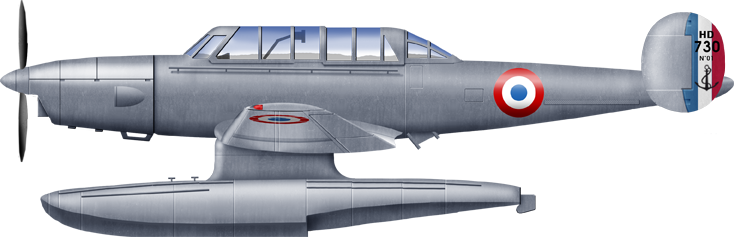
Illustration of the HD.730.

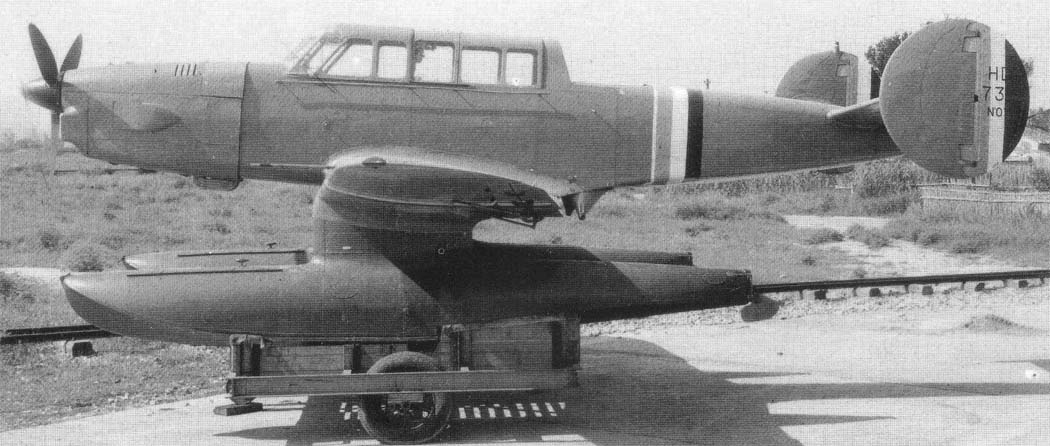
HD 732 in 1945, side view before testings. It had French ID bands on the wings and fuselage.
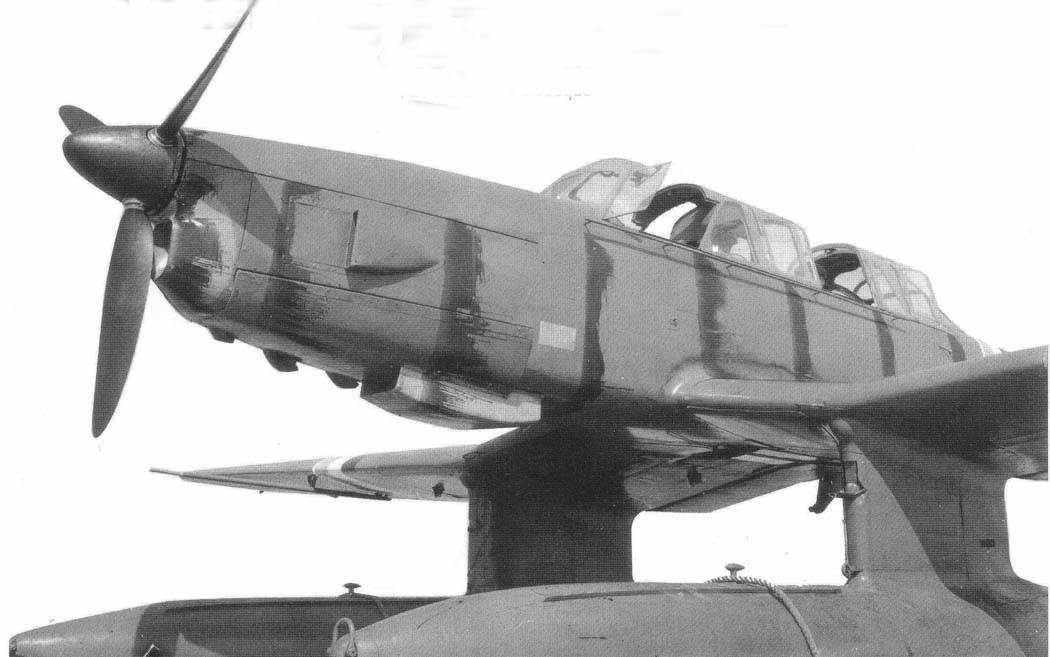
HD 732 in 1945, not a camouflage but fatigued paint after testing.
Read More
Links
fr.wikipedia.orgguyrevel.free.fr/
wardrawings.be
airwar.ru
secretprojects.co.uk/
1000aircraftphotos.com
aircraft-catalog.com/
- Lohner E (1913)
- Macchi M3 (1916)
- Macchi M5 (1917)
- Macchi M7 (1918)
- Ansaldo ISVA (1918)
- Short S.38 (1912)
- Sopwith Baby (1916)
- Short 184 (1916)
- Fairey Campania (1917)
- Sopwith Cuckoo (1917)
- Felixstowe F.2 (1917)
- Gotha WD.2 (1914)
- Friedrichshafen FF 33 (1916)
- Albatros W4 (1916)
- Albatros W8 (1918)
- Hanriot HD.2
- Grigorovich M5 (1915)
- Grigorovich M9 (1916)
- Grigorovich M11 (1917)
- IJN Farman MF.7
- IJN Yokosho Type Mo
- Yokosho Rogou Kougata (1917)
- Yokosuka Igo-Ko (1920)
- Curtiss N9 (1916)
- Curtiss H4 (1916)
- Curtiss H12 (1917)
- Curtiss H16 (1918)
- Aeromarine 39
- Vought VE-7
- Douglas DT (1921)
- NAF/Curtiss TS-1 (1922)
- Boeing FB.5 (1923)
- Boeing F4B (1928)
- Vought O2U/O3U Corsair (1928)
- Grumman FF (1931)
- Akron class airships (1931)
- Curtiss F9C Sparrowhawk (1931)
- Curtiss F11C Goshawk (1932)
- Curtiss BF2C Goshawk (1933)
- Blackburn Blackburn (1922)
- Supermarine Seagull (1922)
- Fairey Flycatcher (1923)
- Hawker Horsley (1925)
- Blackburn Ripon (1926)
- Fairey IIIF (1927)
- Fairey Seal (1930)
- LGL-32 C.1 (1927)
- Fokker T.II (1921)
- Fokker T.III (1923)
- Caspar U1 (1921)
- Dornier Do J Wal (1922)
- Rohrbach R-III (1924)
- Mitsubishi 1MF (1923)
- Mitsubishi B1M (1923)
- Yokosuka E1Y (1923)
- Nakajima A1N (1927)
- Nakajima E2N (1927)
- Mitsubishi B2M (1929)
- Nakajima A2N (1930)
- Nakajima A4N (1935)
- CANT 18
WW1
✠ K.u.K. Seefliegerkorps:
 Italian Naval Aviation
 RNAS
RNAS
 Marineflieger
 French Naval Aviation
 Russian Naval Aviation
 IJN Air Service
 USA
USA
Interwar
 Interwar US
 Interwar Britain
Interwar France
 Interwar Netherlands
 Interwar Germany
 Interwar Japan
 Interwar Italy
- Grumman F2F (1933)
- Curtiss SOC seagull (1934)
- Grumman F3F (1935)
- Northrop BT-1 (1935)
- Consolidated PBY Catalina (1935)
- Grumman J2F Duck (1936)
- Brewster/NAF SBN-1 (1936)
- Curtiss SBC Helldiver (1936)
- Vought SB2U Vindicator (1936)
- Brewster F2A Buffalo (1937)
- Douglas TBD Devastator (1937)
- Vought Kingfisher (1938)
- Curtiss SO3C Seamew (1939)
- K-class Blimps (1939)
- Douglas SBD Dauntless (1939)
- Grumman F4F Wildcat (1940)
- F4U Corsair (NE) (1940)
- Brewster SB2A Buccaneer (1941)
- Grumman TBF/TBM Avenger (1941)
- Consolidated TBY Sea Wolf (1941)
- Grumman F6F Hellcat (1942)
- Curtiss SB2C Helldiver (1942)
- Curtiss SC Seahawk (1944)
- Grumman F7F Tigercat (1944)
- Grumman F8F Bearcat (1944)
- Ryan FR-1 Fireball (1944)
- Douglas AD-1 Skyraider (1945)
- Fleet Air Arm
- Hawker Osprey (1932)
- Fairey Swordfish (1934)
- Blackburn Shark (1934)
- Supermarine Walrus (1936)
- Fairey Seafox (1936)
- Blackburn Skua (1937)
- Short Sunderland (1937)
- Blackburn Roc (1938)
- Fairey Albacore (1940)
- Fairey Fulmar (1940)
- Grumman Martlet (1941)
- Hawker sea Hurricane (1941)
- Brewster Bermuda (1942)
- Fairey Barracuda (1943)
- Fairey Firefly (1943)
- Grumman Tarpon (1943)
- Grumman Gannet (1943)
- Supermarine seafire (1943)
- Blackburn Firebrand (1944)
- Hawker Sea Fury (1944)
- Coastal Command
- Vickers Wellington (1937)
- IJN aviation
- Yokosuka E6Y (1930)
- Aichi D1A "Susie" (1934)
- Mitsubishi A5M "Claude" (1935)
- Nakajima A4N (1935)
- Yokosuka B4Y "Jean" (1935)
- Mitsubishi G3M "Nell" (1935)
- Nakajima E8N "Dave" (1935)
- Kawanishi E7K "Alf" (1935)
- Nakajima B5N "Kate" (1937)
- Kawanishi H6K "Mavis" (1938)
- Aichi D3A "Val" (1940)
- Mitsubishi G4M "Betty" (1940)
- Mitsubishi A6M "zeke" (1940)
- Nakajima E14Y "Glen" (1941)
- Nakajima B6N "Jill" (1941)
- Mitsubishi F1M "pete" (1941)
- Aichi E13A Reisu "Jake" (1941)
- Kawanishi E15K Shiun "Norm" (1941)
- Nakajima C6N Saiun "Myrt" (1942)
- Yokosuka D4Y "Judy" (1942)
- Kyushu Q1W Tokai "Lorna" (1944)
 Luftwaffe
- Heinkel 114 (1935)
- Arado 196 (1937)
- Me109 T (1938)
- Blohm & Voss 138 Seedrache (1940)
 Italian Aviation
- Savoia-Marchetti S.55
- IMAM Ro.43/44
- CANT Z.501 Gabbiano
- CANT Z.506 Airone
- CANT Z.508
- CANT Z.511
- CANT Z.515
 French Aeronavale
- GL.300 (1926-39)
- CAMS 37 (1926)
- Levasseur PL.5 (1927)
- Potez 452 (1935)
- Loire 210 (1936)
- Loire 130 (1937)
- LN 401 (1938)
 Soviet Naval Aviation
- Shavrov SH-2 (1928)
- Tupolev TB-1P (1931)
- Beriev MBR-2 (1930)
- Tupolev MR-6 (1933)
- Tupolev MTB-1 (1934)
- Beriev Be-2 (1936)
- Polikarpov I16 naval (1936)
- Tupolev MTB-2 (1937)
- Ilyushine DB-3T/TP (1937)
- Beriev Be-4 (1940)
 Swedish Naval Aviation
- SAAB B17S
-
 Skoda Š-328V
  R-XIII Idro
 Fokker C.XI W (1934)
 Rogožarski PVT-H (1938)
WW2
 ☍ USNA
- De Havilland Sea Vixen
- Hawker Sea Hawk
- Supermarine Scimitar
- Blackburn Buccaneer
- Hawker Sea Harrier
- Douglas A4 Skyhawk
- Grumman F9F Panther
- Vought F8 Crusader
- McDonnell-Douglas F-4 Phantom-II
- North Am. A5 Vigilante
- TU-142
- Yak 38 forger
☢ Cold War
✧ NATO
Fleet Air Arm
 US Navy
☭ Warsaw Pact
Merch
Seafire Mark 45; HMS Pretoria Castle
Zeros vs its aversaries
Aichi D3A “Val” Junyo
Mitsubishi A5M poster
F4F wildcat
Macchi M5
SBD Dauntless Coral Sea
SBD Dauntless USS Enterprise
SBD-4 CV22