Vickers Wellington in the Coastal Command (1940-45)
 Coastal Command, c2,500 built.
Development
The main RAF 2-engine medium bomber

The Wellington was developed from Air Ministry Specification B.9/32 middle of 1932, for a medium bomber for the Royal Air Force. This specification called for a modern 2-engined day with high performance under the assumption "the bomber will always get through". So expected to be unescorted. Others developed for the same were the famous Armstrong Whitworth Whitley and Handley Page Hampden. Performance requirements changed substantially however and the engine was also changed. In the end, the Wellington prototype was designed during the mid-1930s at Brooklands, Weybridge, Surrey, under Vickers-Armstrongs' chief designer Rex Pierson.
One key feature which constributed to the model's immortal fame was its very modern (for the time) geodetic airframe fuselage structure. Designed by genious engineer Barnes Wallis it enabled resistance while being flexible and light, and being wrapped in canvas, made it extremely easy to repair. The Wallington shared around 85% of their structural components with the Warwick bomber developed later under the Specification B.1/35. A civilian model was also developed, the Vickers VC.1 Viking.
However, after it entered service in 1936, the Wellington only was frontline for the first part of the war as its design soon was seen as obsolescent. It became typically used as a night bomber and became in fact one of the primary long range model of the Bomber Command. In 1943, it started to be superseded by the faster and more modern Avro Lancaster and HP Halifax which carried a bigger payload, faster, and were better protected for the role. Relegated as a second fiddler, the Wellington however gradually started to find a new career gradualy from 1941. As the first entry in the Coastal Command, this bomber, at first refused to the service, became soon its primary instrument. It started service as an anti-submarine aircraft and even remained first-line in this service until 1945, while it was relegated to secondary roles in the RAF. The Wellington was named after Arthur Wellesley, 1st Duke of Wellington, vanquisher of Napoleon.
The Coastal Command's Darling
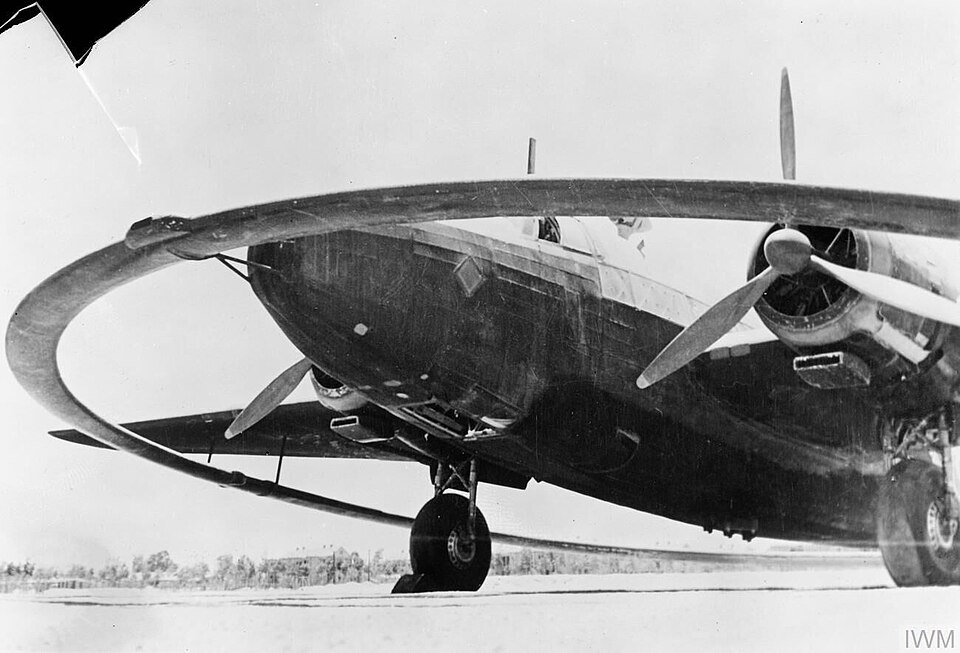
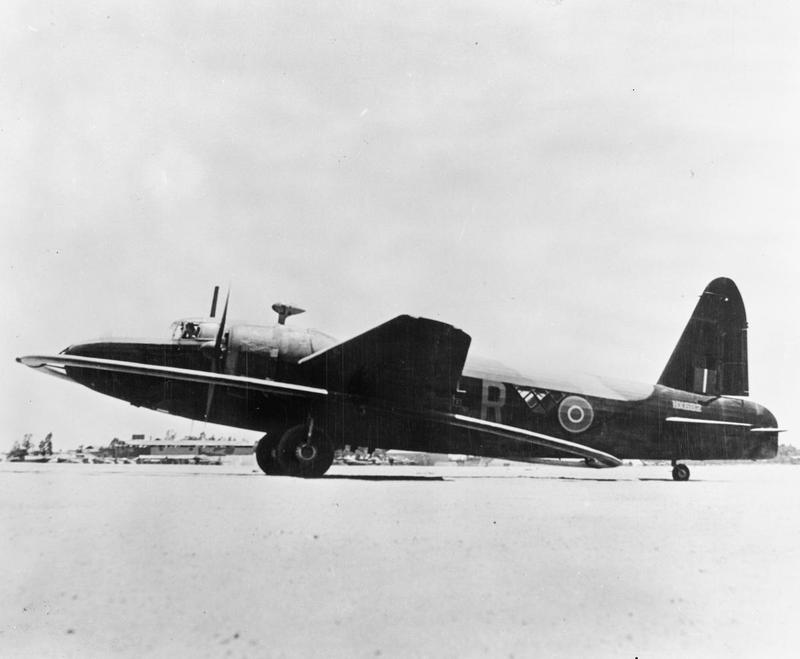
The 48 ft diameter magnetic coil on a Wellington DWI Mark II used to detonate naval mines.
RAF Coastal Command was a specialized formation within the British Royal Air Force founded already in 1936, as its maritime aviation arm. It was not a competitor of the Fleet Air Arm (FAA) as the latter was limited to "marine aircraft" only, meaning ship-borne or seaplanes. In contrast, the Coastal Command was provided regular land-based bomber to operate from coastal bases. The equipment and strategy remained native to the RAF, but it was a cooperative service working with the Royal Navy. The Coastal Command played a critical role in securing Allied victory in the Second World War.
Indeed the "Cinderella Service" created in a major RAF restructuring also seeing the creation of the Fighter and Bomber Commands. was very much the result of disagreements between the Royal Navy and the RAF over funding and control. Due to this lack of resources and secondary status it became the "Cinderella Service". Until 1941 the Coastal Command was equipped with "RAF leftovers", literrally the "drawer's scraps", in 1939 consisting of 19 under-strength squadrons totaling roughly 170 operational aircraft. It was a mix of seaplanes and land-bases bombers: The Supermarine Stranraer and Saro London for example made the bulk of its purely coastal bases like Felixtowe. From 1938 however it started to receive the Short Sunderland Mark I, soon to be its best asset as far as flying boats were concerned.
As for land-based models, the Coastal Command flew for example the Bristol Blenheim light bomber in its first versions. The main issue was the strict separation of the bomber command from the Coastal Command so very few to the dismay of its first and most active commander, Sir Philip Joubert de la Ferté complaning of its neglect. Some 16 of these c170 aircraft were allocated to trade defence. Hugh Trenchard accepted to see however the developement of bombers for the maritime arm but only to bolster the air offensive from over the sea, and were classic land based models not specialised anti-submarine warfare. Until the war started, the sad truth was that the Air Ministry was thoroughly uninterested in any aircraft which fell outside the bomber function. And the bomber command continued to jealously keep its assets, not dispensing them to the Coastal Command.
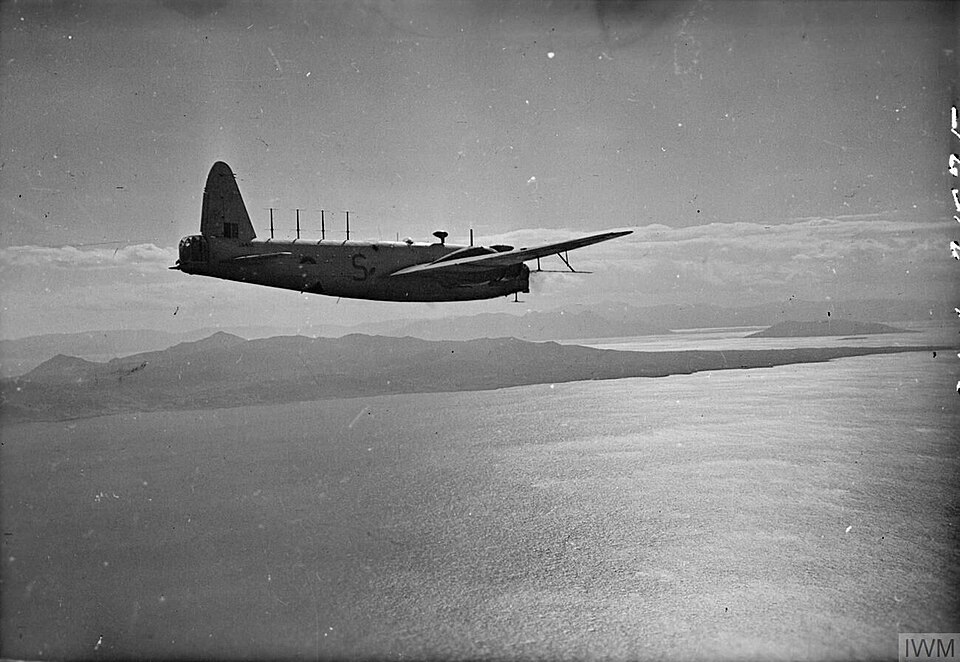
GR Mark XIII, the most common Coastal Command model
So when the idea of detaching now older Wellingtons Mark I, to be superseded by more modern variants in the bomber command, to the Coastal Command, it was the first good news since a while. From September 1939, the CC tried to exist under a more vigorous Air Marshal Sir Frederick Bowhill, the longest in service, successor of De la ferté, from 18 August 1937 to 14 June 1941. It was him that really shook the air ministry in order to obtain, from the Warwick, its first dedicated bomber, at least a part of the Bomber Command's precious assets. However even with mounting pressure of the battle of the Atlantic, the CC could not obtain any bomber, even obsolete ones, and only from 1940, a number of Wellingtons equipped to explode magnetic mines were detached to operate with the CC. So the first Wellingtons were "mineseepers". They had a large antenna-like magnetic gimble causing, when flying at low altitude, magnetic mines to explode. They played their role, and were returned to the bomber command after reconversion, and the service still had to make due with its antiquated Blenheim Mark I, hoping to make a lucky bomb hit on a surfaced U-Boat.
At last in late 1941, Bowhill, just before departing and Joubert de La Ferté returning obtained from "bomber harris" to have now largely obsolete Mark I-IIs modified as proper maritime bombers. But it's only with the Mark VIII that the first proper maritime bombers, dedicated to U-Boat hunt, were developed. They were indeed modified with a leigh light. They preyed by night across the Bay of Biscaye in search of surfaced U-Boats. The first of these was accepted in the 221 Squadron and detached to the Mediterranean in January 1942. However the Wellingtons that were at last obtained at the time were used for "maritime reconnaissance" over the Atlantic, meaning they were loaded with bombs and depht charges if available, shared with the Fleet Aoir Arm and engaged at will any surfaced U-Boats. Sin,ce the latter emerged at night to reload their batteries before or after, and in between convoy tracking and attacks (made systematically by night from 1942) the Wellingtons had to be adapted for night missions.
Main Versions
Med Fishington and Snoopington
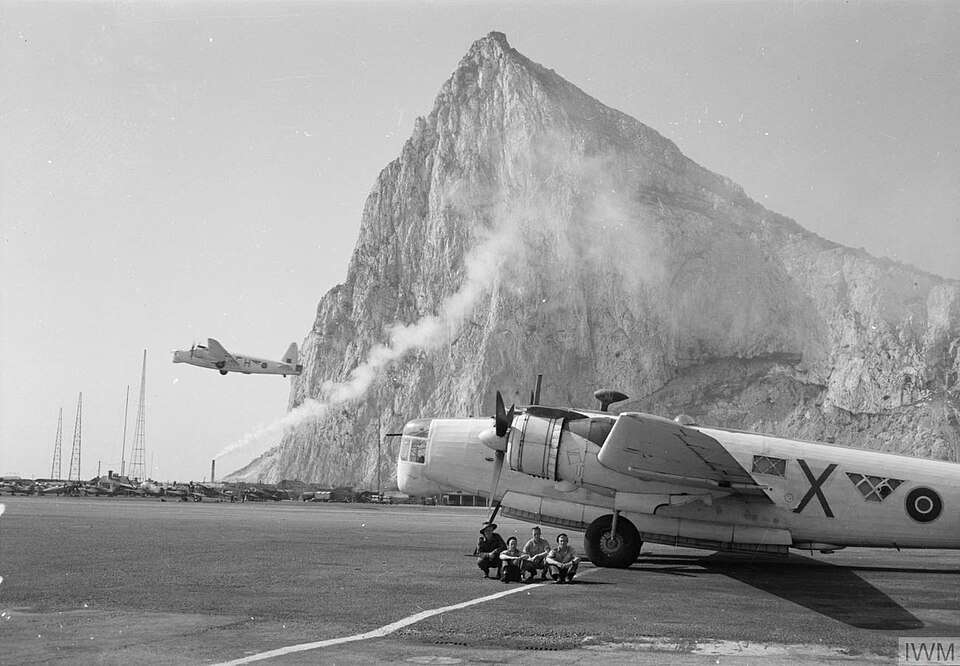
Mark XIV operating from Gibraltar
In 1942 the Wellington was adapted to perform night anti-shipping torpedo attacks directed against the axis shipping in the Mediterranean. The torpedo-carrying Wellington became quollocially for its crews the "Fishington". It was assited by another variant, also vital for night operations to detect these targets, the radar equipped Wellington guiding the first, and also colloquially known as the "Snoopington". They generally operated in pairs, or full squadrons with the torpedo carriers in the center of the formation and radar equipped ones further out watching forward, aft and either wing due to their short range. The N°38 Squadron Coastal Command started to operated these from Shallufah, Egypt. It even had an advanced detachment from RAF Luqa in Malta in 1942.
Annt-Uboat Wellingtons
The Wellington was adopted by RAF Coastal Command bases tasked of patrolling the western approaches and in general the taking part in the Battle of the Atlantic at large. The Mark IC was the first used by the Coastal Command had an endurance of over 10 hours at just 125 knots (144 mph) and with a 1,500 lb (680 kg) bomb payload or depth charges. U-Boat patrol was done by day, but soon they took turns to be aloft in the same sector in turn night and day. On 6 July 1942 a Wellington sank its first surfaced U-Boat. In 1944-45, Wellingtons were also sent to Greece for support for the British fighting the communis insurgents in the Greek Civil War. Later they ended in the Hellenic Air Force. Others, notably Mark VIIIs, started to operate from the African coast. The most famous was the N°26 Squadron SAAF (South African Air Force) based in Takoradi on the Gold Coast (now Ghana). There was also the Free French 344 Squadron from Dakar with the French aslmo operating the type.Minesweeping Duties
 As the war started, also the fear of magnetic mines. Apart degaussing ships, the best way to detonate the mines at sea was the specialised "Directional Wireless Installation" (DWI) a deceptive name and cover story for these hoop variants of the Mark IC whioch flew at low altitude with a giant, 48 ft (15 m) diameter metal hoop to explode these magnetic mines. The hoop radiated a powerful magnetic when field passing over them. The first sucessful mission was on 8 January 1940, the on 13th to "test the waters" of the system, and soon it appeared that pilots deliberately flew below the safe 35 ft (11 m) altitude. One was caught in the explosive blast and damaged, but flew back. The hoop itself was an aluminium coil made in an aerodynamic balsa case. The turrets were faired over and MGs removed as well as all unnecessary equipment to save weight and install the extra De Havilland Gipsy Six engine and generator feeding the hoop.
No. 1 GRU, RAF Manston started operations routinely, soon joined by a No. 2 GRU from RAF Bircham Newton. The Wellingtons DWI were in case escorted by Bristol Blenheims (fighter variant) from No. 600 Squadron as the Battle of France progressed. One DWI was sent to the Middle East, became the model for more conversion of Wellingtons deployed in this theaters as the axis also dropped magnetic minefields. They were used notably to clear out the vital Suez Canal Zone and then ports along the coast. Indeed Italian submarines were ordered to mine these entrancces In all, 11 Wellington DWI Mark I were modified, to the first standard, operated by No. 1 General Reconnaissance Unit. They routinely cleaned up the Thames Estuary until the Royal Navy coiuld take this job over. This unit was then transferred to Egypt and started operations over theSuez Canal.
ASW variants
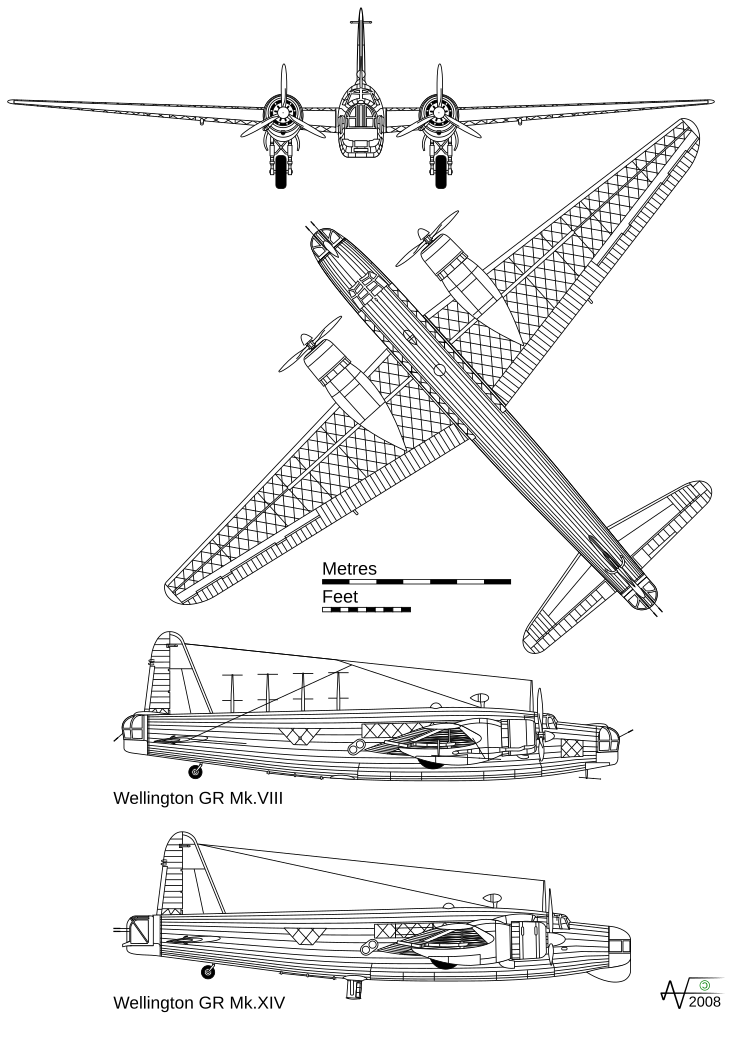 Instrumental to this development was the Leigh Light. It was invented by Wing Commander Humphrey de Verd Leigh, and fitted on the "dustbin" turret below the belly. This 24-inch search light was tested from a DWI Wellington in January 1941. This prototype at first used the same batteries already feeding the onboard engine and generator to reduce weight. The design was tested and approved into production, started a long serie of Leigh Light-equipped Wellingtons. The Mark IC, VIII, XIII and XIV also combined it with radar altimeters, os that they could fly to just 50 ft (15 m) over the waves. The idea was detecting the U-Boat mass by radar, and then be vectored in, until illuminating the target. Indeed the radar was no longer able to track its signal half a mile away just among returns from the water's surface. The combo was deployed on most versions used for ASW work.
By late 1944, a radar-equipped Wellington XIV from 407 Sqn. RCAF became the RAF's first airborne early warning and control aircraft. It was deployed with a fighter Interception Unit and deployed at 4,000 ft (1,200 m) over the North Sea, vectoring De Havilland Mosquito and Bristol Beaufighters towards a flight of Heinkel He 111 bombers from Dutch airbases to launch their V-1 flying bomb. The FIU Wellington vectored first the Beaufighters to attack the bombers, the faster Mosquitos were kept to attack the V-1 if launched. They started top operate with a ratio of 4 Beaufighters for a single Mosquito. This system could be also used by the Coastal Command to vector in ASW Wellingtons on U-Boats, provided the FIU Wellington could detetct them, notably via trigonometric radio interception.
Wellington Mark VIII
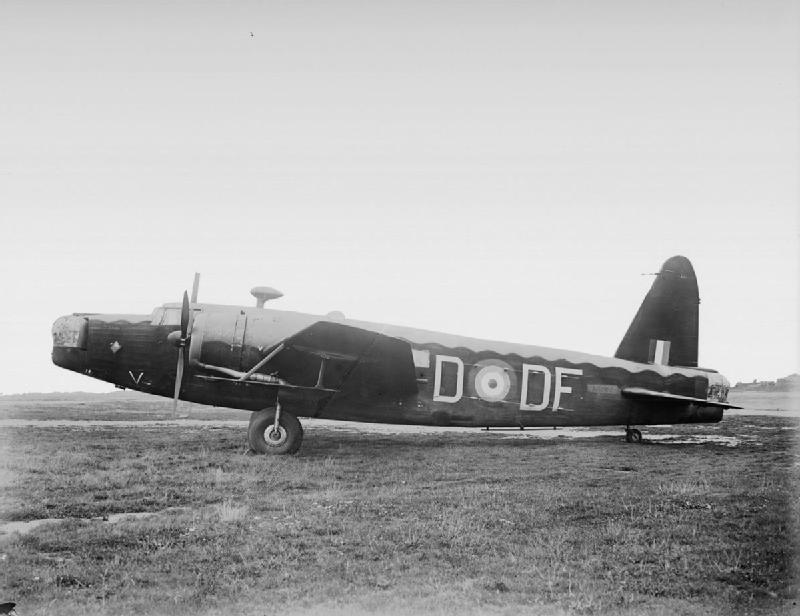
Type 429 Wellington General Reconnaissance (GR) Mark VIII
The first Coastal Command was the Mark IC conversion, used for reconnaissance, ASW and anti-shipping attacks and first fitted with the Leigh light. 307 were so manufactured at Weybridge, of which 58 were fitted with the Leigh light for night patrols. U-Boats were especially vulnerable by then, surfaced and near immobile when reloading their batteries.
Wellington Gr. Mark XI
The Mark X became the main Coastal Command version to be declined in other CC model. Vickers Type 440 Wellington B, 3,804 built, most widely used variant. Two 1,675 hp (1,250 kW) Hercules XVIII engines. Used to develop the GR. Mark XI to XIV. The Type 458 sub-variant had an ordinary nose turret and ASV Mark II radar antenna, no waist guns. 180 built at Weybridge and Blackpool.Wellington Gr. Mark XII
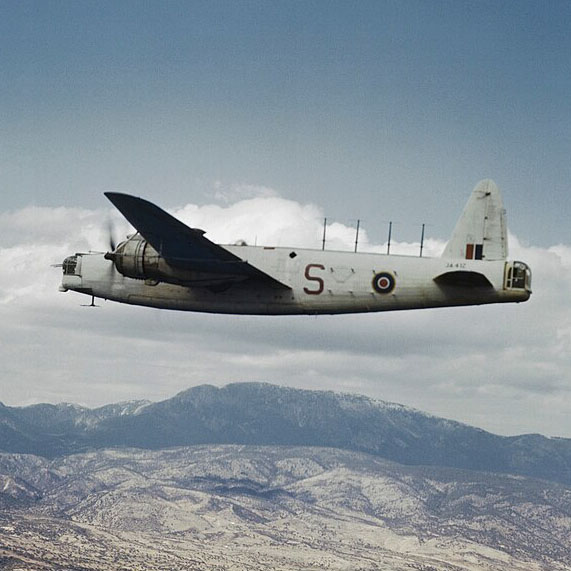
Asl called Type 466, it was adapted to carry two 18 inches (457 mm) airborne torpedoes under wings. It had a redesigned to fit the centrimetric ASV Mark III radar with its charactestic chin radome. It had twin flexible machine guns in a clear canopy instead of the front turret. It had also the Leigh light in the bomb bay and no longer the "dustbin" turret. It also was powered by a pair of Hercules VI or XVI engines. Only 58 of these were built at Weybridge and Broughton, Flintshire.
Wellington Gr. Mark XIII
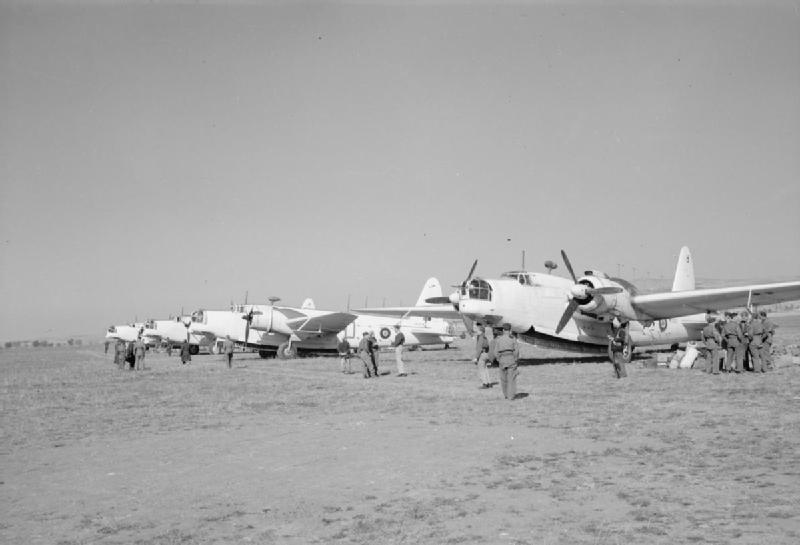
The Type 466 had an ordinary nose turret and mast for the ASV Mark II radar (no chin radome, no waist guns). tIt was faster, powered by the Hercules XVII rated for 1,735 hp (1,294 kW). There were 844 built, including two at Weybridge and the remainder at Blackpool: Main coastal command bomber.
Wellington Gr. Mark XIV
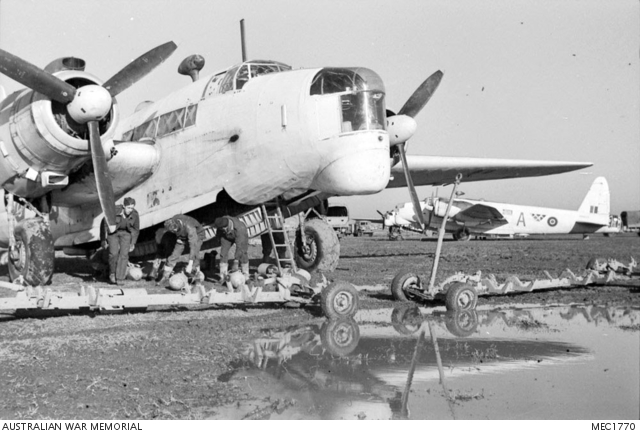
Type 467: Chin radome for the ASV Mark III radar, RP-3 explosive rocket rails under wings. Hercules XVII engines. 841 built at Weybridge, Broughton, Blackpool second most common model of the Coastal Command.
The pure ASW bomber: Warwick

A Vickers Warwick based at No 179 Squadron, RAF, St Eval, Cornwall, England. This squadron was the first to receive this type of aircraft (developed alongside the famous Vickers Wellington) in November 1944 and was used for anti-submarine work over the Bay of Biscay and the Western Approaches
The Coastal Command had however a true, specialized ASW bomber, developed from 1940 alongside the Wellington at the same factories and from the same teams: It was the biggest hope of the Coastal Command: Along with some 11,460 Wellingtons, the 846 Warwicks represented a fraction of the total number of aircraft built by Vickers-Armstrongs, otherwise an industrial giant of Britain, very much linked to naval construction as well: In the 1880-1900s it provided 80% of the cruisers in service globally, outperforming all shipbuiding nations, even providing cruisers to Japan, Russia and the US.
Design
General conception
 Left: The Leigh leight. Like the ASV radar, this pairing proved instrumental in these ASW patrols, but the leigh light in particular was only mounted to the Wellingtons used in night patrols only. The Welington used by the Coastal Command was not that different from regular Wellingtons apart the modifications detailed above and below. Back in 1935, the Wallington was mostly defined by revolutionary feature: The geodetic construction. Designed by the legendary Barnes Wallis, this unique structural approach made the Wellington one of the most durable and resilient aircraft of World War II.
Instead of relying on a traditional internal framework of heavy bulkheads and longitudinal stringers, threre was a lattice-like basketweave structure making for a network of curved, interlocking duralumin-aluminum alloy channels woven diagonally across the fuselage and wings. Stressed were spread along all these elements instead of a few parts. Plus being modular, they could be replaced after battle damage with ease, in addition to the presnece of all this network to continue carrying the structure. The structural load was widely spread and it was not rare to sea Wellingtons badly damaged by AA and loosing a massive section of the fuselage, then come back home. Stress and tension were simply redistributed through the remaining unbroken lattice paths. Apart replacing individual pass-produced lattice nodes, repairing the fabric skin was all needed.
Instead of external suralumin skin, Vickers wrapped this structure in fabric skin. This made for hybrid construction. The entire duralumin geodetic framework was covered in layers of doped Irish linen fabric. To prevent it rubbing against the sharp metal edges of the geodetic frame, the lattice structure itself was first wrapped in protective fabric strips before the main outer skin was applied. This skin however offered zero protection against fragmentation and was highly vulnerable to fire.
 Mark XVI, very close to the XIV.
Another peculiarity of the Wellington was its High-Aspect-Ratio Wing. Barnes Wallis applied advanced sailplane and aerodynamic theories and like the B24 Liberator, the wings were remarkably long, straight, and tapered, featuring a high aspect ratio. This gave the Wellington exceptional lift efficiency, impressive gliding capability even with both dead engines. The structure allowed a better tnternal Volume and that was used for self-sealing fuel tanks without heavy internal reinforcement.
The Crew Layout was five or six men depending on the versions, with a pilot, co-pilot and navigator, a bomb aimer, a wireless operator, and a nose and/or tail gunners. The Wellington had a Fully retractable main landing gear, retracting rearward into the engine nacelles, paired with a fixed tailwheel. These were modular engine mounts with a firewall designed with universal mounting points to switch from Bristol Pegasus to Rolls-Royce Merlins or Bristol Hercules radials without redesigning the core airframe. In practice as we will see, Bristol Radials were used throughout Coastal Command versions.
Engines
Depending on versions, performances could vary greatly. The Wellington with its span of 86 ft 2 in (26.26 m) was already a bit large for a pair of 800 hp radial engines. The initial production was to have the 9-cylinder Bristol Pegasus XVIII radial engine (delivering around 1,050 hp), but these engines were not ready in time for the first official Mark I flight on December 23, 1937. The initial Mark I prototype flew with Bristol Pegasus XX engines instead. After an accident and subsequent repairs, the prototype received the intended Pegasus XVIII engines once they became fully available. Subsequent production Mark I and IC aircraft standardized on the Pegasus XVIII powerplant. They were rated for 1,050 hp (780 kW) still, not enough. The Mark IC and VIII had the same 9-cylinder, single-row radial air-cooled engine also rated for 1,050 horsepower (780 kW) each at takeoff. But for bombing missilns at high alttitude they were issued a s supercharger for optimized performance, not present for the Coastal Command variants.All had the same three-bladed de Havilland constant-speed variable-pitch propellers.
The Mark XII had at last two 1,675 hp (1,250 kW) Hercules XVIII engines.
The Mark XIII and XIV had two Hercules XVII rated for 1,735 hp (1,294 kW). They were the final evolution of the type and the power to weight ratio was more favourable.
Performances were as follows below in the table for the IC and VIII. For the XIII and XIV, Maximum Speed was 250 mph (402 km/h) and normal range was 1,390 miles (2,237 km) that could be extended to 1,760 miles (2,832 km) with auxiliary fuel. Service Ceiling was 16,000 feet (4,877 m) and maximum Loaded Weight was 31,000 lbs (14,061 kg) for the same payload decribed below. For best flight endurance thay stay low and slow, and could manage amazing flight patrols for half a day. At 11-15 meters above the wave, there was already some "wing-in-groun" effect that could extra lift and reduce fuel consumption. Thus, unlike their bomb command counterparts flying high and fast, they had the best range and flight duration of the type.
Armament
Defensive Armament
If forward-firing weaponry to suppress enemy deck guns during low-altitude attack runs was considered more important, it was neglected on the Wellingtons, which stuck to a standard defensive array, reduced compared to the Bomber Command variants. They all used the compact and largely available standard rifle-calibre .303 in (7.7 mm) Browning machine guns. They were used throughout, albeit the exact layout depended heavily on whether the nose was taken up by advanced radar housings. There were at least one armed position at the nose, optional, and one at the tail, at first with a twin mount and tail quad gun in later versions.The Mark VIII still retained the standard bomber defense setup. It carried two .303 guns in the power-operated nose turret, two .303 guns in the tail turret, and two .303 guns in the beam (waist) positions.Mark XI & Mark XIII (Daylight Torpedo Hunters): Equipped with standard mast-mounted ASV Mk II radar, leaving the nose clear. They retained the power-operated Frazer Nash dual-gun nose turret and dual-gun tail turret, but sacrificed the beam guns to save weight.
Mark XII & Mark XIV (Night Anti-Submarine Hunters): The large chin-mounted radome for the centimetric ASV Mk III radar completely blocked or forced the removal of the standard nose turret. To compensate for losing the power turret, a pair of flexibly mounted, hand-held .303 Browning machine guns were installed in the nose window so the crew could manually suppress U-boat deck gunners during the final Leigh Light illumination run. They retained the standard power-operated dual-gun tail turret for rear defense.
18 inches of 457mm torpedoes
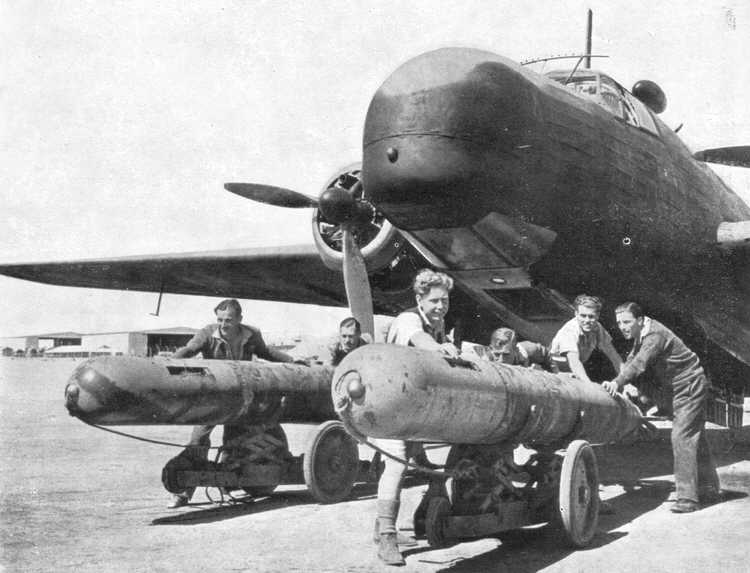
The GR Mk XI & XIII for their daylight anti-shipping missions were tailored specifically to carry two 18-inch (1,610 lb) naval torpedoes. In this variant, the three-row bomb bay was gutted, the keel now comprised two inner longitudinal structural beams, separating the three narrow bays, all heavily modified or cut back. Specially bulged external bomb bay undershields or fairings were bolted to the aircraft's belly. Indeed, the torpedoes could not fit completely inside the narrow depth of the bays, so aerodynamic fairings played a role to cover these semi-recesses into the fuselage structure and streamlining.
As the torpedoes themselves, two could be carried side by side: These were Mark XII aerial torpedoes, first designed in 1935 specifically for aircraft delivery and standard standard-issue for the RAF Coastal Command strike wings until 1945. They were however modified, with the "Mat" TailDropping which needed structural reinforcement. It had a Matric Tail or wooden directional box fins, temporary breakaway wooden fins clamped to the rear metal fins by friction. They stabilized the torpedo while in the air, and for water entry shedding, after impacting the ocean surface the sudden shock shattered the wooden directional frame so they broke away instantly leaving the standard under-water metal rudders clear for steering control and stay on course and required depth.
Specifications: Diameter: 17.7 inches (450 mm), Weight 1,548 lbs (702 kg).
Warhead: 388 lbs (176 kg) TNT or Torpex detonated by a mechanical "contact pistol" fitted to the nose.
Propulsion: 140 hp four-cylinder burner engine heated by fuel mixed with compressed air. Settings 40 knots (74 km/h) for 1,500 yards (1,370 m) or 27 knots (50 km/h) for 3,500 yards (3,200 m).
Bombs
The Wellington had a two-section, two-door configuration, opened hydraulically, and enough space and racks for a multi-tier vertical or slanted cell racks designed to hold arrays of smaller 250-lb or 500-lb general-purpose (GP) bombs layered on top of each other. They could be useful in anti-ship attack in the Med, albeit direct hits were rare. Against submarines, this was also no ideal.Depth Charges
The Coastal Command variants were soon modified to take on depth charges. These original multi-tier racks were completely removed from all three parallel tracks as the depth charges required precise horizontal release mechanisms to maintain a flawless spacing pattern (the "straddle") across a submarine's path. Ground crews replaced the multi-tiered setup with heavy-duty universal single-tier horizontal beam carriers. There were upgraded release slings and steadying crutches installed as standard GP bombs were thin and aerodynamic while naval depth charges were squat, heavy, un-aerodynamic cylinders closer to oil drums. To there were wider, heavy-duty suspension slings capable of wrapping around the thicker diameter of a depth charge. Adjustable mechanical steadying crutches (swivel pads) were installed on the upper bay framework to clamp down tightly against the sides of the cylindrical depth charges, stopping them from shifting or swaying during violent, low-altitude maritime maneuvers.As for the depth charge used, they were standard Royal Navy types (see below), but to be dropped they needed a setup, and thus fusing and detonator umbilicals. The Challenge was to setup specialized hydrostatic pistols (fuses) for a pre-set depth through the bomb bay’s electrical and mechanical fusing lines. They were all re-routed. New pull-wire attachment brackets were integrated next to the release shackles. As the depth charge dropped, these specialized lanyard wires mechanically pulled the safety pins from the hydrostatic pistols, arming the weapon instantly as it left the bay without relying on traditional airflow to spin a fuse vane.
Also the Coastal Command Wellingtons were given new low-altitude "Spring-Loaded" Doors instead of the ones hydraulically opened and closed, way too slowly. Encounters were U-Boats at 250-300 kph were blistering fast, unlike high altitude bombings. At the extremely low altitudes for depth-charge attacks at 50-100 feet above the waves there were revised structural belly paneling for new spring-loaded bomb bay doors, to snap open nearly instantaneously as release button was pressed. The precise moment for this release was the task of the Leigh Light operator and bombardier. They chased any mechanical lag.
These were initially the 450-lb Mark VII depth charge. The cylinder was fitted however before departing with a conical nose fairing and boxed tail fin unit to provide basic ballistic flight path when dropped. They contained the standard 290 lbs of Amatol (later Minol) high explosive but aerodynamics were poor and if dropped above 115 feet, the impact was about to break these apart or cause it to wildly ricochet. This was moderated by very low flight when possible. However when bouncing, the DC could badly damage the fuselage underbelly, wings or tails. They were used as stopgap before tailored airborne depth charge were developed.
Mark XI Depth Charge replaced them from 1942, proving instrumental in the Atlantic ASW for all large airborne platforms. the Mark XI depth charge was a revolutionary weapon designed explicitly for high-speed, air-dropped deployment by aircraft like the Wellington Mark XI, XIII, and XIV. It had a total weight of roughly 250 lbs, featured a radically different physical as it was streamlined, slim like a bomb and its body featuring a flat or concave nose. The Concave Nose avoid an effect of traditional conical ends that could skip or "porpoise" across the water when dropped at speed. That new nose could bit into the surface instantly upon impact, forcing it to plunge straight down without deflection. The Mark XI was flled with 170 lbs of Torpex, roughly 50% more powerful than TNT by weight. The Mark XI could safely be dropped at speeds up to 250 knots and from 1,250 feet... They were a game changer. In addition fuses were eventually updated to activate at a shallow 25-foot setting, ensuring the shock was alongside the U-boat's shallow hull rather than safely deep beneath it.
RP-3 Rockets
The RP-3 ("Rocket Projectile 3-inch") became the best asset for the RAF Coastal Command and it was notably deployed under wings by the late Vickers Wellington variants, especially the Mark XIV. These rockets were also extremely common on other platforms used in attack roles like the Beufort, Beaufighter and (Sea)Mosquito. It had a steel rocket motor tube 3 inches (76 mm) wide, but was also highly modular and received all sorts of different warheads just screwed on depending on the target and mission. Mark XIV Wellingtons generally carried eight, two pairs of four mounted under each outer wing panel. The Launch Rails were slotted into heavy steel.But they could be wooden launch rails bolted under the wings. Pilots were trained in a tactic called "underwater rocketry." Whe using the solid 25-lb rocket short enough, it just dove and travelled straight to the U-Boat's outer hull, then puncturing the pressure hull, both beneath the surface, causing rapid flooding dooming the boat. Typically they were fired in pairs, one from each wing simultaneously to prevent interference and from yawing violently sideways. On other cases they could be sent in a full "salvo" of all eight to blanket the target zone and ensure a hit by luck. However the Wellington was ill-adapted for this compared to other models. The geodetic wing structure could suffrer heavy stresses when absorbing the blast and recoil of rocket launches. After several if such missions, cracks rapidly developed, and they needed to be inspected and discovered between missions, which was made difficult by the wrapping.
Specifications:
Weight 60–90 lbs (27–41 kg) depending on the warhead.Propellant: A solid-fuel cordite stick packed inside the 3-inch tube.
Maximum Speed: Approximately 480 mph (770 km/h) added to the aircraft’s forward speed.
Maximum Range: Up to 1,600 yards (1,500 m). Pilots preferred 500–800 yards for better accuracy.
Warhead Types:
-25-lb Solid Steel Armor-Piercing (AP) using kinetic energy to punch a pressured hull.
-60-lb High-Explosive (HE) "SAP" or semi-armor-piercing packed with explosives. They were used to blast away a U-boat’s deck-mounted anti-aircraft guns. They could be used in a complementary way.

⚙ Vickers Mark IC specifications | |
| Empty Weight | 18,556 lb (8,417 kg) |
| Max Takeoff weight | 28,500 lb (12,927 kg) |
| Lenght | 64 ft 7 in (19.69 m) |
| Wingspan | 86 ft 2 in (26.26 m) |
| Height | 17 ft 5 in (5.31 m) |
| Wing Area | 840 sq ft (78 m2) |
| Engine | 2 Bristol Pegasus Mark XVIII radial engines, 1,050 hp (780 kW) each |
| Top Speed, sea level | 235 mph (378 km/h, 204 kn) at 15,500 ft (4,700 m) |
| Cruise Speed | |
| Range | 2,550 mi (4,100 km, 2,220 nmi) |
| Climb Rate | 1,120 ft/min (5.7 m/s) |
| Ceiling | 18,000 ft (5,500 m) |
| Armament | 6–8× .303 (7.7 mm) Browning .303 Mk II, 4,500 lb (2,000 kg) payload see notes |
| Crew | 5-6 |
Service
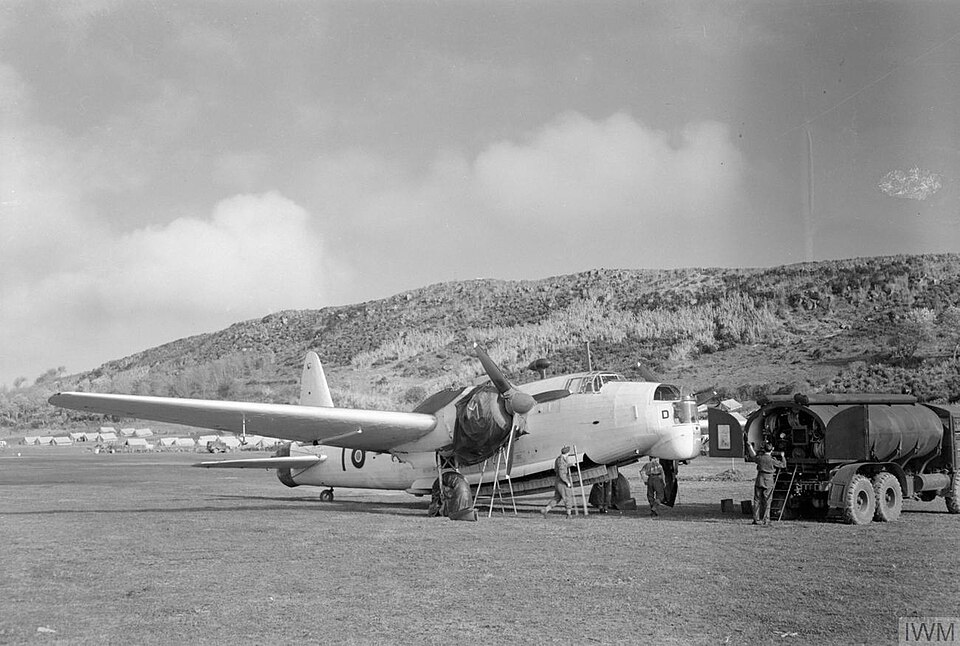
Mark XIV operating from the Azores
The strategic night bomber morphed into one of the most effective maritime hunters of the war.
Night-Time Anti-Submarine Warfare
Before 1942, German U-boats exploited a critical vulnerability: they stayed submerged during the day to avoid Allied planes and surfaced exclusively at night to recharge their batteries. The Wellington completely disrupted this routine.The Hunt: Equipped with Air-to-Surface Vessel (ASV) radar, Wellingtons (such as the GR Mk VIII, XII, and XIV) swept dark waters. The radar guided the aircrew through the dark to within roughly one mile of a surfaced submarine. At the final moment, the pilot lowered a retractable, high-intensity Leigh Light from the aircraft’s belly.The 24-million-candlepower searchlight instantly illuminated the blindsided U-boat, allowing the pilot to make a precise, ultra-low-altitude bombing run to drop a "stick" of Torpex depth charges before the submarine could crash-dive.The Strategic Impact: This tactic was so devastating in the Bay of Biscay that Admiral Karl Dönitz was forced to strip U-boats of their night-time safety, ordering them to cross the bay submerged by night and face Allied aircraft during the day instead. This tactic was so devastating in the Bay of Biscay that Admiral Karl Dönitz was forced to strip U-boats of their night-time safety, ordering them to cross the bay submerged by night and face Allied aircraft during the day instead.
Its late Type VIIC/41 and Type IXC/40 were called "FLAK-U" for some, as they were festooned with AA, in particular the latter with a 37mm, and a quad 20mm (Flakvierling). Even the 88 mm deck gun could fire at some elevation. So for a Wellington flying "low and slow" by daylight for a depht charge run, this was a death sentence, so they tried to take on U-Boat facing their bow where was the 88 mm rather than the side or rear where was the AA.
D-Day and Channel Protection
During the summer of 1944, Coastal Command Wellingtons formed an aerial wall over the southwest approaches and the English Channel.The Mission: Flocks of GR Mark XIV Wellingtons flew continuous night patrols to insulate the Allied D-Day invasion fleets from naval sabotage.The Targets: They successfully hunted and neutralized German E-boats (fast torpedo boats), R-boats (minesweepers), and midget submarines attempting to slip out of French ports to torpedo Allied troop transports.Anti-Shipping and Torpedo Strike Wings
In daylight and night operations, specialized torpedo-carrying Wellingtons (primarily Marks VIII, XI, and XIII) served as heavy anti-shipping assets.The Mediterranean Theater: Operating from critical bases like Malta, torpedo Wellingtons hunted Axis supply convoys trying to reinforce Rommel’s forces in North Africa.The Setup: They frequently flew alongside heavily armed Bristol Beaufighters. The Beaufighters would sweep in first to suppress a convoy's anti-aircraft escort ships with cannon fire and rockets, leaving the slower Wellingtons clear to execute precise, low-level torpedo drops.The DWI "Wedding Ring" Mine-Exploders
One of the most visually bizarre operational uses of the airframe was the Wellington DWI (Directional Wireless Installation).The Mechanism: These aircraft were stripped of armament and fitted with a massive, 51-foot-diameter aluminum magnetic coil suspended beneath the fuselage and wings.The Operation: Powered by an internal auxiliary Ford V8 engine generator, the ring pulsed a massive electrical current downward. Wellingtons flew dangerously low (often just 35 feet above the water) over vital shipping lanes, ports, and the Suez Canal, intentionally triggering and exploding German magnetic sea mines safely from the air.Not an easy or safe Job
Despite its immense success, maritime patrolling was exceptionally hazardous. So much so the Wellington suffered the highest operational loss rate of any Coastal Command aircraft type. While some were shot down by heavy U-boat anti-aircraft fire during target illumination, the majority of losses occurred due to the extreme mental and physical fatigue of flying long, dark, single-pilot missions. Pilots frequently suffered spatial disorientation during low-altitude attack runs, accidentally flying straight into the ocean. They flew intense, round-the clock missions sometimes in gale, pitch black and without all the modern creature iof comfort of modern aviation, like a simple altitude warning system. Even in that case, flying as they did over the crest of waves would trigger such warnings incessantly.In Conclusion
The Wellington and strongly related Warwick became the primary instruments of the coastal Command until 1945, despite the arrival of better models, like the Avro Anson, backbone of early coastal patrols, and then Lockheed Hudson, and naval versions of the Bristol Beaufort, which proved one of its greatest asset. Then came the B-17 and B-24 Liberator. The CC spent 1941 to 1945 try to protect Allied supply convoys from German U-boats, with its primary responsibility of watching over the "Mid-Atlantic Air Gap" and provide continuous air cover. There were also more active, Anti-Shipping Squadrons actively searching for and attacking German surface warships and Axis merchant shipping networks massive patrols.Crews flew thousands of hours over 10 million square miles of ocean, stretching from the Arctic to North Africa, destroyed 212 German U-boats, sank massive amounts of enemy shipping but the service also suffered a higher loss rate than Bomber Command: 2,060 aircraft and 5,866 personnel, and earned comparativly more Victoria Crosses. The Wellington was very much part of this story, as when it was gradually retitred from frontline operations with the RAF, Vickers continue to run the production exclusively for the Coastal Command.
Gallery
Author's illustrations: Types and liveries

Vickers Wellington Mark 1C, 311th Squadron RAF (CC) Autumnn 1942
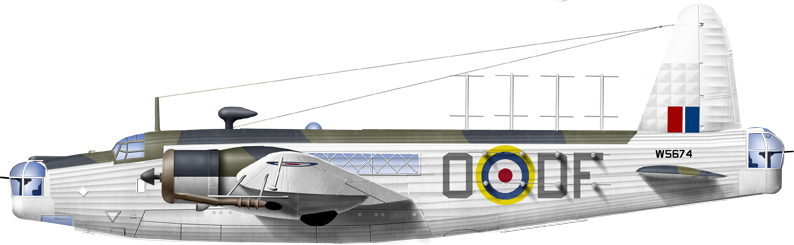
Mark IC DFO 221 Sqn. Reykyavik 1943
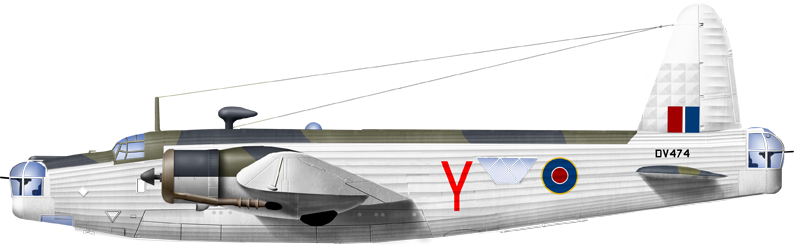
Mark IC of a Czech Sqn 311S RAF January 1943
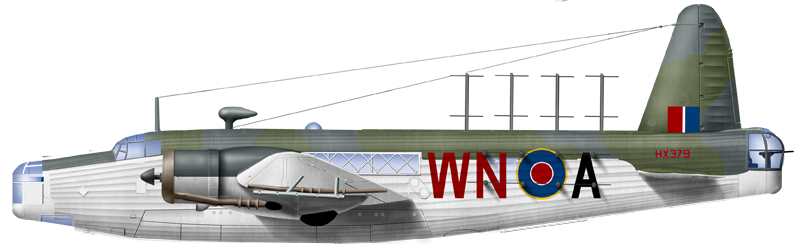
Mark VIII, unknown unit
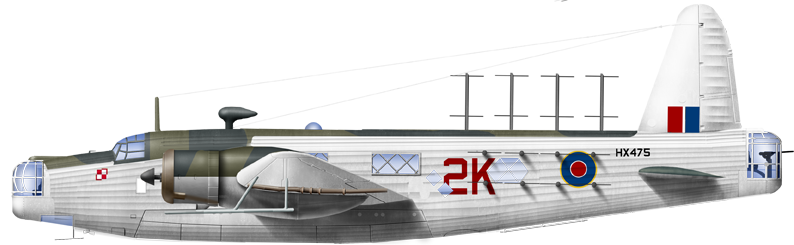
GR MXII in RAF (Polish) Sqn. Service 1943
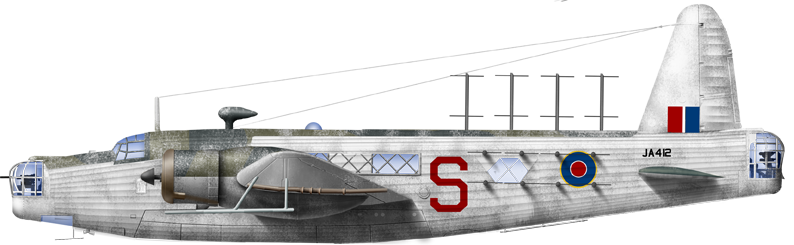
GR Mk XIII 221 Sqn. Greek coast 1945
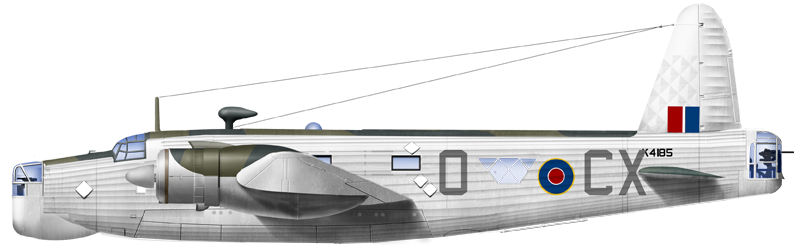
GR Mark XIV, Unit unknown
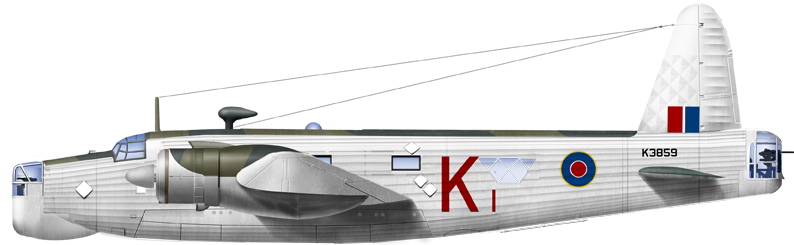
GR Mark XIV, Unit unknown
Additional profiles and photos (Pinterest)

Mark X if serial He 488 red V 1942

Mark VIII

Mark XI

Mark XII

Mark XIII RAF 304 Sq 2D 1943

Mark XIV from a RAF CC Polish Sqn service

Mark XIV Polish Sqn. 1944

Artist rendering of a Mk.I.C, September 1942, Czech squadron.

Mark XIV In French service 1945-50. They were used for example by the Flotille 55S

Artist rendition of an attack

Access to a Mark XIV
Links and resources
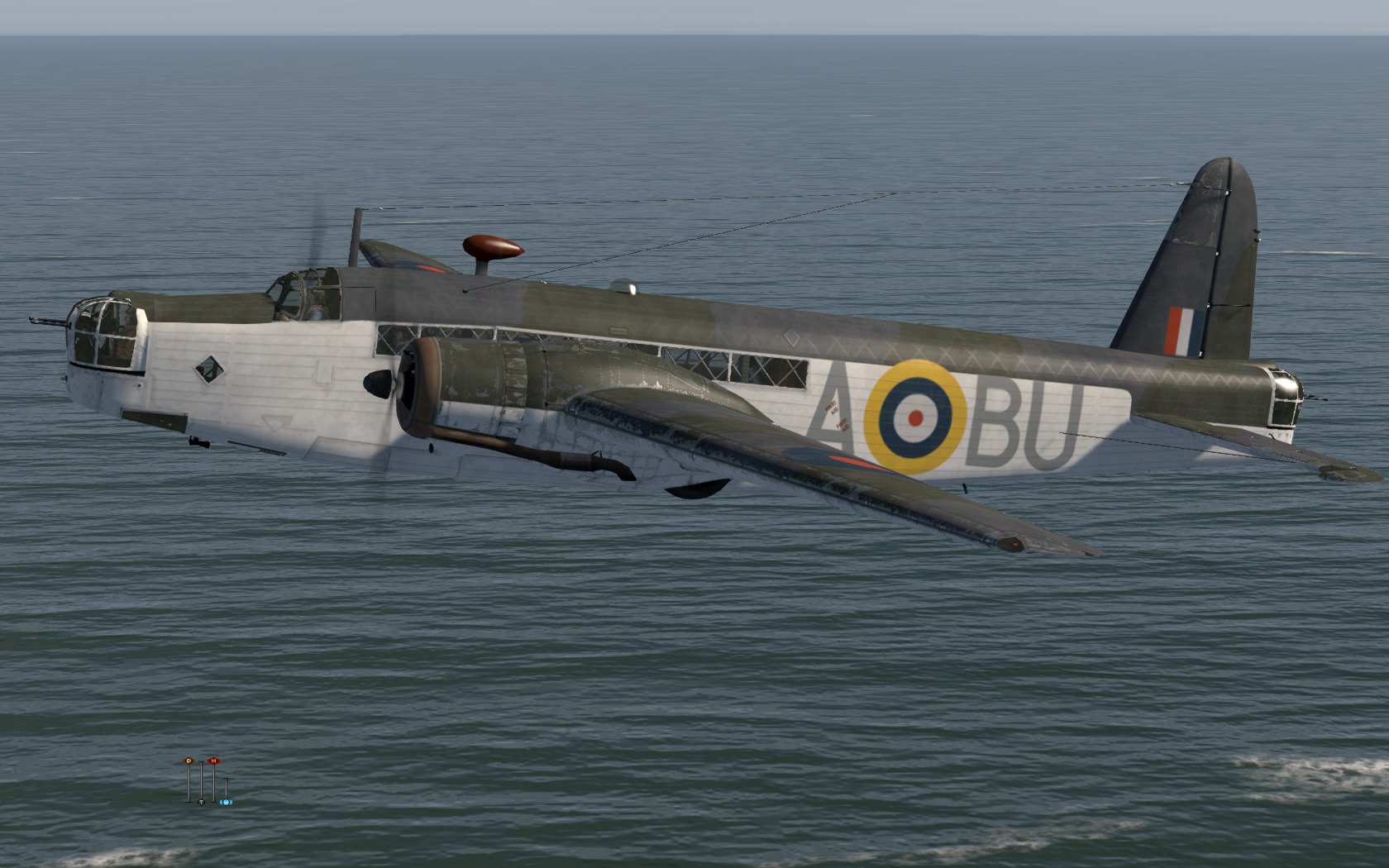
armedconflicts.com
sas1946.com
warhistory.org
key.aero/
armedconflicts.com
asisbiz.com/
fcafa.com/
wardrawings.be
en.wikipedia.org
ibccdigitalarchive.lincoln.ac.uk/
RAF Coastal Command
Videos
The model corner
Trumpeter's 1/72 scale Vickers Wellington Mk.XIV by Roland Sachsenhoferuk.airfix.com
- Lohner E (1913)
- Macchi M3 (1916)
- Macchi M5 (1917)
- Macchi M7 (1918)
- Ansaldo ISVA (1918)
- Short S.38 (1912)
- Sopwith Baby (1916)
- Short 184 (1916)
- Fairey Campania (1917)
- Sopwith Cuckoo (1917)
- Felixstowe F.2 (1917)
- Gotha WD.2 (1914)
- Friedrichshafen FF 33 (1916)
- Albatros W4 (1916)
- Albatros W8 (1918)
- Hanriot HD.2
- Grigorovich M5 (1915)
- Grigorovich M9 (1916)
- Grigorovich M11 (1917)
- IJN Farman MF.7
- IJN Yokosho Type Mo
- Yokosho Rogou Kougata (1917)
- Yokosuka Igo-Ko (1920)
- Curtiss N9 (1916)
- Curtiss H4 (1916)
- Curtiss H12 (1917)
- Curtiss H16 (1918)
- Aeromarine 39
- Vought VE-7
- Douglas DT (1921)
- NAF/Curtiss TS-1 (1922)
- Boeing FB.5 (1923)
- Boeing F4B (1928)
- Vought O2U/O3U Corsair (1928)
- Grumman FF (1931)
- Akron class airships (1931)
- Curtiss F9C Sparrowhawk (1931)
- Curtiss F11C Goshawk (1932)
- Curtiss BF2C Goshawk (1933)
- Blackburn Blackburn (1922)
- Supermarine Seagull (1922)
- Fairey Flycatcher (1923)
- Hawker Horsley (1925)
- Blackburn Ripon (1926)
- Fairey IIIF (1927)
- Fairey Seal (1930)
- LGL-32 C.1 (1927)
- Fokker T.II (1921)
- Fokker T.III (1923)
- Caspar U1 (1921)
- Dornier Do J Wal (1922)
- Rohrbach R-III (1924)
- Mitsubishi 1MF (1923)
- Mitsubishi B1M (1923)
- Yokosuka E1Y (1923)
- Nakajima A1N (1927)
- Nakajima E2N (1927)
- Mitsubishi B2M (1929)
- Nakajima A2N (1930)
- Nakajima A4N (1935)
- CANT 18
WW1
✠ K.u.K. Seefliegerkorps:
 Italian Naval Aviation
 RNAS
RNAS
 Marineflieger
 French Naval Aviation
 Russian Naval Aviation
 IJN Air Service
 USA
USA
Interwar
 Interwar US
Interwar Britain
 Interwar France
 Interwar Netherlands
 Interwar Germany
 Interwar Japan
 Interwar Italy
- Grumman F2F (1933)
- Curtiss SOC seagull (1934)
- Grumman F3F (1935)
- Northrop BT-1 (1935)
- Consolidated PBY Catalina (1935)
- Grumman J2F Duck (1936)
- Brewster/NAF SBN-1 (1936)
- Curtiss SBC Helldiver (1936)
- Vought SB2U Vindicator (1936)
- Brewster F2A Buffalo (1937)
- Douglas TBD Devastator (1937)
- Vought Kingfisher (1938)
- Curtiss SO3C Seamew (1939)
- K-class Blimps (1939)
- Douglas SBD Dauntless (1939)
- Grumman F4F Wildcat (1940)
- F4U Corsair (NE) (1940)
- Brewster SB2A Buccaneer (1941)
- Grumman TBF/TBM Avenger (1941)
- Consolidated TBY Sea Wolf (1941)
- Grumman F6F Hellcat (1942)
- Curtiss SB2C Helldiver (1942)
- Curtiss SC Seahawk (1944)
- Grumman F7F Tigercat (1944)
- Grumman F8F Bearcat (1944)
- Ryan FR-1 Fireball (1944)
- Douglas AD-1 Skyraider (1945)
- Fleet Air Arm
- Hawker Osprey (1932)
- Fairey Swordfish (1934)
- Blackburn Shark (1934)
- Supermarine Walrus (1936)
- Fairey Seafox (1936)
- Blackburn Skua (1937)
- Short Sunderland (1937)
- Blackburn Roc (1938)
- Fairey Albacore (1940)
- Fairey Fulmar (1940)
- Grumman Martlet (1941)
- Hawker sea Hurricane (1941)
- Brewster Bermuda (1942)
- Fairey Barracuda (1943)
- Fairey Firefly (1943)
- Grumman Tarpon (1943)
- Grumman Gannet (1943)
- Supermarine seafire (1943)
- Blackburn Firebrand (1944)
- Hawker Sea Fury (1944)
- Coastal Command
- Vickers Wellington (1937)
- IJN aviation
- Yokosuka E6Y (1930)
- Aichi D1A "Susie" (1934)
- Mitsubishi A5M "Claude" (1935)
- Nakajima A4N (1935)
- Yokosuka B4Y "Jean" (1935)
- Mitsubishi G3M "Nell" (1935)
- Nakajima E8N "Dave" (1935)
- Kawanishi E7K "Alf" (1935)
- Nakajima B5N "Kate" (1937)
- Kawanishi H6K "Mavis" (1938)
- Aichi D3A "Val" (1940)
- Mitsubishi G4M "Betty" (1940)
- Mitsubishi A6M "zeke" (1940)
- Nakajima E14Y "Glen" (1941)
- Nakajima B6N "Jill" (1941)
- Mitsubishi F1M "pete" (1941)
- Aichi E13A Reisu "Jake" (1941)
- Kawanishi E15K Shiun "Norm" (1941)
- Nakajima C6N Saiun "Myrt" (1942)
- Yokosuka D4Y "Judy" (1942)
- Kyushu Q1W Tokai "Lorna" (1944)
 Luftwaffe
- Heinkel 114 (1935)
- Arado 196 (1937)
- Me109 T (1938)
- Blohm & Voss 138 Seedrache (1940)
 Italian Aviation
- Savoia-Marchetti S.55
- IMAM Ro.43/44
- CANT Z.501 Gabbiano
- CANT Z.506 Airone
- CANT Z.508
- CANT Z.511
- CANT Z.515
 French Aeronavale
- GL.300 (1926-39)
- CAMS 37 (1926)
- Levasseur PL.5 (1927)
- Potez 452 (1935)
- Loire 210 (1936)
- Loire 130 (1937)
- LN 401 (1938)
 Soviet Naval Aviation
- Shavrov SH-2 (1928)
- Tupolev TB-1P (1931)
- Beriev MBR-2 (1930)
- Tupolev MR-6 (1933)
- Tupolev MTB-1 (1934)
- Beriev Be-2 (1936)
- Polikarpov I16 naval (1936)
- Tupolev MTB-2 (1937)
- Ilyushine DB-3T/TP (1937)
- Beriev Be-4 (1940)
 Swedish Naval Aviation
- SAAB B17S
-
 Skoda Š-328V
  R-XIII Idro
 Fokker C.XI W (1934)
 Rogožarski PVT-H (1938)
WW2
 ☍ USNA
- De Havilland Sea Vixen
- Hawker Sea Hawk
- Supermarine Scimitar
- Blackburn Buccaneer
- Hawker Sea Harrier
- Douglas A4 Skyhawk
- Grumman F9F Panther
- Vought F8 Crusader
- McDonnell-Douglas F-4 Phantom-II
- North Am. A5 Vigilante
- TU-142
- Yak 38 forger
☢ Cold War
✧ NATO
Fleet Air Arm
 US Navy
☭ Warsaw Pact
Merch
Seafire Mark 45; HMS Pretoria Castle
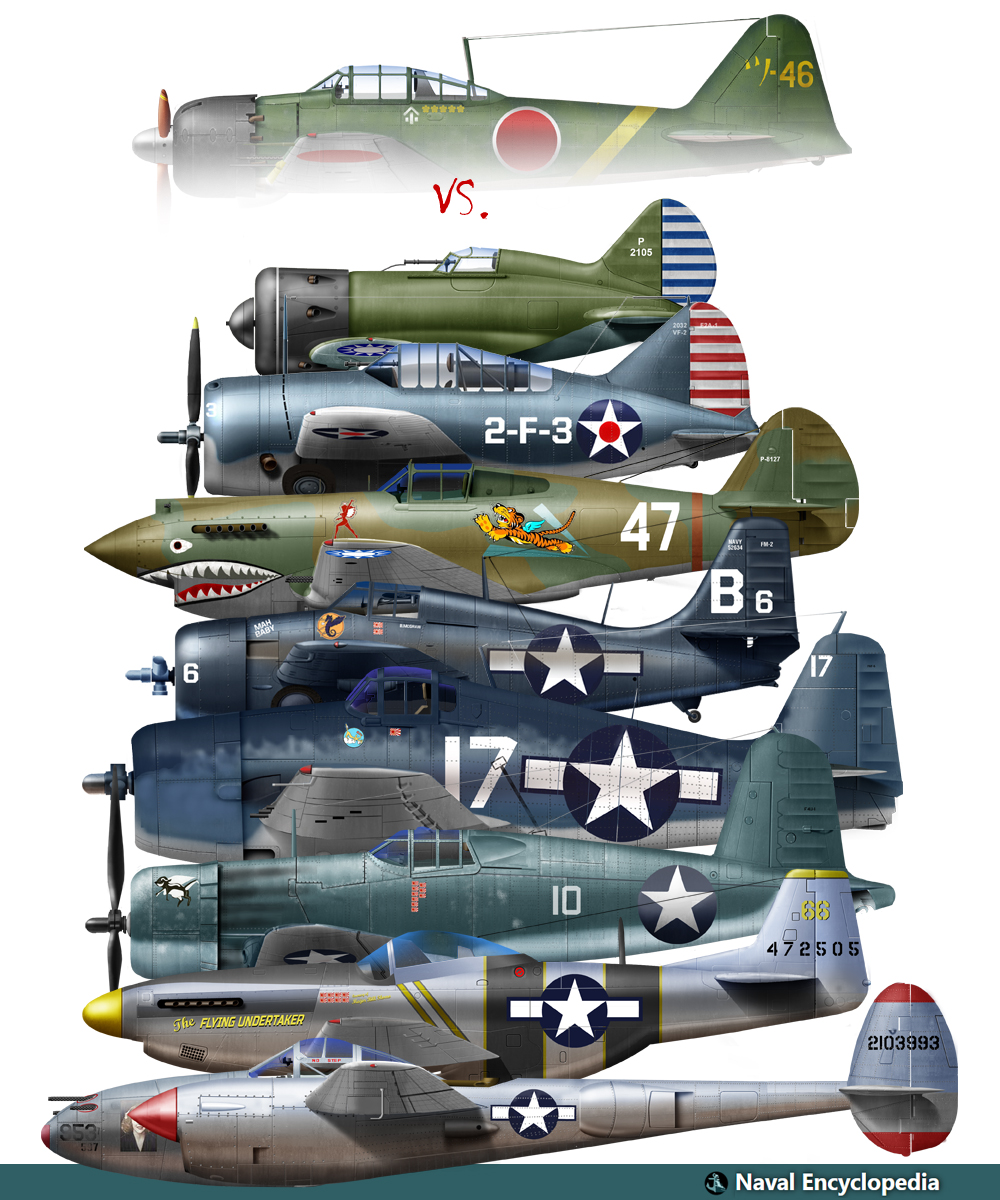
Zeros vs its aversaries
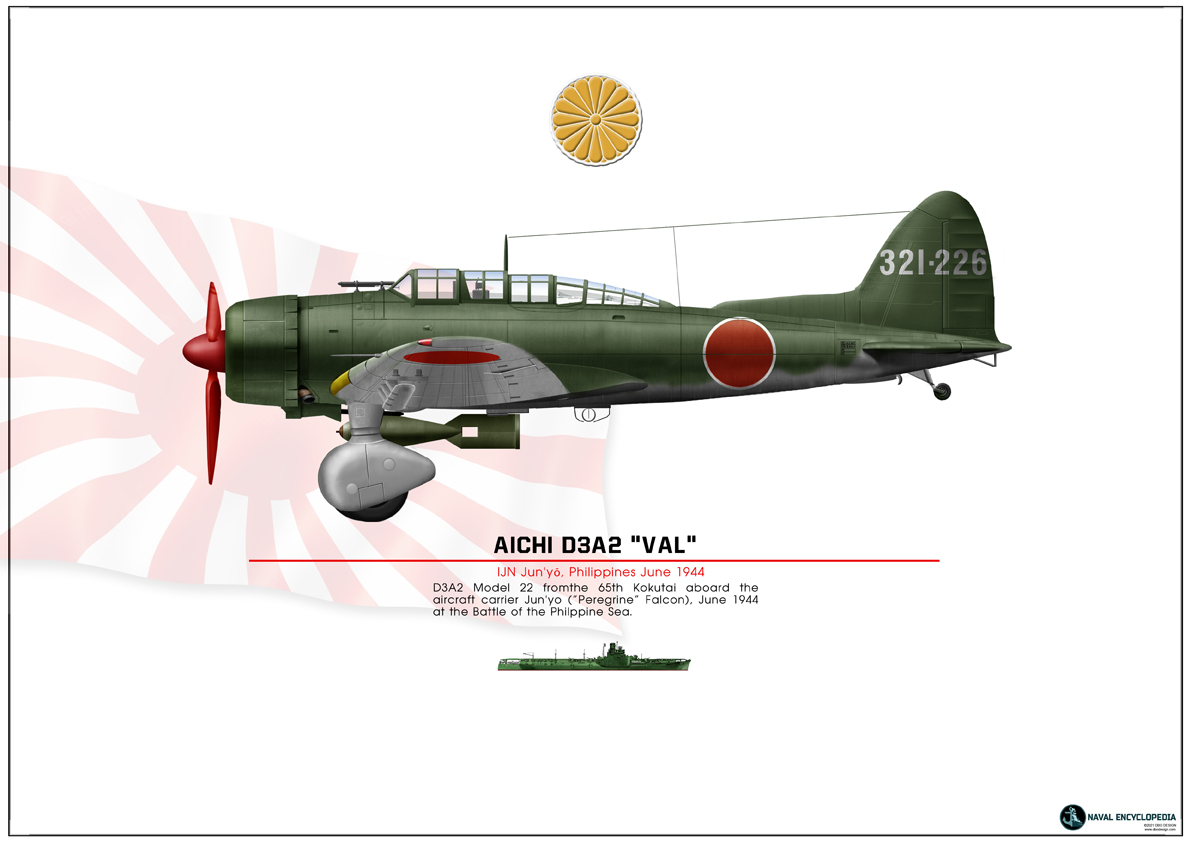
Aichi D3A “Val” Junyo
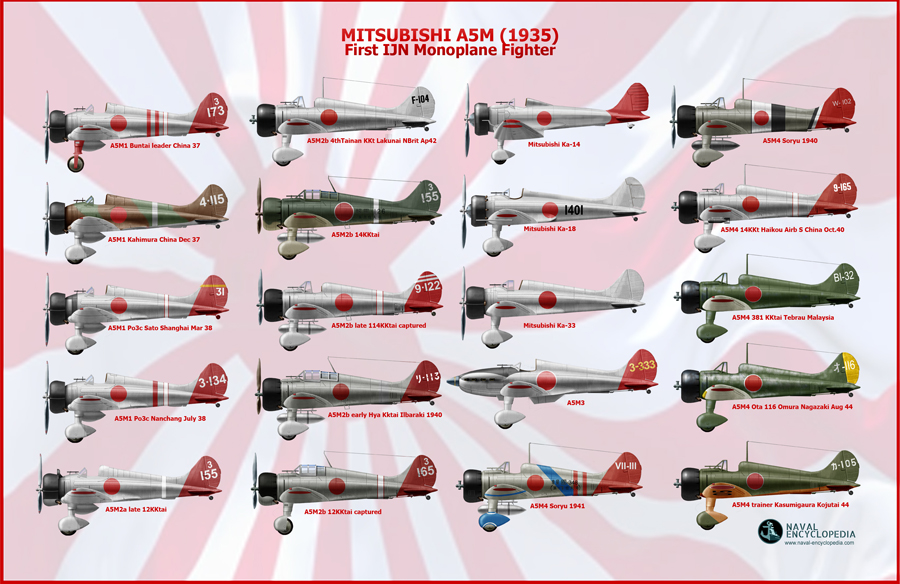
Mitsubishi A5M poster
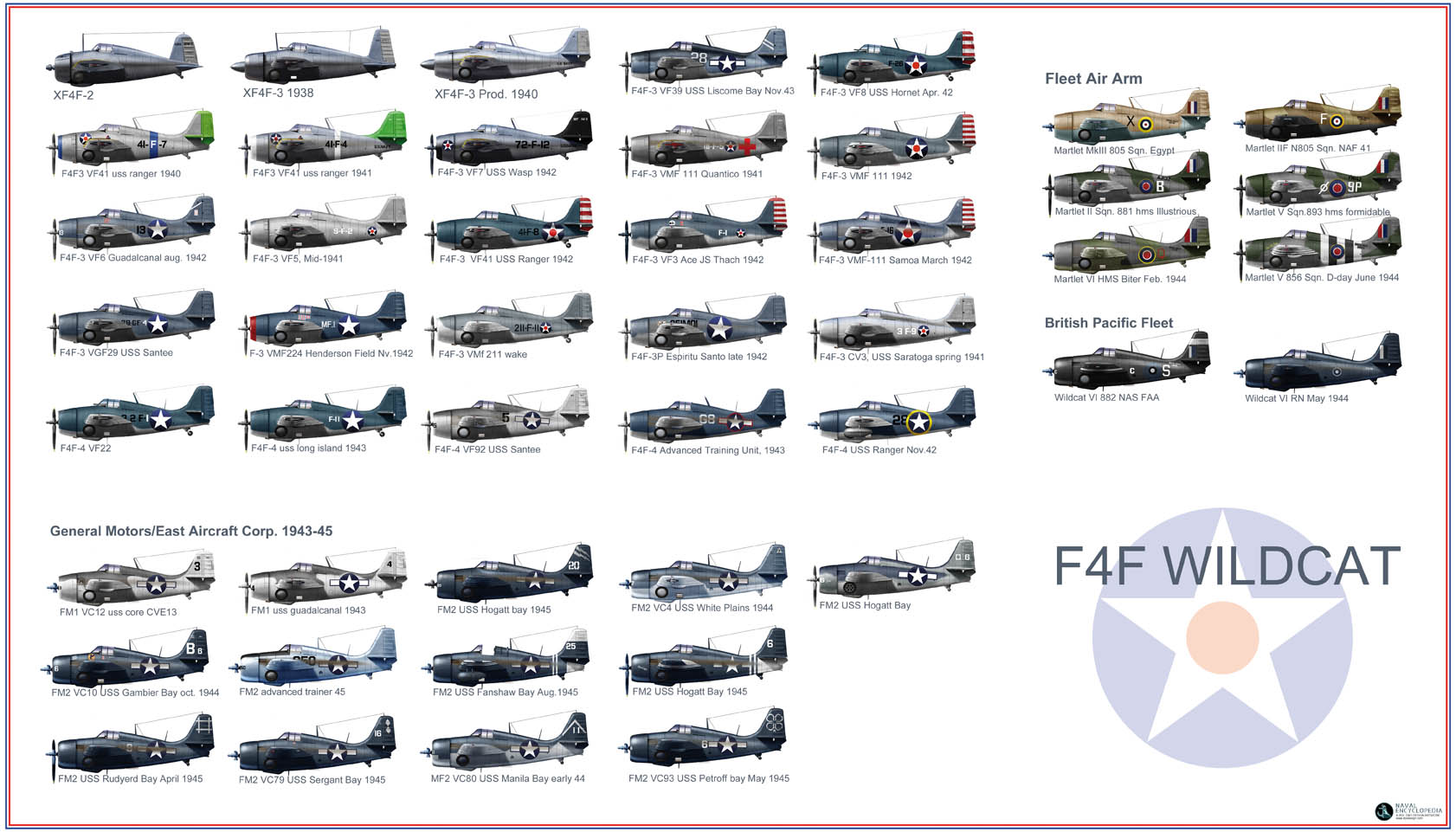
F4F wildcat
Macchi M5
SBD Dauntless Coral Sea
SBD Dauntless USS Enterprise
SBD-4 CV22