
Lockheed P-38 lightning (1940)
 1940-45 USAAC fighter: 10,037 built.
The first U.S. Army fighter capable of over 400 mph
The only American fighter produced continuously throughout U.S. participation in WWII
The first operational American fighter with: Twin engines, Turbo-superchargers, a Tricycle landing gear and Concentrated nose-mounted armament.
It became legendary in the Pacific, where America’s top aces like Richard Bong and Thomas McGuire flew it.
The post here is for reference but will concentrate on the P38 records in the Pacific and against IJN aviation, as well as naval aspects of this USAC model.
⚠ Note: This post is just a reminder about the P-38 Lightning for reference in relation to other models. It does not intent to be as exhaustive as other naval aircraft coverage.
The Bell P-38 in brief

Development
Origins (1937 Requirement): In 1937, the United States Army Air Corps issued Circular Proposal X-608 for a high-altitude interceptor for 360+ mph speed, heavy armament and rapid climb capability. This was an extremely ambitious requirement for the time. Lockheed responded with a radical design. Lockheed’s Solution was under superstar lead designers Hall Hibbard and especially Clarence 'Kelly' Johnson a quite revolutionary approach with a twin-boom central nacelle layout for extra rigidity, better aerodynamic efficiency, to have enough space for turbo-superchargers, then still in early development, to free the nose and concentrated guns there, and having the advantage if reduced torque effects with counter-rotating props. The final paper project proposed won the competition on 23 June 1937 with the Model 22, later Lockheed was contracted to build the prototype XP-38 over 1938. It was however easier said than done, the final bird was quite complicated to pull off and cost a staggering $761,000.The result was the flying XP-38 Prototype (1939) which first flew in January 27, 1939. The XP-38 showed remarkable performance immediately at Lockheed Skunk Works. A famous publicity flight by Lt. Benjamin S. Kelsey attempted a transcontinental speed record. The Record pace was achieved but the Aircraft crashed during landing at Mitchel Field. Despite the crash, performance was so impressive that production was approved nevertheless. Nothing indeed came close. One factor in ots high speed, outside the engines, was its extensive use of stainless steel and smooth, flush-riveted, butt-jointed aluminum skin panels.
Development went on until the end of the year, and the first pre-production version soon showed major teething issues of compressibility at high-speed dives with shockwaves forming, a nose tucking under and the elevator effectiveness vanishing. Pilots sometimes could not recover. The XP-38 was soon considered a "death trap". There were also cooling Problems and when it serted service in European cold/high-altitude escort operations. It was also quite complex compared to single-engine fighters, and maintenance was demanding. Plus the P38 was lated in production, much delayed by changes to meet the need for mass production (the final model was very different in construction from the prototype) and sudden required expansion of Lockheed's facility in Burbank, so there was just no space yet to build the new bird. Then further delays came out from further production model YP-38 tests.

P38s shipped by a CVE in New York, about to depart for Europe.
Bell however improved gradually improved the model, introducing dive recovery flaps, improved intercoolers, better engine reliability and hydraulic boosted ailerons among others, which all transformed the aircraft into a highly capable mature fighter. Mass production only started by By November 1941, but many problems remained to be solved like buffeting. Before any jets, the blazing speed of the P38 introduced a new set of speed-related issues that were never experienced before. It was a trailblazer. Well before everything was ironed out in 1943, by March 1940 already, both France and Britain ordered the P38 through the Anglo-French Purchasing Committee, ordering 667 P-38s for US$100M, French Model 322F, British 322B, later a variant of the early P-38E. After July 1940 the entire French order was passed onto the RAF, but delivery was slow, even they were much simplified. The new model was baptized "Lightning" around June 1941, and the name stuck, albeit it was never official in the US for a long time, but after tests, the order was cancelled.
Meanwhile back in the US, the USAAF "Bomber Mafia" insisted for the conversion of the new fighter into a long-range escort fighter, not just an interceptor. Early P38Es were also equipped for reconnaissance, like the Mosquito and inaugurated the first long range modifications passed on to the P-38F. In late 1941 they were repurpose by the president to detect U-Boat in the Mid-Atlantic... With drop tanks the best they could so was 2,500-mile (4,000 km) in ferry range. They started escorting B-17 to Groenland notably. The first were however deployed on the west coast, and after the 1st Fighter Group after Pearl Harbor, they joined the 14th Pursuit Group in San Diego...
Design specifics

The P-38L was the definitive production version, 37 ft 10 in (11.53 m) long for a wingspan of 52 ft (15.85 m), height of 12 ft 10 in (3.91 m) and wing area of 327 sq ft. it was powered by two Allison V-1710 V-12 engines, the same as on the Curtiss Tomawahk, each pushed to 1,475 hp and more when turbo-supercharged, and sporting counter-rotating propellers eliminating torque roll and giving them excellent high-altitude performance. The P-38L was the most common and best in line, capable of 414 mph (666 km/h) with a combat range of 1,300+ miles and ferry range (drop tanks) of 2,600+ miles. It had a service ceiling of 44,000 ft and a rate of climb of 4,750 ft/min.
It was also armed with a centrally mounted nose 20 mm Hispano cannon and four .50 cal Browning M2 machine guns around, some firing tracers. This arrangement was devastating because there was no convergence issues, a tight bullet stream on a small space, completely devastating that point, and it remained accurate at long range thanks to stagerred fire to avoid interferences. But the P38 also had external Stores and could carry two 2,000 lb bombs or drop tanks and up to 10 rockets in late versions making it an effective fighter-bomber.
Variants
- XP-38 1 Prototype
- YP-38 13 Evaluation aircraft
- P-38 30 Initial production aircraft
- XP-38A 1 Pressurized cockpit
- P-38D 36 Fitted with self-sealing fuel tanks/armored windshield
- P-38E 210 First combat-ready variant, revised armament
- F-4 100+ Reconnaissance aircraft based on P-38E
- Model 322 3 RAF order: twin right-hand props and no turbo
- RP-322 147 USAAF trainers
- P-38F 527 First fully combat-capable P-38 fighter
- F-4A 20 Reconnaissance aircraft based on P-38F
- P-38G 1,082 Improved P-38F fighter
- F-5A 180 Reconnaissance aircraft based on P-38G
- XF-5D 1 A one-off converted F-5A
- P-38H 601 Automatic cooling system; improved P-38G fighter
- P-38J 2,970 New cooling and electrical systems
- F-5B 200 Reconnaissance aircraft based on P-38J
- F-5C 123 Reconnaissance aircraft converted from P-38J
- F-5E 705 Reconnaissance aircraft converted from P-38J/L
- P-38K 2 Paddle blade props; up-rated engines with a different propeller reduction ratio
- P-38L-LO 3,810 Improved P-38J new engines; new rocket pylons
- P-38L-VN 113 P-38L built by Vultee
- F-5F – Reconnaissance aircraft converted from P-38L
- P-38M 75 Night fighter converted from P-38L
- F-5G – Reconnaissance aircraft converted from P-38L
A rarity: The P38E Seaplane

The Lockheed P38E was the first combat-ready variant, with a revised armament. Some, given its high speed, long range and qualities as interceptor, looked at a possible conversion as a floatplane for Pacific service, defending Army and USMC bases. The USN either in 1942 still in 1945 had no floatplane fighter in service. There had been proposals of conversions on the Grumman Widlcat (As the F4F-3S "Wildcatfish"), and on the F6F Hellcat (paper only).
Only the 1944 Curtiss SC Seahawk, the "The Fighting Scout". Powerful, nimble and agile, it pushed into fighter territory, but it was designed as an observation and artillery spotting model to be catapulted. Always obsessed by standardization, both the USN/USMC never really pushed for the adoption of a flighter floatplane, either purpose-design or converted, unlike the Japanese. It was recoignized that a model tailored either for carrier use or catapulted and provided with floats would accumulate a lot of drag and extra weight degrading its performances. The terms of "interceptor" and "floatplanes" were just antinomic. There was also a Douglas A20 and C-47 put on Edo floats for Pacific logistic trials. In any cases, the prowesses and organization of the Seabeas made the propects of such planes null. Indeed evey captured islet in the Pacifc large enough could be converted as an "unsinkable aircraft carrier" in a matter of a week.
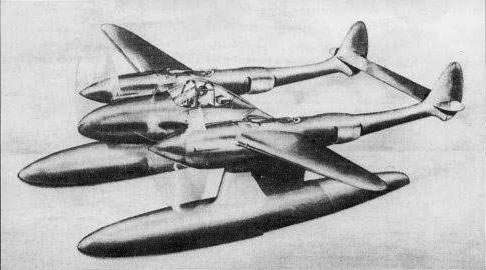
Now, the P38E was the object of a serious study for a floatplane conversion. The P-38E Lightning floatplane was an experimental concept and test modification of the Lockheed P-38 Lightning fighter designed to operate from water, though it never reached active operational service. First off, it had a raised Tail Configuration: A modified P-38E test aircraft featured a raised "piggy-back" tailplane. For water clearance the elevated tail was engineered to keep the horizontal stabilizer and control surfaces clear of water spray during water takeoffs and landings.
The project, as explained in the Polish "Monografie Lotnicze No. 67" presented the project as able to operate in remote areas where no airfields were available but was abandoned with the rapid advance of American offensive in the Pacific. This was a sinular mode, identified as P-38E factory No. 5204, with a stretched and raised tail introduced to reduce buffeting. It was was damaged before first flight. The P-38E "Piggy-Back" with the raised tail was tested for fitting in a pair of tailored EDO floats. The tailplane was raised by 33 inches or about a meter. This required the tail booms to be removed immediately aft of the radiators and replaced by modified section. This was the second variant of Lightning tail modification. Photos shows perhaps two prototypes, one still with peacetime roundels to be modified and a second one with the early wartime roundels showing different versions of the same tail. The floats were fitted with retractable wheels for amphibious operations.
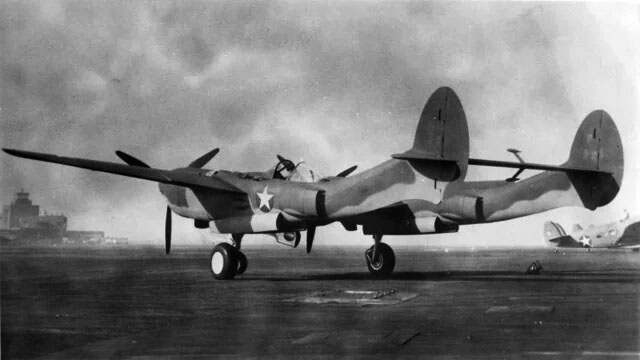
The float layout had various proposed configurations using a single heavy strut under each engine nacelle connecting directly to a large float, paired with slightly swept-up tail booms. The standard Lockheed P-38E Lightning was the first major, combat-ready production version of the twin-engine fighter, with over 200 units built, standardized for the nose of four .50-caliber machine guns and one license-built 20mm Hispano autocannon. While aerodynamic and water-handling tests were explored using the only converted P-38E test bed, the performance penalties, drag of the large floats, and shifting wartime priorities meant the floatplane variant was abandoned before any mass production or combat deployment. It remained an interesting what-if anyway. This project was unveiled by "The Lockheed P-38 Lightning" by Warren Bodie, Widewing Publications, 1991". It was practically unheard of before. However to be very clear, if there was a proposal to make a floatplane variant of the P-38, the only model known, 41-1986 to have been modified for flight testing, saw no floats were ever installed.
"About Buffeting:
Neither the results of force tests nor observations of the model behavior during tests gave any indication as to whether or not tail buffeting occurred. Figures 29 and 30, which give results of measurements of the wake at the position of the tail, show that with the standard tail position, the tail will come within the wake of the wing and fuselage at high Mach numbers. These results indicate that raising the horizontal tail surfaces 32 inches above the standard position should keep them out of the wake, except for Mach numbers above .0.75 at angles of attack above 2, and should thereby largely eliminate buffeting. Reference 2 makes a similar conclusion Tests were made with the tail altered as shown in figure 31. The model dimensions indicated correspond to raising the tail 32 inches and moving it back 24 inches on the airplane. Figure 32 shows the aerodynamic characteristics resulting from this change. The only effect as compared to the standard tail position was an increase in stability." (NACA).
On secret projects.uk
aircraftresourcecenter.com
Other books
P38s in the Pacific, against the IJN and IJA

Since it's a site relative to the Navy, the P38 most interesting collaboration with the Navy was the Pacific theater. Of course it's biggest "coup" for the Navy was to eliminate Isroroku Yamamoto, architect of Pearl Harbour and other operations and the most prominent Navy officer. It was a considerable morale booster as well. But the P38 in the Pacific did much more. In fact that's where they earned most of their kills, starting to rival the F6F Hellcat, the "butcher bird" in that select club.
The Pacific, P38's "home"
If the P-38 had a “natural home,” it was the Pacific Theater. While it had mixed results in Europe, in the Pacific it became one of the most effective Allied fighters of the war. The reasons were straightforward:Immense distances between islands and bases,
Frequent operations over open ocean,
Need for long-range escort,
Sparse emergency landing options,
Japanese emphasis on maneuverability over armor/protection,
The P-38’s range, firepower, climb, and twin-engine survivability fit these conditions almost perfectly. Pacific combat was fundamentally different from Europe.
Typical missions involved 500–1,000+ mile round trips, escorting bombers deep over water, long patrols over island chains, search-and-destroy interception missions. Single-engine fighters often lacked this reach, both USAAF and Navy ones. With drop tanks, the P-38 could escort bombers farther than almost any Allied fighter until very late in the war. This made it indispensable in New Guinea, the Solomon Islands, the Philippines, Marianas and for all sorts of long-range interception operations.
Twin Engines Meant meant Survival, as a single engine failure over Pacific jungle or ocean was often fatal. The P-38 could often return on one engine, maintain altitude long enough for recovery and Save experienced pilots. This significantly improved pilot survival and retention. That mattered enormously because combat experience was priceless.
High-Speed Firepower Against Japanese Fighters was also important, as Japanese fighters like the Mitsubishi A6M Zero excelled at low-speed turning, tight maneuvering and agility, so the P-38 doctrine emphasized Speed, vertical maneuvering, Energy fighting and Hit-and-run attacks. Its concentrated nose armament was devastating. One firing pass could cripple lightly built Japanese aircraft.
Operational Doctrine

The Pacific forced American pilots to develop tactics tailored to the P-38. Energy Fighting: The P-38 was not used as a turn fighter. Instead it adopted the Boom-and-Zoom tactic. The pilot would climb above enemy formation, dive at high speed (nearly supersonic), fire a concentrated burst and zoom back upward. This exploited its excellent dive acceleration, high-speed stability, powerful climb ability and vertical Combat envelope. The Lightning excelled in high yo-yos, zoom climbs, split-S disengagement, slashing attacks. This avoided prolonged turning contests with Japanese aircraft.
Also it excelled at mutual Support. The P-38 doctrine emphasized loose Pair / Finger-Four, as Pairs of aircraft worked together when the Lead attacked, the Wingman covered, with immediate support against enemy counterattack. This reflected evolving American tactical doctrine and gave experienced formations a major edge.
The P38 became the king of Long-Range Escort: The P-38 pioneered true Pacific escort doctrine. Its role was to stay close enough to protect bombers, yet retain altitude and speed for interception. Pilots had to carefully manage fuel mixture, Turbo settings, Formation discipline, Navigation over featureless ocean. Navigation errors could be fatal if the P38 get separated. Bombers had a large crew and a dedicated navigator, so P38 pilots in princple had to only "follow the pack".
Major Pacific Operations

Guadalcanal and Solomon Islands (1942–43):
The P-38 first proved itself here. It was there a bomber escort, used for interception and air superiority sweeps deep inside the Solomons. It gave U.S. forces the ability to reach Japanese bases previously beyond effective fighter range. This shifted the air war. Operation Vengeance (18 April 1943) remained the P-38’s most famous mission. Objective: Intercept and destroy the transport carrying Japanese Admiral Isoroku Yamamoto. Execution: Sixteen P-38Gs performing a daring 1,000-mile precision interception, with dead reckoning navigation at sea, and low-altitude approach to avoid radar. Result: Yamamoto, the grand admiral and biggest hope for the IJN, was shot down over Bougainville. This demonstrated exceptional range when needed, precision navigation capability and strategic reach. It remains one of history’s most remarkable fighter interceptions.New Guinea Campaign:
The aircraft became central to General George C. Kenney’s offensive doctrine. Tasks: Escorting medium bombers, fighter sweeps, strafing Japanese airfields and maritime interdiction. The P-38 enabled aggressive forward pressure.Philippines (1944–45):
By this stage later P-38J/L variants were mature. Roles expanded to escort, ground attack, shipping strikes (with rockets), interception of Japanese reinforcements. The aircraft was now highly refined.Well Known Strenghts and Weaknesses

Tactical Strengths Against Japanese Fighters: Firepower, with one short, accurate burst often destroying the target, often flimsy built. Dive Speed enabled to disengage when necessary. Altitude Performance was excellent as an asset, as the P38 was vastly superior at high altitude, hence its usefulness to work with B29s. It had great stability as Gun Platform and excellent for deflection shooting. However the P38 also had weaknesses, its large Size, making it easy to spot. it was less Agile at Low Speed, so to any ambush by IJA/IJN pilots close to base or about to land. It was also dangerous if drawn into turning fights. The compressibility in Early Models was tisky in steep dives and rxperienced pilots learned to avoid these traps.
The Great Pacific P-38 Aces
Major Richard Bong

America’s top-scoring ace ever, with 40 aerial victories. He served with the 49th Fighter Group and later the 5th Air Force. Why he excelled: Extraordinary gunnery discipline, Aggressive but controlled tactics and Deep mastery of the P-38. Bong often closed to extremely short range before firing. This maximized the Lightning’s concentrated armament.
Major Thomas McGuire

Thomas McGuire was second best, credited 38 aerial victories, America’s second-highest-scoring ace ever. Her was known for brilliant tactical aggression, exceptional formation leadership, technical understanding of energy fighting but he was killed in combat in January 1945 in the Philippines.
Charles MacDonald

Charles H. MacDonald was credited 27 victories. he was known for calm precision and disciplined tactics.
Other notables: Gerald R. Johnson (22 victories), one of the most effective Pacific P-38 leaders.
Thomas J. Lynch: 20 victories, a key New Guinea ace.
Conclusion

What Made Pacific Aces Successful: The best P-38 pilots shared several traits, patience, waiting for high-probability firing opportunities, Energy Discipline, never squandering speed or altitude.
They were also good at Teamworking, as Lone-wolf tactics were dangerous. They were also marksmen, known for Gunnery Precision, as the Lightning had a short window of opportunity due to its speed diffrential with almost all its targets emphasis by its tactics, and this rewarded accurate bursts.
It was the aircraft that let the USAAF project fighter power across enormous distances before the North American P-51 Mustang became widespread in the Pacific and made sustained long-range Allied fighter offensives possible across the vast ocean spaces of the war, and it produced America’s highest-scoring aces because its performance perfectly matched the operational realities of that theater.
Gallery
Author's illustrations: Types and liveries

P-38F of USAF top ace Richard Bong in 1944 - Author's illustration
The incontestable winning point of the P-38 design was its superchargers, worked on for years at NACA -predecessor of NASA- which enabled superior performances to anything else that flew at the time, thanks to the light fuselage and peculiar twin-boom design combined to two very powerful inline engines, a pair of Allison V-1710 V-12 liquid-cooled turbo-supercharged piston engine rated for 1,600 hp (1,200 kW) each, enough for 666 km/h (414 mph/360 kn) based on 1,425 hp.
At high altitude, reaching 44,000 ft (13,000 m) the superchargers gave it superior performances, well completed by a combat range of 2,100 km (1,300 mi, 1,100 nmi) versus 1,870 km (1,160 mi, 1,010 nmi) for the A6M2. It was still faster at all altitude ranges than the A6M5 and could escape easily in dives, reaching in rare cases 800+ kph but dealing with extreme air compressibility issues, notably strong vibrations.
For agility however, it was noted as inferior to the A6M5 and only the pilot's respective skills generated a more balanced result. A twin-boom plane generally had more drag than a monocoque, single fuselage model. However the model generated plenty of aces, like Richard Bong (40) or Thomas McGuire (38), top aces of the USAAF, which preferred it over the M51 Mustang. Like the Navy pilots they were perfectly briefed over the advantages and weaknesses of the A6M and they had in the nose the most powerful armament of any US "light" fighter in this war, one Hispano M2(C) 20 mm cannon and four M2 Browning machine guns in the nose. One or two 20 mm HE rounds could tear apart a zero while the P38 presented almost the same ruggedness as the Corsair and Hellcat.
Note: More profiles to come in a future update.
Additional photos (Pinterest)


Books
Links
Pilot Manual 19441943 educational movie on the P38
wikipedia.org
The model corner
All kits on scalemates- Lohner E (1913)
- Macchi M3 (1916)
- Macchi M5 (1917)
- Macchi M7 (1918)
- Ansaldo ISVA (1918)
- Short S.38 (1912)
- Sopwith Baby (1916)
- Short 184 (1916)
- Fairey Campania (1917)
- Sopwith Cuckoo (1917)
- Felixstowe F.2 (1917)
- Gotha WD.2 (1914)
- Friedrichshafen FF 33 (1916)
- Albatros W4 (1916)
- Albatros W8 (1918)
- Hanriot HD.2
- Grigorovich M5 (1915)
- Grigorovich M9 (1916)
- Grigorovich M11 (1917)
- IJN Farman MF.7
- IJN Yokosho Type Mo
- Yokosho Rogou Kougata (1917)
- Yokosuka Igo-Ko (1920)
- Curtiss N9 (1916)
- Curtiss H4 (1916)
- Curtiss H12 (1917)
- Curtiss H16 (1918)
- Aeromarine 39
- Vought VE-7
- Douglas DT (1921)
- NAF/Curtiss TS-1 (1922)
- Boeing FB.5 (1923)
- Boeing F4B (1928)
- Vought O2U/O3U Corsair (1928)
- Grumman FF (1931)
- Akron class airships (1931)
- Curtiss F9C Sparrowhawk (1931)
- Curtiss F11C Goshawk (1932)
- Curtiss BF2C Goshawk (1933)
- Blackburn Blackburn (1922)
- Supermarine Seagull (1922)
- Fairey Flycatcher (1923)
- Hawker Horsley (1925)
- Blackburn Ripon (1926)
- Fairey IIIF (1927)
- Fairey Seal (1930)
- LGL-32 C.1 (1927)
- Fokker T.II (1921)
- Fokker T.III (1923)
- Caspar U1 (1921)
- Dornier Do J Wal (1922)
- Rohrbach R-III (1924)
- Mitsubishi 1MF (1923)
- Mitsubishi B1M (1923)
- Yokosuka E1Y (1923)
- Nakajima A1N (1927)
- Nakajima E2N (1927)
- Mitsubishi B2M (1929)
- Nakajima A2N (1930)
- Nakajima A4N (1935)
- CANT 18
WW1
✠ K.u.K. Seefliegerkorps:
 Italian Naval Aviation
 RNAS
RNAS
 Marineflieger
 French Naval Aviation
 Russian Naval Aviation
 IJN Air Service
 USA
USA
Interwar
 Interwar US
 Interwar Britain
 Interwar France
 Interwar Netherlands
 Interwar Germany
 Interwar Japan
 Interwar Italy
- Grumman F2F (1933)
- Curtiss SOC seagull (1934)
- Grumman F3F (1935)
- Northrop BT-1 (1935)
- Consolidated PBY Catalina (1935)
- Grumman J2F Duck (1936)
- Brewster/NAF SBN-1 (1936)
- Curtiss SBC Helldiver (1936)
- Vought SB2U Vindicator (1936)
- Brewster F2A Buffalo (1937)
- Douglas TBD Devastator (1937)
- Vought Kingfisher (1938)
- Curtiss SO3C Seamew (1939)
- K-class Blimps (1939)
- Douglas SBD Dauntless (1939)
- Grumman F4F Wildcat (1940)
- F4U Corsair (NE) (1940)
- Brewster SB2A Buccaneer (1941)
- Grumman TBF/TBM Avenger (1941)
- Consolidated TBY Sea Wolf (1941)
- Grumman F6F Hellcat (1942)
- Curtiss SB2C Helldiver (1942)
- Curtiss SC Seahawk (1944)
- Grumman F7F Tigercat (1944)
- Grumman F8F Bearcat (1944)
- Ryan FR-1 Fireball (1944)
- Douglas AD-1 Skyraider (1945)
- Fleet Air Arm
- Hawker Osprey (1932)
- Fairey Swordfish (1934)
- Blackburn Shark (1934)
- Supermarine Walrus (1936)
- Fairey Seafox (1936)
- Blackburn Skua (1937)
- Short Sunderland (1937)
- Blackburn Roc (1938)
- Fairey Albacore (1940)
- Fairey Fulmar (1940)
- Grumman Martlet (1941)
- Hawker sea Hurricane (1941)
- Brewster Bermuda (1942)
- Fairey Barracuda (1943)
- Fairey Firefly (1943)
- Grumman Tarpon (1943)
- Grumman Gannet (1943)
- Supermarine seafire (1943)
- Blackburn Firebrand (1944)
- Hawker Sea Fury (1944)
- Coastal Command
- Vickers Wellington (1937)
- IJN aviation
- Yokosuka E6Y (1930)
- Aichi D1A "Susie" (1934)
- Mitsubishi A5M "Claude" (1935)
- Nakajima A4N (1935)
- Yokosuka B4Y "Jean" (1935)
- Mitsubishi G3M "Nell" (1935)
- Nakajima E8N "Dave" (1935)
- Kawanishi E7K "Alf" (1935)
- Nakajima B5N "Kate" (1937)
- Kawanishi H6K "Mavis" (1938)
- Aichi D3A "Val" (1940)
- Mitsubishi G4M "Betty" (1940)
- Mitsubishi A6M "zeke" (1940)
- Nakajima E14Y "Glen" (1941)
- Nakajima B6N "Jill" (1941)
- Mitsubishi F1M "pete" (1941)
- Aichi E13A Reisu "Jake" (1941)
- Kawanishi E15K Shiun "Norm" (1941)
- Nakajima C6N Saiun "Myrt" (1942)
- Yokosuka D4Y "Judy" (1942)
- Kyushu Q1W Tokai "Lorna" (1944)
 Luftwaffe
- Heinkel 114 (1935)
- Arado 196 (1937)
- Me109 T (1938)
- Blohm & Voss 138 Seedrache (1940)
 Italian Aviation
- Savoia-Marchetti S.55
- IMAM Ro.43/44
- CANT Z.501 Gabbiano
- CANT Z.506 Airone
- CANT Z.508
- CANT Z.511
- CANT Z.515
 French Aeronavale
- GL.300 (1926-39)
- CAMS 37 (1926)
- Levasseur PL.5 (1927)
- Potez 452 (1935)
- Loire 210 (1936)
- Loire 130 (1937)
- LN 401 (1938)
 Soviet Naval Aviation
- Shavrov SH-2 (1928)
- Tupolev TB-1P (1931)
- Beriev MBR-2 (1930)
- Tupolev MR-6 (1933)
- Tupolev MTB-1 (1934)
- Beriev Be-2 (1936)
- Polikarpov I16 naval (1936)
- Tupolev MTB-2 (1937)
- Ilyushine DB-3T/TP (1937)
- Beriev Be-4 (1940)
 Swedish Naval Aviation
- SAAB B17S
-
 Skoda Š-328V
  R-XIII Idro
 Fokker C.XI W (1934)
 Rogožarski PVT-H (1938)
WW2
 ☍ USNA
- De Havilland Sea Vixen
- Hawker Sea Hawk
- Supermarine Scimitar
- Blackburn Buccaneer
- Hawker Sea Harrier
- Douglas A4 Skyhawk
- Grumman F9F Panther
- Vought F8 Crusader
- McDonnell-Douglas F-4 Phantom-II
- North Am. A5 Vigilante
- TU-142
- Yak 38 forger
☢ Cold War
✧ NATO
Fleet Air Arm
 US Navy
☭ Warsaw Pact
Merch
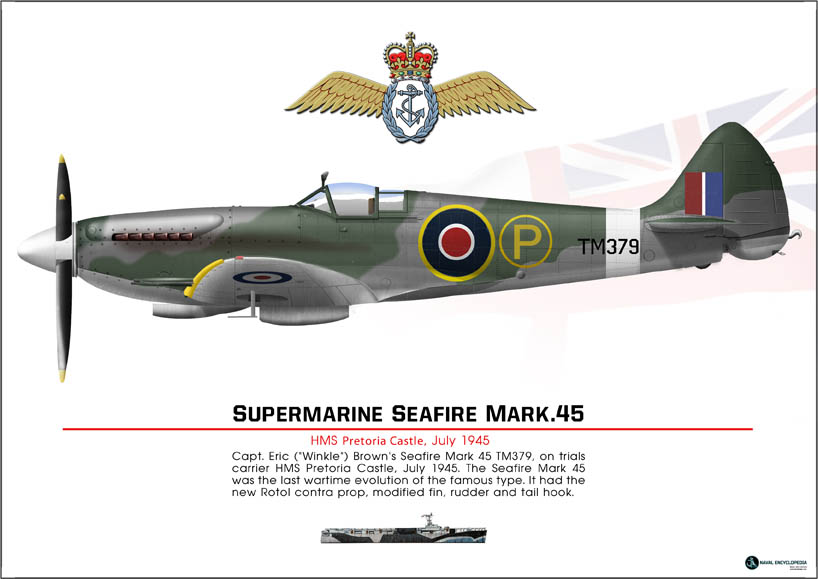
Seafire Mark 45; HMS Pretoria Castle
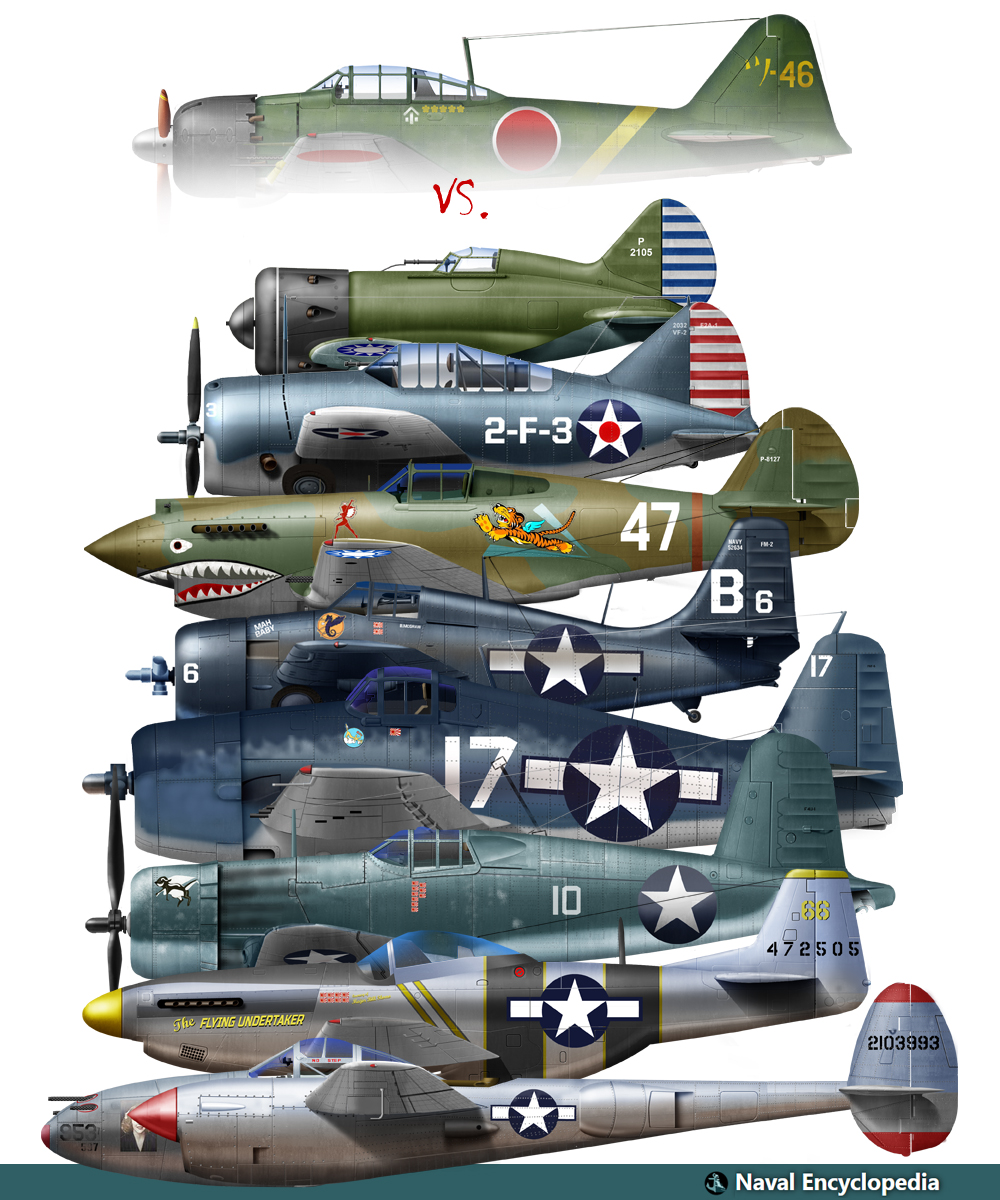
Zeros vs its aversaries
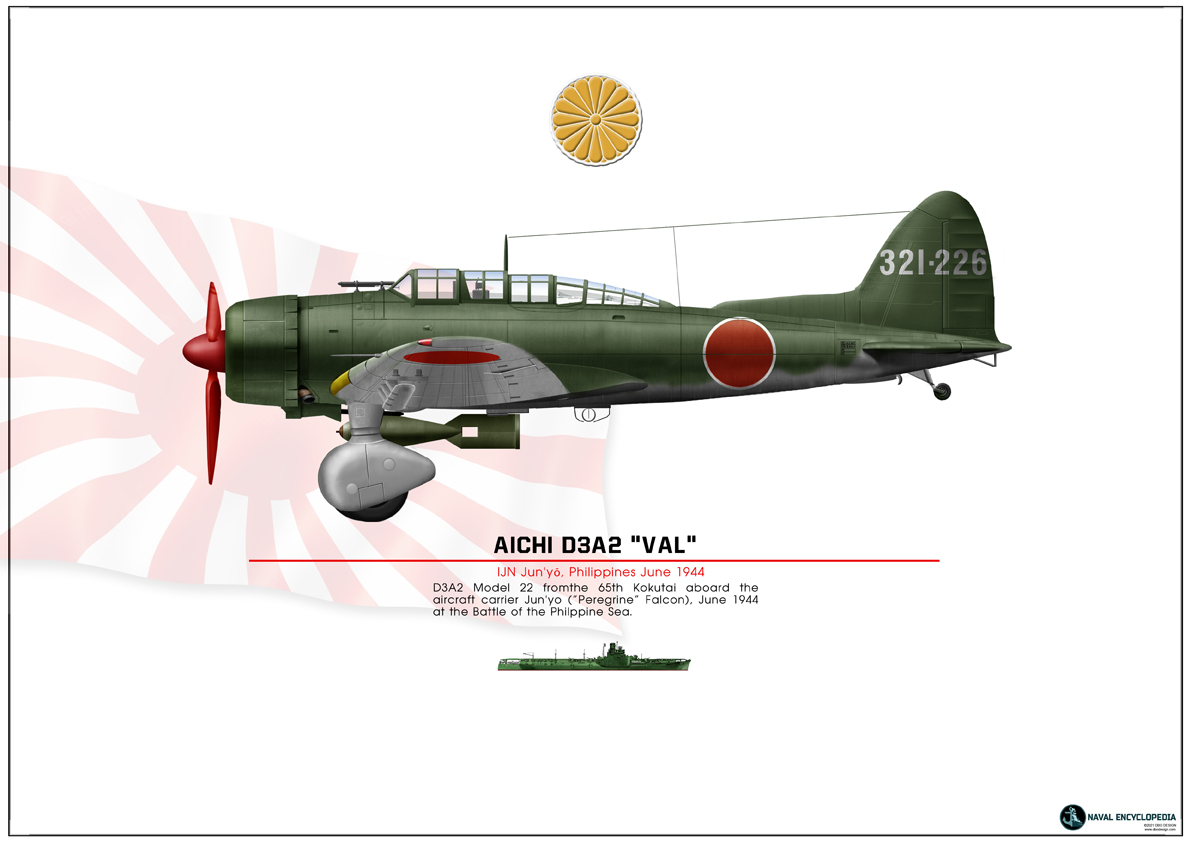
Aichi D3A “Val” Junyo
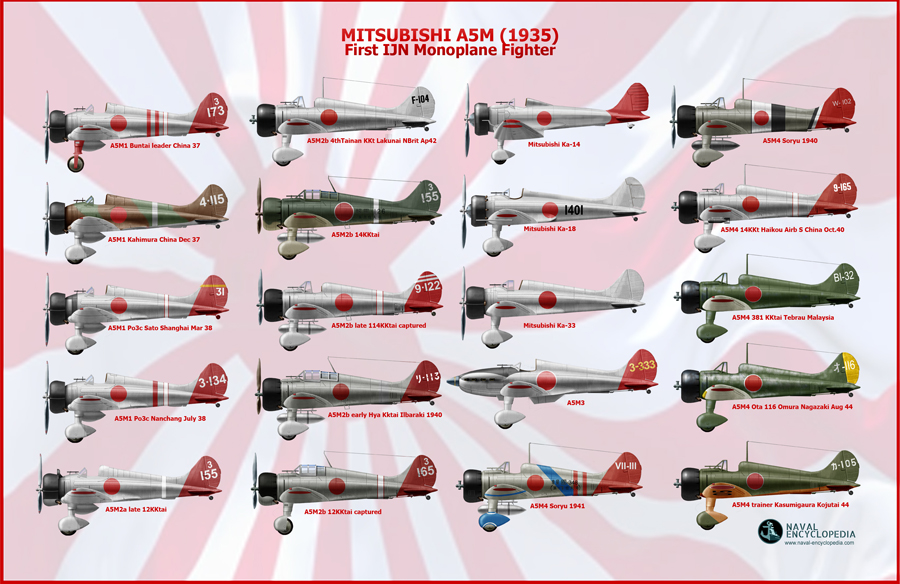
Mitsubishi A5M poster
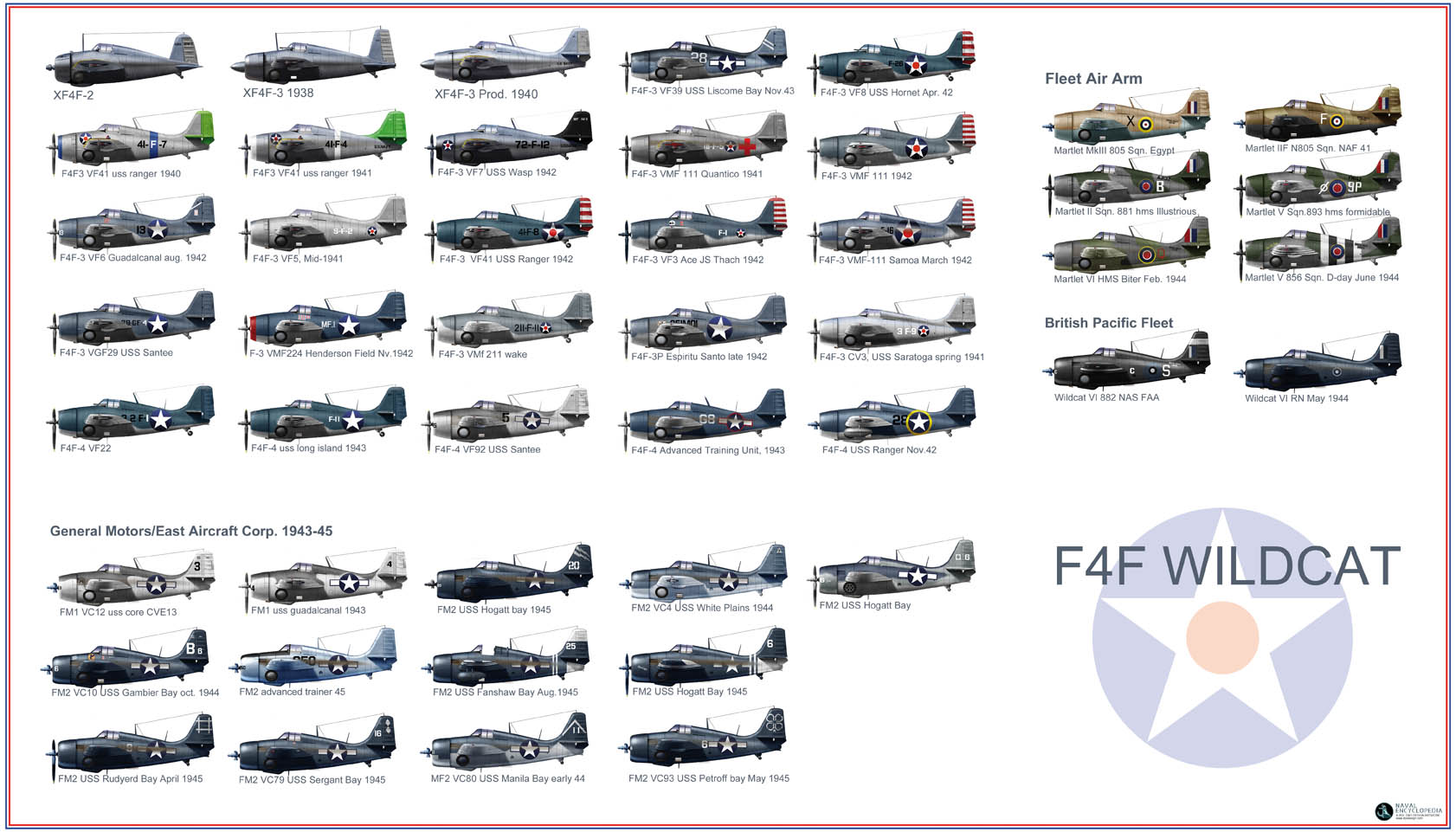
F4F wildcat
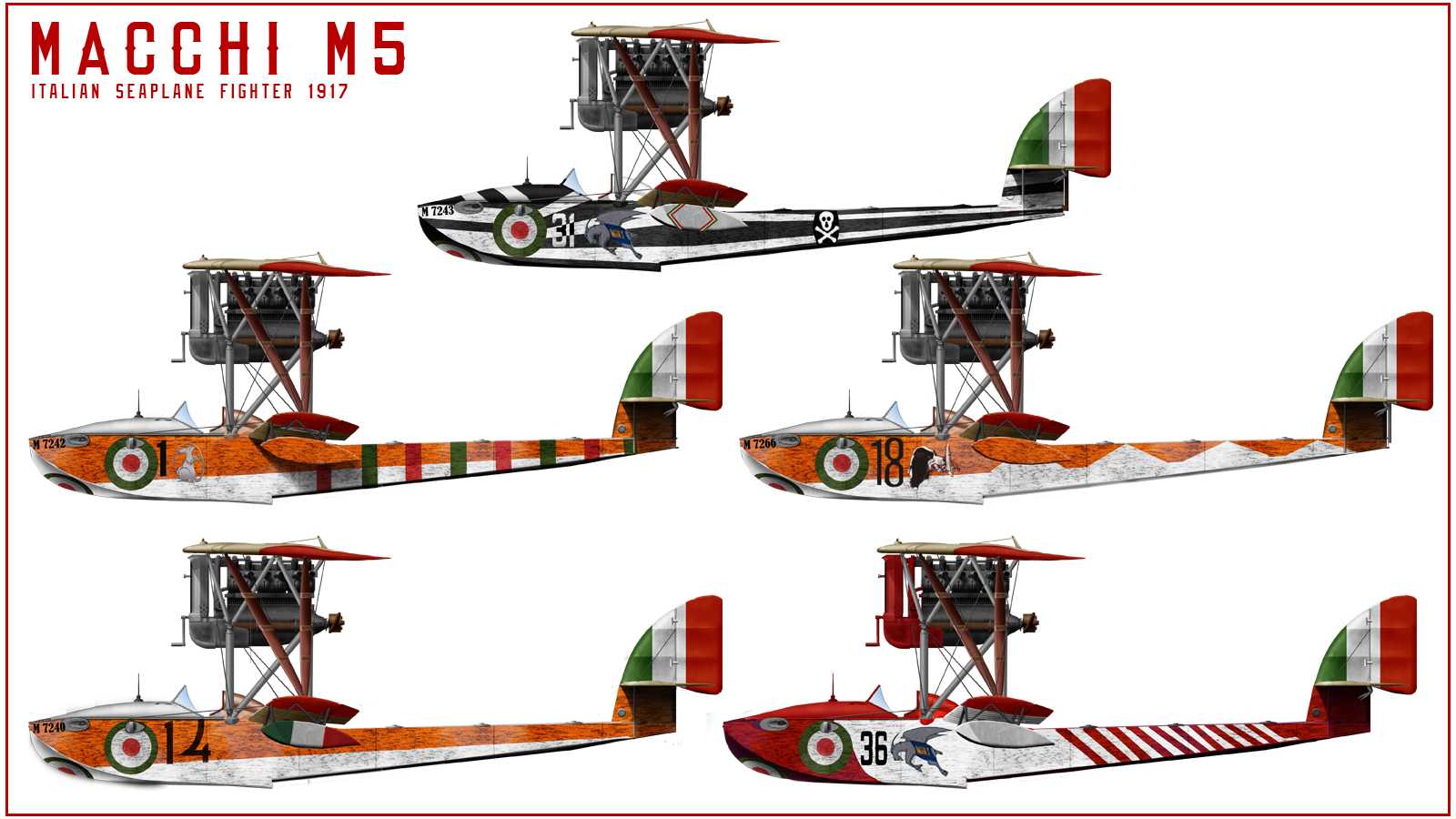
Macchi M5
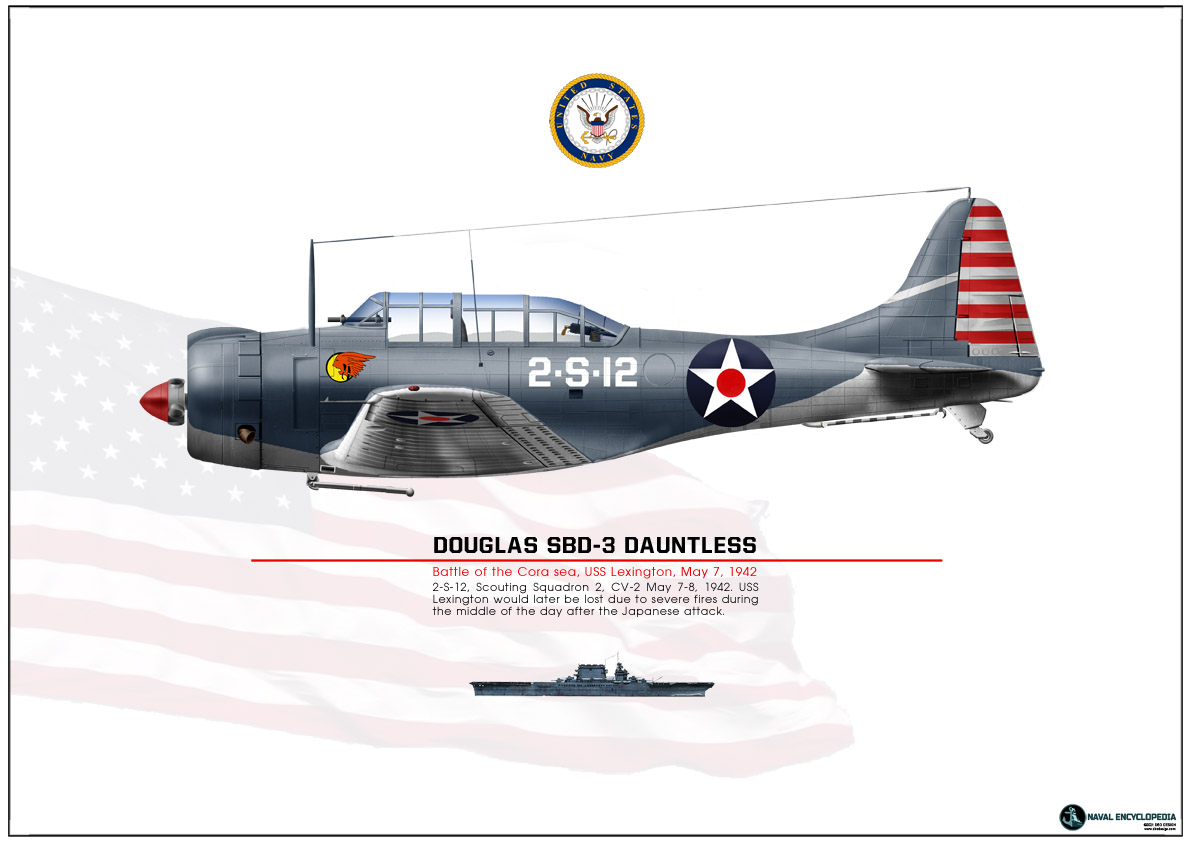
SBD Dauntless Coral Sea
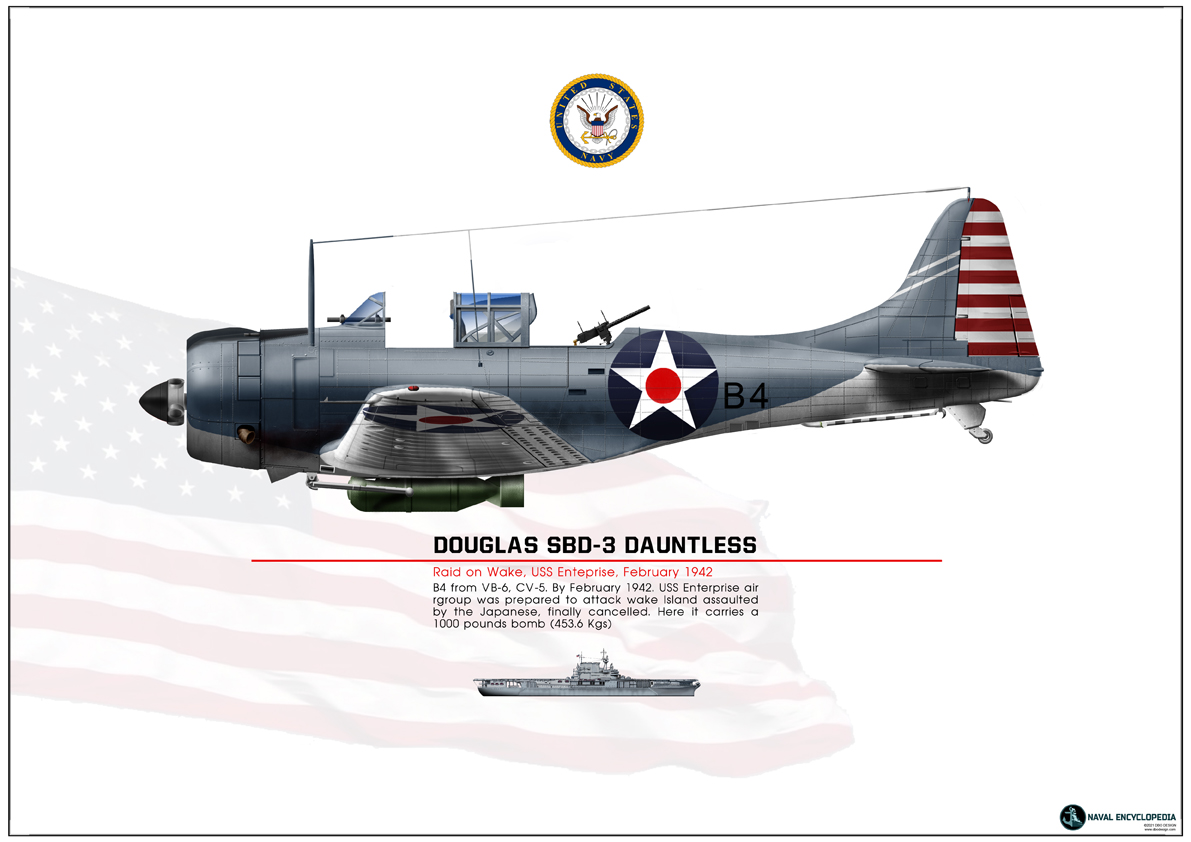
SBD Dauntless USS Enterprise
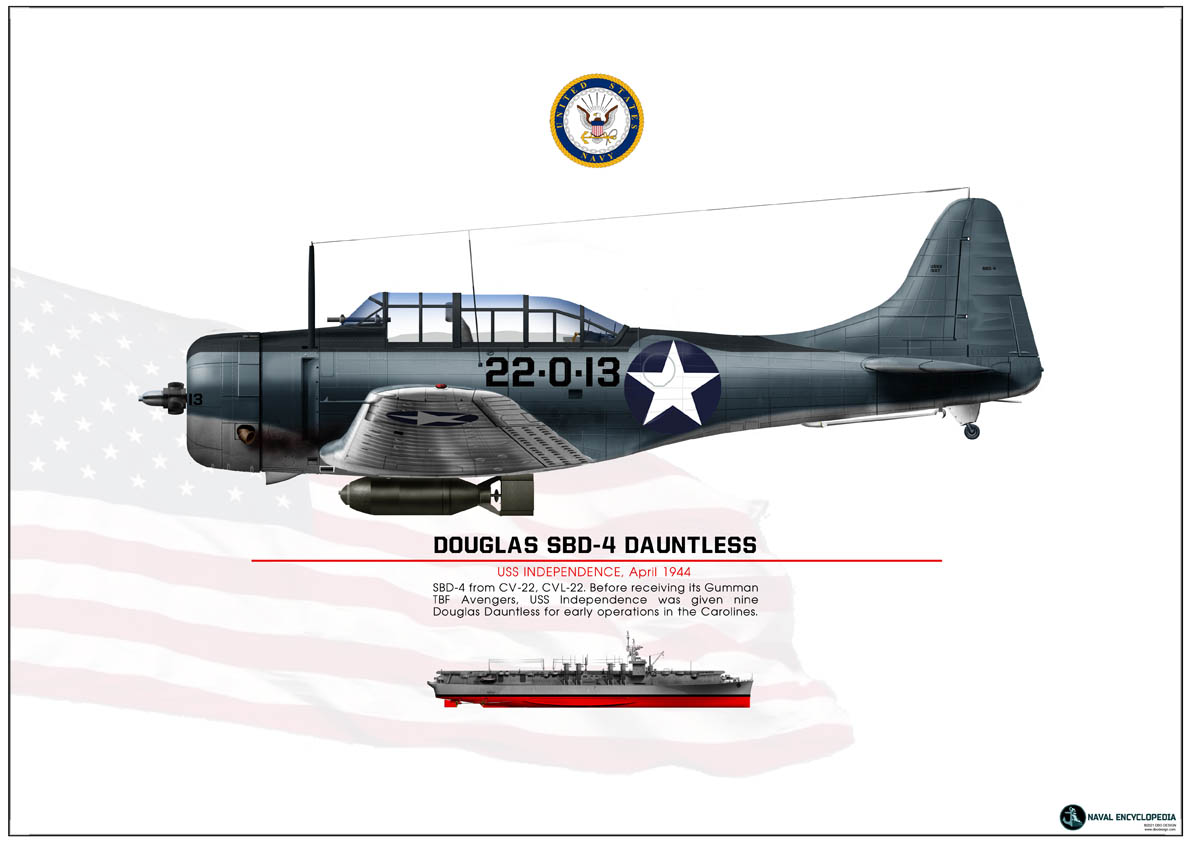
SBD-4 CV22