Curtiss P40 in Naval Service
 USAAC Fighter-Bomber (1940-45), c13,700 built
The Curtiss P40 never was of course a naval fighter, however it was not even proposed to the Navy given its limitations for the job: Structural as the airframe was generally unsuited for carrier operations and it suffered from a relatively small wing area, high stall and landing speeds, poor over-the-nose pilot visibility for deck approaches, high take-off run requirement whereas its liquid-cooled Allison inline engine was prone to overheating during extended low-speed idling, which is common on crowded aircraft carrier flight decks. Now, it did operate from aircraft carrier decks (see later) for taxi missions, just taking off, and also stored in hangars. No need to land.
As for a potential floatplane conversion, Edo's standard large floats (such as the Edo 6560) were mathematically evaluated for the P-40's weight class, but the project never moved to an actual prototype. Plus in case of such conversion the engine would ingest seawater spray it was never designed for, plus the drag and dead weight from the floats and struts woul d have been a massive penalty due to a poor power-to-weight ratio at higher altitudes. I would have been sluggish to act as seaborne interceptor.
The P-40 in brief:
The Curtiss P-40 Warhawk was one of the most widely used American fighter aircraft of the early years of World War II. Though often overshadowed by later designs like the North American P-51 Mustang, it played a crucial role across multiple theaters of war.Basic Specifications
Manufacturer: Curtiss-WrightFirst flight: 1938 (prototype), introduced 1941
Engine: Allison V-1710 liquid-cooled V-12
Top speed: ~360 mph (580 km/h), depending on variant
Range: ~650 miles (1,050 km)
Armament:
Typically 6 × .50 caliber machine guns
Bombs (up to 2,000 lb) or rockets
Design & Characteristics
The P-40 was based on the earlier Curtiss P-36 Hawk but upgraded with a more powerful inline engine.Strengths: Rugged and durable — could absorb heavy damage, Stable gun platform — effective in dives and strafing, Good low-to-medium altitude performance
Weaknesses: Poor high-altitude performance (no advanced supercharger), Outclassed later in the war by newer German and Japanese fighters, Limited climb rate compared to rivals.
Combat History

China & the “Flying Tigers”: The P-40 became famous with the First American Volunteer Group, led by Claire Lee Chennault. It flew against Japanese aircraft like the Mitsubishi A6M Zero Used dive-and-zoom tactics instead of dogfighting. Iconic shark-mouth nose art.
North Africa & Europe: Operated by the Royal Air Force, where it was called the “Kittyhawk” or “Tomahawk”. Played a major role in the North African Campaign. Provided ground support and air defense
Pacific Theater: Used heavily by the United States Army Air Forces. Battles over New Guinea, Guadalcanal, and the Philippines. Effective in ground attack and escort roles.
Variants
P-40B/C (Tomahawk): Early versions used by Flying Tigers.P-40E: Improved armament (6 guns), widely produced
P-40F/L: Used Rolls-Royce Merlin engine (better performance)
P-40N: Lightened, fastest production version
The Shark Mouth Legend
The famous shark-mouth design was inspired by British pilots and made iconic by the Flying Tigers. It became one of the most recognizable nose arts in aviation history.How It Compared
Feature P-40 Warhawk/Mitsubishi A6M ZeroSpeed; Moderate/Good
Maneuverability: Average/Excellent
Durability; High/Low
Firepower: Strong/Moderate
The P-40 couldn’t out-turn the Zero, but it could dive faster, take more hits, use energy tactics to win.
Strategic Importance
Even though it wasn’t the best fighter overall, the P-40 was available early in the war when better fighters weren’t ready, it was reliable and easy to maintain and exported widely (UK, USSR, China, Australia). It helped buy time for more advanced aircraft to enter service.A Navalized P36C ?
Before going into the P40, its direct ancestor, which flew (almost) for everybody but the USAAC, could have been used either by the USN, or the USMC at the time the former still fielded stocky Grumman biplanes. Though the Brewster F2A was chosen instead as its first monoplane. The P36 was a solid fighter... for 1936. The best difference between it and the 40 was of course going from a sturdy and short Whight radial to a longer but more efficient Packard inline engine. The P36C was lighter, easier to manage on a carrier deck and had room for improvements without being too heavy. It was perhaps overall better suited for carrier operations than the P40, starting with a shorter nose making for a better vision ahead and below for landing.However, overall, the F4F seemed a better proposition. Nevertheless, P-36s were delivered to Hawaii in February 1941, loaded on the aircraft carrier USS Enterprise in California, a first for this USAAC model. They were stripped down for the light and flew off its deck by USAAC pilots while off the coast of Hawaii. This saved considerable time over the traditional shipping method in disassembled in cargo crates on under tarpaulins on a freighter. This became a new standard and other tets were made. The FAA was also much into this, notably since late 1940s for Malta. 5 of these put a good fight over Pearl Harbour on the 7th, downing two Zeros for one loss, and scoring the first victories on this war.
The P36C was a good candidate though, it was the morst powerful, with a additional 0.30 in machine gun in each wing, external ammunition boxes under the wings, and the R-1830-17 of 1,200 hp (890 kW) engine. 30 were completed as such. Curtiss had an office in France and marketed the H-75 its French version, to equip the future fleet carriers of the Joffre class. But they would have needed a tailhook and a much reinforced frame to take repeated landing shock, a better landing gear, as well as extra coating for the extrernal structure to deal with corrosion. In the end it's unlikely Curtiss had the capacity to do this anyway, as Curtiss-Wright was insanely busy in this period, developing the P-40, C-46, SB2C, and O-52 among others.
In addition the P36 was an interceptor and just lacked the "legs" of the F4F. However as pros, it had the same radial as the Brewster F2A and Grumman F4F. There were also discussions in 1940 about the FAA and questions about the Hawks be navalised for carrier use well before the Sea Hurricane. The FAA indeed badly needed modern carrier fighters at that stage. Neither the Fairey Fulmar, not the Skua, both 2-seat jack of all trades, nor the biplane sea Gladiator were proper, modern fighters indeed.
The US "Naval Service" of the Curtiss P-40

Fantasy artists depiction of a USN P40E of VFA-103 Jolly Rogers, with victories (pinterest)
Obviously the P40 was not designed for carrier service or requested as such. Back in 1936 when the P-36, its predecessor, was barely operational, there were considerations by Curtiss to propose it to the Navy in a modified version, but Grumman by the time firmly imposed itself as a trusted provider. So the Curtiss fighter was not adopted. Although it had a powerful engine and a well protected inline engine elss susceptible to seawater spray degradation, there was no problem with its short, stout undercarriage albeit it would have needed to be lilely made a bit taller with a new telescopic arrangement, and beefed up. An arrestor hook was not an issue to install, just requiring strenghtening near the tail, and it was done on the P-40K (photo below).
P40K "navalized", USAAF 42-46205 15FG6NFS 18, USS Breton, Dec. 10, 1943.
The main technical issues were firstly:
-Nose too long and not optimized for carrier landing (better than the Corsai though)
-Lacking foding wings (never was designed for that)
-Having a long fuselage with small wings comparatively, making too fast and dangerous landings.
-Lacking the extra power to weight ratio to receive all the extra standard USN gear, like a better radio set, extra navigation gear, pilot's personal lifeboat, etc. About 100 kgs more, not counting the buffed landing gear and tail hook, degrading performances.
-The inline engine had greater maintenance requirements. Being water cooled it created issues at sea where space was at a premium.
Still, the question remains a topic for aviation enthusiasts: There are many photos of P-40 aboard carriers. At first glance, they looked like part of the air group, but at second glance, it is a well and common thing to carry USAAF aircraft these to various theaters (PTO, MTO, etc.). The "hard" truth (at least for fans of the "hawk"), is that they were never navalized for U.S. Navy service, or at least in a standrdized way. Indeed in the Pacific, due to the great distances involved, the U.S. Army Airforce relied on the U.S. Navy to transport their aircraft. So not only P40s but also P-47s, P-39s, P-38s, lacking long-distance ferry range were stacked up on decks of carriers. Not fleet carriers of the TF38/58 of course, speaheading offensives against Japan, but more modest "jeep carriers". Their deck was way too short for them to take off. They only needed to berth in a port with cranes, to have them landed. They were not only crammed on the deck, they could also be crammed the same way in the hangar, provided the lift was large enough. And so, that's the story of P40s on carrier decks in a nutshell.
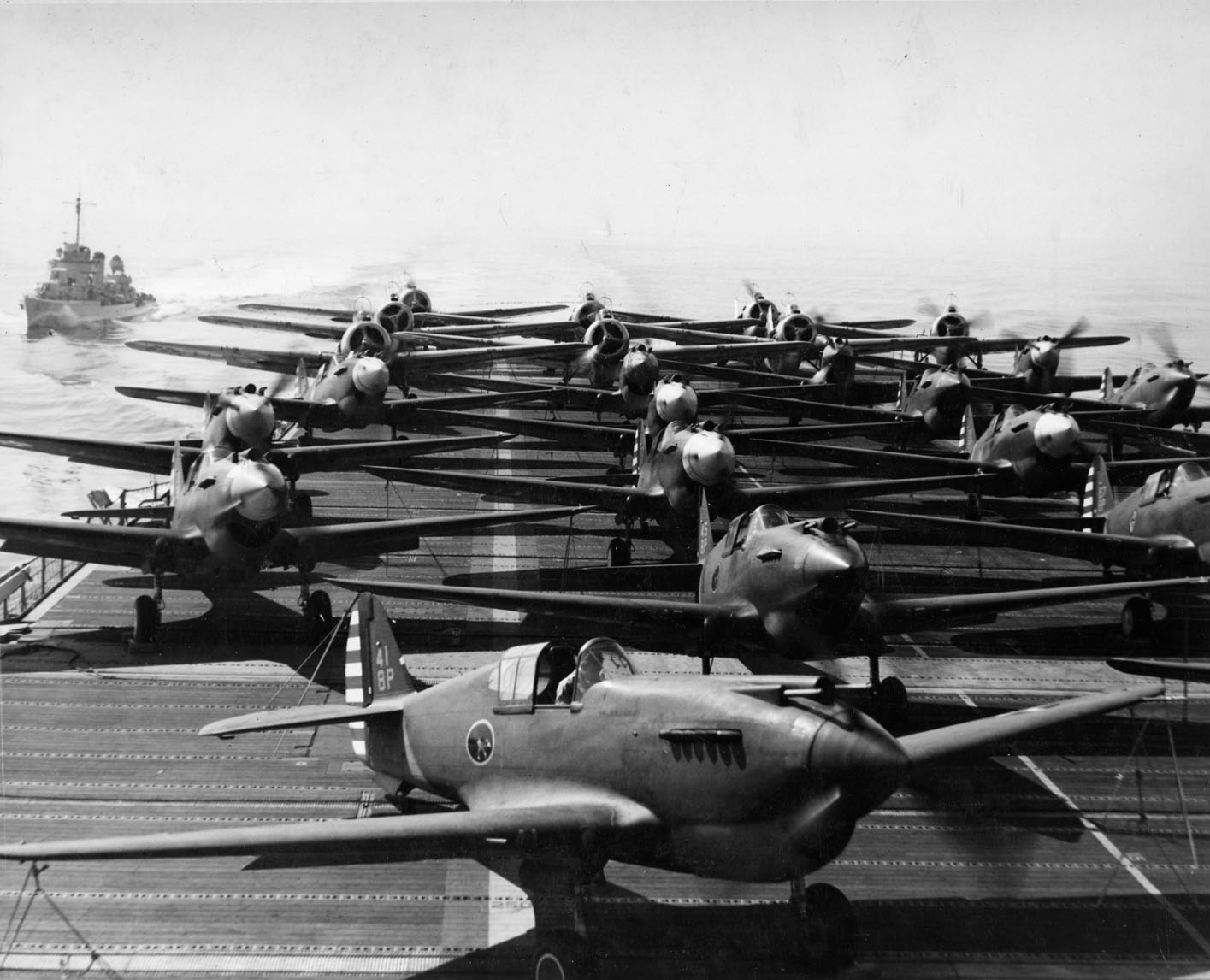
Well before 1943 tests, P40s could take off without help if the deck was longer, like this one on 14 October 1940 from USS Wasp. Bob Cressman stated:
Now ready to join the fleet and assigned to Carrier Division 3, Patrol Force, Wasp shifted to Naval Operating Base, Norfolk (NOB Norfolk) from the Norfolk Navy Yard on 11 October. There, she loaded 24 Curtiss P-40 fighters from the Army Air Corps' 8th Pursuit Group and nine North American O-47A reconnaissance aircraft from the 2d Observation Squadron, as well as her own spares and utility unit Grumman J2F Duck flying boats on the 12th. Proceeding to sea for maneuvering room, Wasp flew off the Army planes in a test designed to compare the take-off runs of standard Navy and Army aircraft. That experiment, the first time that Army planes had flown from a Navy carrier, foreshadowed the use of the ship in the ferry role that she performed so well in World War II.
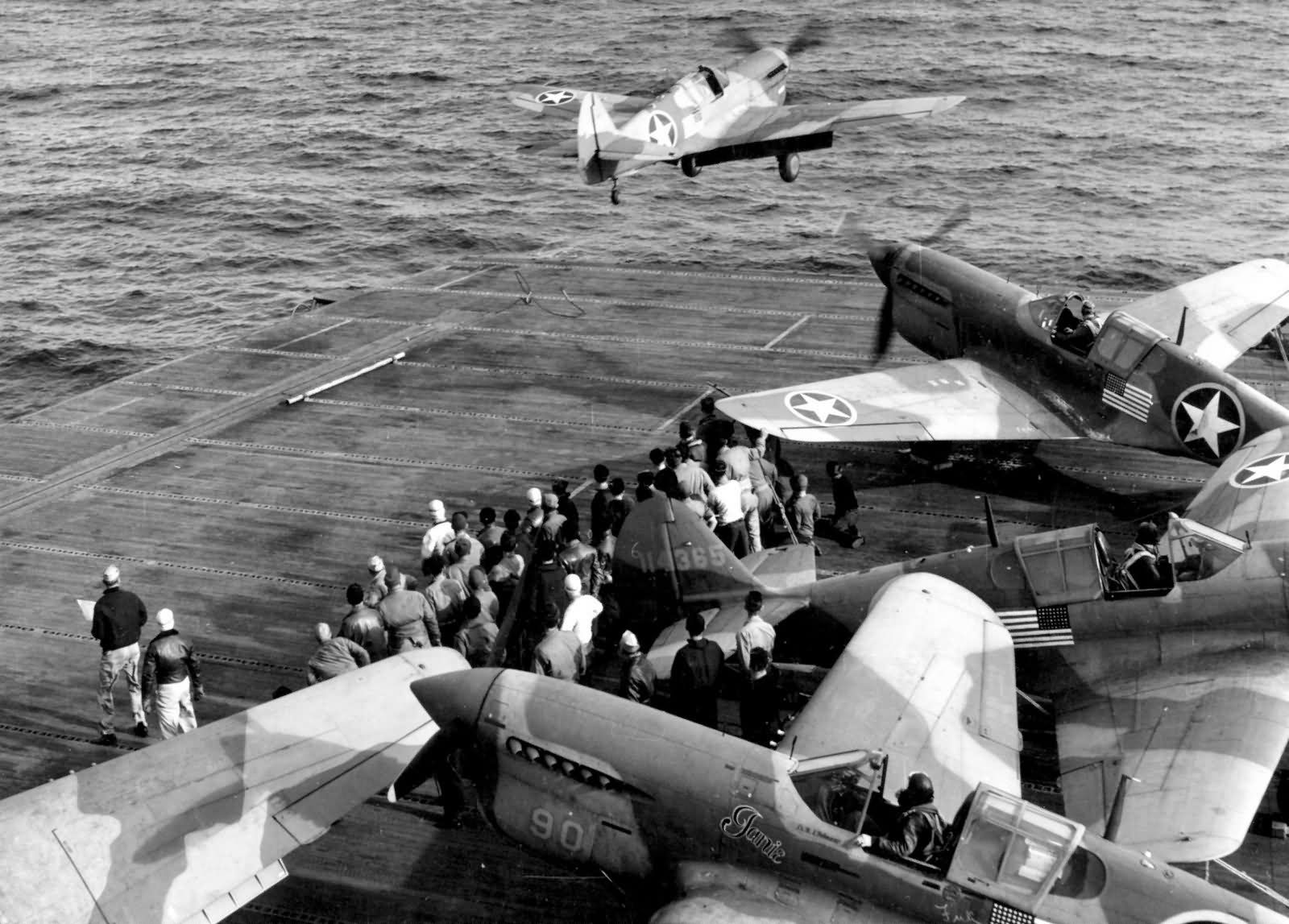
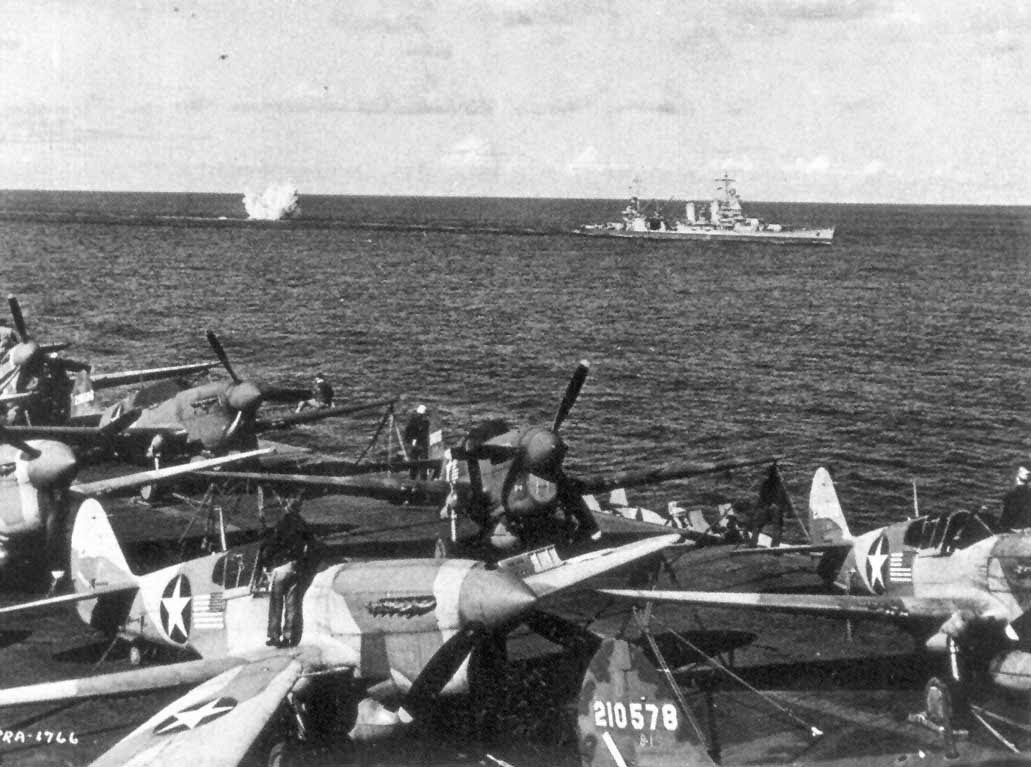
Another go was useful during Operation Torch in November 1942, the start of US participation into the "western campaign". Since August, on the other side of the planet, the Solomons campaign already started in August. Here, top, launched from USS Chenango, bottom, launched from USS Ranger.
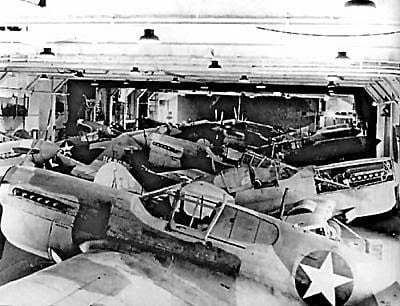
P40Bs in the hangar of USS Chenango, an escort carrier converted from a former oiler, part of the Sangamon class. This showed if turned sideways, the P40 wings fit the carrier's lift. For Operation Torch, the idea was to have a squadron of P40Bs asap, on the first captured airfield by US troops. These P-40s were stored between the hangar and decks and launched at sea rom the USS Ranger and USS Chenango.
The "Navalized" P40K
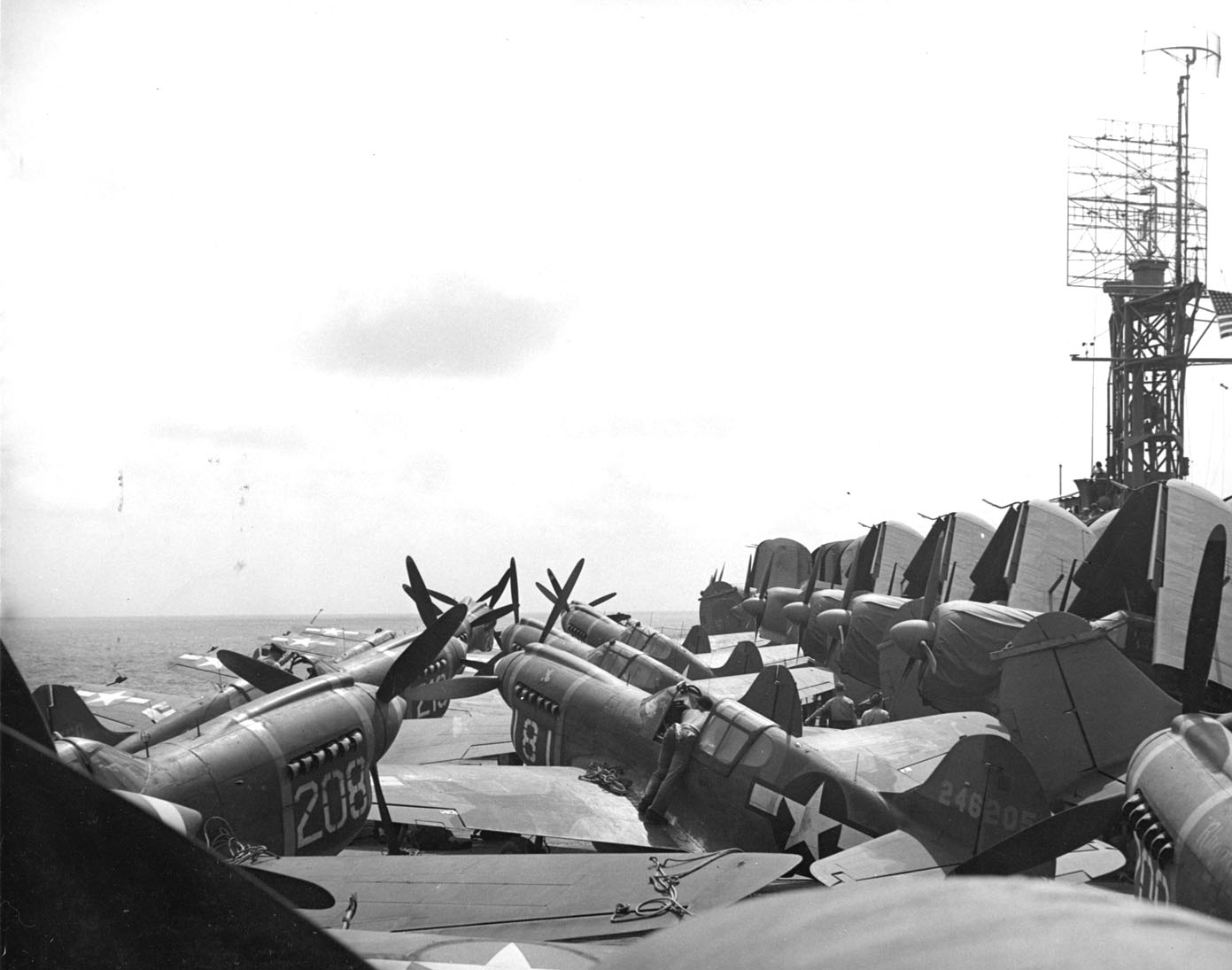
A Curtiss P-40K serial 42 45205, White 18, 6 Night Fighter Squadron, 15 Fighter Group prepares to catapult from USS Breton (CVE-23), 10 December 1943
Still, some were also catapulted, instead of waiting to reach a port, even catapult if the deck was short, like this mass-launching from USS Breton. She was a Bogue class carrier that took part also in some hunter-killer groups as well. Indeed, "free lauching" P40s had been a hassle. A P40F needed for this to have its weight stripped down to 7,500 lbs, 360ft of deck (110 m) and with a 35kt head wind.
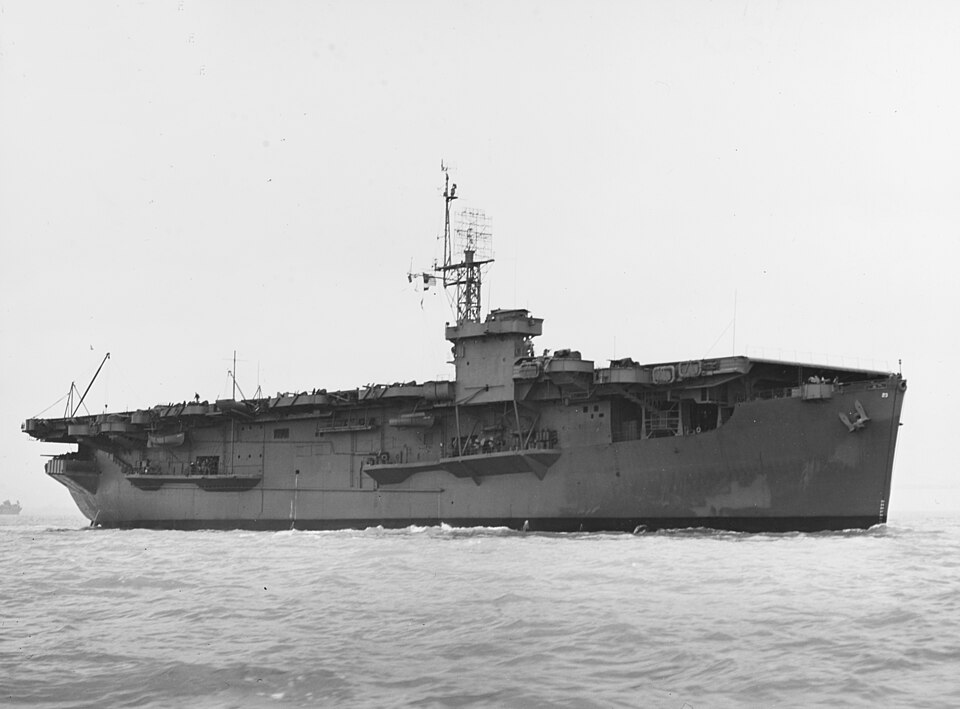
Here, the tactic, if not using the catapult, was to wait since the engine was at full throttle, and release the retaining cables, that would be followed by a launch. USS Breton was used to ferry them to the front, and operated with the Carrier Transport Squadron, Pacific Fleet. Her sailings carried her throughout the Pacific supplying men, materiel, and aircraft to units of the fleet engaged in making strikes on the enemy. While engaged in these duties, Breton took part in the capture and occupation of Saipan (11 June–10 August 1944); the Battle of the Philippine Sea (19–20 June); the 2nd Bonins raid (24 June); and the assault and occupation of Okinawa (6–7 April 1945).
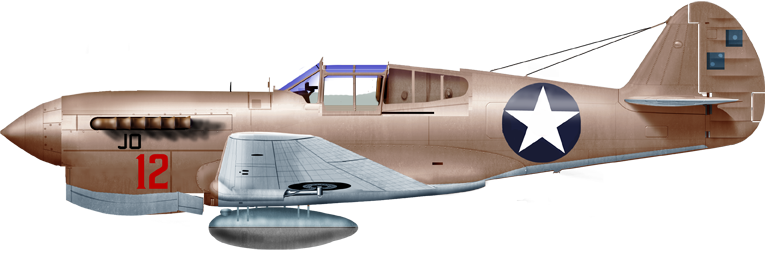
Curtiss P40F "Jo" 64th Fighter Sqn. 57th Fighter Group, USS Ranger July 1942
On December 10, 1943, the Bogue-class USS Breton (CVE-23) catapulted thirteen USAAF Curtiss P-40K Warhawks while en route to Espiritu Santo. These land-based fighters were launched directly from the deck to reinforce the isolated airfield on Canton Island (now part of Kiribati). While historical captions often refer to these aircraft as "navalized," these P-40s had neither an arrestor tail hooks or folding wings. They only had standard catapult bridles and holdback bars purely for a one-way launch to ferry them to their island destination. Historical records and archival photos from NavSource Online present conflicting data regarding the specific airframe markings. Photographic records for this date often conflate two distinct aircraft: serial number 42-46205 (marked as "White 181" belonging to the 15th Fighter Group) and serial number 42-45205 (marked as "White 18" belonging to the 6th Night Fighter Squadron). If most photos shows dark nose bands, records from the 15th FG indicate a distinct Robin's Egg Blue.
⚙ P40E specifications | |
| Empty Weight | 5,922 lb (2,686 kg) |
| Gross Weight | 8,515 lb (3,862 kg) |
| Length | 31 ft 8.5 in (9.665 m) |
| Wingspan | 37 ft 3.5 in (11.367 m) |
| Height | 10 ft 8 in (3.25 m) |
| Wing Area | 236 sq ft (21.9 m2) |
| Airfoil | root: NACA2215; tip :NACA2209 |
| Engine | Allison V-1710-39 V-12 liquid-cooled PE: 1,240 hp (920 kW), 0.14 hp/lb (0.23 kW/kg) |
| Propeller | 3-bladed Curtiss-Wright electric constant-speed |
| Top Speed | 361 mph (581 km/h, 314 kn) at 15,000 ft (4,600 m) |
| Cruise Speed | 308 mph (496 km/h, 268 kn) |
| Range | 716 mi (1,152 km, 622 nmi) at 70% power |
| Climb Rate | 15,000 ft (4,600 m) in 6 minutes 15 seconds |
| Ceiling | 29,100 ft (8,900 m) |
| Wing Loading | 35.1 lb/sq ft (171 kg/m2) |
| Armament | 6× 0.5 in (12.7 mm) M2 Browning MG wings, 250-1000 Ib bombs |
| Crew | 1 Pilot |
Soviet P40 in Naval Service
The Soviet Navy's aviation branch (VVS VMF) used Lend-Lease Curtiss P-40 Warhawks primarily for coastal defense, escorting shipping convoys, and fighter sweeps in the far north and Black Sea regions during World War II. The Soviet Union received over 2,400 Curtiss P-40 aircraft, known as Tomahawks and Kittyhawks, via Lend-Lease between 1941 and 1944. While most went to the Red Army Air Force (VVS RKKA) and National Air Defense (PVO), a significant number were reassigned to the Soviet Naval Aviation units by 1943, particularly in the Northern Fleet. Naval P-40s protected naval bases, patrolled coastal shipping lanes against Axis bombers, and escorted Allied Arctic convoys heading toward Murmansk.Soviet pilots valued the P-40 for its heavy firepower, robust mechanical strength, armor protection, and long operational range. However the were more critical on other areas: They considered it underpowered at high altitudes, lagging behind local Yakovlev fighters or German Messerschmitts in speed, climb rate, and maneuverability. In addition they had never been designed for Severe winter conditions on the Eastern Front. This caused issues like silver-alloy engine bearing failures. Shortages of spare parts led Soviet ground crews to perform local improvisations, including radiator and tire modifications.
Northern Fleet

P-40 of the Northern Fleet, part of lend-lease supplies, Top ace Boris Safonov "white 10", 1943. Note the unique light blue livery. Soviet P-40 Tomahawks in the Far North wore a distinctive, deeply layered blend of factory-applied British paints, hasty field modifications, and stark tactical markings.
Unlike the heavily weathered Arctic schemes of the North, Black Sea P-40s reflected the sun-baked and maritime environment of the southern front. Sea-Sky Camouflage Modifications: Many P-40Es arrived in the standard American Olive Drab over Neutral Grey. However, to better blend with the deep blue of the Black Sea, some maintenance units repainted the upper surfaces with custom maritime greys or dark blues, while undersides were kept a crisp AMT-7 Light Blue.
Due to the high-profile nature of the battles in the south, Black Sea P-40s frequently featured prominent presentation slogans painted in white or yellow Cyrillic script along the fuselage sides, such as "Za Rodinu!" or names of the factory workers who funded the aircraft. Due to the fluid nature of the frontline over the Kuban and Crimea, Black Sea P-40s frequently featured bright red or yellow spinners and tail tips to prevent friendly fire from Soviet shipboard anti-aircraft gunners, who were notoriously quick to shoot at unfamiliar foreign aircraft shapes.
The Soviet Union received 247 Tomahawks (P-40, P-40B, P-40C and Tomahawk IIBs redirected from RAF), first Allied aircraft accepted into Soviet inventory in late 1941. The majority of the subsequent 2,178 Kittyhawks (P-40E, K, M, N) transitioned directly to Soviet Naval Aviation (VVS VMF) and Air Defense (PVO) but the original Tomahawks were far fewer in number within the Northern Fleet. By late 1944 and early 1945, mechanical breakdowns and combat reduced operational frontline inventory and by 1st May 1945, records show the entire Northern Fleet Air Force held 82 Kittyhawks, but just 2 surviving frontline Tomahawks. They shared with those of the air force the same objectives, overlapping: Defending Murmansk, Arkhangelsk, and the vital Arctic supply arteries.
Units concerned were:
The 2nd Guards Mixed/Fighter Aviation Regiment (2nd GvSAP / GvIAP): Safonov’s legendary elite regiment operated out of bases on the Kola Peninsula (such as Vaenga). They were the primary naval unit integrating P-40s into convoy escort operations.
The 19th Guards Fighter Aviation Regiment (19th GvIAP): Originally the 145th IAP, this unit operated on the Karelian Front alongside the naval air arms to defend Arkhangelsk shipping paths.
The 20th Guards Fighter Aviation Regiment (20th GvIAP): Flew heavily over East Karelia and the Murmansk rail lines, often operating mixed fleets of Tomahawk IIBs and early Kittyhawks.
The 27th Reserve Aviation Regiment (27th ZAP): Stationed near Arkhangelsk, this GULAG-constructed depot served as the receiving and training hub where newly arrived Arctic convoy Tomahawks were assembled and test-flown before assignment.

Because the Tomahawk lagged behind the Messerschmitt Bf 109F/G in climb rate and high-altitude speed, Soviet Northern Fleet pilots abandoned single-aircraft dogfighting in favor of tightly coordinated group tactics. Pilots were strictly instructed never to attempt to climb away from a Messerschmitt. Instead, they utilized the Tomahawk's excellent dive acceleration and high structural strength to escape or dive-attack. If caught at low-to-medium altitudes, they relied on its superior horizontal turning circle to force a snapshot opportunity. When ambushed, Soviet flights formed a defensive horizontal circle where each P-40 protected the tail of the plane ahead of it.
The heavy forward fire from their wing-mounted .303 and .50 caliber machine guns created a lethal zone for any German fighter attempting to breach the circle. To squeeze every knot of speed and climb out of the underpowered Allison engines, Soviet ground crews frequently stripped the outer wing machine guns from Tomahawk IIBs, relying instead on the heavier nose-mounted weapons to reduce weight.
Northern Fleet aces who flew the P-40
Note that Soviet pilots tended to massively "overclaim", like many of their contemporaries.Boris Safonov (The Arctic Legend)
 Total Victories: 20 solo and 5 shared kills (across all aircraft). Lieutenant Colonel Boris Safonov was the premier Soviet naval ace and the first pilot to be named a twice-Hero of the Soviet Union during World War II. On 17 May 1942, flying a P-40E Kittyhawk ("White 10"), Safonov scored the very first Northern Fleet aerial victory in a P-40 by downing a German Junkers Ju 88 bomber. On 30 May 1942, while aggressively defending the Allied convoy PQ-16 from a wave of German bombers, Safonov's P-40 suffered a catastrophic engine failure—a common vulnerability with early Soviet P-40 operations—and he crashed into the Arctic sea.
Nikolai Kuznetsov
Total Victories: 36 kills. Lieutenant Nikolai Kuznetsov of the 436th Fighter Aviation Regiment (IAP) is highly notable because, unlike many pilots who transitioned to other aircraft later in the war, he scored the vast majority of his aerial victories directly behind the controls of the P-40 (specifically the P-40K variant).Nikolai Golodnikov
Serving with the 2nd Guards Fighter Regiment, Golodnikov became famous postwar for his detailed tactical breakdowns of the P-40 in Soviet service. While Western history often labels the Warhawk as mediocre, Golodnikov strongly defended the plane. He noted that if a pilot understood how to manage the Allison engine without over-revving it, the Kittyhawk could engage German Messerschmitt Bf 109F fighters on equal terms through 1943. He highly praised its ruggedness, heavy firepower, and horizontal maneuverability in dogfights.Alexei Kukharenko
Total Victories: 18 kills. Kukharenko served as a deputy squadron commander directly under Boris Safonov in the Northern Fleet during the early defense of Murmansk. He successfully flew the P-40E Kittyhawk during the fierce 1942 coastal defense campaigns before eventually taking command of his own squadron.Black Sea Fleet
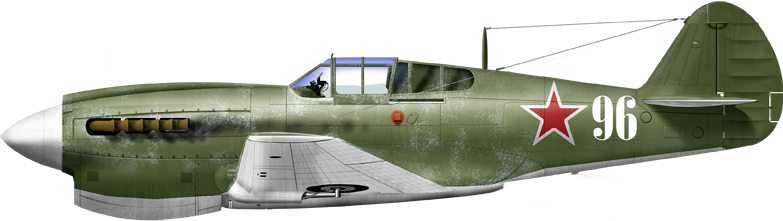
Green livery "96 white" of the Black Sea Fleet in 1943.
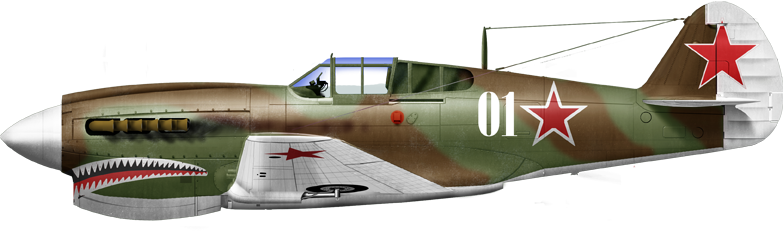
P40K-1 from the 7th IAP Black Sea Fleet, Sokologornoe Airfield May 1944
The Soviet Black Sea Fleet aviation branch (VVS CHF) integrated the Lend-Lease P-40 Warhawk into a very different kind of warfare than their Northern Fleet counterparts. While Northern units focused on protecting Arctic oceans, Black Sea P-40s engaged in grueling amphibious operations, intense air defense of isolated naval fortresses, and anti-shipping strikes. The deployment of the P-40 in the Black Sea was highly dynamic, moving along the Crimean coastline, the Caucasus, and the Taman Peninsula as the frontline shifted.
7th Fighter Aviation Regiment (7th IAP-ChF): This was one of the primary naval units operating the P-40 (primarily P-40E Kittyhawks) in the Black Sea theatre. They were heavily involved in defending the skies over vital ports like Novorossiysk, Gelendzhik, and Tuapse.
62nd Fighter Aviation Regiment (62nd IAP-ChF): Operating out of airfields in the Caucasus, this unit utilized the P-40's long range to conduct long-distance fighter sweeps over the Black Sea, intercepting German Ju 88 and He 111 bombers attacking Soviet shipping.
The Defense of Sevastopol (1941–1942): Early in the war, a small handful of Tomahawks were deployed to the besieged naval fortress of Sevastopol, operating out of basic dirt strips under constant artillery fire until the city fell.
Mission Profiles and Black Sea Tactics
The geographic reality of the Black Sea—isolated naval hubs, mountainous coastal terrain, and contested shipping lanes—dictated how naval pilots utilized the P-40.Amphibious Cover: During major Soviet landings, such as the Kerch-Eltigen Operation in late 1943, Black Sea P-40s were tasked with maintaining air superiority over the landing zones. Because they could loiter over the beachheads longer than Soviet Yakovlev fighters, they were ideal for keeping German Stuka dive-bombers at bay.
Anti-Shipping and Reconnaissance: The P-40’s rugged design made it a surprisingly effective fighter-bomber. Black Sea pilots regularly fitted the centerline rack with FAB-250 (250 kg) bombs to attack Axis coastal shipping, barges, and German E-boats moving along the Crimean coast.
Air Battles over the Kuban (1943): Black Sea Fleet P-40s were drawn into the massive, meat-grinder air battles over the Kuban region. Here, they faced elite German fighter wings like JG 52. Because the P-40 could not compete with the Messerschmitt Bf 109G or Focke-Wulf Fw 190 in the vertical plain, Black Sea pilots relied heavily on low-altitude horizontal dogfights and stepped formation tactics to survive.
Aces
Several elite Soviet Black Sea Fleet (VVS ChF) pilots and units deployed alongside them managed to achieve or cement their ace status directly at the controls of the P-40 Warhawk.Dmitry Koval (The Kuban P-40 Trailblazer)
Lieutenant Dmitry Ivanovich Koval is one of the most statistically significant P-40 pilots on the southern front. Serving with the 45th Fighter Aviation Regiment (IAP), Koval achieved official ace status right during the ferocious opening phases of the North Caucasian and Kuban air battles in early 1943. Operating his P-40 Kittyhawk at the lower, denser operational altitudes where the aircraft actually excelled, Koval shot down 6 German aircraft in rapid succession to cement his place as one of the Fleet's primary Warhawk specialists.Nikolai Krasnov
Though he flew multiple aircraft types throughout his illustrious career, Krasnov spent a highly critical window of 1943 flying the P-40 Kittyhawk over the southern maritime and coastal sectors. He was renowned for mastering the heavy horizontal dive-and-turn mechanics of the P-40 to counter the energy-fighting tactics of German Messerschmitts over the Black Sea beachheads. He went on to become one of the top overall Soviet aces of the southern theater, famously adapting Western aircraft traits to survive the dense meat-grinder environment of the Kuban.Grigory Rechkalov & Andrey Baklan (The Intermittent Pilots)
While predominantly famous for their staggering scores in the P-39 Airacobra, prominent Black Sea and southern theater aces like Grigory Rechkalov and Andrey Baklan spent formative operational periods in mixed-regiment structures containing P-40s. During the frantic defensive actions over the Crimean ports and the Taman Peninsula, these pilots alternated or flew escort alongside P-40 elements. They regularly utilized the massive forward punch of the P-40's wing-mounted heavy machine guns to strip down Axis bombers like the Ju 88.Rather than a single standout pilot dominating the aircraft's legacy like Safonov did in the North, the Black Sea P-40 record was built on collective unit achievements: > The 7th IAP-ChF: This specific naval fighter regiment generated a dozen localized aces who operated the P-40E and P-40K. They routinely scored multiple victories while protecting the shipping loops between Novorossiysk and Gelendzhik.
> The 11th and 25th Reserve Aviation Regiments (ZAP): Based in the Caucasus, the instructors here were highly decorated combat aces who flew the P-40 extensively. They developed the specific "low-altitude deflection shooting" tactics that allowed young Black Sea pilots to quickly score their first kills when intercepting Axis maritime strike planes.
Operational History (Pacific P40s)

Artist's depiction of RAAF P40s over New Guinea.
The Curtiss P-40 Warhawk was one of the most important Allied fighters in the Pacific during the first half of World War II. Before newer fighters such as the P-38, P-47, and P-51 became widely available, the P-40 carried much of the burden of air combat against Japan in the Pacific and China-Burma-India theaters. The P-40 is most famous for its use by the American Volunteer Group (AVG), the Flying Tigers, commanded by Claire Chennault. Their shark-mouth-painted P-40s became iconic. Rather than turning with Japanese fighters, they used diving attacks, speed, and firepower to defeat opponents. How it compared with Japanese fighters. Against aircraft like the Japanese A6M Zero, the P-40 was generally faster in a dive. It was tougher and could absorb more battle damage. It carried heavy armament (typically six .50-caliber machine guns). It could not match the Zero's low-speed turning ability. As a result, successful P-40 pilots avoided turning dogfights and relied on "boom-and-zoom" tactics—diving attacks followed by climbing away.
Although it was eventually replaced by more advanced fighters, the P-40 was the main USAAF fighter in the Pacific during 1941–42 and played a major role in stopping Japanese expansion. Along with the P-39 and F4F Wildcat, it helped break Japanese air superiority during the critical early years of the war.
The Allied Curtiss P-40 Warhawk was predominantly flown by the USAAF, RAAF, and RNZAF against the Imperial Japanese Navy's land-based and carrier-borne aviation across the Pacific Theater. They notably have to face the legendary Mitsubishi A6M Zero, IJN's premier fighter as well as land-based bombers like the Mitsubishi G4M "Betty". Like others, P-40 pilots had to discard traditional dogfighting rules completely to achieve air superiority. The P-40 was the thin line holding the Pacific during the dark early years of the war, locking horns with IJN aviation in several major sectors:
The Defense of Pearl Harbor (1941): During the initial strike by the IJN First Air Fleet carriers on 7 December 1941, a handful of USAAF P-40s from Haleiwa and Wheeler fields managed to scramble. Pilots like George Welch and Kenneth Taylor scored the first American victories of the war against IJN Val dive-bombers and Zero fighters.
The New Guinea Campaign (1942–1944): Flying out of Port Moresby and Milne Bay, the Royal Australian Air Force (RAAF) Nos. 75, 76, and 77 Squadrons, alongside USAAF P-40 units, engaged the elite IJN Tainan Kōkūtai (Air Group)—which included legendary aces like Saburō Sakai. They successfully checked the Japanese advance toward Australia.
The Solomons and Guadalcanal (1943): While the US Marine Corps Wildcats handled the early carriers, USAAF P-40Fs and P-40Ks, along with Royal New Zealand Air Force (RNZAF) squadrons, moved into Henderson Field and New Georgia. They regularly intercepted massive waves of IJN land-based bombers and Zero escorts sent down from the fortress at Rabaul.
To survive and dominate the Zero, P-40 units weaponised the stark design differences between the two aircraft: The P-40 Advantage had heavy armor plate, self-sealing tanks, massive dive speed and high wing loading versus the A6M Zero's Elite Agility, Tight Turn Radius, Excellent Climb and Low Stall Speed.
Allied pilots utilized their superior weight and structural strength to dive from high altitude, deliver a devastating burst from their six .50 caliber machine guns, and immediately rely on their dive momentum to zoom back up out of reach. If a P-40 pilot missed, they were strictly ordered never to turn back to engage, as the Zero would instantly slip inside their turning radius. Zeros lacked armor plating and self-sealing fuel tanks. A single, accurate pass from a P-40's heavy .50 caliber weapons could disintegrate an IJN fighter or set it ablaze, whereas the heavily armored P-40 could absorb an incredible amount of Japanese 7.7mm and 20mm fire and still return to base. Perfected by US Navy pilots but widely adopted by P-40 squadrons in mixed air commands, this tactic involved two P-40s flying abreast. When an IJN Zero latched onto the tail of one P-40, the two wings turned toward each other, crossing paths and allowing the second P-40 to take a clear head-on or high-angle deflection shot at the pursuing Japanese fighter.

Curtiss Hawk 81-A2 (export version of the P-40B) Tomawhawk of Claire Chennault's volunteer Chinese flighter squadron "Flying Tigers", 1941. The 1st American Volunteer Group (AVG) under U.S. Captain (ret.) Claire Lee Chennault flew the Curtiss P-40 Warhawk, protect key Chinese supply routes, the Burma Road, and bomb Japanese forces. They were Credited with nearly 300 confirmed enemy aircraft victories, losing few pilots, but the unit was disbanded in July 1942, integrated into the regular U.S. Army Air Forces. Not all pilots were able to be accustomed their next units, applying a greater discipline and hierarchical rules. Boyington was part of the AVG until April 1942 and would create his squadron of USMC pilots VMF-122 in early 1943.
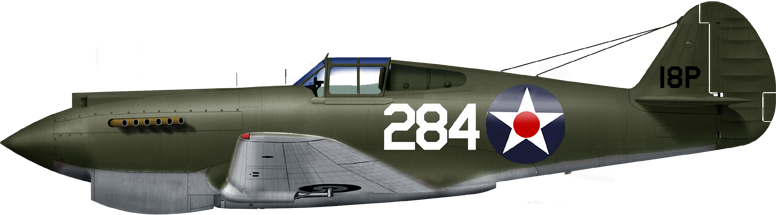
P40B Tomawhawk Bu no41-13297 in Hickam Field, Pearl Harbour, 7 Dec.1941. According to Rear Admiral Samuel Eliot Morison there were 94 pursuits near Pearl Harbour, 64 Curtiss P-40B/P-40C Tomahawks, and 20 older P-36 Curtiss Hawks. In total 84 P40/P36 were usable, not all operational between Hickam, and Haleiwa (Oahu). Second Lieutenant George S. Welch (Presidential DSC) of the 47th Squadron, 15th Pursuit Group for example on his P-40B shoot down 2 Nakajima B5N2 torpedo bombers, 1 Mitsubishi A6M2 Zero fighter and an Aichi D3A1 dive-bomber from this airfield. He has been playing poker all night and was half asleep when the attack started, rushing over 10 miles in a car to Haleiwa (no attack yet) in Tuxedo, making two sorties that day with 2nd Lt. Kenneth Taylor. This event inspired one scene of Emmerich's "Pearl Harbor".
P40K Tomawhawk navalized for tests, USS 1943 (in prep)
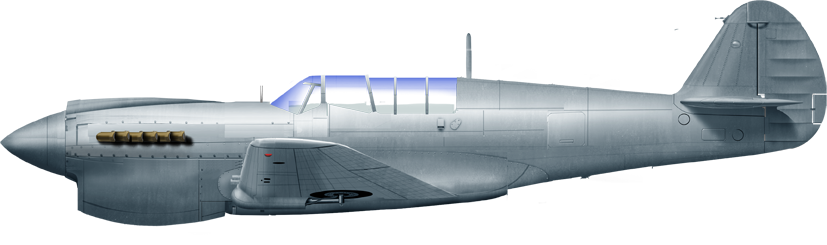
P40N Warhawk, base profile, ongoing work for Pacific liveries

Aussie P40 in action

"Grace", P40E, same. All three from pinterest
Src/Read more about the P40:
«Истребитель Кертисс Р-40» (Curtiss P-40 Fighter) by Vladimir Kotelnikov and Oleg Leyko«"Ястребы" Донована Берлина» (Donovan Berlin's "Hawks") by A. Kotlobovsky
«Киттихауки против Кригсмарине в годы ВОВ» (Kittyhawks Against the Kriegsmarine During the Great Patriotic War) hosted on Красные Соколы (Red Falcons)
"The P-40 in Soviet Aviation" by Vladimir Kotelnikov (Published in The Journal of Slavic Military Studies)
USS Breton and P40 launches
ww2aircraft.net usn P40 ferry adventures
ww2aircraft.net navalized warhawk
mustang.gaetanmarie.com
navalized mustang
- Lohner E (1913)
- Macchi M3 (1916)
- Macchi M5 (1917)
- Macchi M7 (1918)
- Ansaldo ISVA (1918)
- Short S.38 (1912)
- Sopwith Baby (1916)
- Short 184 (1916)
- Fairey Campania (1917)
- Sopwith Cuckoo (1917)
- Felixstowe F.2 (1917)
- Gotha WD.2 (1914)
- Friedrichshafen FF 33 (1916)
- Albatros W4 (1916)
- Albatros W8 (1918)
- Hanriot HD.2
- Grigorovich M5 (1915)
- Grigorovich M9 (1916)
- Grigorovich M11 (1917)
- IJN Farman MF.7
- IJN Yokosho Type Mo
- Yokosho Rogou Kougata (1917)
- Yokosuka Igo-Ko (1920)
- Curtiss N9 (1916)
- Curtiss H4 (1916)
- Curtiss H12 (1917)
- Curtiss H16 (1918)
- Aeromarine 39
- Vought VE-7
- Douglas DT (1921)
- NAF/Curtiss TS-1 (1922)
- Boeing FB.5 (1923)
- Boeing F4B (1928)
- Vought O2U/O3U Corsair (1928)
- Grumman FF (1931)
- Akron class airships (1931)
- Curtiss F9C Sparrowhawk (1931)
- Curtiss F11C Goshawk (1932)
- Curtiss BF2C Goshawk (1933)
- Blackburn Blackburn (1922)
- Supermarine Seagull (1922)
- Fairey Flycatcher (1923)
- Hawker Horsley (1925)
- Blackburn Ripon (1926)
- Fairey IIIF (1927)
- Fairey Seal (1930)
- LGL-32 C.1 (1927)
- Fokker T.II (1921)
- Fokker T.III (1923)
- Caspar U1 (1921)
- Dornier Do J Wal (1922)
- Rohrbach R-III (1924)
- Mitsubishi 1MF (1923)
- Mitsubishi B1M (1923)
- Yokosuka E1Y (1923)
- Nakajima A1N (1927)
- Nakajima E2N (1927)
- Mitsubishi B2M (1929)
- Nakajima A2N (1930)
- Nakajima A4N (1935)
- CANT 18
WW1
✠ K.u.K. Seefliegerkorps:
 Italian Naval Aviation
 RNAS
RNAS
 Marineflieger
 French Naval Aviation
 Russian Naval Aviation
 IJN Air Service
 USA
USA
Interwar
Interwar US
 Interwar Britain
 Interwar France
 Interwar Netherlands
 Interwar Germany
 Interwar Japan
 Interwar Italy
- Grumman F2F (1933)
- Curtiss SOC seagull (1934)
- Grumman F3F (1935)
- Northrop BT-1 (1935)
- Consolidated PBY Catalina (1935)
- Grumman J2F Duck (1936)
- Brewster/NAF SBN-1 (1936)
- Curtiss SBC Helldiver (1936)
- Vought SB2U Vindicator (1936)
- Brewster F2A Buffalo (1937)
- Douglas TBD Devastator (1937)
- Vought Kingfisher (1938)
- Curtiss SO3C Seamew (1939)
- K-class Blimps (1939)
- Douglas SBD Dauntless (1939)
- Grumman F4F Wildcat (1940)
- F4U Corsair (NE) (1940)
- Brewster SB2A Buccaneer (1941)
- Grumman TBF/TBM Avenger (1941)
- Consolidated TBY Sea Wolf (1941)
- Grumman F6F Hellcat (1942)
- Curtiss SB2C Helldiver (1942)
- Curtiss SC Seahawk (1944)
- Grumman F7F Tigercat (1944)
- Grumman F8F Bearcat (1944)
- Ryan FR-1 Fireball (1944)
- Douglas AD-1 Skyraider (1945)
- Fleet Air Arm
- Hawker Osprey (1932)
- Fairey Swordfish (1934)
- Blackburn Shark (1934)
- Supermarine Walrus (1936)
- Fairey Seafox (1936)
- Blackburn Skua (1937)
- Short Sunderland (1937)
- Blackburn Roc (1938)
- Fairey Albacore (1940)
- Fairey Fulmar (1940)
- Grumman Martlet (1941)
- Hawker sea Hurricane (1941)
- Brewster Bermuda (1942)
- Fairey Barracuda (1943)
- Fairey Firefly (1943)
- Grumman Tarpon (1943)
- Grumman Gannet (1943)
- Supermarine seafire (1943)
- Blackburn Firebrand (1944)
- Hawker Sea Fury (1944)
- Coastal Command
- Vickers Wellington (1937)
- IJN aviation
- Yokosuka E6Y (1930)
- Aichi D1A "Susie" (1934)
- Mitsubishi A5M "Claude" (1935)
- Nakajima A4N (1935)
- Yokosuka B4Y "Jean" (1935)
- Mitsubishi G3M "Nell" (1935)
- Nakajima E8N "Dave" (1935)
- Kawanishi E7K "Alf" (1935)
- Nakajima B5N "Kate" (1937)
- Kawanishi H6K "Mavis" (1938)
- Aichi D3A "Val" (1940)
- Mitsubishi G4M "Betty" (1940)
- Mitsubishi A6M "zeke" (1940)
- Nakajima E14Y "Glen" (1941)
- Nakajima B6N "Jill" (1941)
- Mitsubishi F1M "pete" (1941)
- Aichi E13A Reisu "Jake" (1941)
- Kawanishi E15K Shiun "Norm" (1941)
- Nakajima C6N Saiun "Myrt" (1942)
- Yokosuka D4Y "Judy" (1942)
- Kyushu Q1W Tokai "Lorna" (1944)
 Luftwaffe
- Heinkel 114 (1935)
- Arado 196 (1937)
- Me109 T (1938)
- Blohm & Voss 138 Seedrache (1940)
 Italian Aviation
- Savoia-Marchetti S.55
- IMAM Ro.43/44
- CANT Z.501 Gabbiano
- CANT Z.506 Airone
- CANT Z.508
- CANT Z.511
- CANT Z.515
 French Aeronavale
- GL.300 (1926-39)
- CAMS 37 (1926)
- Levasseur PL.5 (1927)
- Potez 452 (1935)
- Loire 210 (1936)
- Loire 130 (1937)
- LN 401 (1938)
 Soviet Naval Aviation
- Shavrov SH-2 (1928)
- Tupolev TB-1P (1931)
- Beriev MBR-2 (1930)
- Tupolev MR-6 (1933)
- Tupolev MTB-1 (1934)
- Beriev Be-2 (1936)
- Polikarpov I16 naval (1936)
- Tupolev MTB-2 (1937)
- Ilyushine DB-3T/TP (1937)
- Beriev Be-4 (1940)
 Swedish Naval Aviation
- SAAB B17S
-
 Skoda Š-328V
  R-XIII Idro
 Fokker C.XI W (1934)
 Rogožarski PVT-H (1938)
WW2
 ☍ USNA
- De Havilland Sea Vixen
- Hawker Sea Hawk
- Supermarine Scimitar
- Blackburn Buccaneer
- Hawker Sea Harrier
- Douglas A4 Skyhawk
- Grumman F9F Panther
- Vought F8 Crusader
- McDonnell-Douglas F-4 Phantom-II
- North Am. A5 Vigilante
- TU-142
- Yak 38 forger
☢ Cold War
✧ NATO
Fleet Air Arm
 US Navy
☭ Warsaw Pact
Merch
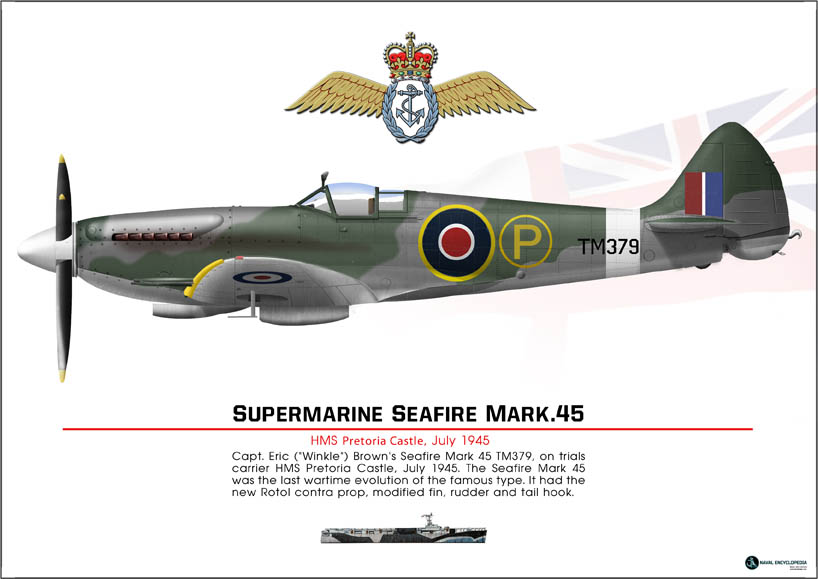
Seafire Mark 45; HMS Pretoria Castle
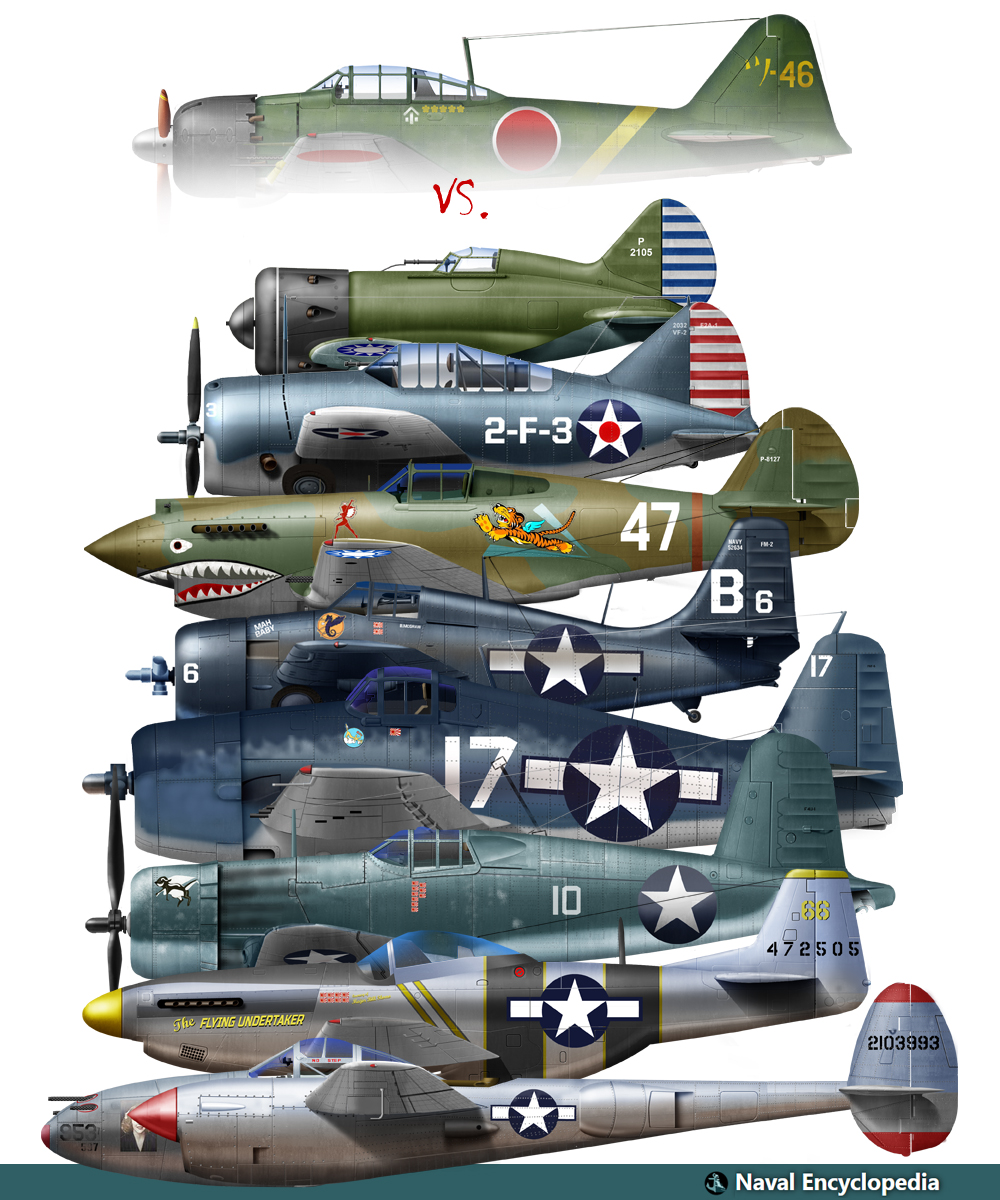
Zeros vs its aversaries
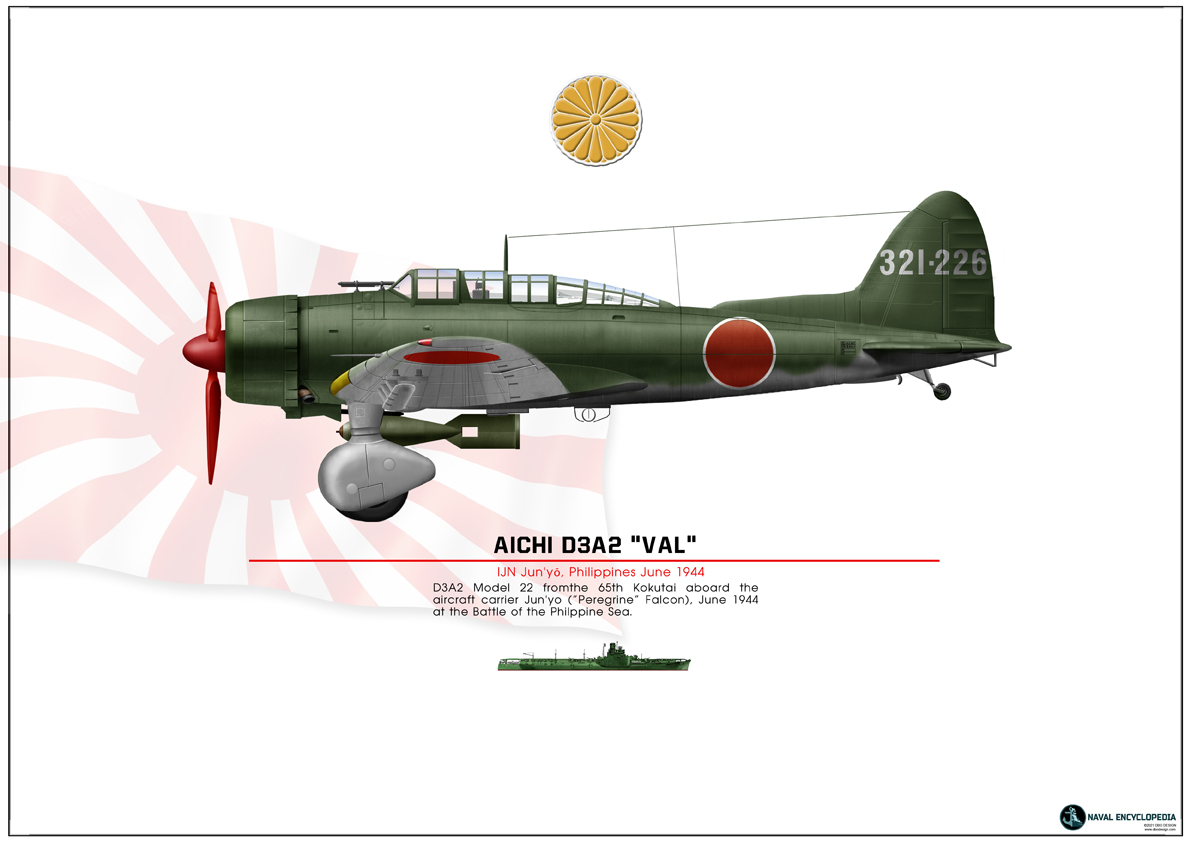
Aichi D3A “Val” Junyo
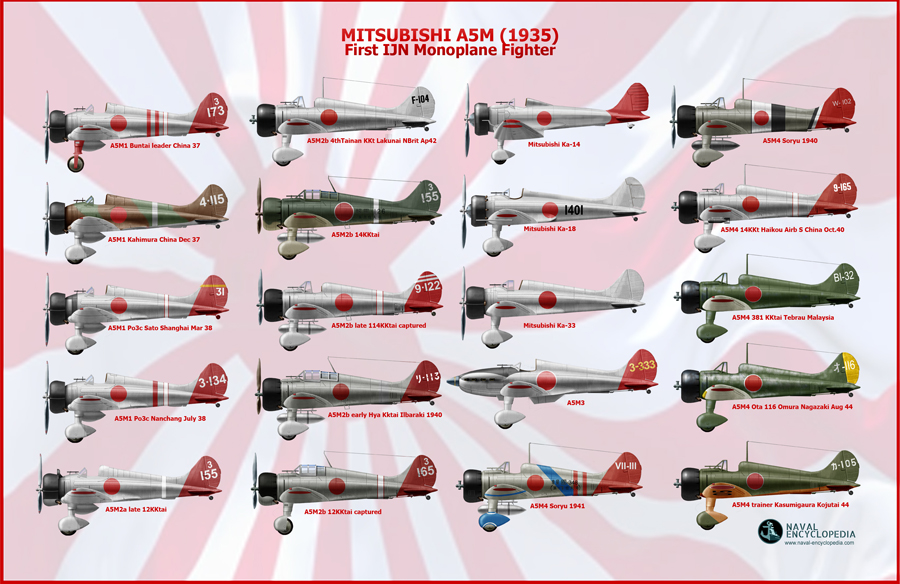
Mitsubishi A5M poster
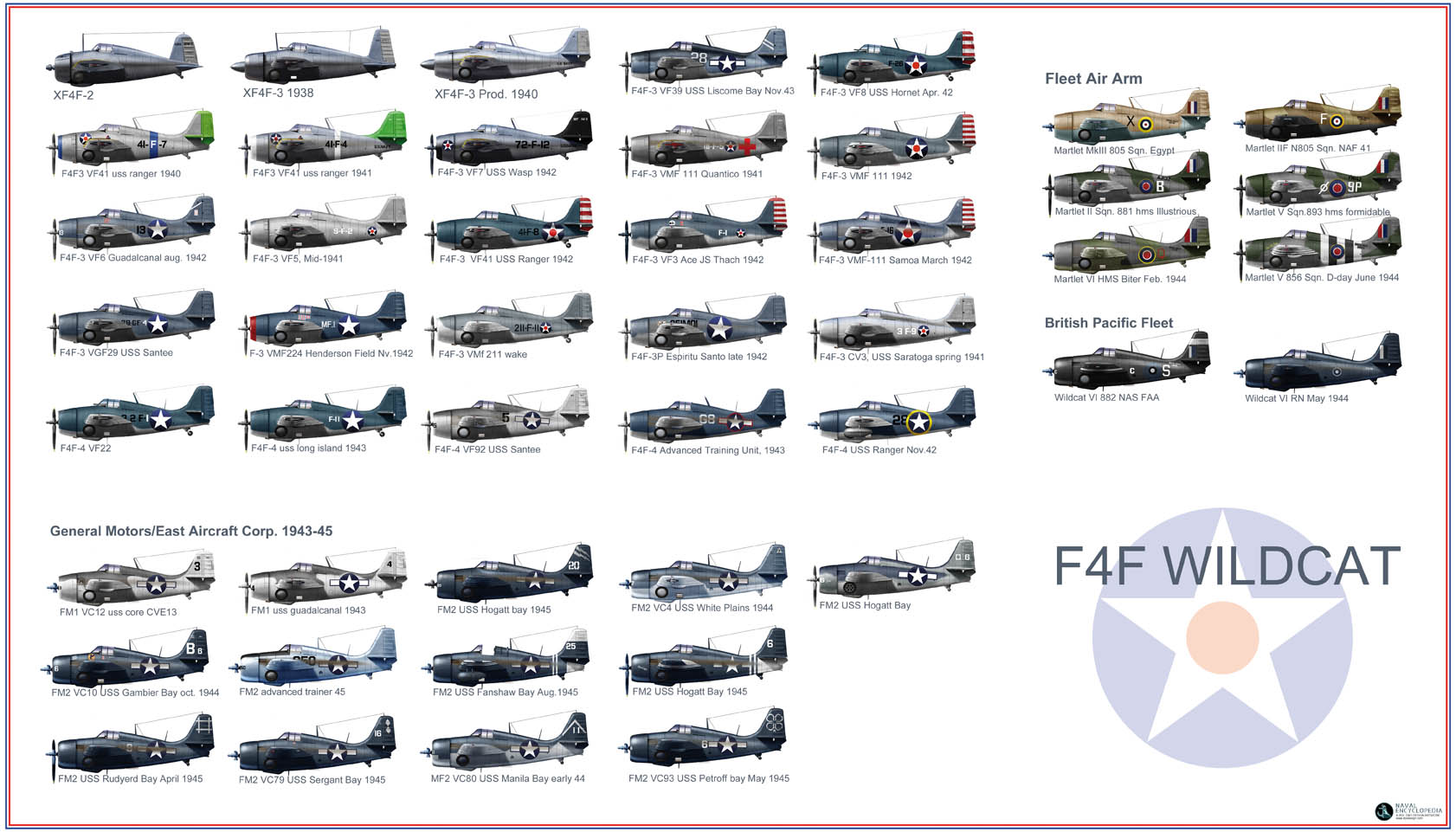
F4F wildcat
Macchi M5
SBD Dauntless Coral Sea
SBD Dauntless USS Enterprise
SBD-4 CV22