SAAB-17BS
 38 floatplane built, 1943-44
Context and Development
About SAAB
SAAB is the industrial giant of Sweden, a world-famous aeronautical company with the Gripen as its current superstar, but it diversified in the cold war to other products, like cars. It was founded however as Svenska Aeroplan Aktiebolaget, as a late interwar military aircraft manufacturer. Sweden pursued strict neutrality but became increasingly concerned about rising military tensions in Europe, especially its southern German neighbour. Sweden still relied heavily on foreign aircraft suppliers and the government feared, rightly so, that imports could be cut off in case of war, leaving the country defenseless. Saab was thus officially founded on 2 April 1937 as the (“Swedish Aeroplane Company Ltd”), a state-sponsored but private industrial group attracting engineers with the sole mission of designing and build military aircraft for Sweden. It was backed by Swedish industrial and financial groups, notably the influential Marcus Wallenberg banking family.Initial production began in Trollhättan and later expanded to Linköping, as its long-term aerospace center. SAAB quickly moved from concept to production, focusing on aircraft suited to immediate Swedish defensive needs: The Saab 17 was the first, intended for reconnaissance and as a dive bomber, followed by the larger Saab 18 twin-engine bomber/recon aircraft and the Saab 21 advanced fighter design, albeit development started in 1939 and it was barely operational before 1945. All these aircraft were designed specifically for nordic weather conditions, short runways (a characteristic still true today with the distributed defence concept) and defensive air operations rather than offensive. Between 1939 and 1945 the workforce grew dramatically with thousands of employees, production capacity expanded and engineering capability matured quickly, notably with the help of the US, believed to stay neutral in a future war.
The base: SAAB 17
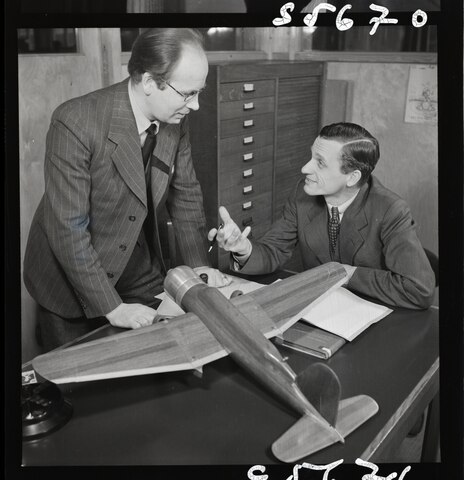 In the late 1930s, Sweden needed its own aicraft rather than relying on imports and after SAAB was founded, looked for suitable models to be developed for its specific needs. For a first model, the Air Force expressed the need for a jack of all trade, usable for reconnaissance, level bombing, dive bombing and coastal patrol (so working with the Svenska Marinen as well). This was SAAB's first major design assignment. This domestic replacement aircraft started development in 1938, led by the arly engineering team in Linköping. Engineers looked for a strong structure for dive bombing, short takeoff performance for dispersed bases, operating with little maintenance in rough conditions and in winter with skis, and as seen above, great flexibility for multiple missions without modifications. SAAB team also looked at many foreign models to take some ideas, and the previous ASJA B5 on which the SAAB 17 derived, was essentially a Northrop 8 (see later). The end product was a single-engine, two-seat aircraft with a pilot and observer/gunner.
The basic design was a mid-wing monoplane layout with All-metal construction and stressed-skin design for strength and reduced weight, a large wing area for stability at low speeds and a strong airframe allowing steep dive attacks without structural failure. The Landing Gear was one of its most distinctive features as it was retractable and doubled as dive brakes. When lowered partially the gear legs created drag. It also had rear ailerons stabilizers when diving, but this avoid complex and heavy dive-brake panels and simplified construction. More so, the wheeled landing gear in standard could be easily swapped for skis in winter, and a floats version was intended for maritime reconnaissance. This adaptability was highly valued by Swedish planners to lower costs.
Potential wartime supply was uncertain so Saab designed the SAAB-17 to receive a variety of radial engines, the cell was very adaptable and modular. The choices considered were the Pratt & Whitney Twin Wasp for the SAAB 17A, Bristol Mercury for the SAAB 17B and Italian Piaggio P.XI for the 17C. This adaptability made sure production could continue in wartime despite embargoes or shortages, with licenced secured for each.
The land-version Armament Layout comprised two Forward-firing machine guns in the wings and a flexible rear defensive gun as a baseline, completed by a bomb load under the fuselage with a crutch fitted to swing the bomb clear of the aircraft, as well as light attachements under the wings. The observer benefited of a large glasshouse with good visibility to handle navigation, reconnaissance photography, and rear defense, with his traversing seat. He had a map table, a radio set in the middle of the cockpit, at his back when facing to the rear on his flexible mount MG position.
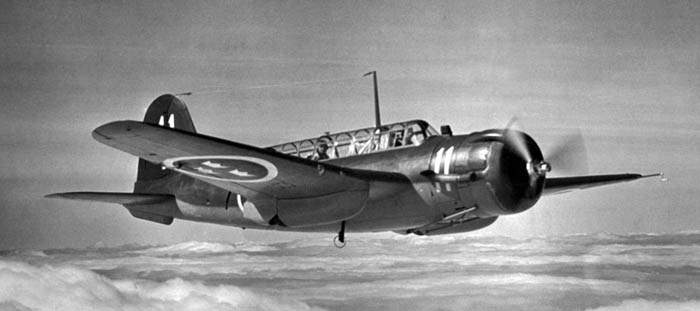
The Saab 17 emphasized stability rather than extreme speed a predictable dive behavior, good low-speed handling making it suitable for relatively inexperienced wartime pilots. it had a thick wing profile for lift, excellent short-field performance, high structural robustness to go with it, and was easy to maintain, with all accesses readily available. However for a first model, develpment was remarkably short as it made its maiden flight in May 1940, just as Germany invaded the West. The winter 1940-41 showed its strong performance in snow and cold conditions and it entered the same year, an essential part of its neutrality deterrent component. Lessons directly helped creating the Saab 18 and Saab 21.
SAAB-17BS Design
Svenska Marinen's air Assets
The Swedish Navy in 1939 was the most powerful of Scandinavia, a real deterrent for the Kriegsmarine as well as the Soviet Baltic Fleet. It was composed of a few cruisers, destroyers, but above all by a fleet of ageing but modernized coastal battleships completed bt torpedo boats, submarines and minelayers capable of making enemy movements hard close to Swedish coastal waters, as well as MTBs perfectly suited for the maze of islands of the eastern coast, completed by Coastal Artillery (Kustartilleriet). Which brought us to Swedish Naval Aviation. By default of a radar network, the country had many airbases for coastal patrols, but still a limited park of dedicated marine aircraft. Yet, by default of an aicraft carrier, which was studied in 1939, the country had already in 1934 HSwMS Gotland, its first and only aircraft cruiser.The ship was intended to provide reconnaissance to Swedish defensive combat groups constituted around coastal battleships and TBs/destroyers. The cruiser carried and operated six Hawker Osprey floatplanes, which were the bedrock of its naval aviation, but ageing in 1940. Called S.9 they had a 600 hp Swedish-built NOHAB Bristol Mercury radial engine with interchangeable wheeled landing gear. The Osprey was a derivative of the Hart (1930). Otherwise, ASJA was was its main supplier, with the S7, and later B5 in 1936, based on the Northrop 8-A 1. SAAB also provided the B3C, a local version of the Junkers Ju-86 bomber, used for maritime patrol. Sweden also operated the Ju-52, but it seems not in its floatplane configuration.
SAAB did not started completely out of the blue, but with talented engineers with some experience. They came from ASJA (AB Svenska Järnvägsverkstädernas Aeroplanavdelning), established as a private venture in 1930 from the Industrial conglomerate AB Svenska Järnvägsverkstäderna and only producing models under licence. ASJA merged in 1937 with Bofors as AB Förenade Flygverkstäder (AFF). The dive bomber ASJA L10 was its last model and became the SAAB 17 when was integrated into SAAB. The company also worked on the ASJA L11 (later Saab 18), the "Swedish Do-17". The latter was intended to carry torpedoes as the SAAB T18B but this went nowhere, neither its cold war version carrying an early anti-ship missile RB 302 in 1949.
Development
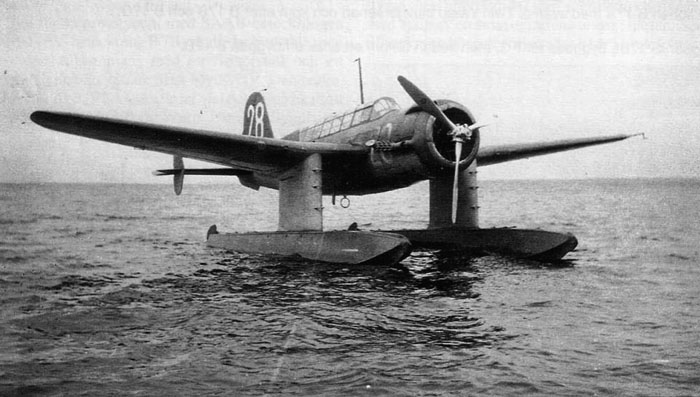
If a dive bomber was of great interest for the Navy, there was no doctrine yet. In any case, the Navy did not had its own air branch, and the models operated for the Svenska Marinen were all managed and operated by the Svenska Flygvapnet (Swedish Air Force). No specific doctrine of cooperation with the Navy to use the dive bomber was established and the sole unit operating the type, specificallt for the Navy became F 2 Hägernäs/Roslagen Air Corps Naval Support Wing near Stockholm, equipped entirely with 38 S-17BS floatplanes. As seen above, the SAAB 17 was planned to swap its landing gear for skis, or two floats. This enabled the quick conversion of the model into a dedicated reconnaissance version of B 17B with floats, called the B 17BS. It was powered by a Bristol Mercury XXIV engine like the B version, and 38 were built, a detail in a total of 326 Saab 17 all types produced until August 1944.
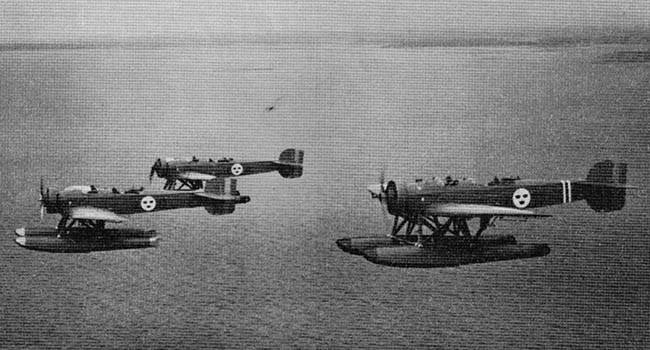
However the floatplane version, already planned in 1938, had a specific role, replacing the now completely obsolete Svenska Aero S 5, a licence-made Heinkel HE 5 nicknamed the "Hansa". This three-seat monoplane was for its time (1926) a good general purpose model, mostly used for reconnaissance, but well armed (Three MGs) and able to carry if needed 160 kg (350 lb) of bombs under the rear fuselage. In all, 40 were made from the S5, 5A, 5B, 5C and 5D, the last versios with a Bristol Pegasus engine (photos).
Design
The advantage of the conversion was that the SAAB B 17BS was quickly operational. If the base model first flew on 18 May 1940, it really only was introduced from March 1942. In general, development between 1940 and 1942 experienced delays due to many issues found, especially around wing failures, as well as additional modifications needed before it could be cleared for dive bombing. Even in this capacity, its use as such remained limited to shallow attacks. It could have supported the Navy however.As for the BS, it had its former wheeltrain legs doubling as air brakes removed and instead fairings fitted in place, connected to standard licenced floats. The latter were likely derivatives from the Osprey's models, all-metal and compartmented in case of punctures, fitted with attachements points, a storage compartment for a small anchor, cables and flares, as small inflatable boat, ect. Each float had a composite rudder as well, with cables. The legs has steps to climb on board via the wings roots.
Otherwise, the remainder of the aircraft were completely unchanged. It was a conventional, all-metal mid-wing cantilever monoplane, with a long greenhouse canopy (convertible for some sources into a 3-seater if needed), a single radial engine in the nose. Only the control surfaces were covered in fabric. The floatplane differed for its massive fairings joining the floats. The latter were believed to produce less drag than conventional struts, adopting a wing profile, but turned vertically. Like the standard model, the floatplane kept its small vertical fins to the horizontal stabilizer to remain stable. In Swedish, nomenclature its configuration was called "Marinspaningsplan".
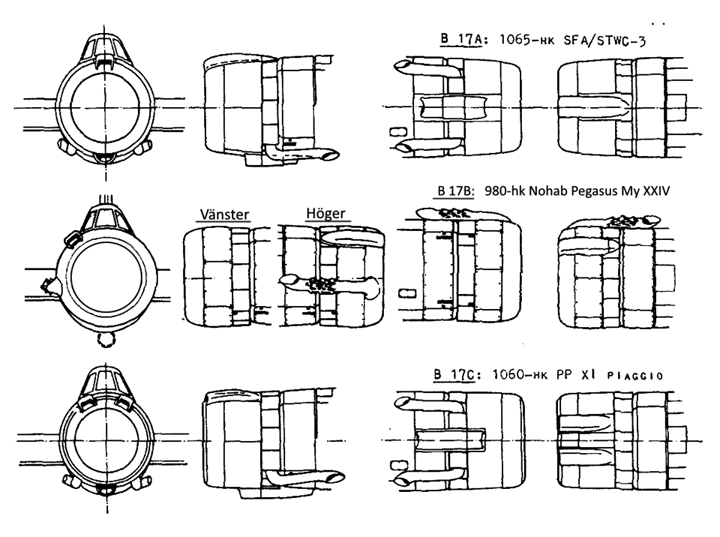
The powerplant was the same Bristol Mercury XXIV built by Svenska Flygmotor AB (SFA). It was the only powerplant properly licenced as other versions used unlicenced US and Italian engines. The Mercury XXIV was a nine-cylinder, air-cooled, single-row, piston radial engine, connected to an all-metal three bladed, variable pitch propeller. In theory it could use the new British 100-octane fuel, but it's dubious it was adopted in Sweden. Output was likely 825 hp (615 kW). Performances of the B 17BS of course diverged from the regular model due to the drag caused by the floats, and are conjectural (see below), lower than the regular wheeltrain SAAB 17 B. The engine had a left-side massive exhaust pipe, absent from the right side.
Armaments wise, the SAAB 17 BS retained its baseline three machine guns: Two fixed forward-firing 8 mm (0.315 in) Flygplanskulspruta Ksp m/22F (M1919 Browning AN/M2) machine guns and a single rear cockpit flexible 8 mm (0.315 in) Flygplanskulspruta Ksp m/22R (M1919 Browning AN/M2) machine gun. To fire, the gunner had to slide forward his canopy, but his view and fire angle directly straight back was blocked by the fuselage, a bit like the SB2C Helldiver. In theory it could have carry as much as 700 kg (1,500 lb) of bombs but due to the floats, this was limited to underwings racks for a total of six or nine small bombs. The internal bomb bay may have been fixed shut or used for storage. The pirmary mission of the floatplane was reconnaissance for the fleet, first and foremost. At less than 350 kph max it was an easy prey, but range was an estimable 1,700 km (1,100 mi, 920 nmi), well enough for screening the fleet in the Baltic.
Detailed specs
Specs SAAB-17BS | |
| Crew: | 2: Pilot, Navigator/Observer/Gunner |
| Fuselage Lenght | 32 ft 10 in or 10 m, 11 m with floats. |
| Wingspan | 44 ft 11 in / 13.7 m |
| Height | 14 ft 9 in/4.5 m, c6m with floats. |
| Empty weight: | c4 tons |
| Gross weight: | c 4,5 tons |
| Powerplant: | Bristol Mercury XXIV 9 cyl. AC radial 825 hp (615 kW) |
| Propeller: | 3-bladed variable |
| Top speed: | c250 mph / 420 kmh |
| Endurance/range: | 1,056 miles / 1,700 km |
| Service ceiling: | 32,200 ft / 9,800 m |
| Armament - Guns | 3x 8mm Ksp m/22F: 2x in the wings fwd, 1x rear. Bombs. |
The SAAB-17BS in action:
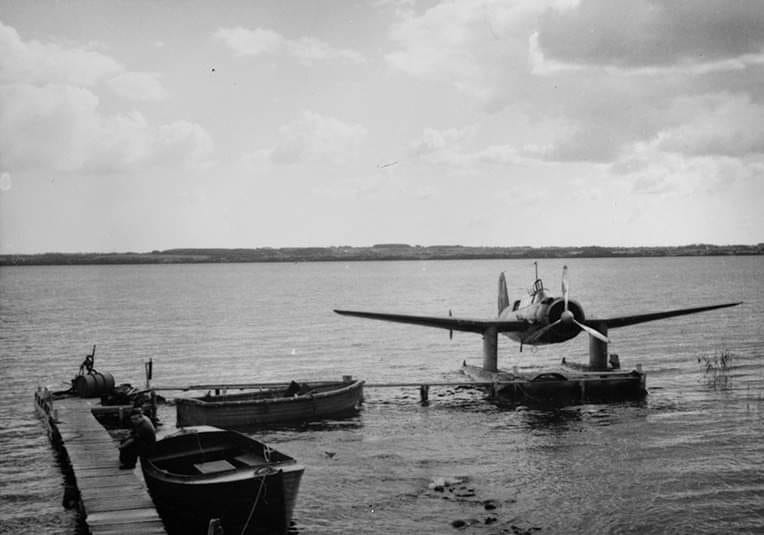
Saab 17 BS berthed in WW2, src Facebook
As seen above, the SAAB 17BS saw 38 delivered between 1943 and 1944, all assigned to the F 2 Hägernäs/Roslagen Air Corps Naval Support Wing near Stockholm. It seems howeve rproduction went on until 1945 for a total of 54 delivered according to some Swedish sources, and the unit remained active until 1948. The SAAB 17 BS were built in Trollhättan, and the company test pilot Anders Helgstrand flew the prototype floaplane as well. The floats and their generous fairing had an enormous deflection power and he describe his model willing to turn eitehr side without command. With a string side wind, strenght was needed to keep it fly straight. Thus the floatplane production version received two extra stabilizers compensating for the massive steering force of the floats.
Neutrality air patrols over the Swedish coastal waters were a dull job generally, albeit encounters with either Soviet or German aircraft were not rare. Fortunately none ended as a loss. The latter were mostly due to engine issues in flights, or failed landing or water take off. Still, the SAAB 17 in its float version was as strong as the land-based version, as showe by one S 17BS that landed on a frozen grass field in the Stockholm area and managed to take off again. The glasshouse procured some advantages as navigation aids were not great at that time, and the pilot was guided by his navigator/gunner, helped by a map, compass and watch most of the time. He could observe, but also could act as signalman while handle radio communication.
However despite all his roles in WW2, he was often a conscript, not a radio specialist. Many times there was no radio contact with the ground while in patrol. Bad weather also, most of the time made reconnaissance in the Baltic difficult. F 2 Hägernäs crews gathered in the morning, checked the weather forecast and then decided whether it would be a flying or a non-flying day. But many times, the weather changed while in flight and pilots were forced to find their way home in fog or bad weather over a featurless sea, so flying close to enough to coast to have it in sight in bad weather became a habit. Winter was often synonimous with close-to-shore operations. As seen above, the SAAB 17 BS was used until 1948, after which the squadron was relocated to Roslagen and the model retired. Postwar, two B 17BS were purchased by Osterman Aero, used to carry fish and shellfish from Bergen (Norway) to the Swedish capital. One land-based version suvived and still is flying today, others at in museums as the model was also used by Finland and Denmark. But in Swedish inventory, the SAAB 17BS was not replaced.
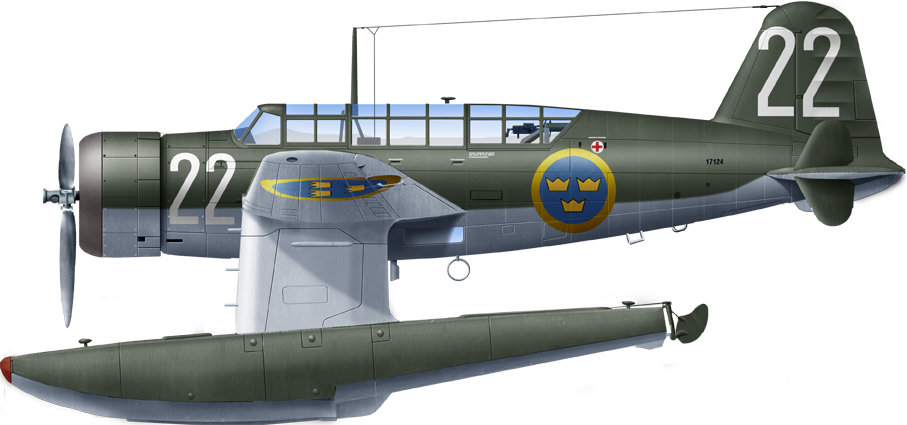
Illustration of "22", F 2 Hägernäs 1944
From Facebook
Wiki CC
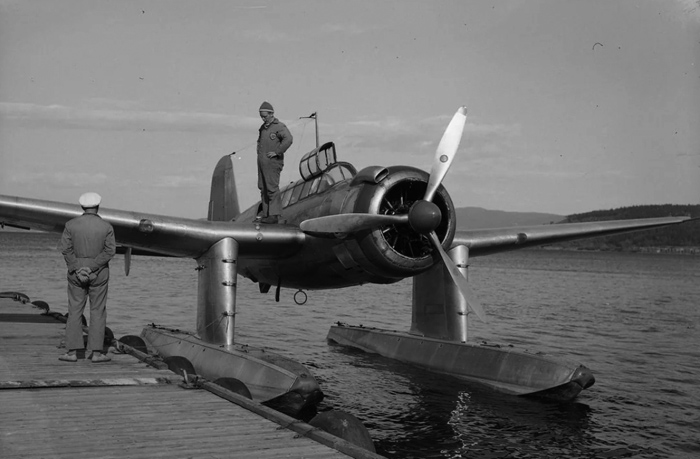
Src Reddit


From pinterest

From pinterest

From pinterest
Read More and Sources
Hansson Karl-Axel, red (1989). Flyget på Karlsborg: Västgöta flygflottilj : 1939-1989. Stockholm: Prisma.Thorsson, Nils (1975). Historik och kartläggning av vapenmateriel för flygplan. Arboga.
links
plane-encyclopedia.comsaab.com/
avrosys.nu
aef.se/Flygvapnet
mach-flyg.com
en.wikipedia.org
sv.wikipedia.org
Flygplanskryssare Gotland
secretprojects.co.uk
Bristol_Mercury
Model Kits
imodeler.comrcgroups.com
See Tarangus 1:48 kit TA4811 of the SAAB 17BS
Video
- Lohner E (1913)
- Macchi M3 (1916)
- Macchi M5 (1918)
- Ansaldo ISVA (1918)
- Short S.38 (1912)
- Sopwith Baby (1916)
- Short 184 (1916)
- Fairey Campania (1917)
- Sopwith Cuckoo (1917)
- Felixstowe F.2 (1917)
- Friedrichshafen FF 33 (1916)
- Albatros W4 (1916)
- Albatros W8 (1918)
- Hanriot HD.2
- Grigorovich M5 (1915)
- Grigorovich M9 (1916)
- IJN Farman MF.7
- IJN Yokosho Type Mo
- Yokosho Rogou Kougata (1917)
- Yokosuka Igo-Ko (1920)
- Curtiss N9 (1916)
- Aeromarine 39
- Vought VE-7
- Douglas DT (1921)
- Boeing FB.5 (1923)
- Boeing F4B (1928)
- Vought O2U/O3U Corsair (1928)
- Blackburn Blackburn (1922)
- Supermarine Seagull (1922)
- Blackburn Ripon (1926)
- Fairey IIIF (1927)
- Fairey Seal (1930)
- LGL-32 C.1 (1927)
- Fokker T.II (1921)
- Caspar U1 (1921)
- Dornier Do J Wal (1922)
- Rohrbach R-III (1924)
- Mitsubishi 1MF (1923)
- Mitsubishi B1M (1923)
- Yokosuka E1Y (1923)
- Nakajima A1N (1927)
- Nakajima E2N (1927)
- Mitsubishi B2M (1927)
- Nakajima A4N (1929)
- CANT 18
WW1
✠ K.u.K. Seefliegerkorps:
 Italian Naval Aviation
 RNAS
RNAS
 Marineflieger
 French Naval Aviation
 Russian Naval Aviation
 IJN Air Service
 USA
USA
Interwar
 Interwar US
 Interwar Britain
 Interwar France
 Interwar Netherlands
 Interwar Germany
 Interwar Japan
 Interwar Italy
- Curtiss SOC seagull (1934)
- Grumman FF (1931)
- Curtiss F11C Goshawk (1932)
- Grumman F2F (1933)
- Grumman F3F (1935)
- Northrop BT-1 (1935)
- Grumman J2F Duck (1936)
- Consolidated PBY Catalina (1935)
- Brewster/NAF SBN-1 (1936)
- Curtiss SBC Helldiver (1936)
- Vought SB2U Vindicator (1936)
- Brewster F2A Buffalo (1937)
- Douglas TBD Devastator (1937)
- Vought Kingfisher (1938)
- Curtiss SO3C Seamew (1939)
- Douglas SBD Dauntless (1939)
- Grumman F4F Wildcat (1940)
- F4U Corsair (NE) (1940)
- Brewster SB2A Buccaneer (1941)
- Grumman TBF/TBM Avenger (1941)
- Consolidated TBY Sea Wolf (1941)
- Grumman F6F Hellcat (1942)
- Curtiss SB2C Helldiver (1942)
- Curtiss SC Seahawk (1944)
- Grumman F8F Bearcat (1944)
- Ryan FR-1 Fireball (1944)
- Douglas AD-1 Skyraider (1945)
- Fleet Air Arm
- Fairey Swordfish (1934)
- Blackburn Shark (1934)
- Supermarine Walrus (1936)
- Fairey Seafox (1936)
- Blackburn Skua (1937)
- Short Sunderland (1937)
- Blackburn Roc (1938)
- Fairey Albacore (1940)
- Fairey Fulmar (1940)
- Grumman Martlet (1941)
- Hawker sea Hurricane (1941)
- Brewster Bermuda (1942)
- Fairey Barracuda (1943)
- Fairey Firefly (1943)
- Grumman Tarpon (1943)
- Grumman Gannet (1943)
- Supermarine seafire (1943)
- Blackburn Firebrand (1944)
- Hawker Sea Fury (1944)
- IJN aviation
- Yokosuka E6Y (1930)
- Aichi D1A "Susie" (1934)
- Mitsubishi A5M "Claude" (1935)
- Nakajima A4N (1935)
- Yokosuka B4Y "Jean" (1935)
- Mitsubishi G3M "Nell" (1935)
- Nakajima E8N "Dave" (1935)
- Kawanishi E7K "Alf" (1935)
- Nakajima B5N "Kate" (1937)
- Kawanishi H6K "Mavis" (1938)
- Aichi D3A "Val" (1940)
- Mitsubishi A6M "zeke" (1940)
- Nakajima E14Y "Glen" (1941)
- Nakajima B6N "Jill" (1941)
- Mitsubishi F1M "pete" (1941)
- Aichi E13A Reisu "Jake" (1941)
- Kawanishi E15K Shiun "Norm" (1941)
- Nakajima C6N Saiun "Myrt" (1942)
- Yokosuka D4Y "Judy" (1942)
- Kyushu Q1W Tokai "Lorna" (1944)
 Luftwaffe
- Arado 196 (1937)
- Me109 T (1938)
- Blohm & Voss 138 Seedrache (1940)
 Italian Aviation
- Savoia-Marchetti S.55
- IMAM Ro.43/44
- CANT Z.501 Gabbiano
- CANT Z.506 Airone
- CANT Z.508
- CANT Z.511
- CANT Z.515
 French Aeronavale
- GL.300 (1926-39)
- Levasseur PL.5 (1927)
- Potez 452 (1935)
- Loire 210 (1936)
- Loire 130 (1937)
- LN 401 (1938)
 Soviet Naval Aviation
- Shavrov SH-2 (1928)
- Tupolev TB-1P (1931)
- Beriev MBR-2 (1930)
- Tupolev MR-6 (1933)
- Tupolev MTB-1 (1934)
- Beriev Be-2 (1936)
- Polikarpov I16 naval (1936)
- Tupolev MTB-2 (1937)
- Ilyushine DB-3T/TP (1937)
- Beriev Be-4 (1940)
-
 Skoda Š-328V
  R-XIII Idro
 Fokker C.XI W (1934)
 Rogožarski PVT-H (1938)
WW2
 ☍ USNA
- De Havilland Sea Vixen
- Hawker Sea Hawk
- Supermarine Scimitar
- Blackburn Buccaneer
- Hawker Sea Harrier
- Douglas A4 Skyhawk
- Grumman F9F Panther
- Vought F8 Crusader
- McDonnell-Douglas F-4 Phantom-II
- North Am. A5 Vigilante
- TU-142
- Yak 38 forger
☢ Cold War
✧ NATO
Fleet Air Arm
 US Navy
☭ Warsaw Pact
Merch
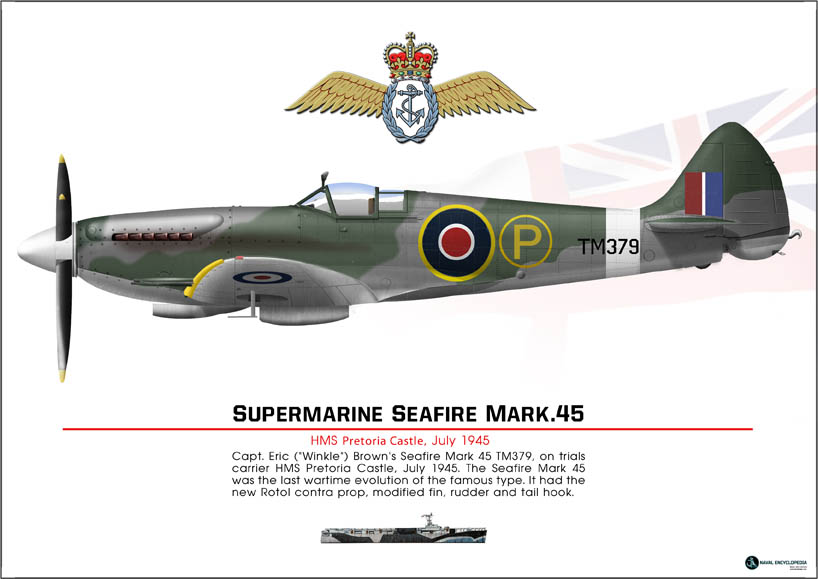
Seafire Mark 45; HMS Pretoria Castle
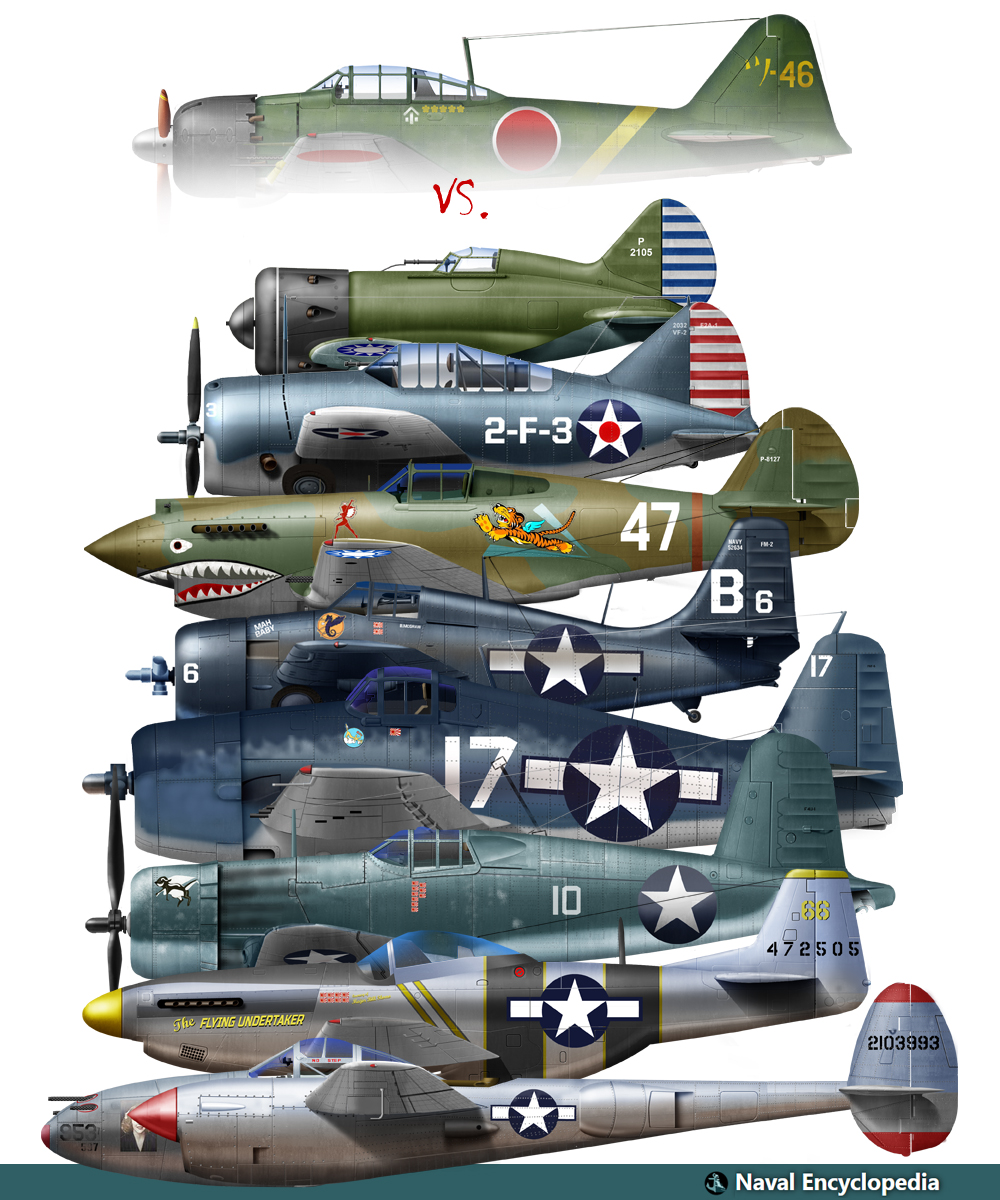
Zeros vs its aversaries
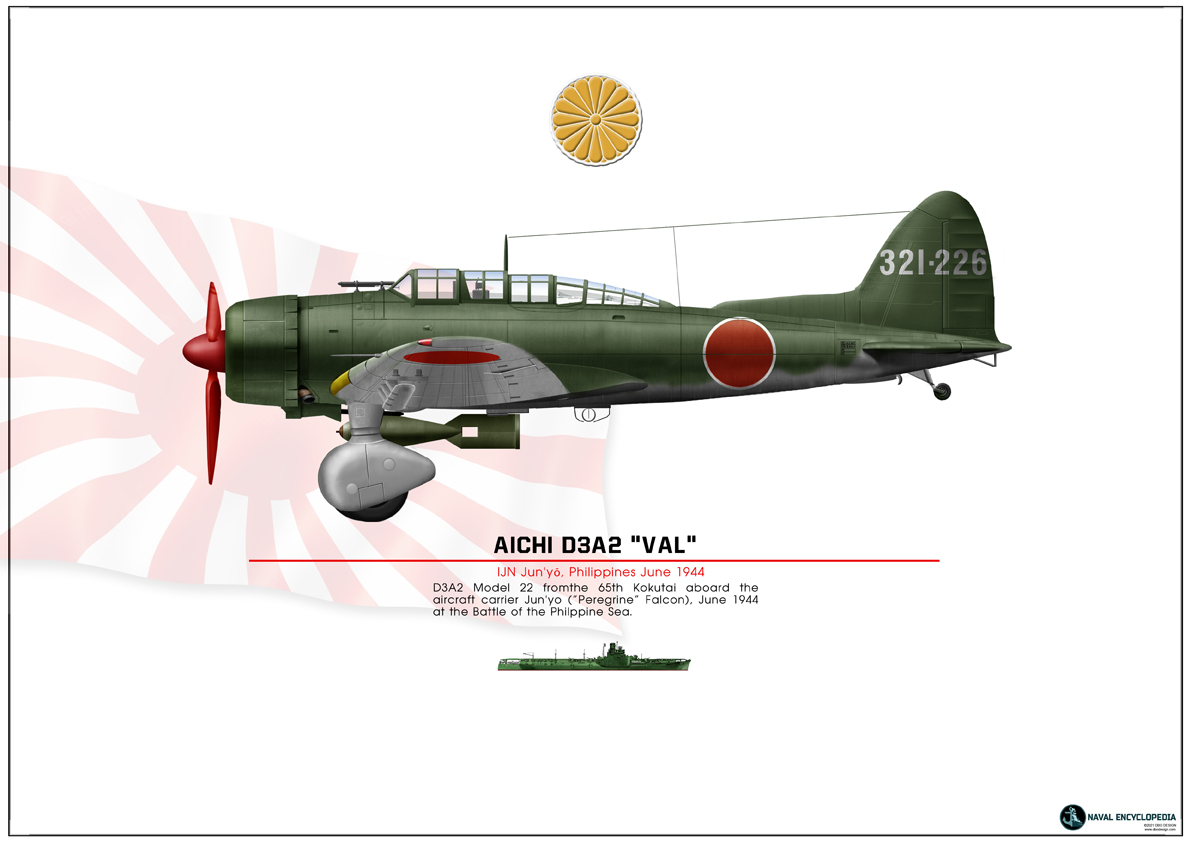
Aichi D3A “Val” Junyo
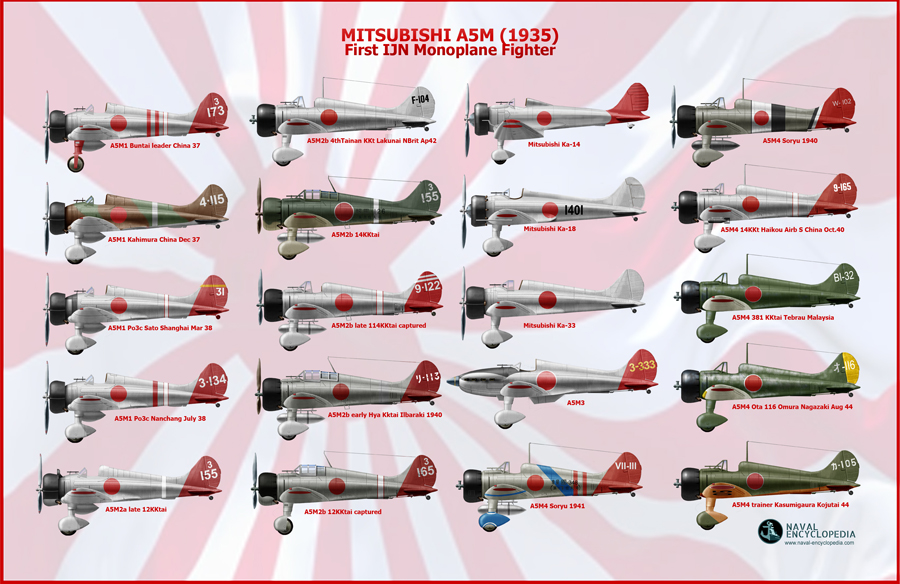
Mitsubishi A5M poster
F4F wildcat
Macchi M5
SBD Dauntless Coral Sea
SBD Dauntless USS Enterprise
SBD-4 CV22