Fokker T.II (1921)
 USN (1921-27)
Torpedo Floatplane: 3 Prototypes.
Development and Design
The Fokker T.II or T.2 (Not to be confused with the Fokker T-2) was a single engine monoplan floatplane designed in the from 1920 as a torpedo bomber. The Royal NL Navy however never expressed the need for such an aicrart and instead, Fokker, given its rising business in the US, proposed the design to the US Navy, leading to three being purchased and tested them against other aircraft from the home market and UK. The T.IIs hovever was not selected, and saw no further production. It remained in service for several years for tests though. It was an important step in the postwar internatonal market of military aircraft, covering the needs of all three branches, that was covered by Anthony Fokker in the interwar.The Fokker "T" designation was both both bombers and torpedo bombers and the T.II was the first of this series that was really manufactured, albeit in small numbers. The T.I of 1919 relained a paper project, unbuilt. The three ordered on plans by the US Navy in early 1921, were completed towards the end of that same year. The idea of carrying and dropping a torpedo by air was a true revolution, with the first trials performed as early as 1915 by the RNAS, the naval Branch of British Military Aviation. The obvious issue with that type of design, was to be able to carry a very heavy load (a torpedo) given the weak output of the engines of that era, albeit technology went by major leaps in these four years of war, with output more than doubling in the meantime. In 1918 a 400 hp engine gave a brand new serie of opportunities, notably regarding payload.
The Netherlands, involved in the fight without Anthony Fokker (6 April 1890 – 23 December 1939), that, distraught by the lack of perspective in his home country in 1912, moved to Johannisthal near Berlin, where he founded his first own company, "Fokker Aeroplanbau" after he was promise considerable investments. In the following years he created may models and relocated his factory to Schwerin, becoming "Fokker Flugzeugwerke GmbH", then "Fokker Werke GmbH" and the greatest German aircraft manufacturer, arguably enabling the Empire to face France, Britain and Russia in the air with fewer, but often better aircraft. The "Fokker scourge" in 1915 and 1917 was also a burning souvernir for allies airmen. With the Treaty of Versailles forbiding Germany to build any aircraft or aircraft engines he returned in his home country, strong of a rich experience, cash, and a brand name that was known across the globe. He went into commercial aviation, pitting his models against the greatest aircraft manufacturers of the time, and especially in the US.
He also never neglected the needs of the military aviation, despite its rare contracts. The Navy was not forgotten, nor the idea to carry a torpedo, basically replacing torpedo boats of old by their flying equivalents, which presented many advantages, provided the flying platform was stable and powerful enough, as even a 450 mm torpedo (18 inches) Mark VII and VII* weighted c450 kgs. So the engine used was key. His model was a monoplane, which was bold at the time, of vert modern construction, nearly all-metal, and when proposed to the USN in 1921 it looks quite modern. It impressed General Billy Mitchell, which even visited the Fokker works at Veere, in early 1922. Loke General Clayton Bissell he was encouraged by Fokker to test the T.II, and when reporting it unresponsive to the controls, Fokker shelved almost a meter of the fuselage, structure re-welded, curing the issues. Thus, the three T.IIs were shipped to the US and started testing in 1922, as FT-1 (Fokker, torpedo).
Fokker much later in 1926 would even establish hos North American branch, the Atlantic Aircraft Corporation, gaining traction by exploits such as Byrd in his Fokker F.VII in the North Pole and Amerlia Earhart on the F.VII3m, Charles K. Smith in another for a world circumnavigation. His trimotor became a huge commercial success in 1928-30. Meanwhile, his FT Seaplane, based on the T.I. but much improved began its existence as the T.II in Veere...
General design
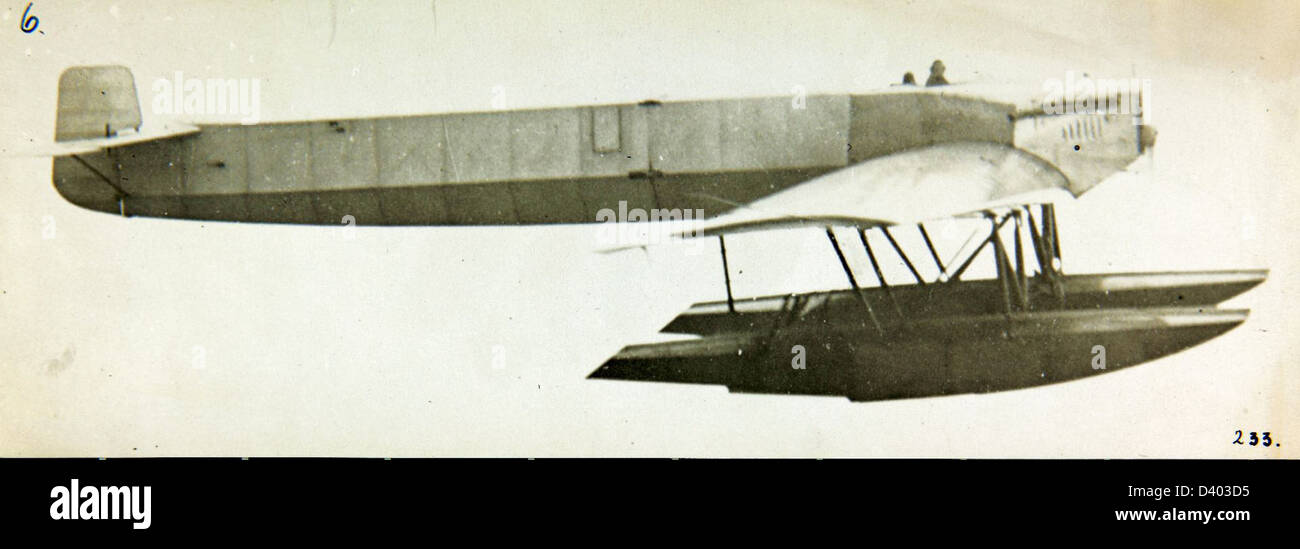 Initial T.II with its long fuselage (1921)
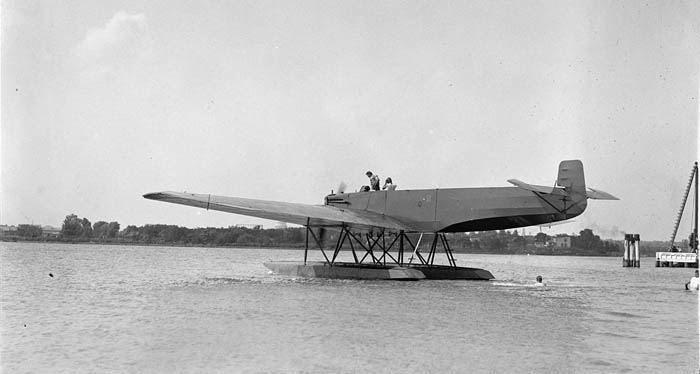
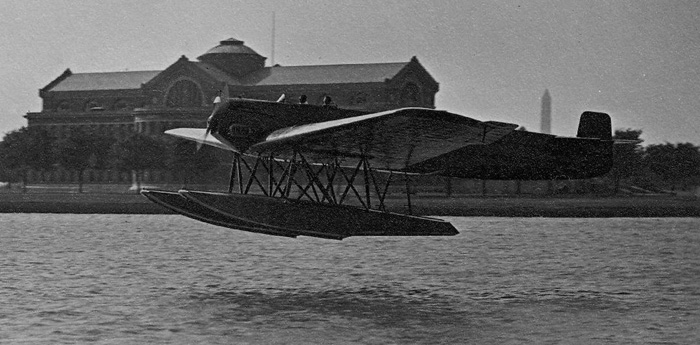
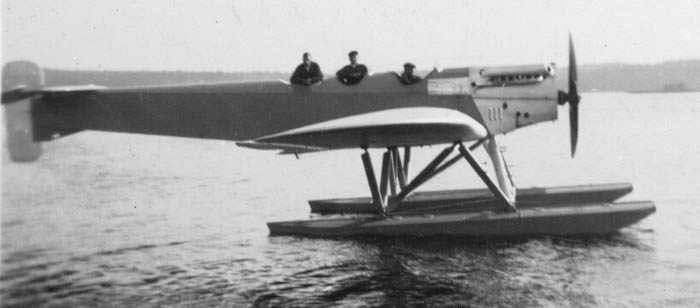
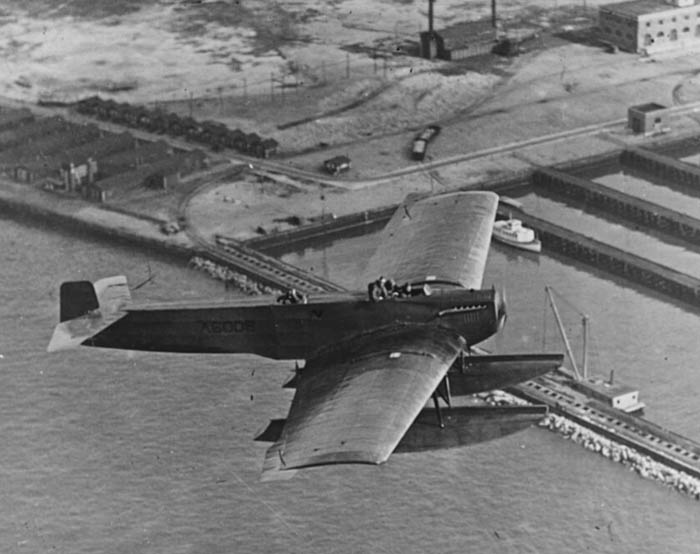
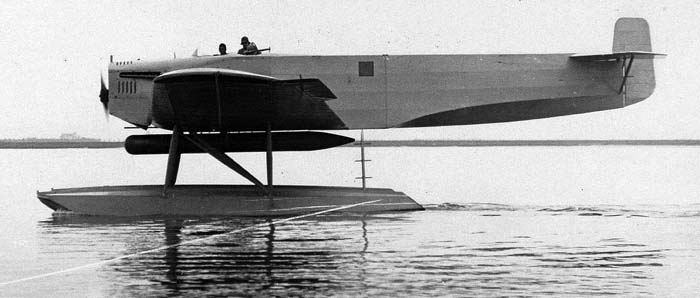
The T.II was a cantilever low wing monoplane, with straight and tapered square tipped wings. It had also overhung ailerons. The fuselage was boxy, made of a lattice-like metal tubes structure, which was deep from tail to nose. It was powered forward by a 400 hp (300 kW) Liberty 12A water-cooled V-12. This engine drove a two blade propeller. The crew comprised two men that sat in tandem in separate and open round cockpits, over the wing (shouldered). The rear position had a defensive machine gun on a pintle mount.
The tailplane was mounted on top of the fuselage and like the elevators, and wings, all straight and tapered in plan, square tipped. The fin and rudder were short albeit the former extended below the fuselage, to the deep keel, like WWI German floatplane designs. The T.II had its twin float undercarriage that reprsented in size about 70% of the aircraft's length. They projected well forward of the nose, and were mounted on the fuselage by N-struts inn two pairs reinforced by diagonal transverse bracing on each float. There were no transverse interfloat struts however as the belly needed to be clean to carry and drop the torpedo.
Engine and Performances

The Liberty L-12 was a grounbreaking engine designed to power military aircraft in WWI, largely state-sponsored for the rising US Aircraft Industry. This was to be the proverbial, powerful, universal model built by all car manufacturers, Lincoln, Ford, Packard, Marmon, and Buick. In May 1917, a month after the US declared war on Germany, a federal task force, "the Aircraft Production Board" summoned top engine designers Jesse G. Vincent (Packard) and Elbert J. Hall (Hall-Scott) to Washington for a conference. They were given the task of designing a new, very powerful aircraft engine surpassing those of Britain, France, and Germany.
The Board specified a very high power-to-weight ratio and simplicity for mass production. Development started on 29 May 1917 at the Willard Hotel, Washington, to produce basic drawings in just five days. It was adopted, almost unchanged. Its mean features were a single overhead camshaft and rocker arm valvetrain inspired by the Mercedes D.IIIa engine. In July 1917, the smaller 8-cylinder prototype was tested at Packard and arrived in Washington for further testing. In August 1917, this was the turn to the 12-cylinder, also tested and approved. Production was launched afterwards, and the state owned blueoprint distributed to the manufacturers above. In total, until 1919, some 20,748 were manufactured out of an order of 22,500. So naturally when Fokker envisioned hos T.II for the US Market, the engine (imposed anyway) was a no-brainer.
It was a very flexible design, modular enough to go from four to six cylinders in one or two banks for inline fours, V-8s, inline sixes, and V-12. The Fokker T.II was powered more precisely by the Packard V-1650, inverted Liberty 12-A produced up to 1926. It had a bore of 5 in (127.0 mm), a stroke of 7 in (177.8 mm) for a displacement of 1,649.3 in3 (27.02 L). The block measured 67.375 in (1,711.3 mm) for a width of 27 in (690 mm) and height of 41.5 in (1,050 mm), dry weight of 844 lb (383 kg). The raw output of this engine led Fokker to calculate the dimensions and construction of his model, in a generous way, but the torpedo load proved too much. It's no wonder why the ugly but robust Douglas TB.2 won the day with its biplane configuration (meaning more lift) and compact design, that made the best of the same engine. The Fokker being a monoplane, there was less drag and a top speed of 167 km/h (104 mph, 90 knots) but it was sluggish and had a low climb rate. Its very generous dimensions, 15.56 m (51 ft 1 in) in lenght initially for a wingspan 19.83 m (65 ft 1 in) completely dwarved the Douglas (38 ft 9 in or 11.8 m x 51 ft 10 in (15.8 m). It had a gross weight of 3,308 kg (7,293 lb) however, just a bit lighter than the Fokker's 3,314 kg (7,306 lb), albeit it used the more powerful 450 hp (340 kW) L-12 fr a better top speed of 100 mph (160 km/h, 87 kn) and no issue to take off with the short 1,835 lb (832 kg) aerial torpedo...
Armament
The T.II had no forward armament, only a rear defensive armament operated by the second crew member behind the pilot. Noth were close enough to intercat during the flight, which wa simportant for teamwork when dropping the torpedo at the right time. This operator manned a single machine gun (not precised, could be a Lewis), in the rear cockpit. The main offensive payload was the torpedo, mounted externally under the fuselage, between floats, and with several attachement points using a manual release, and guide. The 450 mm or 18-inches envisioned was of US origin, either the 1916 Bliss-Leavitt 18" (45 cm) Mark 7 Type D (1,036 lbs. (470 kg)), but more likely the latest Bliss-Leavitt 18" Mark 7 Mods 5A (1922) which weighted 1,628 lbs. (738 kg) for a payload of 326 lbs. (148 kg) TNT or TPX and was capable of 3,500 yards (3,200 m) at 35 knots thanks to its wet-heater and Mark 7 mod 2 Gyro to stay on course. It was way too heavy for the Fokker and tests were likel made with the short Mark 7 Type D.⚙ Fokker T.II specifications | |
| Gross weight | 3,314 kg (7,306 lb) |
| Fuselage lenght: | 15.56 m (51 ft 1 in) |
| Wingspan: | 19.83 m (65 ft 1 in) |
| Propulsion | Liberty 12A water-cooled V-12 engine 300 kW (400 hp) |
| Top Speed | 167 km/h (104 mph, 90 kn) |
| Armament | Machine gun in rear cockpit, Torpedo |
| Propeller | 2-bladed, wooden |
| Crew | Two: Pilot, Operator/Rear Gunner |
The Fokker T.II Variants & Operators
Hos T.II first flew indeed by January 22, 1922 and was made ready in the Netherlands for test flights without a torpedo. After Mitchell and Bissell remarks, he ordered the fuselage to be shortened by 90 cm to improve performances. General Mitchell (Army Air Service) after his visit to Veere in early March 1922 tested it and remarked that indeed, performances were lacking, and Fokker had the fuselage shortened by another 90 centimetres after a demonstration. By early June 1921 the T.II was believed ready to be tested in the US and shipped to America via Antwerp. The completion of the other two had yet to begin at that point.Fokker was in America for a second visit in July 1922, successfully flew himself the T.II on 8 July, at the Naval Air Station Anacostia. However, no contractual demonstration with a torpedo took place as performances were still jusged underwhelming. After he departed, Navy pilots tried to take off with a torpedo under the belly and the T.II couldnot "unstick" to the water. It was clear to eberybody that it was both too large as a reconnaissance model, and to weak as a torpedo carrier. So the Navy declared the bulky, inelegant but robust but powerful biplane Douglas DT as winner of its comparative trials. Orders were placed and that was the end of the Fokker T.II in the Americas. In addition the USN was not pleased when it turned out that Fokker had neglected to move the floats of the FT a bit forward after shortening the hull, creating quite an inbalance, something was was evaluated as basic calculations. The FT failed to meet contract conditions so the two other FTs, that could have been re-engined with a later version of the Liberty for example, were still to be delivered in mid-1923.
Tests at Anacostia base also pitted against the Fokker T.II the Curtiss CT-1, Douglas DT-1, Stout ST-1 and British Blackburn Swift F. The three T.IIs ended at the Naval Air Station of Hampton Roads, until about 1926. From 1923 to 1927, the last two were used for tests. The third was not scrapped, but reconverted into a transport aircraft, sold in 1928 and registered flying through the 1929 economic crash and perhaps a few years afterwards.
Variants
T.II: Company designation of the torpedo bomber evaluated by the US Navy as the Fokker FTFT-1: US Navy designation as delivered.
FT-2: 3rd aircraft modified by the US Navy.
Illustrations
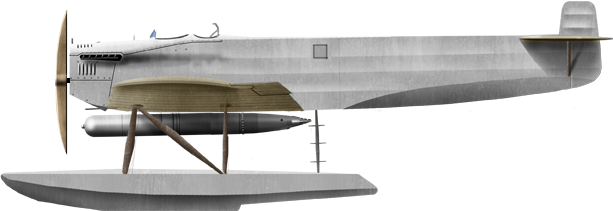
The prototype T.II, unmarked, with a torpedo (possibly a dummy one).
Gallery
Read More
Books
Wesselink, Theo; Postma, Thijs (1982). De Nederlandse vliegtuigen. Haarlem: RomemGreen, William (1962). Warplanes of the Second World War: Volume Six, Floatplanes. London: Macdonald.
Taylor, Michael J. H. (1989). Jane's Encyclopedia of Aviation. London: Studio Editions. p. 404.
World Aircraft Information Files. London: Bright Star Publishing. pp. File 894 Sheet 34.
Links
fokker-history.comLiberty_L-12
navweaps.com
wiki Fokker_T.II
dutch-aviation.nl/
encyclopedia.pub
Model Kits
No T.II but here a T.IIIVideos
- Lohner E (1913)
- Macchi M3 (1916)
- Macchi M5 (1918)
- Ansaldo ISVA (1918)
- Short S.38 (1912)
- Sopwith Baby (1916)
- Short 184 (1916)
- Fairey Campania (1917)
- Sopwith Cuckoo (1917)
- Felixstowe F.2 (1917)
- Friedrichshafen FF 33 (1916)
- Albatros W4 (1916)
- Albatros W8 (1918)
- Hanriot HD.2
- Grigorovitch M5
- IJN Farman MF.7
- IJN Yokosho Type Mo
- Yokosho Rogou Kougata (1917)
- Yokosuka Igo-Ko (1920)
- Curtiss N9 (1916)
- Aeromarine 39
- Vought VE-7
- Douglas DT (1921)
- Boeing FB.5 (1923)
- Boeing F4B (1928)
- Vought O2U/O3U Corsair (1928)
- Blackburn Blackburn (1922)
- Supermarine Seagull (1922)
- Blackburn Ripon (1926)
- Fairey IIIF (1927)
- Fairey Seal (1930)
- LGL-32 C.1 (1927)
- Fokker T.II (1921)
- Caspar U1 (1921)
- Dornier Do J Wal (1922)
- Rohrbach R-III (1924)
- Mitsubishi 1MF (1923)
- Mitsubishi B1M (1923)
- Yokosuka E1Y (1923)
- Nakajima A1N (1927)
- Nakajima E2N (1927)
- Mitsubishi B2M (1927)
- Nakajima A4N (1929)
- CANT 18
WW1
✠ K.u.K. Seefliegerkorps:
 Italian Naval Aviation
 RNAS
RNAS
 Marineflieger
 French Naval Aviation
 Russian Naval Aviation
 IJN Air Service
 USA
USA
Interwar
Interwar US
 Interwar Britain
 Interwar France
 Interwar Netherlands
 Interwar Germany
 Interwar Japan
 Interwar Italy
- Curtiss SOC seagull (1934)
- Grumman FF (1931)
- Curtiss F11C Goshawk (1932)
- Grumman F2F (1933)
- Grumman F3F (1935)
- Northrop BT-1 (1935)
- Grumman J2F Duck (1936)
- Consolidated PBY Catalina (1935)
- Brewster/NAF SBN-1 (1936)
- Curtiss SBC Helldiver (1936)
- Vought SB2U Vindicator (1936)
- Brewster F2A Buffalo (1937)
- Douglas TBD Devastator (1937)
- Vought Kingfisher (1938)
- Curtiss SO3C Seamew (1939)
- Douglas SBD Dauntless (1939)
- Grumman F4F Wildcat (1940)
- F4U Corsair (NE) (1940)
- Brewster SB2A Buccaneer (1941)
- Grumman TBF/TBM Avenger (1941)
- Consolidated TBY Sea Wolf (1941)
- Grumman F6F Hellcat (1942)
- Curtiss SB2C Helldiver (1942)
- Curtiss SC Seahawk (1944)
- Grumman F8F Bearcat (1944)
- Ryan FR-1 Fireball (1944)
- Douglas AD-1 Skyraider (1945)
- Fleet Air Arm
- Fairey Swordfish (1934)
- Blackburn Shark (1934)
- Supermarine Walrus (1936)
- Fairey Seafox (1936)
- Blackburn Skua (1937)
- Short Sunderland (1937)
- Blackburn Roc (1938)
- Fairey Albacore (1940)
- Fairey Fulmar (1940)
- Grumman Martlet (1941)
- Hawker sea Hurricane (1941)
- Brewster Bermuda (1942)
- Fairey Barracuda (1943)
- Fairey Firefly (1943)
- Grumman Tarpon (1943)
- Grumman Gannet (1943)
- Supermarine seafire (1943)
- Blackburn Firebrand (1944)
- Hawker Sea Fury (1944)
- IJN aviation
- Aichi D1A "Susie" (1934)
- Mitsubishi A5M "Claude" (1935)
- Nakajima A4N (1935)
- Yokosuka B4Y "Jean" (1935)
- Mitsubishi G3M "Nell" (1935)
- Nakajima E8N "Dave" (1935)
- Kawanishi E7K "Alf" (1935)
- Nakajima B5N "Kate" (1937)
- Kawanishi H6K "Mavis" (1938)
- Aichi D3A "Val" (1940)
- Mitsubishi A6M "zeke" (1940)
- Nakajima E14Y "Glen" (1941)
- Nakajima B6N "Jill" (1941)
- Mitsubishi F1M "pete" (1941)
- Aichi E13A Reisu "Jake" (1941)
- Kawanishi E15K Shiun "Norm" (1941)
- Nakajima C6N Saiun "Myrt" (1942)
- Yokosuka D4Y "Judy" (1942)
- Kyushu Q1W Tokai "Lorna" (1944)
 Luftwaffe
- Arado 196 (1937)
- Me109 T (1938)
- Blohm & Voss 138 Seedrache (1940)
 Italian Aviation
- Savoia-Marchetti S.55
- IMAM Ro.43/44
- CANT Z.501 Gabbiano
- CANT Z.506 Airone
- CANT Z.508
- CANT Z.511
- CANT Z.515
 French Aeronavale
- GL.300 (1926-39)
- Levasseur PL.5 (1927)
- Potez 452 (1935)
- Loire 210 (1936)
- Loire 130 (1937)
- LN 401 (1938)
 Soviet Naval Aviation
- Shavrov SH-2 (1928)
- Tupolev TB-1P (1931)
- Beriev MBR-2 (1930)
- Tupolev MR-6 (1933)
- Tupolev MTB-1 (1934)
- Beriev Be-2 (1936)
- Polikarpov I16 naval (1936)
- Tupolev MTB-2 (1937)
- Ilyushine DB-3T/TP (1937)
- Beriev Be-4 (1940)
-
 Skoda Š-328V
  R-XIII Idro
 Fokker C.XI W (1934)
WW2
 ☍ USNA
- De Havilland Sea Vixen
- Hawker Sea Hawk
- Supermarine Scimitar
- Blackburn Buccaneer
- Hawker Sea Harrier
- Douglas A4 Skyhawk
- Grumman F9F Panther
- Vought F8 Crusader
- McDonnell-Douglas F-4 Phantom-II
- North Am. A5 Vigilante
- TU-142
- Yak 38 forger
☢ Cold War
✧ NATO
Fleet Air Arm
 US Navy
☭ Warsaw Pact
Merch
Seafire Mark 45; HMS Pretoria Castle
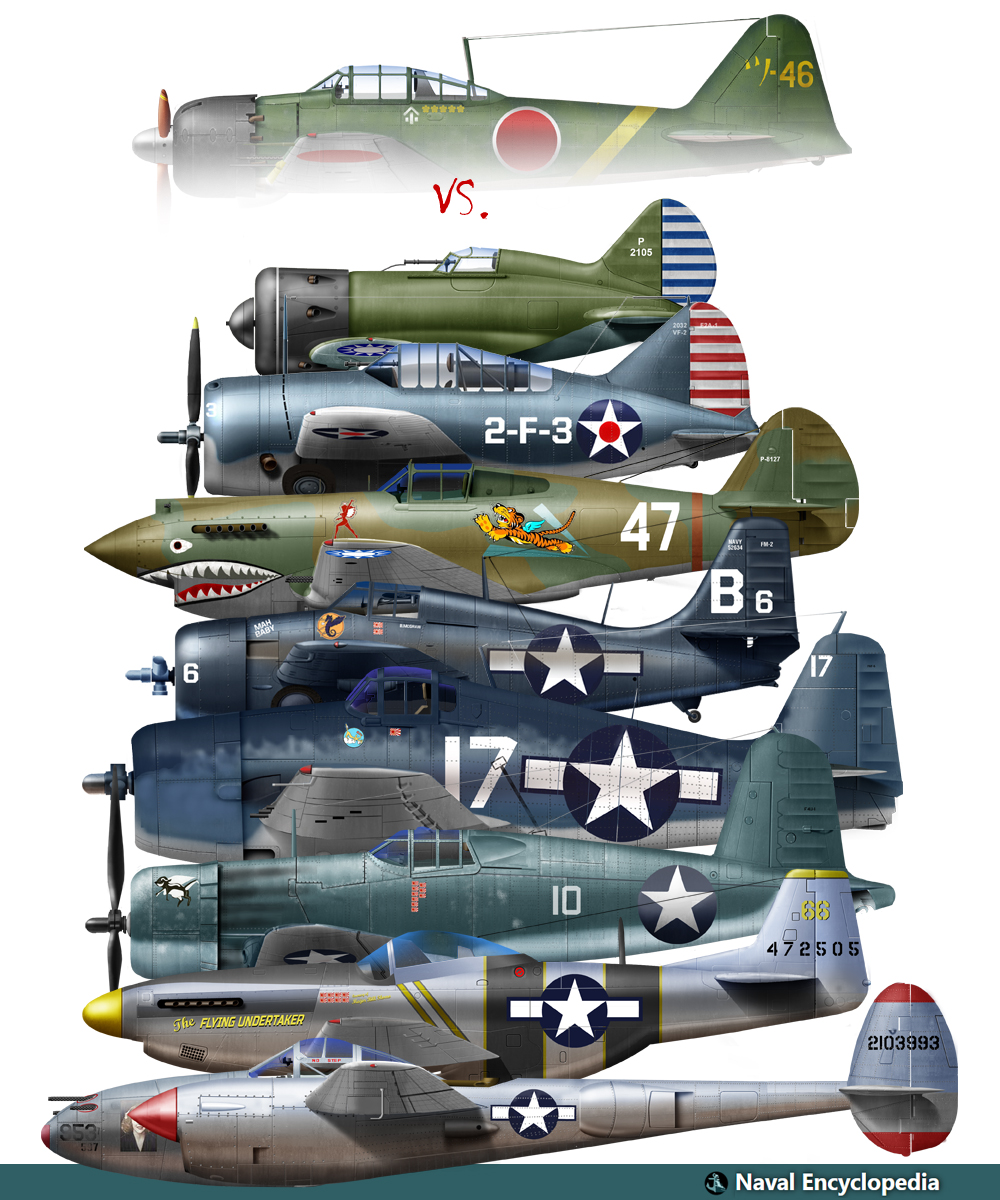
Zeros vs its aversaries
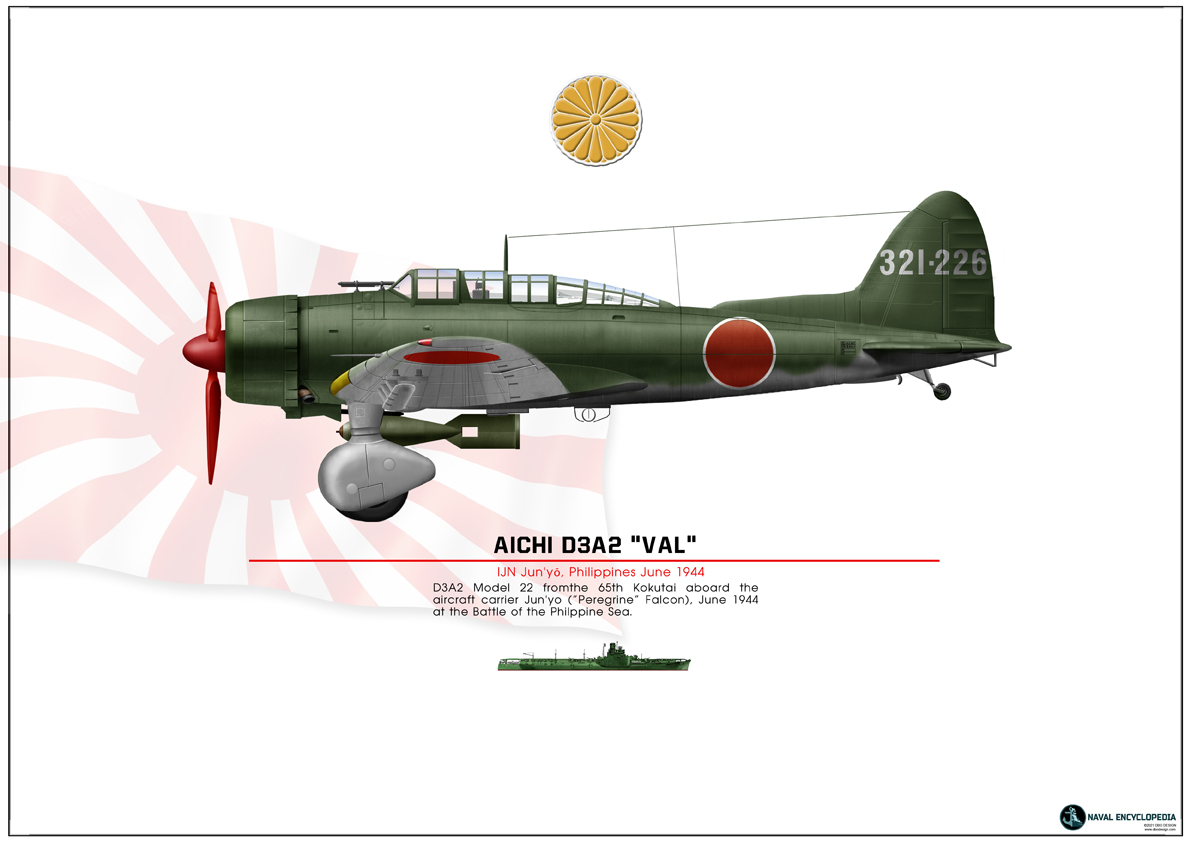
Aichi D3A “Val” Junyo
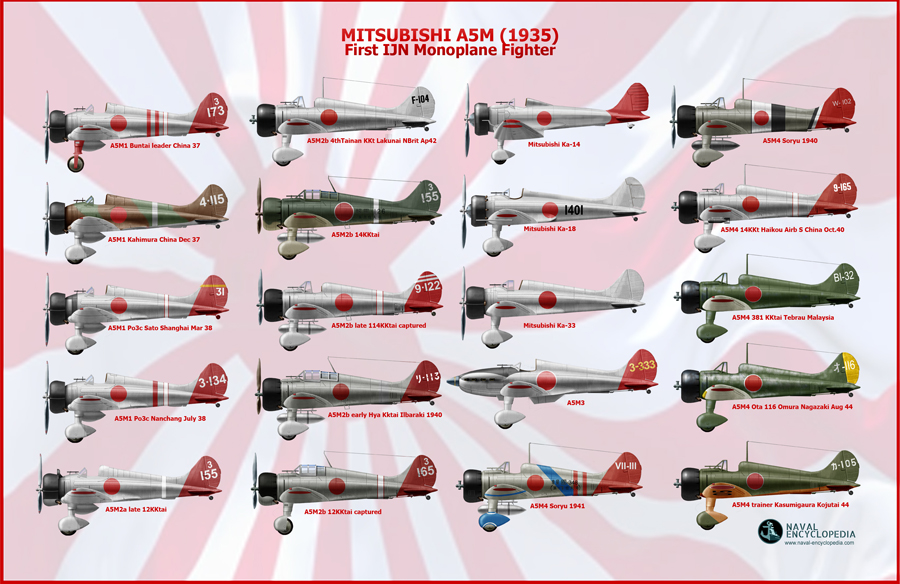
Mitsubishi A5M poster
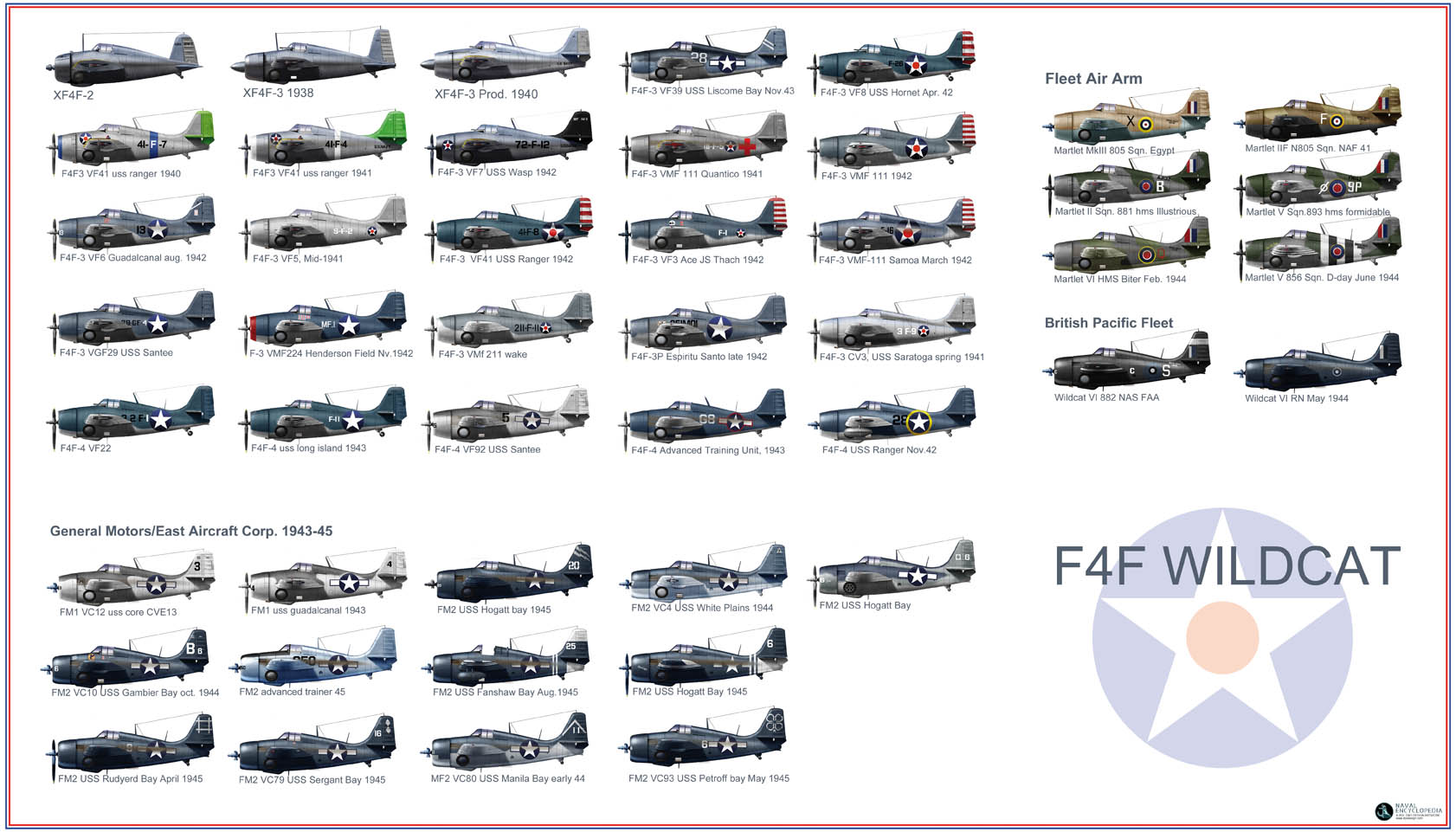
F4F wildcat
Macchi M5
SBD Dauntless Coral Sea
SBD Dauntless USS Enterprise
SBD-4 CV22