Vought F4U Corsair (1940)
 US Navy Fighter Bomber (1940-76), 12,270 built
36 years of service for the "Gullwing Marvel"
For its production, which went further than the Hellcat, and shy of their land rivals, the P51 Mustang and P47 Thunderbolt, the Corsair certainly outlived them all but its active service, 36 years. A rare feat for any WW2 vintage model.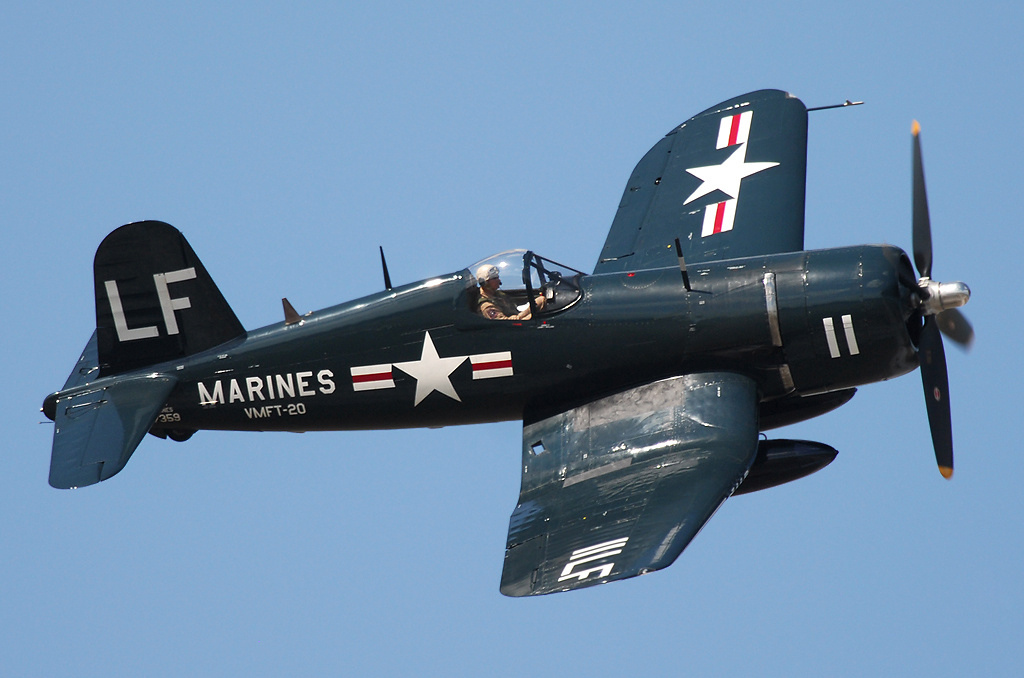
Vought F4U Corsair
One key to understand this success could be the fact it was as good as a fighter than as a bomber, with its heavy payload and robust construction, high survivability. In fact it was the very fist dedicated fighter-bomber of the USN, for many years, soldiering in WW2 and Korea for the US alone. The French Aeronavale retained them until 1963 and they were deployed in four conflicts. In addition to the USN and USMC, the Corsair was also deployed with allied the Fleet Air Arm (1944-45) as the RNZAF. But also Argentina, in addition to El Salvador and Honduras.
Quite unique with its long nose (or pilot far back), a problem for taxiing and landing, and gull wings, plus double radial, the Corsair was quite unique and went down into popular culture with the 80's famous serie "baa baa black sheep". Many survived to these days between private and public colections, museums and exhibitions. A "classic", the pilots also called "Ensign Eliminator", "Bent-Wing Eliminator" (due to its extensive flight training) or just "U-bird" or "Bent Wing Bird". But the time spent was well rewarded in combat. Over North Korea it was probably one of the most important ground attack aircraft, despite being overshadowed by the Lockheed P33 and Sabre in the skies.
Genesis of the design
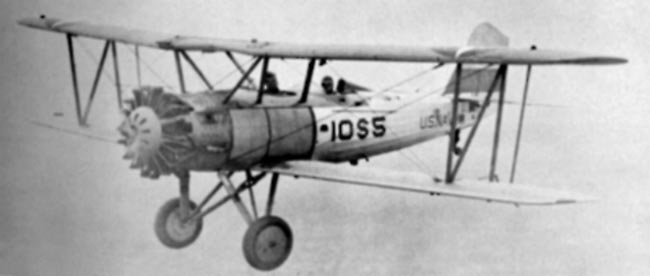
Vought O2U/O3U
The first takeoff in history from the deck of a ship was carried out on November 14, 1910 by the American pilot Eli. He also landed on the deck of the cruiser Pennsylvania on January 18, 1911. These two dates are the birthdays of carrier-based aviation. The years of the First World War were the time of the birth of aircraft carriers as a new class of warships, which were soon destined to become the main striking force of the leading fleets. Immediately before the Second World War, there were 23 aircraft carriers in the fleets of various states, including Japan - 9, the USA - 7, England - 6 and France - 1. The main tasks facing aircraft carriers were:
Torpedo-bomb strikes by carrier-based aircraft on ship groups and convoys at sea, bases and coastal structures;
Anti-aircraft and anti-submarine defense of large formations of ships;
Operational and tactical intelligence;
Anti-aircraft and anti-submarine defense of convoys.

XF4U-1 NACA tests in 1940
The first large-scale combat operation using aircraft carriers was carried out by Japanese carrier-based aircraft (from six aircraft carriers) on December 7, 1941, during a surprise raid on the US naval base at Pearl Harbor. As a result of this attack, the American fleet suffered heavy losses. This raid showed the exceptionally great combat capabilities of aircraft carriers and radically changed the views on these ships in the USA, England and other countries, where they began to be recognized as one of the main striking forces of the fleet, capable of solving important tasks of war at sea. Mass construction of these ships began. During the war years, 169 aircraft carriers were built, of which 137 were built in the USA. The performance of combat missions by aircraft carriers required the creation of a special class of carrier-based aircraft. The main differences between these aircraft and land aircraft were:
The presence of special devices for takeoff and landing on an aircraft carrier (landing hook, ejection device attachment, etc.);
Increased capacity of fuel tanks;
Special equipment for flights over the sea;
Rotary wing consoles to reduce the geometric dimensions of the aircraft during storage and maintenance on an aircraft carrier.
The first carrier-based aircraft, as a rule, were created by modifying conventional aircraft. But in the future, most of these aircraft were created specifically for operations from aircraft carriers. During the war, there were three main types of fighter aircraft in the service of the American carrier-based aviation, which were mainly used in combat operations in the Pacific Ocean. These aircraft were the Grumman Wildcat, Hellcat and Chance Vought fighter Corsair. The F4F "Wildcat" carrier-based fighter, which made its first flight on September 2, 1937, was widely used over the Pacific Ocean and proved to be a reliable fighter.
Although it was somewhat inferior in speed to the Japanese Zero fighter, but the large wing area and low load on it gave the car excellent controllability and good maneuverability, and the tank protection and cockpit armor made the aircraft more tenacious. It was these qualities that ensured the combat use and release of the F4F until the end of the war. In total, 7815 aircraft of all modifications were produced.

F4U4 cutaway (Delta Eds, Italy), pinterest
However, with the advent of new Japanese fighters, the US Navy needed a new, more powerful aircraft. It was planned that the "Wildcat" would be replaced by the "Corsair" fighter, which was created by Chance Vought. But due to delays in terms and various technical shortcomings of the XF4U-1 prototype, it was decided to create a new fighter based on the "Wildcat" by Grumman as a temporary measure until the appearance of the F4U "Corsair". The F6F "Hellcat" fighter turned out to be so successful that its production not only did not stop after the appearance of the Corsair serial fighters, but also continued until 1949. It was the most massive fighter of the American naval aviation during the Second World War. A total of 12,274 aircraft were produced. All F6F "Hellcats" account for 75% of all combat victories won by US naval fighters. They destroyed 5,157 enemy aircraft with their own losses of 270 aircraft!
On February 1, 1938, the US Navy announced a competition for the creation of a single-seat fighter aircraft adapted to operate from the deck of an aircraft carrier. At the request of the customer, its speed was to be at least 350 miles/hour (563 km / h) at an altitude of 20,000 feet (6096 m). The Vought design bureau, led by chief engineer Rex Beisele, adopted several fighter concepts for work, later embodied in two projects, the V-166A and V-166B. When working on them, it was not yet completely clear which engine would be chosen for mass production, and therefore two versions of the fighter were designed at once. One was the V166A with a 1200 hp R-1830 Twin Wasp engine, and the other was the V-166B with a 2000 hp R-2800-2 Double Wasp 18-cylinder engine.
Design Development 1938-42

Theoretical calculations led U.S.Navy to accept the second version of the aircraft project, and on June 11, 1938, a contract was signed to build a prototype under the designation XF4U-1. It competed with the Bell XFL-1 Airabonita and the twin-engine Grumman XF5F-1 Skyrocket, which were never accepted for serial production. Vought designers used a Hamilton Standard Hydromatic propeller with a diameter of 4064 mm, the largest three-bladed propeller used on single-engine aircraft, on their fighter. The choice of the wing, which looks like a W in the front view, was largely dictated by the desire to achieve the required distance between the ground and the propeller blades without excessively increasing the length of the main landing gear. In addition to purely practical considerations, Rex Beissel used the results of research in a wind tunnel when choosing a W-shaped wing. When creating the aircraft, completely new technologies were used. For the first time, the spot welding method was used, which significantly reduced the overall weight of the structure and improved the aerodynamic characteristics of the aircraft. When cooling the engine, hydraulically adjustable shutters on the hood were used.
The armament of the prototype consisted of two 12.7 mm machine guns in the wings and two synchronized 7.62 mm machine guns above the engine. To combat formations of enemy bombers on the XF4U-1, 20 2.4 kilogram bombs were placed in the wing compartments. It was assumed that, flying over a dense formation of bombers, it would be enough to drop bombs to hit one or more aircraft. Between February 8 and 11, 1939, representatives of the Ministry of Naval Aviation carried out the acceptance of the layout of the XF4U-1 prototype at the Vought-Sikorsky plant. After that, work on the aircraft was even more accelerated. After testing the XR-2800-4 engine (1850 hp) and running the aircraft around the airfield, the chief pilot of the company Lyman A. Baylord (Luman A.Buliard) May 29, 1940 lifted the car into the sky from the Bridgeport Municipal airfield, Connecticut. The first flight lasted 38 minutes and showed high performance of the aircraft. However, the flight ended in a forced landing due to high-frequency shaking of the aileron trimmers, which came off at a speed of 370 km/h. Despite the significant workload in managing the aircraft, the pilot managed to land it without damage. Among the shortcomings that were identified during the flight, the main ones were engine overheating and poor performance of the fuel system. Therefore, the chief pilot of Pratt & Whitney, Lewis MacLain, was involved in the tests.

During the fifth test flight, June 12, 1940, the pilot Boone T. Guyton (Boone T. Guyton) crashed into trees during an emergency landing on a golf course (at a speed of 150 km / h). The aircraft rolled over and received severe damage to the fin and propeller, and one wing was torn off. The pilot miraculously survived. It was believed that with such damage it would be impossible to restore the aircraft, but thanks to a successful design, the aircraft was repaired three months later. Test flights were continued in October. A new R-2800-8 engine with a power of 2000 hp was installed on the prototype. On October 1, while on a flight from Strenford to Hartford, this aircraft overcame the 400-mile speed limit and reached a record speed of 405 miles per hour (651.7 km / h). The rate of climb of the machine with a mass of 4250 kg was 810 m / min, and the ceiling was 10,730 meters. Tests also showed the shortcomings of the aircraft. The XF4U-1 stalled on the wing at a minimum landing speed. There were many problems with the unfinished engine, which overheated a lot.
One of the types of flight tests that the prototype underwent was the measurement of the maximum dive speed of the aircraft at a distance of 3050 meters. During these flights, a speed of 829 km / h was reached. However, such a high speed led to damage to the fabric covering on the rudders and ailerons. On January 28, 1941, the last dive flight was made. It was carried out from a height of 6100 meters, while the speed was 810 km / h. The flight ended in a forced landing, as the engine was seriously damaged by the strong spin-up of the propeller during a dive. Another test, which consisted of performing ten turns of a corkscrew, which the prototype went through, showed that the withdrawal of the aircraft requires significant physical effort from the pilot. Only by releasing a special anti-spin parachute, it was possible to stop the rotation.

All this revealed the need to make a number of changes to the prototype. The experience of combat operations in Europe also required design improvements from the creators of the aircraft. The armament of the XF4U-1 was considered insufficient and changed. Now it consisted of 6 machine guns of 12.7 mm caliber, three in each wing. Ammunition was 400 rounds per barrel, except for external machine guns, where the ammunition was 25 less. Under the inside of the wings, two MARK 41-2 bomb racks were installed to replace the anti-aircraft bomb armament, which had been dismantled. The increase in the number of machine guns in the wing forced the designers to eliminate the fuel tanks here. Instead, a sealed tank with a capacity of 897 liters was installed immediately behind the engine. This led to the transfer of the cockpit back by 813 millimeters. To improve visibility, the number of metal elements in the design of the lantern was reduced, and for rearward visibility, transparent "ears" were placed behind the sliding part of the lantern, as on the R-40 fighter. Changed tail wheel and brake hook. The armor of the aircraft, in addition to bulletproof glass 38 mm thick, protected the pilot in the cockpit and the oil tank. The total weight of the armor reached 68 kg. The aircraft was equipped with recognition equipment.
The final tests before the representatives of the fleet took place on February 24-25, (the aircraft was piloted by Guyton). And already on March 3, Vought was instructed to prepare for serial production, and the order for the first 584 aircraft, under the factory designation VS-317, was received from the Navy on June 3, 1941. The first serial F4U-1 (serial number 02153) with an R-2800-8 engine with a power of 1970 hp. was produced by the plant in Dallas and made its first flight on June 28, 1942. During test flights, a speed of 638 km / h was achieved at an altitude of 7540 meters and a rate of climb of 15.23 m / s. The empty weight was 4028 kg, and the takeoff weight of the aircraft was 5388 kg. The official transfer of the aircraft to the US Navy took place on July 31, 1942, after which the aircraft was sent to the aircraft carrier "Sangamon" ("Sangamon") in the Chesapeake Bay.
Design

The aircraft was a single-seat, all-metal, single-engine, low-wing, reverse-gull wing aircraft. The aircraft fuselage is a three-dimensional structure with duralumin skin reinforced with frames and stringers. It consists of four parts: motor, anterior, middle and posterior. The skin is attached to the frames and stringers by spot welding. The propulsion part - from the beginning of the fuselage to the fire barrier (the first main frame) - 2.33 meters. It contains: a gearbox, an engine, a fire extinguishing system, a supercharger, an oil tank. An antenna strut is attached to the front main frame, mounted to the right of the axis of the aircraft and slightly tilted forward.
The front part of the fuselage, oval section, from the front main frame to the second main frame (4.72 meters from the beginning of the fuselage). It contains the main fuel tank (897 l), reserve fuel tank (189 l), cockpit. The thickness of the skin above the fuel tank is 2.5 mm. The front of the lantern is made of 38 mm thick glass. The pilot's head and shoulders are covered by an armored plate (68 kg). Rear view is provided by a mirror on the cover of the lantern.
The middle part of the fuselage from the second main frame to the frame at a distance of 7.31 m from the beginning of the fuselage. It contains a compartment with radio and navigation equipment. A second antenna pole is also attached here.
The rear part of the fuselage ends with a frame at a distance of 9.436 m from the beginning of the fuselage. It houses the tail wheel and landing hook. In addition, the rear of the fuselage carries the tail unit. Stabilizers of metal construction, with fabric covering of elevators. Stabilizer installation angle 1.25° Area 2.66 m2. The area of the elevators is 0.68 m2. Deviation of the elevators 23° up and 17° down. The keel, also of metal construction, is set 2° to the left of the axis of the aircraft in order to compensate for torque from the engine. The rudder is covered in fabric. Keel area 2.03 m2. The width at the root is 0.86 m. The area of the rudder is 1.20 m2. Rudder deflection 25° in both directions.
The wing is of metal construction, shaped like a W in the front view. The wing profile is NACA 2300, with a thickness of 18% at the root, 15% at the folding area and 9% at the tip. The wing consists of a center section and two consoles. The center section has an integral interface with the fuselage. The main spar is attached to the front main frame. In the front view, the center section has a negative angle of 23 °, the installation angle of the center section is 2 °, the width at the root is 2.66 m. Under the center section, on the fuselage are two hooks for the catapult. The outer part of the wing has a metal set, duralumin sheathing from the toe to the main spar and cloth after. On modifications F4U-5 and later, the wing skin is all-metal.

FG-1 with Pratt & Whitney R-2800-8 engine

OE-EAS OTT 2013 main landing gear
The consoles were hydraulically folded in the parking lot. The folded wing span is 5.2 m, the height of the aircraft is 4.9 m. In the front view, the consoles had a positive V 8.5 °. Landing flaps (on the center section and part of the console) had duralumin sheathing. The area of the flaps is 3.38 m2. Deviated hydraulically down to an angle of 50 °. Ailerons with plywood sheathing, 2.28 m long, were suspended at three points, deviated upward by an angle of 19 ° and downward by an angle of 14 °. Area - 1.68 m2. Trimmers on each aileron, on the left, in addition, an adjustment trimmer. The width of the wing at the end is 1.8 m. On the left console there is a PVD and a landing light. On the upper parts of the console there are hatches for access to machine guns, from below there are cartridge case ejectors. Each console has unprotected fuel tanks with a capacity of 235 liters.
Aircraft landing gear: the main racks were retracted into the center section in flight with the wheels turning 90 °. Track 3.68 m. Wheel diameter 813 mm, width 203 mm. The wheelbase is 7.43 m. The tail wheel with a diameter of 317 mm and a width of 114 mm had a non-pneumatic solid rubber tire. The tail wheel retracted into the fuselage.
Engine - Pratt & Whitney R-2800-8 Double Wasp - 18-cylinder two-row air-cooled star, equipped with a two-stage two-speed supercharger with subsequent air cooling. Takeoff power 2000 hp at 2700 rpm. The cross-sectional area of the engine is 1.4 m2. Hamilton Standard propeller - variable pitch, three-bladed, 4.06 m in diameter. On modification F4U-4 and later, four-bladed 3.98 m in diameter.

Corsair Firing Rockets
The armament of the aircraft consisted of 6 Colt-Browning M-2 machine guns of 12.7 mm caliber. Machine guns were installed at a distance of 2.51 m, 2.69 m, 2.86 m from the axis of the aircraft. Machine gun weight 29 kg, rate of fire 750 high / min, bullet weight 43 grams, bullet speed at the muzzle 800 m / min. The total ammunition capacity was 2350 rounds (400 for each of the four internal and 375 for each of the two external). Modification F4U-1C was equipped with four 20-mm guns. Starting from the F4U-1D modification, 2 453.6 kg bombs or 8 127 mm unguided rockets could be suspended under the wing.
Production

Variants
- F4U-1: 758 made
- F4U-1A: 2,066 made
- F4U-1C: 200 made
- F4U-1D: 1,675 made 1944
- XF4U-4: 5 pre-prod prototypes
- F4U-4: 2,351, bulk of production 1944-45
- F4U-5: 568 made, service 1946
- AU-1: 111 made, special attack version 1952 (Korea)
- F4U-7: Ultimate Vought variant: 94 made
- F3A-1: 305 made in 1943
- F3A-1D: 430 made in 1944
- FG-1: 1,704 made in 1943
- FG-1D: 2,303 made in 1944
- F2G-1: 5 prototypes
- F2G-2: 10 pre-prod tested.
- Corsair Mk I: F4U-1 birdcage: 95*
- Corsair Mk II: F4U-1A/-1D blown-canopy 510
- Corsair Mk III: Brester Corsair: 334 F3A-1 + 96 F3A-1D*
- Corsair Mk IV: Goodyear Corsairs (400 FG-1/-1A + 457 FG-1D
Vought
Brewster
Goodyear
Commonwealth (UK/AUS/NS)
⚒ specifications 1943 | |
| Dimensions | 28 ft 9 in (8.76 m) x 38 ft 0 in (11.58 m) x 11 ft 10 in (3.61 m) |
| Wing area | Wing area: 260 sq ft (24 m2) |
| Airfield | Root: NACA 23015; tip: NACA 23009 |
| Weight, empty | 4,907 lb (2,226 kg) |
| Weight, gross | 7,423 lb (3,367 kg) |
| Propulsion | Pratt & Whitney R-1830-76 14-cyl 1,200 hp (890 kW) |
| Propeller | 3-bladed constant-speed propeller |
| Speed, max. | 331 mph (533 km/h, 288 kn) |
| Ceiling | 39,500 ft (12,000 m) |
| Climb Rate | 2,303 ft/min (11.70 m/s) |
| Range | 845 mi (1,360 km, 734 nmi) |
| Wing load | 28.5 lb/sq ft (139 kg/m2) |
| Power/mass | 0.282 kW/kg (0.172 hp/lb) |
| Armament: MGs | 4 × 0.50 in (12.7 mm) AN/M2 Browning MGs with 450 rounds |
| Armament: Bombs | 2 × 100 lb (45.4 kg) bombs |
| Armament: Rockets | Six 5 inches (127 mm) rockets underwings, 2x3 racks (FM-2) |
| Payload: | 2 × 58 US gal (48 imp gal; 220 l) drop tanks |
| Crew: | One Pilot |
1943 Improved Corsair

F4U-1A
In the middle of 1943, the serie of 758-series F4U-1, the famous "birdcage" due to the peculiar canopy structure, led to a new modification known as the F4U-1A, pushed at the same time on all three assembly lines recently setup. In addition to Vought indeed, Goodyear and Brewster factories started production of their own variant called the FG-1A and F3A-1A respectively. The main difference was obviously the new new convex "bubble" cockpit canopy. There were still reinforcement bars, two forward and two transverse above the bubble canopy. Also, the pilot's seat was raised by 178 mm. This enabled to partially cope with the effect of falling on the wing with the installation of a 152-mm (6 inches) triangular blotch on the right wing, located on the leading edge, near the machine gun holes. Also the F4U-1A was able to accept this time two racks underwings for 454 kg bombs under the fuselage, or an external fuel tank rated for 662 liters. From November 1943, the first serie comprised some 862 F4U-1A fitted with the improved Pratt & Whitney R-2800-8W "Double Wasp" engine rated for 2,250 hp.F4U-1C
Then followed 190 aircraft produced as the F4U-1C with the same engine but instead of six Browning 0.5 cal. heavy machine guns, received four 20 mm Hispano M2 cannons. The latter had a low rate of fire and were not used for dogfights, but instead thought of as ground attackers, or against large aircraft in night interceptions. The first left the factory at Vought on August 30, 1943. Combined, 2,066 F4U-1A were manufactured coprising 1944, 200 F4U-1C also comprising those of 1944, and 1,675 F4U-1D in 1944 alone, succeeding to the F4U-1A.F4U-1D

This next version, the F4U-1D, returned to six heavy machine guns but the main difference was the presence of two permanent bomb racks under the center section to carry 454-kilogram bombs or fuel tanks, which freed the unerwaings to mount other payloads, notably rockets from late 1944. In addition, Brewster proposed on its own production to have a central pylon hanging bombs or fuel tanks weighing up to 907 kg. Given the rigidity of the Corsair, this transformed the fighter into an optional dive-bomber. The last 266 F4U-1Ds and 295 FG-1Ds were modified to support four racks and suspension points under each wing, in order to fire of eight 5-inches or 127mm HVAR rockets. Combining those and 900 kgs of bombs, the F4U-1D was now more of a fighter-bomber. To test new tactics by the last months of 1943, Vought commissioned Charles A. Lindbergh to conduct two test flights over the front line, with the maximum bomb load, a 907 kg bomb under the central pylon plus two 454 kg bombs under the center underwing section.
Amazingly, this was 1,363 kgs, almost half the bomb load of the B-17. Charles Lindbergh violated instructions forbidding air combat but still he destroyed positions of Japanese AA artillery 370 km from the base. This flight confirmed the possibility the F4U-1D as the umtimate USMC heavy fighter-bomber. Production of the 1D was mostly deployed at Goodyear under the designation FG-1D, the latter delivering 2,303 og these. Initially, it was planned to connect Brewster to the -1D but this was canceled amidst controversy about how the company was still managed and failed to deliver quality products. By July 1944, the US government decided to pull the plug of a decidedly flawed company even after Jimmy Work was replaced by a Navy manager, and the company completely stopped any production of the Corsairs whatsoever. Goodyear however had no such issues and went on with follow-up models until many years after the end of WW2.
The Fleet Air Arm obtained a total of 510 F4U-1A/D (under the single denomination Corsair Mark II). Unlike their US equivalents, they did served aboard British carriers of the BPF, the British Pacific Fleet by late 1944. The latter found indeed a new way to guide pilots down to the carrier deck despite poor visibility, and this was remarkable as British armoured carriers were much smaller than the standard US Essex class. The FAA also obtained the less glorious F3A-1 and F3A-1D from Brewster, 334 and 96 respectively, despite their flaws under the generic name Corsair III. The Goodyear FG-1 and 1A as well as the FG-1D were collectively called the Mark IV, and 400 and 457 were delivered respectively.
Combat use

Early Combat Action 1942-43
The command of the Navy intended to use their F4U primarily as a carrier-based interceptor fighter. But unsuccessful experiments in using the Corsair from aircraft carriers forced the US military to use aircraft for the first time in the ground units of the Marine Corps (U.S. Marine Corps). The first such unit was the VMF-124 squadron, formed on September 7, 1942 at Camp Kern, California. The squadron was trained on a new aircraft for them and was declared operational on 28 December. The VMF-124 was armed with 22 F4U-1 Corsair aircraft.On Friday, February 12, 1943, the squadron was transferred to the island of Guadalcanal in the Solomon Islands. On the same day, the Corsairs completed their first sortie, escorting PB4Y bombers during their raid on Japanese ships in Bouangville. But on this day they did not come into combat contact with enemy aircraft. While performing a similar task on February 14, fighters from VMF-124, together with R-40 and R-38, were intercepted by 50 Japanese Zero fighters. The debut for the "Corsairs" was unsuccessful, they lost two cars in this battle. The total losses of the Americans were: two Corsairs, four P-38s, two P-40s, two PB4Ys with three Japanese Zeros shot down. The F4U pilots were justified only by the fact that 20 flight hours were completely insufficient for retraining from the Buffalo and Wildcat fighters. The battle tactics were also not worked out. The pilots simply did not yet know the capabilities of their aircraft. However, after two months of fighting, the squadron had 68 Japanese aircraft on its combat account, and the losses amounted to 11 Corsairs and three pilots killed.
During the two-month battles, the F4U-1 pilots developed tactics that became standard in battles with Japanese aircraft. Using the advantages of the "Corsairs" in speed and rate of climb, the American pilots attacked the Japanese first. Having found enemy planes, the Americans quickly gained altitude, and then dived on them, destroying enemy vehicles with machine gun fire. After the attack, they left the battle with a climb and occupied a new line for a second attack. Yielding to the "Zero" in maneuverability, the "Corsairs" tried not to get involved with them in a close maneuverable battle. And in difficult situations, the Corsair could break away from the enemy due to a quick climb or dive. Word of the Corsair's greater capabilities spread as VMF-124 increased its number of victories, and more Marine squadrons began to receive new F4U-1 fighters.
A Dangerous plane for aircraft carriers
Much more difficult was the preparation for the use of the aircraft on aircraft carriers. The first series of test takeoffs and landings, carried out on the aircraft carrier USS Sangamon from September 25, 1942, revealed many design flaws preventing carrier use.- For no apparent reason, it lost speed on approach fell on the right wing. If the pilot did not have to react, fell into a tailspin.
- It was unstable due to the strong torque of the propeller in takeoff and landing, fluttering left and right.
- The engine severely limited the pilot's view, making it impossible to evaluate distances when landing
- Drops of oil fall from the engine onto the windshield, blinding the pilot, notably when landing
- Landing on a turn to see the landing deck made it drop its nose, hitting the deck hard and bouncing off causing train damage and/or missing the cable.
Vought-Sikorsky Division (part of United Aircraft Corp.) put a lot of effort into improving the model with more than 100 changes made and documented:
-To counteract propeller torque, the stabilizer angle was changed 2 degrees to the left.
-To improve rearward visibility, a 180 mm extrusion in the canopy helped installing a rear mirror.
-The undercarriage legs damping was made softer.
-Oil leakage from the hydraulic hood shutter control system was solved by closing shut the upper engine cooling flaps.
-Additional fuel tanks were placed in front of the wing. -Total mass of the F4U-1 after upgrades, 5,770 kg.
To increase production rate, it was deployed under state contract (plans were purchased by the government but a licence contract granted) at Goodyear Aeronautical Corp. in Ohio, and Brewster Aeronautical Corp. in NYC. The first Goodyear FG-1 was operational and made its maiden flight by February 25, 1943. It differed from the Vought F4U-1 by non-folding wings which had many advantages since carrier deployment was banned. One FG-1 was used as a flying laboratory to test a Westinghouse axial compressor jet engine. Brewster started production of the F3A-1, similar to the F4U-1 fighter, on April 26, 1943, so barely a month later.
The controversial Brewster F3A Corsair
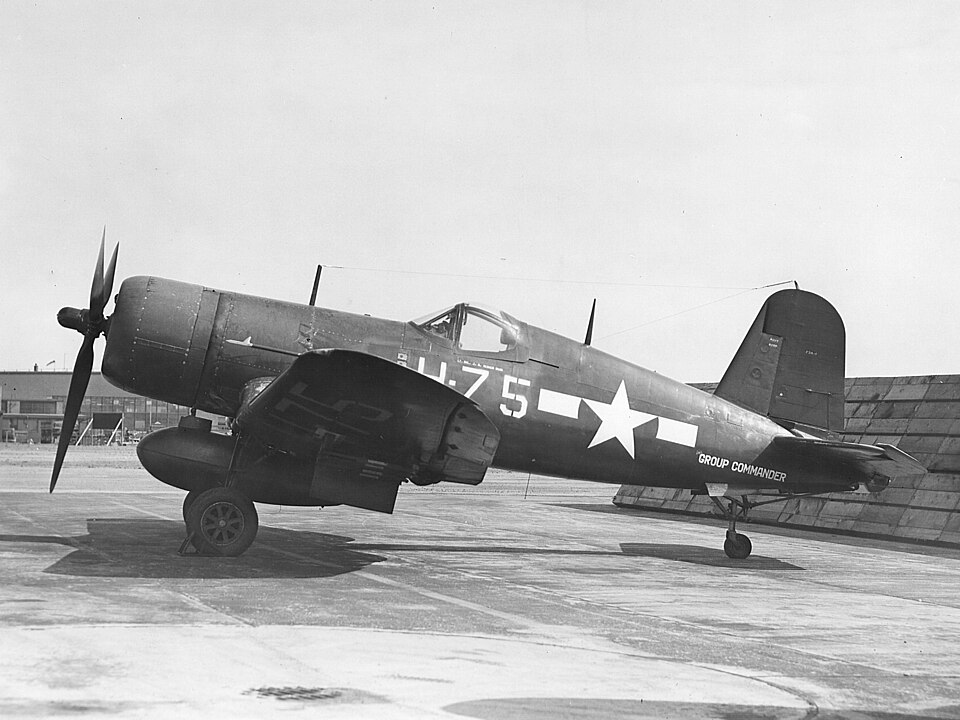
Brewster F3A-1D of Commander, Marine Air Group 91 in 1945.
However the choice of latter was controversial. The company, under supervision of Jimmy Work, failed to deliver the modern monoplane fighter the USN wanted with the F2A Buffalo, which career was short and unglamorous. The next scout bomber SB2A Buccaneer was much worse, and in addition of being a very bad aircraft technically, suffered from countless quality issues that eventualy led Brewster in 1942 to be seized by the Navy to resume production after failing to deliver a single plane on schedule. The SBD2A was eventually considered a lost cause and discarded, while the Corsair was imposed instead under licence as pragmatically, the facilities, workers and tools were there. Decision was taken in November 1941, and in all, until closed in 1944, Brewster delivered 735 Corsairs, 430 going to the FAA and the remainder kept for training. Indeed, pilots of these F3A (the next iteration after the F2A Buffalo) was mixed at best.
Quality control was sloppy and remained problematic under Navy supervision. Deliveries in 1943 and 1944 never equalled those of Vought and Goodyear. Thus, they were considered unfit for frontline service and none of the F3A-1 and F3A-1D ever saw combat. To add insult to injury, these were delivered very late and missed all schedules, much of it due to labor unrest, strikes and even sabotages in some cases, a legacy of previous money laundering scheme under Alfred and Ignacio Miranda and associate F. William Zelcher making $5.5 million in commissions for international sales. Work had hired them as company salesmen but they performed dubious recruitments, with embedded fraud and trade union activism that wrecked all relations with the direction. Between the delays and poor quality, on July 1, 1944, with the outcome of the war still in the balance, the United States Navy canceled its contracts with the Brewster Aeronautical Corporation. Years of bad management, poor engineering, corruption, bedeviling labor trouble, and suspected sabotage forced the Navy to shut Brewster's doors. This also ended this line of production for the Corsair, albeit Goodyear never failed to deliver and between it and Vought, the cotas were reached in 1945. Closed, bankrupt in 1945 the company was sold by Work to the Navy and became postwar the Naval Air Development Center.
Tests of the Improved F4U-1
On October 3, 1942, upgraded F4U-1 fighters began to enter the US Navy's VF-12 Experimental Squadron. However, the fleet command was not sure that the pilots would successfully cope with landing on an aircraft carrier, and therefore the squadron was initially stationed at a land base in the city of San Diego, California. By January 14, 1943, VF-12 was fully equipped with 22 Corsair fighters and redeployed aboard the aircraft carrier Core on January 22. In March-April 1943, the new F4U-1 fighters entered the VF-17 squadron, previously armed with F6F3 Hellket aircraft. In mid-April, the unit was transferred aboard the aircraft carrier "Bunker Hill" ("Bunker Hill"). It was the first U.S. Navy carrier-based squadron to enter combat in Corsair aircraft. Beginning in September 1943, VF-17 pilots, operating from ground bases in the Solomon Islands, destroyed 127 Japanese aircraft and 5 ships in 76 days. Fifteen pilots of the squadron became aces. One of them, Lieutenant Kepford (Ira Kepford), before his return to his homeland won 17 victories and became the fifth among naval pilots in terms of the number of aircraft shot down.The VF-17 squadron was the first to prove that the Corsairs were suitable for operations from aircraft carriers. Departing from the islands of New Georgia on November 8, 1943, F4Us from VF-17 carried out a combat mission to cover the aircraft carriers Essex and Bunker Hill, whose aircraft attacked the city of Rabaul. Having intercepted and destroyed a group of 18 Japanese bombers, the Corsairs almost completely used up their fuel supply. Therefore, contrary to instructions, a forced decision was made to land on aircraft carriers. All aircraft landed safely on deck. This landing influenced the further decision of the command on the wider use of the F4U from aircraft carriers. However, things didn't always end so happily. On January 25, 1944, 23 Corsairs from VMF-422 took off from the island of Tarawa for a 700-mile ferry flight to Funatuti. Bad weather and an unsuccessfully planned route led to the fact that the squadron got lost, and, having completely run out of fuel, the planes fell into the sea. Only one plane reached the base. Six pilots died while landing on the water.
Corsair Aces

Greg "Pappy" Boyington's Corsair. He took the head of USMC's ace factory "Baa Baa Black Sheep" squadron in 1944.
Many pilots became real aces, fighting on the Corsairs. The first of these was Lt. Kenneth A. Walsh (Kenneth A. Walsh) from VMF-124, who scored six victories. Moreover, he shot down three planes in one day on May 13, 1943. Later, Major G. Weissenberger of VMF-213 Squadron destroyed 3 Zero fighters in one minute of combat! Pilot A. Jensen from VMF-214 squadron, having lost his group due to a tropical downpour, suddenly discovered a Japanese airfield. Dropping to low level flight, he began to shoot the planes standing on the runway. During this attack, Jensen destroyed and seriously damaged 8 Zero fighters, 4 Val dive bombers and 12 Betty bombers.
The next day, photographic reconnaissance data confirmed this. This squadron was commanded by one of the best American aces, Major Gregory M. Boyington (G. M. Boyington). During the battles for Rabaul in November-January 1943-44, having six aircraft shot down in China, he brought the number of his victories to 28. On January 3, 1944, he was shot down, but survived. Another pilot who became an ace over Rabaul was Lieutenant Robert M. Hanson of VMF-215. Starting service in this squadron on October 6, 1943, he won his first victory on November 1. By the beginning of the large-scale battle for Rabaul, Hanson had five victories and in 17 days brought his combat score to 25 aircraft. On February 3, 1944, while attacking the positions of Japanese anti-aircraft artillery, his plane was damaged and fell into the sea. By the end of 1943, all US Marine fighter squadrons in the South Pacific were re-equipped with F4U fighters, and by this time 584 enemy aircraft had been destroyed by the Corsairs.
1944-45 Main Operations
From April 1944, the F4U-1D started for the first time carrier operations, tested aboard the escort aircraft carrier USS Gambier Bay. Pilots performed 113 takeoffs and landings without issue. The landing gear was indeed improved, having a serie of advised modifications to avoid bouncing on deck, changed then introduced on all Corsairs in operation. In parallel, FAA landing practices were also tested and greenlighted, and by April 22, the US Navy lifted all restrictions on the use of the F4U on an aircraft carrier, which was a game changer. Indeed, the USMC until 1944 managed to reach much of its operational areas from scattered islands in the Solomons, then Marianas, but the more isolated nature of the last islands to get to close on Japan meant this was no longer possible to support frontline operations in the island hopping campaign later in 1944.Plus, adoption of the british landing system, albeit tested and approved, took almost a year to be deployed in operations on all frontline US carriers. In fact, the first USN F4U squadrons onbly started operations from early 1945, and in between, the first Marine squadrons VMF-124 and VMF-213 started operations on the carrier USS Essex already from December 28, 1944, a way to solve the problem decribed above. Many USMC Corsairs units remained behind to deal with isolated islands.
From January 3, 1945, training flights saw two pilots died, three crashing but a landmark was achieve by shooting down an IJN fighter from a carrier-based F4U-1D. The battles for Okinawa by March 1945 was the great test for the Corsair, with both F4U1-D operating in total across 10 deck squadrons, four VMFs, three VBFs, three VFs (VF-10 on USS Interpid), VF- 5 on USS Franklin, VF-84 on USS Bunker Hill. There was also an active re-equipment from Hellcats to Corsairs, and by the end of the battle for Okinawa, almost all attack aircraft carriers of TF-38 had squadrons of Corsairs. Soon, they started to be replaced by F4U-4s.
Missile Fighters
On the other side of the world, by June 12, 1944, Germany used V-1 cruise missiles against Britain, and the government looked for measures to combat these. No classic piston-engine fighter was apparently fast enough, albeit the Hawker Tempest had the best kills before was introduced in late 1944 the Gloster Meteor. The most effective way to destroy these was also proposed by the US, working on the 298 mm Tiny Tim missile developed at the California Institute of Technology for the fleet. Two could be suspended under the F4U-1D, turning the latter into the first missile fighter in service anywhere. From July 1944, a special Marine Corps Aviation Group-51 (Marine Air Group MAG-51) was formed with VMF-513 and VMF-514, first deployed in Europe, Britain, in order to intercept V-1 positions as part of "Project Crossbow". However, the production delays of "Tiny Tim" hampered operations and eventually, the whole project was abandoned, as ground forces progressing this winter captured V1 areas of deployments.F4U-2 Night Fighter
In parallel with the development of the daytime fighter already from November 1941, Vought started work on a night version, but this was done without any official directive with a reduced team and progressed slowly. The whole programme was transferred for completion to Naval Aircraft Factory in Philadelphia. The first XF4U-2 was ready by September 1942. In early 1943, only twelve F4U-1 fighters were converted into night fighters and in the end a grand total of thirty-two F4U-2s were produced by NAF. About 100 changes were made to the Vought F4U-1. Notably the right wing saw the addition of a 115 kg streamlined container for the AN/ASP-6 radar, capable of a range of 8 kilometers. This imposed removing the outermost Heavy machine gun on the right wing. The cockpit's dashboard was modified to display a large radar screen. There was also the addition of a radio altimeter and other additional electronic equipment. The F4U-2 kept the option of carrying two 113 kg bombs or one 454 kg bomb still. Combat use was very limited, limited to VF(N)-75 US Navy, operating in the Solomon Islands.On October 31, 1943, a first successful interception was done. The F4U-2 also entered service in the VMF(N)-532 squadron formed on April 3, 1943. After testing, the latter was transferred to the Marshall Islands by February 1944. On the night of April 13-14 a first night interception was done on radar, and the next days, pilots shot down two G4M bombers and three more according to unconfirmed reports. American losses amounted to just a single F4U-2. The squadron also made night bombing runs on heavily defended Japanese targets. Six F4U-2s entered VF(N)-101 Squadron deployed on the USS Essex, Hornet and Interpid, all three having a pair of night fighter for night CAPs for the first time, taking their place alongside Night fighter versions of the Hellcat. However, the Corsair never became standard for the US Navy and instead the F6F-3N and F6F-5N were chosen.
The F4U-4, best Corsair in combat ?

In the next half of 1943, work started on the F4U-4 with a first prototype converted from a standard F4U-1A under the designation F4U-4XA. Maiden flight was on July 19, 1944 and by September 20, it was accepted for sproduction. The need was so great that the fleet ordered 6,049 of these at once. More than 300 changes were made. One key change was the new C-series R-2800-18W engine, with a four-bladed Hamilton Standard propeller with a diameter of 4013 mm. Maximum takeoff power was a record 2,070 hp for a top speed of 683 kph making it already the fastest piston-powered fighter in 1943.
But it was not all: Partly thanks to the injection of water into the cylinders, this enabled to boost power up to 2,450 hp and reach an unprecedented 717 kph. It remained the fastest convetional allied fighter, beating even the Gloster Meteor and Hawker Fury and only close to De Havilland Hornet F1 (the latter capable of 764 kph (475 mph but with two engines) or the last Seafang and Spitfire (975 kph or 606 mph). However the need for extra active cooling of air and oil in the radiators at the root of the wing, not longer sufficient, required the placement of an additional air intake on the hood jaw.
Another critical demand was to improve visibility. This, the cover of the lantern was changed. There was aksi a facilitated access to radio equipment given the folding pilot's seat. The Armament remained of six machine guns of the same 0.5 inches caliber, proven Browning M2. An additional 89.3 kg armor was installed to better protect the pilot and fuel tank. A new suspension system was installed below the wings to enable racks for two 454-kilogram bombs or eight 8-inches heavy HVAR rockets for ground attacks (a role it proved more than adept for).
In this series, there were a few original oddballs:
F4U-4C: Built only to 296 machines, this one was armed with "only" two 20 mm M3 guns in the wings and 220 rounds per barrel with an extra optional 26 rounds for each gun. A sub-serie of 48 machines even an automatic weapon system AN/ASG 10 Mk.I Mod 1, for dropping bombs from a pitch-up more accurately, turning the Corsair into a dive bomber.
F4U-4P: The reconnaissance version (P) had a K-21 camera. Only 11 of these were manufactured.
In September 1945 when the order for 6,000 was reconsidered, a total of 1,912 F4U-4 Corsairs had been built, of which around 500 were used in the compaign of Okinawa, raids on Tokyo, Saigon and Formosa. Postwar the order remaining was cut down to an extra 793 and that affected the production pace. This went down to 20 produced per month with massive layoffs and enough personal to keep the factory somehwat busy.
F4U-4K: Experimental radio-controlled target drone variant (1 prototype)
XF4U-5: Test plane with a new engine cowling and other extensive changes, no production.
Up to August 1, 1947 when production of the F4U-4 was definitely terminated, a grand total of 2,557 were produced by Vought alone. Many others were from Goodyear. Brewster meanwhile saw its own production terminated in shame.
Goodyear Corsairs
Goodyear was intended to produce the F4U-4 as well under the designation FG-4. However their order for 500 was canceled. By March 1944 however, the US Navy signed a contract to supply 418 F2G-1 and F2G-2 mostly assigned to squadrons dedicated to intercept and destroy Kamikaze. This new aircraft received the designation F2G and its main difference was the installation of the largest engine evenr fitted in a Corsair at least for military purposes, the four-star 28-cylinder R-4360-4 Wasp Major engine. This behemoth had an unbridled output of 3000 hp, even surpassing the "Jug" (Thunderbolt) in raw power. Goodyear made the fuselage behind the cockpit lowered to compensate, the cockpit received a new teardrop-shaped canopy that could be entirely moved back.It looked sleek and modern and that eliminated one of its most important shortcomings of an insufficient view forward and around. The armament was down to four 12.7 mm machine guns (1200 rounds total), two very large (728 kg bombs) or 8 HVAR rockets. The F2G-1 however larged folding wings or landing hook as it was intended for land airfields at Okinawa for the late war intended Kyushu invasion (Operation Olympic/Downfall). The next F2G-2 however was modified for carrier operations and did get the folding wings and hook.
The surrender of Japan stopped work on both aircraft and the order was cancelled. Only the first ten FG2-1 were completed, and put on sale after the Navy briefly evaluated them. They were later bought by private individuals and participated in various competitions given their surnatural speed for single-engine piston models. The F2G-2 was however much heavier than a standard Corsair and "only" capable of 431 mph (694 km/h, 374 kn) at 16,400 ft (5,000 m).
F4U-5 Corsairs
This 1945 design modification of the F4U-4 was sanctioned by a maiden flight on 21 December 1945. The war has ended since two months by that stage but Vought wanted to continue production provided the new model brough sufficient advantages, notably to replace F4U1s. The model targeted improvedl performance across the board, incorporating as many Corsair pilots' suggestions as possible. This model had an even more powerful Pratt and Whitney R-2800-32(E) engine, with a two-stage supercharger for better altitude performances. It was credited of an output of 2,760 hp (2,060 kW). It also had an automatic blower controls, cowl flaps, intercooler doors, oil cooler, elevators and rudder spring tabs, modernized cockpit, new retractable tail wheel, heated cannon bays and pitot head. The cowling was also lowered two degrees for better forward visibility and it had all-metal wings. In total, 223 of this F4U-5 were produced instead of the former cancelled orders. This 2700 hp engine gave them a top speed of 408 knots (470 mph) and they climbed at 4,850 feet (1,580 m) per minute. The model led to several declinations:-4U-5N: Radar equipped version (214 delivered)
-F4U-5NL: Winterized version (72 delivered and 29 converted from F4U-5Ns: 101). Rubber de-icing boots wings leading edge+ tail.
-F4U-5P: Long-range photo-reconnaissance version (30 delivered).
Final Corsairs (Cold War)
-F4U-6: AU-1 modified for ground-attack, U.S. Marine Corps.-F4U-7: AU-1 airframe + 43W engine from the F4U-5 for the French Navy.
-FG-1E: Goodyear FG-1 with radar
-FG-1K: Goodyear FG-1 as drone.
-FG-3: Turbosupercharger version converted from FG-1D.
-FG-4: Goodyear F4U-4, never delivered.
AU-1 Corsair
The AU-1 was a variant of the F4U Corsair developed from the F4U-5, and was originally designated as the F4U-6 but was renamed to AU-1. It was designed as a dedicated ground attack aircraft, unlike all the previous Corsairs which were designed as fighters. To fit that role the engine was optimized for low-altitude flight, additional armour was fitted, and the AU-1 had increased suspended armament capacity. The United States Marine Corps utilized the AU-1 in Korea starting in 1952, saw service in the Naval reserves from 1954 to early 1956 before it was officially retired in 1957.High Altitude Escort Corsairs
The program for creating a high-altitude version of the Corsair was also terminated at the same time. It started all the way back to March 1943, when Vought ordered three XF4U-3 prototypes with XR-2800-16C engines fed by a 1009A turbocharger to maintain 2000 hp at an altitude of 12,000 meters (40,000 ft), and a top speed of 663 kph (412 mph) at an altitude of 9,445 meters (31,000 ft). This was a private venture. At the time, the B-29 superfortress program was in full swing with the intention of producting a very fast, very high altitude, and long range bomber (one of the most costly program aside Project Mahattan). Directly linked to the Island-Hopping campaign, they were supposed to be brought to bases close enough to the Japanese Home Islands. But at the time no escort were designated for them. Vought's top management believed the P-51 Mustang being contcentrated in Europe would not be available, and apart the P-38 Lightning for the Army, the Navy could not procure anything. The F6F Hellcat did not fare well at high altitude and even became sluggish. So there was a niche for a high altitude escort fighter for the Pacific.The XF4U-3 was tested at altitude at different regimes in 1943, At low and medium altitudes, but the prototype proved worse than the F4U-1A. The XF4U-3 differed by its large turbocharger air intake under the fuselage. The Navy studied the project and was planned to place an order for another 27 of these, not to Vought but from Goodyear, later reduced to 13. They were efectively built but never deployed on the front line and in 1944-45, only used for various tests. Not a single one performed its intended mission. In between, the P-51 Mustang escorted the B-29 in some occurences, but the B-29 essentially used its advantage to fly in "box formations" without escorts.
What the Japanese Thought of the Corsair
Summing up all modifications brought to the Corsair, and although it started to be widely used in combat operations only from 1944, it shot down a total of 2,140 Japanese aircraft in air battles, with the loss of only 189 aircraft to enemy aviation in air-to-air engagements. Among IJN pilots the Corsair was considered the most powerful fighter of the US fleet, as evidenced by the high ratio of victories to losses (11.3: 1). For every thirty Corsair sorties, more than one Japanese aircraft was shot down. Japanese pilots considered the F4U simply the best American fighter in the Pacific. However it was never the standard carrier-based fighter, that was the Hellcat.
Indeed, prior to the advent of the F4U-1D series, every takeoff and landing were preilous enteprises at best with a non-combat loss ratio due to carrier operations simply unacceptable (see conslusion statistics). To confidently pilot the Corsair, any pilot needed serious flight training, largely above and beyond that of a Hellcat or any other Navy model at the time. This took pilots far more time to be ready and accepted in service, and there is no coincidence that the number of F4Us lost for non-combat reasons far exceeded combat losses. The Navy had a hard time acepting back the Corsair when decision was taken to ban it from carrier decks in 1942, and confined it to USMC use from land bases.
This became incdentally the best and most common fighter bomber of the Marines, although encounters with Japanese aircraft were less common than the Navy F6Fs, frontline almost all the time. TF-38/58, the fast carrier battle group of the US navy was indeed its fulcrum in the island hopping campaign, and often had to lead offensives on "nests" of Japanese aircraft, Navy or Army, like the battle of Formosa, one of the largest air battle of the war, and largely forgotten. The Island (now Taiwan) was literrally festooned with airfields. It had been transformed into the unsinkable aircraft carrier of the Japanese to defend the South China Sea. In that battle, Corsairs loaded with bombs and rockets did play a crucial role, destroying most of these hundreds of Japanese aircraft on the ground already, and shooting down mostlt the few rookie pilots in the air in the meantime.
Aircraft to Aircraft, the F4U was superior to anything the IJA (Army) and IJN (Navy) fielded in 1944. The best and most prolific navy fighter opposed to the Corsair was the A6M5 Zeke, and in terms of speed, armament and resistance to fire, it was absolutely no match. Even with basic training US pilots learned to avoid "playing the zero game", that is entering a dogfight with a Zero (as well as an army Oscar). Instead, they used their sheer robustness and power to zip in and out of compromising positions and dictate the pace of the engagement. The corsair could out-climb or out-drive the Zero any day for example, and taking hard turns that would disclocate the Zero's much lighter structure, not speaking of its armament. Only later in 1945 the Navy started to field better fighters, the rare N1K Kyofu derived from a seaplane, and J2M Raiden designed to intercept the B29. But that that stage they faced the even better F4U-4.
Now facing the IJA fighters, the competition was a bit more even. The Ki-43 Oscar (Hayabusa) was the A6M Rival and encountered about the same issues as the Zero or even worse. It was not powerful, fast enough and also had a paper-thin structure and the usual lack of pilot protection and self-sealing fuel tanks. However even by 1943, a few better contestants entered the arena: The Ki-84 Hayate ("Frank") is generally considered the best Japanese fighter to operate in large numbers during the conflict, boasting high speed, excellent maneuverability with an powerful armament of up to two 30 mm and two 20 mm cannon in 1944, plus the speed and strenght to match the Corsair.
The F4U-5 debut in Korea

Even before the end of World War II, Vought began work on a new modification of the fighter. On December 21, 1945, a prototype XF4U-5 high-altitude fighter took off with a new E-series R-2800-32W engine equipped with a two-stage variable speed compressor. Maximum engine power 2450 hp The engine hood has been modified to accommodate the compressor, and the engine itself is tilted downward at an angle of 2° 45'. All this, together with a new cockpit canopy and canopy, significantly improved the pilot's view. The maximum speed of the prototype was 744 kph at an altitude of 9,570 m, the ceiling increased to 13,440 meters.
The armament was significantly changed, instead of 6 machine guns, 4 M3 T-31 guns of 20 mm caliber were installed. Under the center section, bombs weighing 907 kg could be suspended, and 10 127 mm caliber missiles could be placed under the wing. The first production F4U-5 made its first flight on May 1, 1947. A total of 568 aircraft of 4 modifications were produced. Issue discontinued October 22, 1951. 214 F4U-5N night fighters built. Photo reconnaissance F4U-5P and all-weather night fighters F4U-5NL were also built. For night modifications of the fighter, the maximum speed was reduced to 700 kmph, the ceiling was 13,410 meters.
In the summer of 1950, an armed conflict began on the Korean Peninsula. By decision of the UN, interethnic forces were formed to participate in hostilities, the core of which was American troops. The ground forces accounted for 50%, the Navy - 80%, the Air Force - more than 93% of all countries participating under the UN flag in the war. The combined Navy included more than 800 warships, including 20 aircraft carriers (of which 16 were from the United States). Almost all American aircraft carriers carried F4U-4 or F4U-5 Corsair aircraft.
In the first 10 months of the war, they made 82% of all sorties of naval aviation and marine aviation. "Corsairs" were used mainly for delivering missile and bomb strikes against operational reserves, airfields and industrial facilities on enemy territory. Direct support of their troops was actively carried out. From 4 to 7 December 1950 alone, the F4Us flew 900 sorties with this mission. It was the "Corsairs" that covered the A-1 "Skyraider" carrier-based attack aircraft during the famous torpedo attack on the Khvashomskaya dam.
In addition to strikes against ground targets, F4U-5N night fighters were involved in night interceptions and patrols. Here again the main drawback of the Corsairs appeared - falling on the wing at a speed of less than 167 km / h. It was at such speeds that the North Korean Po-2 and Yak-18 light night bombers mainly flew. However, even at such low speeds, American pilots adapted to shoot down enemy aircraft. The most famous night ace flying the F4U-5N was Lieutenant Guy Bordelon, who shot down five La-11s and Yak-18s in a short period in 1953. The pilots of the Corsairs even had jet MiG-15s on their account, which, of course, without detracting from the merits of the American pilots, rather testifies to the low level of training of the Korean-Chinese pilots.
However, the main goal of the "Corsairs" still remained the ground facilities of the communists. In total, during the war in Korea, "Corsairs" carried out 45% of the 255,000 sorties of naval aviation and marines. F4U were in service with 26 squadrons based on board 10 aircraft carriers. Another 7 squadrons were in service with the marines on 4 aircraft carriers. From ground airfields in Korea and Japan, 3 naval and 1 squadrons of marines operated. Losses in Corsairs for the entire period of the war reached 312 F4U and 16 AU-1 aircraft, and the first aircraft shot down by the American fleet was the F4U. Almost all the Corsairs lost by the Americans were shot down by anti-aircraft fire.-->
Fleet Air Arm Corsairs Mk.I-V in combat

Unlike the Americans, the British used their "Corsairs" not only in the Pacific Ocean, but also in Europe. So, on the afternoon of April 3, 1944, Corsairs from the 1834 squadron of the FAA took part in escorting the Barracuda torpedo bombers that attacked the German battleship Tirpitz in one of the fjords of Northern Norway. However, the attack was not successful, and in July - August 1944, several more raids were undertaken. They were initially delivered as part of the Mutual Assistance in Warfare Act, with the first F4U-1 entering service with the FAA in early 1943 as the Corsair Mark I, without change, and later the F4U-1B (B for British) was redesignated the Corsair F Mk.I. Modifications on the F4U-1A or Corsair F Mk.II". The last 150 delivered were F4U-1Ds, but they kept the generic designation Corsair Mark II. However in common they had their wings reduced by 0.36 meters, in order to fit under tighter hangar roof on British aircraft carriers.
British pilots were trained in the United States. The completed aircraft and pilots were then transferred to Britain on escort aircraft carriers to constitute a first Corsair-equipped FAA squadron, NAS 1830 stationed on HMS Illustrious on June 1, 1943. In July, NAS 1831 was formed on HMS Vengeance (Colossus class), NAS 1833 was the second accepted by HMS Illustrious, and NAS 1834 the first on HMS Victorious. In August 1943, were formed NAS 1835 and NAS 1836 for Victorious, and by September the last squadron, NAS 1837 was formed for HMS Illustrious.
NAS 1841 and 1842 were formed for the aircraft carrier Formidable. There were no encounters between Corsairs and German fighters in their first operations in Norway. In parallel with the combat debut in Europe, British F4Us started service with the Eastern Fleet, and later the British Pacific Fleet. The first eastern operation started April 19, 1944, with NAS 1830 and NAS 1833 escorting Barracudas to attack Sabang, Sumatra. They wrecked and industrial facility on January 24, 1945, and Corsairs shoot down 13 Japanese Ki-44 fighters.
From the spring of 1945, FAA Corsairs started to operate more and more actively from more aircraft carriers. From March 26 to April 4, 1945 alone, they performed 20% of all the 2,000 sorties of British aviation. In June-August, they operated intensively against targets over the Japanese home islands. In total by the end of the war, the FAA operated 19 Corsair-equipped squadrons but they were quickly disbanded. The last two were reorganized on 13 August 1946. In total, the UK received via lend-lease a total of 2,021 Corsairs: 95 F4U-1, 510 F4U-1A, 430 F3A-1 (Corsair F Mk.III) and 977 FG-1 (Corsair F Mk.IV). In total, the FAA operated the Corsair through the 700, 703, 706, 715-719, 721, 723, 731, 732, 736, 738, 748, 757, 759, 760, 767, 768, 771, 778, 787, 791, 794, 797, 885, 1830, 1831, 1833-1838, 1841-1843, 1845, 1846, 1848-1852 Naval Air Squadrons.
RNZAF Corsairs

The first delivery to Commonwealth pilots in the Pacific was on March 23, 1944, when the first thirty arrived at the workshops at Espiriti Santo, New Hebrides. In the Atlantic like in the Pacific, those carried on decks of escort aircraft carriers required careful inspection and parts replacement due to seaspray corrosion, especially in winter. Later, they arrived in crate for better protection, re-assembled close to their deployment area. A special unit was created in Espirito Santo just to assemble and repair carrier-delivered aircraft, aslo capable of assembling crated ones. A special squadron was created to retrain New Zealand pilots from Kittyhawks and Warhawks, and fly assembled Corsairs. The pace of assembly was on average two "Corsairs" daily, with the first 100 ready by June 2, 1944. A total of 287 F4U-1A and F4U-1D were assembled here for the RNZAF and FAA. Aircraft assembly at Espiriti Santo ended in December 1944, moved to Los Negros (Admiral Islands) for the next FG-1D t be now assembled. In total, the Corsair in NZ colors represented 368 F4U-1s and 60 FG-1Ds, operated from 1944 to 1949, namely No. 14-23 Squadron RNZAF.
The first unit to enter the battle on the Corsair was the 20th squadron of the RNZAF, which operated from May 15, 1944 from the island of Bougainville. Until the end of the year, the RNZAF had eight squadrons armed with F4Us. New Zealand fighters operated primarily as attack aircraft and light bombers against Japanese land targets and ships. Aircraft deliveries continued in 1945, with 60 FG-1Ds delivered to the base at Los Negros. The aircraft arrived disassembled. Wings, propellers and equipment were packed in separate boxes. In addition, 77 aircraft were assembled at Hobsovville in New Zealand and used mainly for training.
A total of 424 Corsair aircraft were delivered to the RNZAF, the largest non-US user after Britain: 237 F4U-1A, 127 F4U-1D and 60 FG-1D. They were in service with 13 RNZAF fighter squadrons (from 14 to 26).
After the Japanese surrender, the aircraft were returned to New Zealand and the personnel were demobilized. Only one 14th squadron was stationed as part of the occupying forces in Japan on the island of Honshu at the former Japanese naval aviation base Iwakuni. In February 1948, the squadron was transferred to the base in Bofu. The decision was later made not to continue the presence of New Zealand troops in Japan.
Since the planes were already badly worn out, it did not make sense to transfer them to New Zealand. All aircraft, spare parts and other equipment of the 14th squadron were collected in one place at the airfield and burned on October 10, 1948. On the territory of New Zealand, the decommissioning of the Corsairs also continued. So, for example, in March 1948, 215 aircraft were sold for scrap. In 1949, the last NZ Corsair was taken out of active service, and by 1953, the RNZAF did not have a single aircraft of this type. The Australians never acquired or operated the Corsair.
Other Operators
Since the prototype maiden flight on May 29, 1940, this warbird underwent production for 11 years with 12,576 delivered, through more than 20 modifications. In US service, they remained in service with the US Navy until June 1957, breaking all longevity records for that type. It in fact became the very last piston fighter aircraft produced in the United States apart the Skyraider. Its legacy survived through the Vought A-7 Corsair II of the same company (third of the name after the O2S series).The French Aeonavale F4U-7 in combat

The latest modification of the "Corsair" was the F4U-7, built by order of the French Navy and specifically for operations in Southeast Asia. It mixed the new AU-1 airframe with the propulsion of the F4U-4. 94 in all were produced. Its maiden flight was on July 2, 1952. The last one left the Dallas plant in January 1953.
Indochina
From April to May 1954, French Corsairs were used in Indochina for close attack missions, with bombs, rockets and napalm.Suez
Once operations stopped in 1955 after Dien Bien Phu, with the peace treaty and withdrawal, they could have been stored, but instead they went back into service in 1956, operating from the French aircraft carriers Arromanches and La Fayette as part of Operation Musketeer, against Egypt. This was the "Suez crisis" in which they perofmred again close air support missions.Algeria
Still used until the late 1950s it was planned to have them retired, but the War in Algeria forced their return into the frontline, in the same role as before. They operated over rugged terrains in the southern territories until July 1962. Indeed, at the end of 1956, all three Corsair Flotillas moved to Telergma and Oran, Algeria. There they provided cover and escorted helicopters, joined by the new "Flottille 17F" of Hyères in April 1958. French F4U-7 Corsairs with the 12F, 14F, 15F, and 17F Flotillas were operated hard between 1955 and 1962. On February-March 1958 stroked were launched from the sister ship of Lafayette, the light carrier Bois Belleau (ex USS Belleau Woods), the only carrier involved in this War.Late French Use
After 1959, France already was ramping up its production of Jets and it was clear the F4U had little future in its inventory. The Dassault Etendard (1962) replaced completely the Corsair on the new French Carriers (Foch and Clemenceau). But this did not prevented the French to operate the F4U in new experimental roles. Already in 1959, the Aéronavale experimented with SS.11 wire-guided anti-tank missiles in the 12.F. The pilots needed to manually pilot the missile 2 kilometers from the target on low altitude with a joystick at the right hand while keeping track of a flare on its tail, and still handling the Corsair from the left hand, very tricky in combat conditions. It was reported "effective" but never used in the Algerian War as insurgents never used armoured vehicles. In total tyhe French operated 163 Corsairs, 94 F4U-7s and 69 AU-1s. The last operated at the 14.F Flotilla in Cuers. They were officially withdrawn by September 1964. Next thos not scrapped or purchased by private citizens ended in museum displays.Tunisia
From August 1961, their pilots also flew sorties against the Tunisian insurrection which started. French Squadron 14F flew the F4U-7 until October 1964. France indeed recognized Tunisian independence and sovereignty in 1956 but continued operate forces at Bizerte, planning even to extend the airbase. In 1961, Tunisia asked France to evacuate the base and after a refusal, imposed a blockade on 17 July. When it was not sufficient, local militiamen started to fight the French military in a ground battle that lasted three days. French paratroopers aircraft escorted by Corsairs of the 12F and 17F Flotillas were dropped to reinforce the base. Next, the Aéronavale launched air strikes on Tunisian troops and vehicles on 19–21 July (150 sorties) on Corsairs. All survived but three were damaged by ground fire.South American Use
Surplus Corsairs were delivered to Latin American countries. El Salvador acquired Goodyear FG-1Ds, first acquired and then surplus F4U-4. Honduras received more than twenty F4U-4, F4U-5 and a few night fighter F4U-5N. The Argentine Navy kept its F4U-5s and F4U-5Ns operaying on their aircraft carrier ARA Independencia. They were still active until the early 1970s.Argentina
The Argentine Navy Naval Aviation operated 26 F4U-5/5N/5NL Corsairs from 1956 to 1968. From ARA Independencia this was the 2nd Attack Squadron. They were eventually replaced by F9F Cougar and no longer around when the Falkland war broke up in 1982 (but in museums).El Salvador
The Salvadoran Air Force obtained and operated five US surplus Vought F4Us and twenty Goodyear FG-1Ds in 1957. They were operated until 1976 in a single Fighting and Bombing Squadron. They were intended for counter-insurgency and border patrol.Honduras
The Honduran Air Force acquired and operated nine F4U-4s and ten F4U-5N/-5NL/-5Ps, night and phot-reonnaissance version from 1956 to 1979. One (Lt. De Soto) took part in the "Futbol War" of 1969:Honduran and Salvadorian Corsairs fought in the last ever combat operations of the venerable warbird, the so-called "Soccer war". In 1969 they clashed against each others as both air forces operated them. This war started with a disagreement over a soccer match. Captain Fernando Soto (Honduran Air Force) disguntled by the result, took off, went for the border of El Salvador, patrolled until spotting and shooting down three Salvadoran Air Force aircraft on 17 July 1969: First a Cavalier Mustang in the morening, then in the afternoon, two Goodyear Corsair FG-1s. The pilot was later disciplined and the rest ended in dispolatic terms, but this was to be the last ever propeller-driven aircraft fight ever anywhere.
Soto became the only pilot credited with three kills in an American continental war as well as El Salvador did reprocicated the feat. El Salvador however enlisted former WW1 US veteran pilots on P-51 and F4U like former Korean ace Bob Love, Chuck Lyford, Ben Hall, and Lynn Garrison. It is alleged they flew cxounter patrols in Honduras, but this never wwas confirmed. Lynn Garrison purchased by himself a former French F4U-7 (BuNo 133693) from the French MAAG office in 1964, registered N693M. He flew it for its own fun until destroyed in a 1987 crash in San Diego.
The Corsair Today: Legacy, pop culture, Museums & collections
Second Best "Butcher Bird" of the war
U.S. figures compiled at the end of the war showed both the F4U and FG (The Brewster one was kept for training, inc. static) flew 64,051 operational sorties for the USMC and USN and this was 44% of total fighter sorties for these corps overall. It was the primary USMC fighter for more of the war and a grand total of 9,581 sorties (15%) only were flown from carrier decks. F4U/FG pilots claimed 2,140 air combat victories against 189 losses making for an overall kill ratio of over 11:1, very close to the "butcher bird", the F6F Hellcat (13:1). If the Corsair was carrier-capable from the start and pressed to the frontline like the F6F instead of rear echelon theaters, it's likely it would have the same or a better ratio and held the tile today.Even against the best Japanese opponents, the aircraft claimed a 12:1 kill ratio, that is against the Mitsubishi A6M. This was 6:1 against the Nakajima Ki-84 Hayate, Kawanishi N1K-J and Mitsubishi J2M combined in 1945. But unlike the Hellcat, consigned to CAP (carrier local defence) and semi-independent escort for Helldivers and Avengers in bombing/rocket mission Corsair, the Corsair was almost always deployed in fighter-bomber missions. They delivered in total 15,621 tons (14,171 tonnes) of bombs, which was a staggering 70% of total bombs dropped by U.S. fighters during the war. It was also the prime carrier for rockets.
Still, this warbird was not invincible. Corsair losses in World War II were as follows:
By aerial combat: 189
By enemy ground and ship-board anti-aircraft fire: 349
Operational losses during combat missions: 230
Operational losses during non-combat flights: 692
Destroyed aboard ships or on the ground: 164.
This shows 932 losses due to enemy action, and a total of 1624 losses of which more than 1/3 of total losses were due to accidents, showing how much the long nose and poor vibility and its early issues could have prevented this aircraft to reach the frontline. Some authors even compared it to the early carrier accidents of Brewster Buffalos and Supermarine Seafires. The USN really started to deploy the F4U on carriers in 1945 and only due to intensive training and fixes found by Fleet Air Arm carrier pilots on the Corsair I and II of the British East Indies and Pacific fleets.
The F6F was always the preferred choice for carrier operations and the F8F bearcat was its designated successor, the F4U was to take other roles. Still, it returned partly in carrier service in the Korea war, thanks to even better carrier landings innovations. It's really in Korea that the Corsair took the brunt of operations, with the preferred the F8F Bearcat kept as interceptor, which it was at its core. The two were complementary. And with the advent of early jets, the F8F was quickly sidelined or given to allies whereas the Corsair stayed a bit longer, notably as a night fighter.
The F4U in pop culture: The "Black Sheep" and others
In the late 1970s serie really brought forward the forgotten USMC pilots of WW2 in a serie that was only possible at that stage thanks to the longevity of the warbird and numerous collectioners that possessed it, often in flying conditions. In addition to the ones purchased back from sells from Honruras and El Salvador notably (some were flow by US pilots here until the late 1970s). "Baa Baa Black Sheep" was a TV serie and military drama created by Stephen J. Cannell with 36 episodes directed by Alex Beaton, Robert Conrad (lead actor), Larry Doheny and Walter Doniger, starring the same Robert Conrad (which also narrated the movie and was co-producer), W. K. Stratton, Simon Oakland, Dana Elcar, James Whitmore Jr., Dirk Blocker, Robert Ginty, John Larroquette, Jeff MacKay, Larry Manetti, Joey Aresco and Red West. This was basically the story of VMF-214, a Marine squadron of "misfit" (hence the nickname, song and title) fighter pilots based on the Solomon Islands campaign and Bougainville campaign from 1943 to 1945. It was very loosely based on a part of real-life Gregory Boyington ("Pappy" due to his 30 years compared to other pilots under his command), a veteran of the Flying Tigers in the late 1930s. Reenactors played a very important part in it as well as "props" that were painted US trainers to feature various Japanese aircraft. The USMC base and airfield was at the fictional island of Vella la Cava (base on the real Vella Lavella, New Georgia). In all, thre were two seaons, one from September 21, 1976 to March 22, 1977 and another from December 14, 1977 to April 6, 1978. It was relatively popular at the time, notably in France where i discovered it in my youth, and was released in DVD in 2005, 2017 and 2016.In Disney’s “Planes” anime, a character by the name of Skipper Riley is a Chance Vought F4U-1A/1D Corsair a, WWII vet from the fictional VF-17 "Jolly Wrenches" based off the true VF-17 Jolly Rogers.
The F4U Flying Today and in Museums
Flying Ones
As of 2025, around 30–38 Corsairs remain airworthy worldwide, maintained by museums, private collectors, and heritage flight organizations. These aircraft often appear at airshows, flyovers, and demonstration events. Notable Airworthy F4U Corsairs in the United States: Planes of Fame Air Museum (Chino, California) – F4U-1A Corsair BuNo 17799, one of the oldest flying Corsairs; recently returned to flight after a major restoration and scheduled to appear at airshows and demo flights. Warbirds and Museums Across the U.S. – Multiple FG-1D and F4U-4 variants in flying condition with groups such as: Cavanaugh Flight Museum (Texas), Palm Springs Air Museum (California), Fantasy of Flight (Florida) and Commemorative Air Force units among others.In the United Kingdom at the Fighter Collection (Duxford) zn FG-1 Corsair regularly flown at UK airshows.
In New Zealand an FG-1D Corsair operated by Greencare Aviation/Old Stick & Rudder Company, active in regional warbird events.
In continental Europe: F4U-7/F4U-5 Corsairs flying with private warbird groups like the Salis Collection and others, seen at events such as Air Legend in France.
In Austria, the Tyrolean Jet Service operates an F4U-4 Corsair that flies airshows in Europe.
Where You Can See or Hear a Corsair Today, at Airshows & Warbird Events such as EAA AirVenture Oshkosh (USA), Miramar Air Show (USA), Classic Fighters (New Zealand), Air Legend (France) and others worldwide. Museum Flight Demos – Some museums schedule demonstration flights or special flight days featuring their Corsair warbirds.
Static F4U Corsairs in Museums
Many Corsairs no longer flying are preserved in museums around the world — excellent places to see original aircraft up close. In the USA alone, at the National Naval Aviation Museum (Pensacola, Florida) – features rare Corsairs including restored “Birdcage” early-production examples. At the Intrepid Sea, Air & Space Museum (New York) – displays an FG-1D Corsair on its hangar deck. Also at Pima Air & Space Museum (Tucson, Arizona) – F4U-4 Corsair on display. EAA Aviation Museum (Oshkosh, Wisconsin) – Corsair exhibit among historic aircraft. Outside the US at TAM Museum (São Carlos, Brazil) – F4U-1 Corsair historic display. Fleet Air Arm Museum (Yeovilton, UK) – Corsair exhibit. Also in Various national aviation museums — Canada, Australia, Honduras, France, and more also curate Corsairs for public viewing.
Gallery:
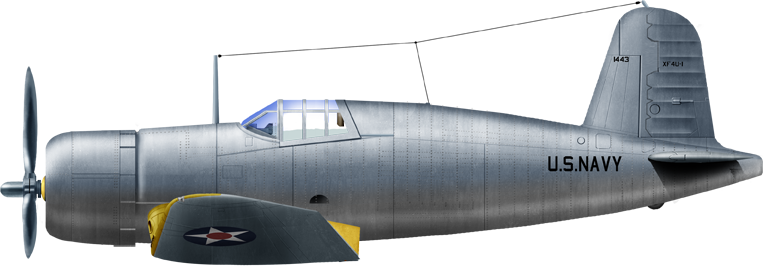
XF4U-1 (1940)
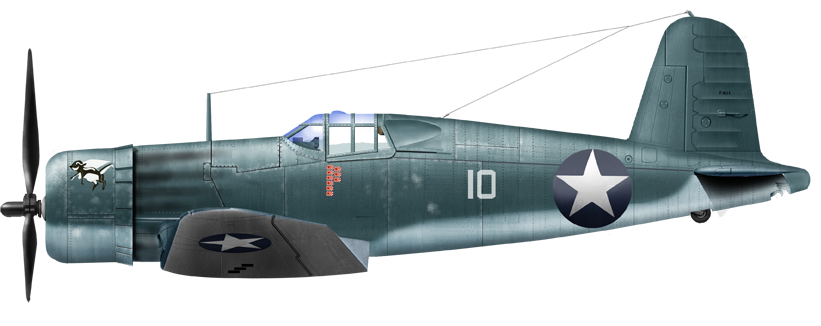
F4U-1 "Gus Gopher" (Wilbur "Gus" Thomas) VMF-213, Guadalcanal 1943

F4U1 VF-17 Lt. Clement Gile, spring 1943.

1st. Lt. Rolland Rinabarger, VMF-214, Espiritu Santo, Sept. 1943

Maj.Greg.J.Weissenberger, VMF-213, Guadalcanal, June 1943

F4U1 2nd.Lt. Henry Huidekoper, VMF-213, Munda, Sept.1943

F4U1 Lt. John Bolt, VMf-213 Russel Island, sept. 1943

F4U1 "Spirit of 76" VMF-215 Lt. Robert Owens Munda, August 1943

F4U1 VF-17, CV-17 USS Bunker Hill Nov. 1943
Note: 758 F4U-1 produced.
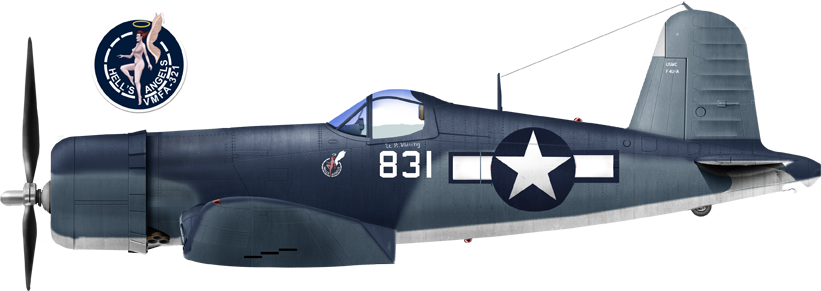
F4U-1A CMF-321 Hell's Angels, USS Kawajein 1944
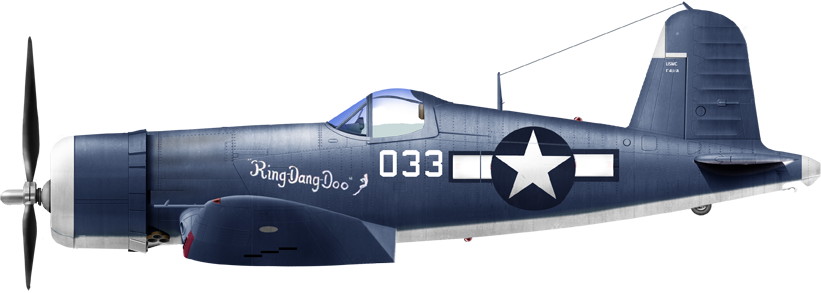
F4U-1A, VMF217 "Ring Dong Doo", Mariannas 1944
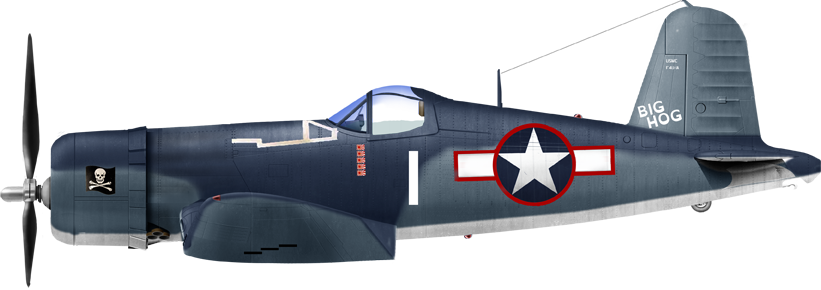
F4U-1A Ltr.John Tommy Blackburn, VF17, February 1944
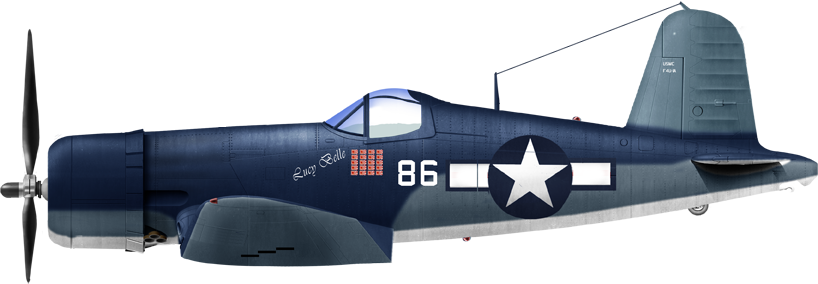
F4U-1A (USMC) VMF-214 Barakoma airfield, Vella Lavella, Solomons, 1944, Greg "pappy" Boyington's plane
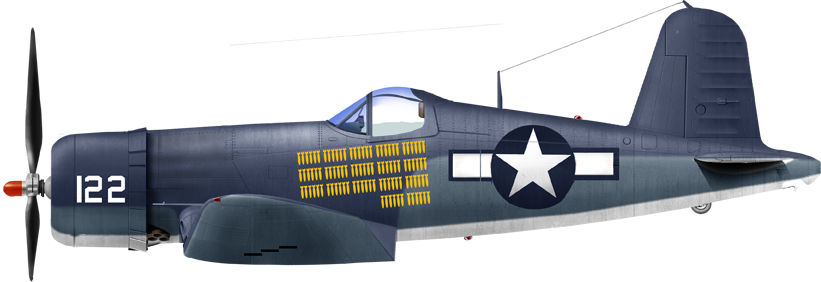
F4U-1A VMF-111. "ole 122" operated in the Gilberts and Marshall islands and set a record for reliability, 100 missions, 400 flight hours and 80,000 miles covered with the same engine.
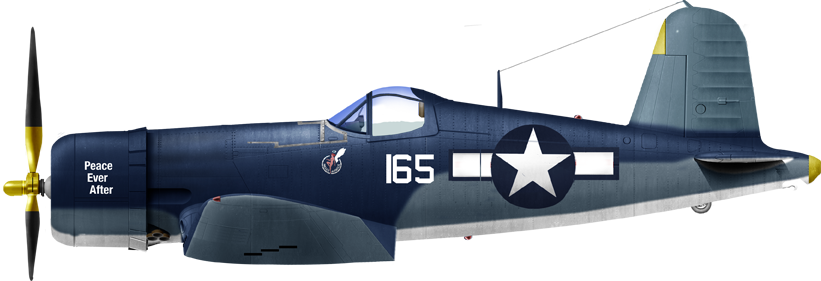
F4U-1A USMC Buaer 50165 VMF-321 Guam 1944
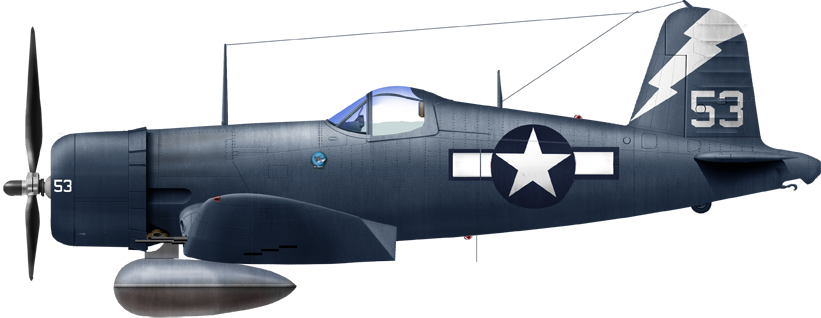
F4U-1C with its 20mm gun. Only a handful were manufactured purely for ground support.
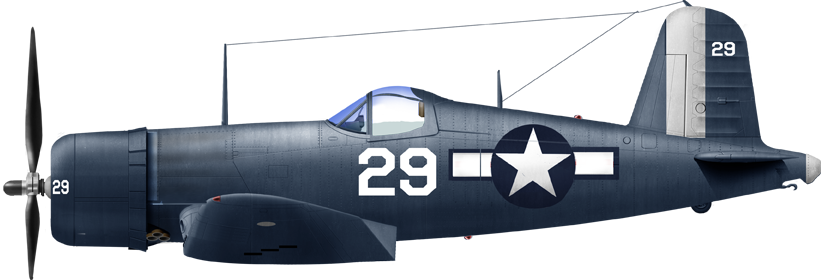
F4U-1D VBF-10 USS Intrepid, Battle of Okinawa March 1945
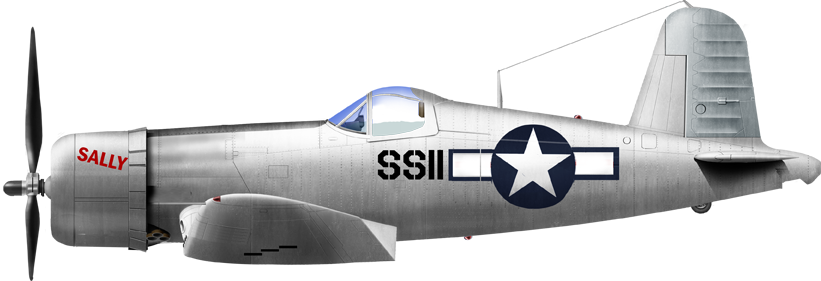
F4U-1D "Sally" Espiritu Santos, 1944, the "scrap metal corsair", made by parts of disabled aircraft by the USMC.
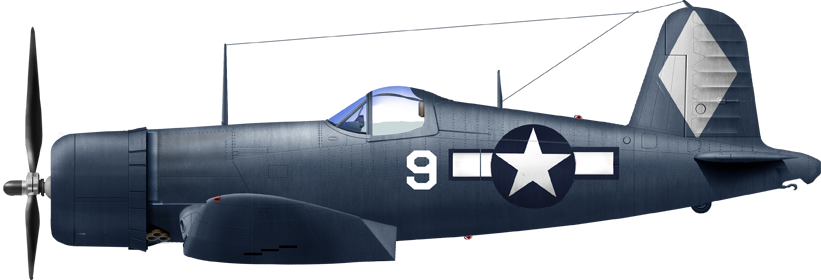
F4U-1D from USS Franklin, CV-13, 1945

F4U-1D from VBF-10 USS Intreprid, Okinawa April 1945

Basic Goodyear FG-1A 1944

Goodyear FG-1D from VMF-213 USS Saisor wit G-Markings in January 1945
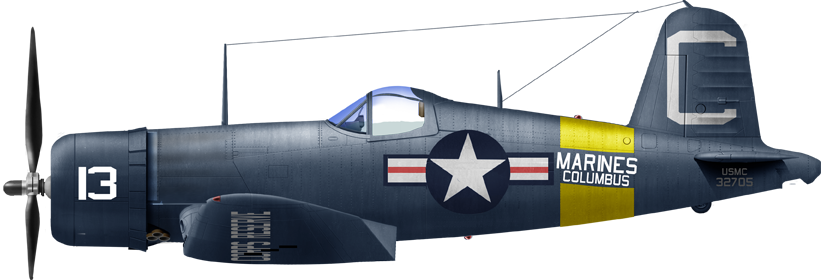
Goodyear FG-1D of the USMC reserve in Columbus, 1947

Goodyear NFG-1D from VF-76A NAS Saint Louis (MO), April 1948

Goodyear XF2G-1 Super Corsair, NS Patuxent December 1945

Brewster F3A Corsair 718 NAS FAA, RNAS Ballyhalbert 1945

Basic F4U-4

F4U-4 From USS Champlain 1945

F4U-4 of the Marines VMFT-20 in 1945

NAS Olathe, Kansas 1945

F4U4 from VF-921 1948

Vought AU-1 USMC VMA-212

Corsair Mark I use for training in Brunswick, Maine, 1944. JT 169 was the last Birdcage from Vought to the British.

Corsair II, 757 NAS HMS Unicorn July 1944

Corsair II (F4U-1D), N18546 Sqn. FAA 1945HMS Colossus Feb. 1945

Corsair II of the Far East Fleet with 6 position markings in 1945

Corsair II from USS Illustrious with SWPA 1945 Markings

F4U-1A from 18th Squadron RNZAF Guadalcanal 1945

F4U-5P USMC

F4U-4 VF-61, AG-6 USS Midway, 1945

F4U-4 “Korean war Hero”, VF653, USS Valley Forge 1950

F4U-1D N184 Squadron FAA HMS Colossus, February 1945
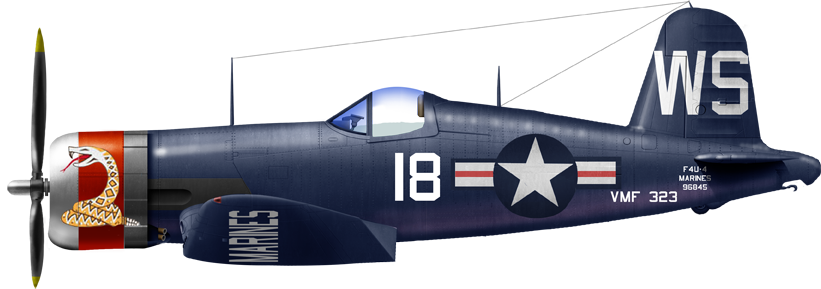
Argentinian F4U-4, VMF-323 "Death rattlers", USS Sicily, South Korea June 1951

USMC F4U-4B, vmf214 Blacksheep, USS Badoeng Strait, South Korea 1951

VMFT-20 USMC Wonsan Airport Korea 1951

F4U-7 Flotille 14F, Suez Op. Musketeer 1956

Argentinian F4U-4, ARA Independencia, 1960

F4U5 of Honduran Ace Fernando de Soto 1969

FG-1D of Escuadrilla 2 El Salvador (Futbol War)
XF4U-3 high altitude NACA prototype tests

F4U-1 production model tested a NACA in early 1943.

3 views of the F4U-1

F4U-1 "birdcage" Corsair in flight c1942

F4U Corsair Udvar Hazy

RNZAF Boomerang and Corsairs on Bougainville

RN Corsair Mark I at Qonset Point, 1943

Vought F4U-1 Corsairs of VF-17 in flight 1943

Preserved F4U5 Corsair

F4U Corsair French Aeronavale Indochina, preserved

FAA Corsair II being pushed on elevator of HMS Glory in 1945

F4U-7 in 1953

F4U-5N FAH-609

CF-15 Corsair

Brewster F3A-1 Corsair

Corsair II 1833 NAS in flight, 1943

F4U-2 of VN-101 from USS Intrepid (CV-11) in 1944

FG-1D in 1944

FG-1D BuNo 88391 RNZAF

Argentinian F9F Cougar and F4U

AU-1 Corsair in flight

F4U-5N of VMFN-513 over Wonsan in 1950

F4U-4 of VF-1B from CVB-41 in 1947
F4U Corsair of the USMC

AD Skkyraider from VA-195 USS Princeton
airwingmedia.com F4U flight manual
alchetron.com
asisbiz.com/Corsair
donhollway.com/blacksheep
modelingmadness.com
airshows.co.uk
www.wardrawings.be
wearethemighty.com
commons.wikimedia.org
markstyling.com
airwar.ru
en.wikipedia.org
key.aero football war
reviews.ipmsusa.org
wings-aviation.ch
F4U prototypes
XF4U-1 (1940)
F4U-1 (1942)
F4U-1 "Gus Gopher" (Wilbur "Gus" Thomas) VMF-213, Guadalcanal 1943
F4U1 VF-17 Lt. Clement Gile, spring 1943.
1st. Lt. Rolland Rinabarger, VMF-214, Espiritu Santo, Sept. 1943
Maj.Greg.J.Weissenberger, VMF-213, Guadalcanal, June 1943
F4U1 2nd.Lt. Henry Huidekoper, VMF-213, Munda, Sept.1943
F4U1 Lt. John Bolt, VMf-213 Russel Island, sept. 1943
F4U1 "Spirit of 76" VMF-215 Lt. Robert Owens Munda, August 1943
F4U1 VF-17, CV-17 USS Bunker Hill Nov. 1943
Note: 758 F4U-1 produced.
F4U-1A (1943)
F4U-1A CMF-321 Hell's Angels, USS Kawajein 1944
F4U-1A, VMF217 "Ring Dong Doo", Mariannas 1944
F4U-1A Ltr.John Tommy Blackburn, VF17, February 1944
F4U-1A (USMC) VMF-214 Barakoma airfield, Vella Lavella, Solomons, 1944, Greg "pappy" Boyington's plane
F4U-1A VMF-111. "ole 122" operated in the Gilberts and Marshall islands and set a record for reliability, 100 missions, 400 flight hours and 80,000 miles covered with the same engine.
F4U-1A USMC Buaer 50165 VMF-321 Guam 1944
F4U-1C (1942)
F4U-1C with its 20mm gun. Only a handful were manufactured purely for ground support.
F4U-1D (1944)
F4U-1D VBF-10 USS Intrepid, Battle of Okinawa March 1945
F4U-1D "Sally" Espiritu Santos, 1944, the "scrap metal corsair", made by parts of disabled aircraft by the USMC.
F4U-1D from USS Franklin, CV-13, 1945
F4U-1D from VBF-10 USS Intreprid, Okinawa April 1945
Goodyear Corsairs
Basic Goodyear FG-1A 1944
Goodyear FG-1D from VMF-213 USS Saisor wit G-Markings in January 1945
Goodyear FG-1D of the USMC reserve in Columbus, 1947
Goodyear NFG-1D from VF-76A NAS Saint Louis (MO), April 1948
Goodyear XF2G-1 Super Corsair, NS Patuxent December 1945
Brewster Corsairs
Brewster F3A Corsair 718 NAS FAA, RNAS Ballyhalbert 1945
F4U-4 (1944)
Basic F4U-4
F4U-4 From USS Champlain 1945
F4U-4 of the Marines VMFT-20 in 1945
NAS Olathe, Kansas 1945
F4U4 from VF-921 1948
AU-1 (1944)
Vought AU-1 USMC VMA-212
British and Commonwealth Corsairs
Corsair Mark I use for training in Brunswick, Maine, 1944. JT 169 was the last Birdcage from Vought to the British.
Corsair II, 757 NAS HMS Unicorn July 1944
Corsair II (F4U-1D), N18546 Sqn. FAA 1945HMS Colossus Feb. 1945
Corsair II of the Far East Fleet with 6 position markings in 1945
Corsair II from USS Illustrious with SWPA 1945 Markings
F4U-1A from 18th Squadron RNZAF Guadalcanal 1945
Cold War Corsairs
F4U-5P USMC
F4U-4 VF-61, AG-6 USS Midway, 1945
F4U-4 “Korean war Hero”, VF653, USS Valley Forge 1950
F4U-1D N184 Squadron FAA HMS Colossus, February 1945
Argentinian F4U-4, VMF-323 "Death rattlers", USS Sicily, South Korea June 1951
USMC F4U-4B, vmf214 Blacksheep, USS Badoeng Strait, South Korea 1951
VMFT-20 USMC Wonsan Airport Korea 1951
Other Operators
F4U-7 Flotille 14F, Suez Op. Musketeer 1956
Argentinian F4U-4, ARA Independencia, 1960
F4U5 of Honduran Ace Fernando de Soto 1969
FG-1D of Escuadrilla 2 El Salvador (Futbol War)
Photos
XF4U-3 high altitude NACA prototype tests
F4U-1 production model tested a NACA in early 1943.
3 views of the F4U-1
F4U-1 "birdcage" Corsair in flight c1942
F4U Corsair Udvar Hazy
RNZAF Boomerang and Corsairs on Bougainville
RN Corsair Mark I at Qonset Point, 1943
Vought F4U-1 Corsairs of VF-17 in flight 1943
Preserved F4U5 Corsair
F4U Corsair French Aeronavale Indochina, preserved
FAA Corsair II being pushed on elevator of HMS Glory in 1945
F4U-7 in 1953
F4U-5N FAH-609
CF-15 Corsair
Brewster F3A-1 Corsair
Corsair II 1833 NAS in flight, 1943
F4U-2 of VN-101 from USS Intrepid (CV-11) in 1944
FG-1D in 1944
FG-1D BuNo 88391 RNZAF
Argentinian F9F Cougar and F4U
AU-1 Corsair in flight
F4U-5N of VMFN-513 over Wonsan in 1950
F4U-4 of VF-1B from CVB-41 in 1947
F4U Corsair of the USMC
AD Skkyraider from VA-195 USS Princeton
Src/Read more about the Vought F4U:
worldwariiaviation.org Brewster F3Aairwingmedia.com F4U flight manual
alchetron.com
asisbiz.com/Corsair
donhollway.com/blacksheep
modelingmadness.com
airshows.co.uk
www.wardrawings.be
wearethemighty.com
commons.wikimedia.org
markstyling.com
airwar.ru
en.wikipedia.org
key.aero football war
The Models Corner:
hyperscale.comreviews.ipmsusa.org
wings-aviation.ch
- Lohner E (1913)
- Macchi M3 (1916)
- Macchi M5 (1918)
- Ansaldo ISVA (1918)
- Short S.38 (1912)
- Sopwith Baby (1916)
- Short 184 (1916)
- Fairey Campania (1917)
- Sopwith Cuckoo (1917)
- Felixstowe F.2 (1917)
- Friedrichshafen FF 33 (1916)
- Albatros W4 (1916)
- Albatros W8 (1918)
- Hanriot HD.2
- Grigorovitch M5
- IJN Farman MF.7
- IJN Yokosho Type Mo
- Yokosho Rogou Kougata (1917)
- Yokosuka Igo-Ko (1920)
- Curtiss N9 (1916)
- Aeromarine 39
- Vought VE-7
- Douglas DT (1921)
- Boeing FB.5 (1923)
- Boeing F4B (1928)
- Vought O2U/O3U Corsair (1928)
- Blackburn Blackburn (1922)
- Supermarine Seagull (1922)
- Blackburn Ripon (1926)
- Fairey IIIF (1927)
- Fairey Seal (1930)
- LGL-32 C.1 (1927)
- Caspar U1 (1921)
- Dornier Do J Wal (1922)
- Rohrbach R-III (1924)
- Mitsubishi 1MF (1923)
- Mitsubishi B1M (1923)
- Yokosuka E1Y (1923)
- Nakajima A1N (1927)
- Nakajima E2N (1927)
- Mitsubishi B2M (1927)
- Nakajima A4N (1929)
- CANT 18
WW1
✠ K.u.K. Seefliegerkorps:
 Italian Naval Aviation
 RNAS
RNAS
 Marineflieger
 French Naval Aviation
 Russian Naval Aviation
 IJN Air Service
 USA
USA
Interwar
Interwar US
 Interwar Britain
 Interwar France
 Interwar Germany
 Interwar Japan
 Interwar Italy
- Curtiss SOC seagull (1934)
- Grumman FF (1931)
- Curtiss F11C Goshawk (1932)
- Grumman F2F (1933)
- Grumman F3F (1935)
- Northrop BT-1 (1935)
- Grumman J2F Duck (1936)
- Consolidated PBY Catalina (1935)
- Brewster/NAF SBN-1 (1936)
- Curtiss SBC Helldiver (1936)
- Vought SB2U Vindicator (1936)
- Brewster F2A Buffalo (1937)
- Douglas TBD Devastator (1937)
- Vought Kingfisher (1938)
- Curtiss SO3C Seamew (1939)
- Douglas SBD Dauntless (1939)
- Grumman F4F Wildcat (1940)
- F4U Corsair (NE) (1940)
- Brewster SB2A Buccaneer (1941)
- Grumman TBF/TBM Avenger (1941)
- Consolidated TBY Sea Wolf (1941)
- Grumman F6F Hellcat (1942)
- Curtiss SB2C Helldiver (1942)
- Curtiss SC Seahawk (1944)
- Grumman F8F Bearcat (1944)
- Ryan FR-1 Fireball (1944)
- Douglas AD-1 Skyraider (1945)
- Fleet Air Arm
- Fairey Swordfish (1934)
- Blackburn Shark (1934)
- Supermarine Walrus (1936)
- Fairey Seafox (1936)
- Blackburn Skua (1937)
- Short Sunderland (1937)
- Blackburn Roc (1938)
- Fairey Albacore (1940)
- Fairey Fulmar (1940)
- Grumman Martlet (1941)
- Hawker sea Hurricane (1941)
- Brewster Bermuda (1942)
- Fairey Barracuda (1943)
- Fairey Firefly (1943)
- Grumman Tarpon (1943)
- Grumman Gannet (1943)
- Supermarine seafire (1943)
- Blackburn Firebrand (1944)
- Hawker Sea Fury (1944)
- IJN aviation
- Aichi D1A "Susie" (1934)
- Mitsubishi A5M "Claude" (1935)
- Nakajima A4N (1935)
- Yokosuka B4Y "Jean" (1935)
- Mitsubishi G3M "Nell" (1935)
- Nakajima E8N "Dave" (1935)
- Kawanishi E7K "Alf" (1935)
- Nakajima B5N "Kate" (1937)
- Kawanishi H6K "Mavis" (1938)
- Aichi D3A "Val" (1940)
- Mitsubishi A6M "zeke" (1940)
- Nakajima E14Y "Glen" (1941)
- Nakajima B6N "Jill" (1941)
- Mitsubishi F1M "pete" (1941)
- Aichi E13A Reisu "Jake" (1941)
- Kawanishi E15K Shiun "Norm" (1941)
- Nakajima C6N Saiun "Myrt" (1942)
- Yokosuka D4Y "Judy" (1942)
- Kyushu Q1W Tokai "Lorna" (1944)
 Luftwaffe
- Arado 196 (1937)
- Me109 T (1938)
- Blohm & Voss 138 Seedrache (1940)
 Italian Aviation
- Savoia-Marchetti S.55
- IMAM Ro.43/44
- CANT Z.501 Gabbiano
- CANT Z.506 Airone
- CANT Z.508
- CANT Z.511
- CANT Z.515
 French Aeronavale
- GL.300 (1926-39)
- Levasseur PL.5 (1927)
- Potez 452 (1935)
- Loire 210 (1936)
- Loire 130 (1937)
- LN 401 (1938)
 Soviet Naval Aviation
- Shavrov SH-2 (1928)
- Tupolev TB-1P (1931)
- Beriev MBR-2 (1930)
- Tupolev MR-6 (1933)
- Tupolev MTB-1 (1934)
- Beriev Be-2 (1936)
- Polikarpov I16 naval (1936)
- Tupolev MTB-2 (1937)
- Ilyushine DB-3T/TP (1937)
- Beriev Be-4 (1940)
-
 Skoda Š-328V
  R-XIII Idro
 Fokker C.XI W (1934)
WW2
 ☍ USNA
- De Havilland Sea Vixen
- Hawker Sea Hawk
- Supermarine Scimitar
- Blackburn Buccaneer
- Hawker Sea Harrier
- Douglas A4 Skyhawk
- Grumman F9F Panther
- Vought F8 Crusader
- McDonnell-Douglas F-4 Phantom-II
- North Am. A5 Vigilante
- TU-142
- Yak 38 forger
☢ Cold War
✧ NATO
Fleet Air Arm
 US Navy
☭ Warsaw Pact
Merch
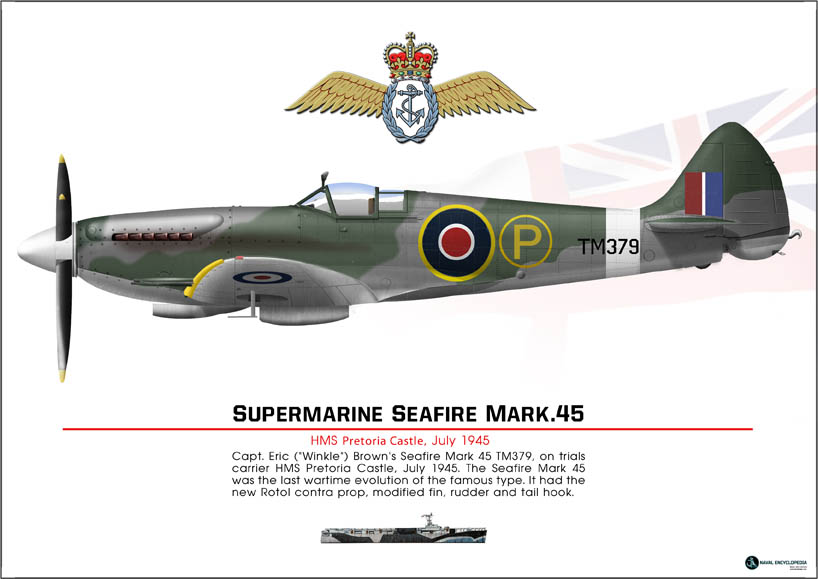
Seafire Mark 45; HMS Pretoria Castle
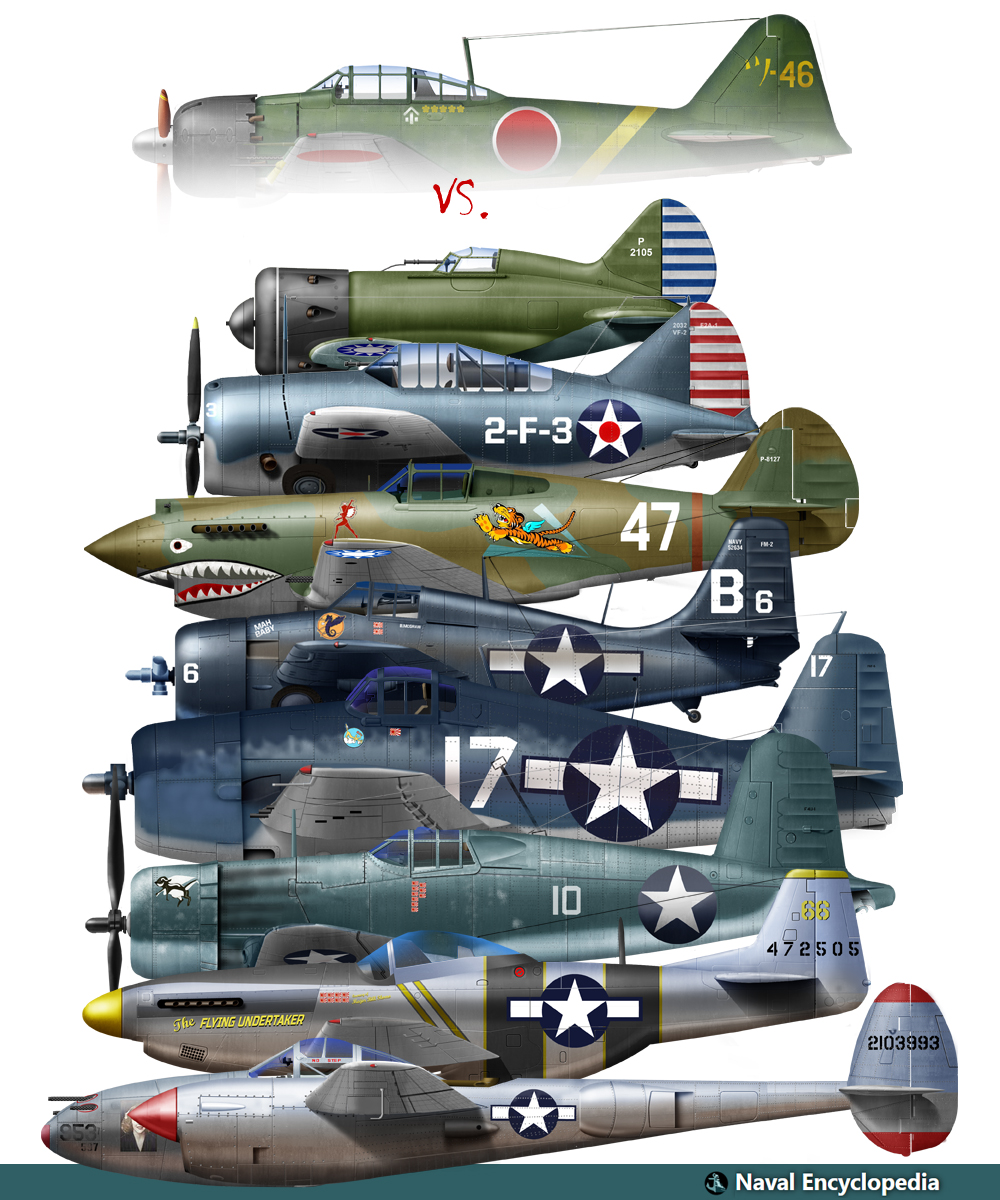
Zeros vs its aversaries
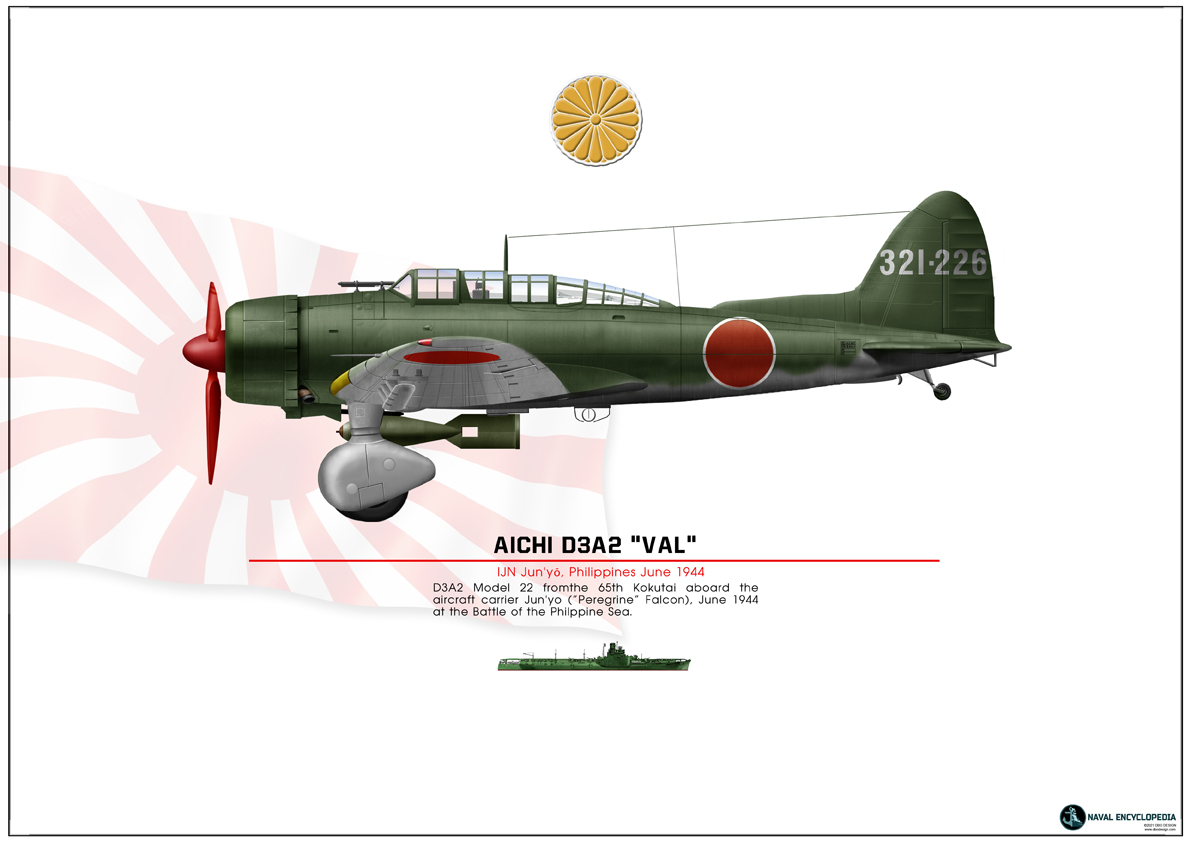
Aichi D3A “Val” Junyo
Mitsubishi A5M poster
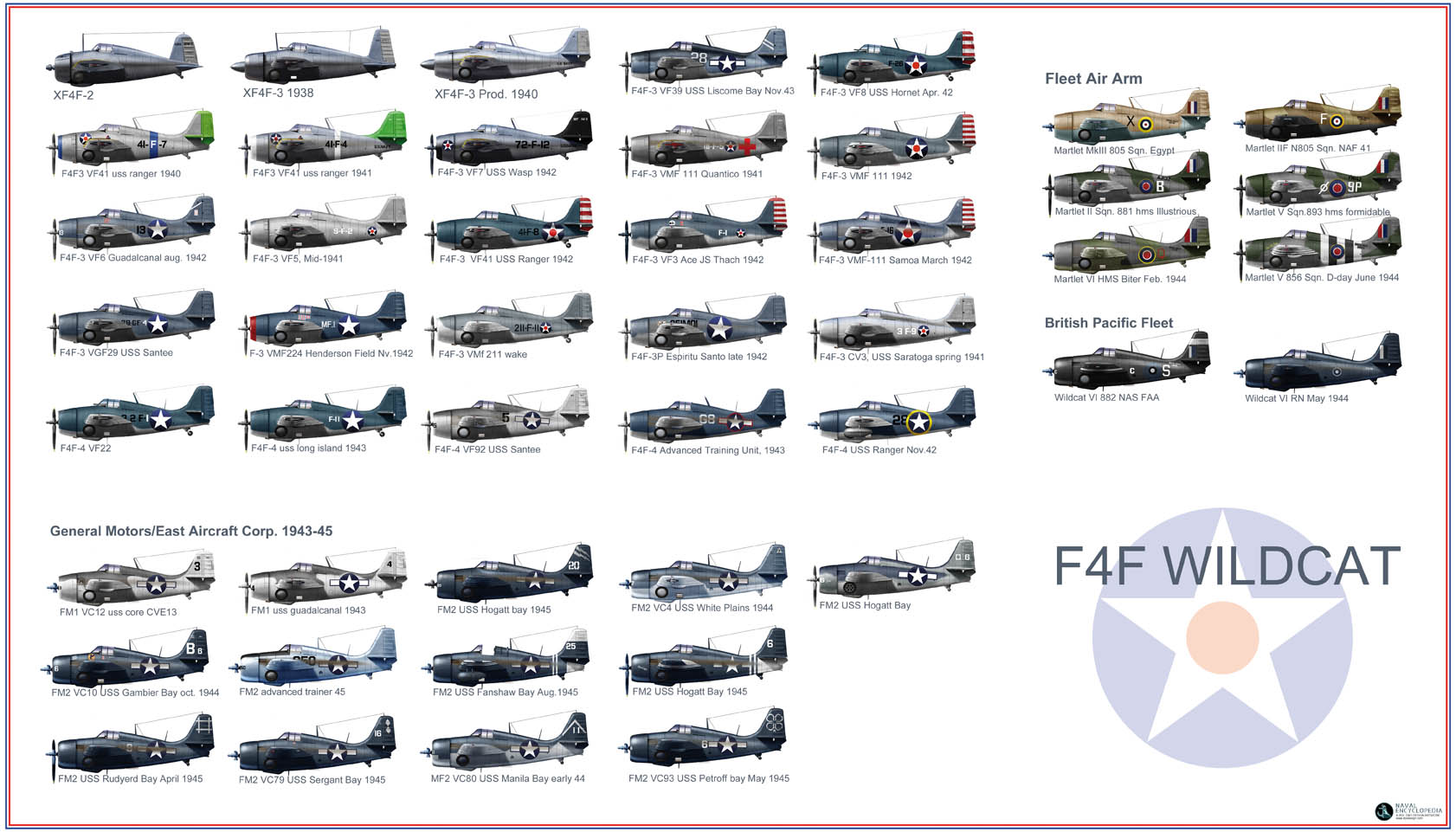
F4F wildcat
Macchi M5
SBD Dauntless Coral Sea
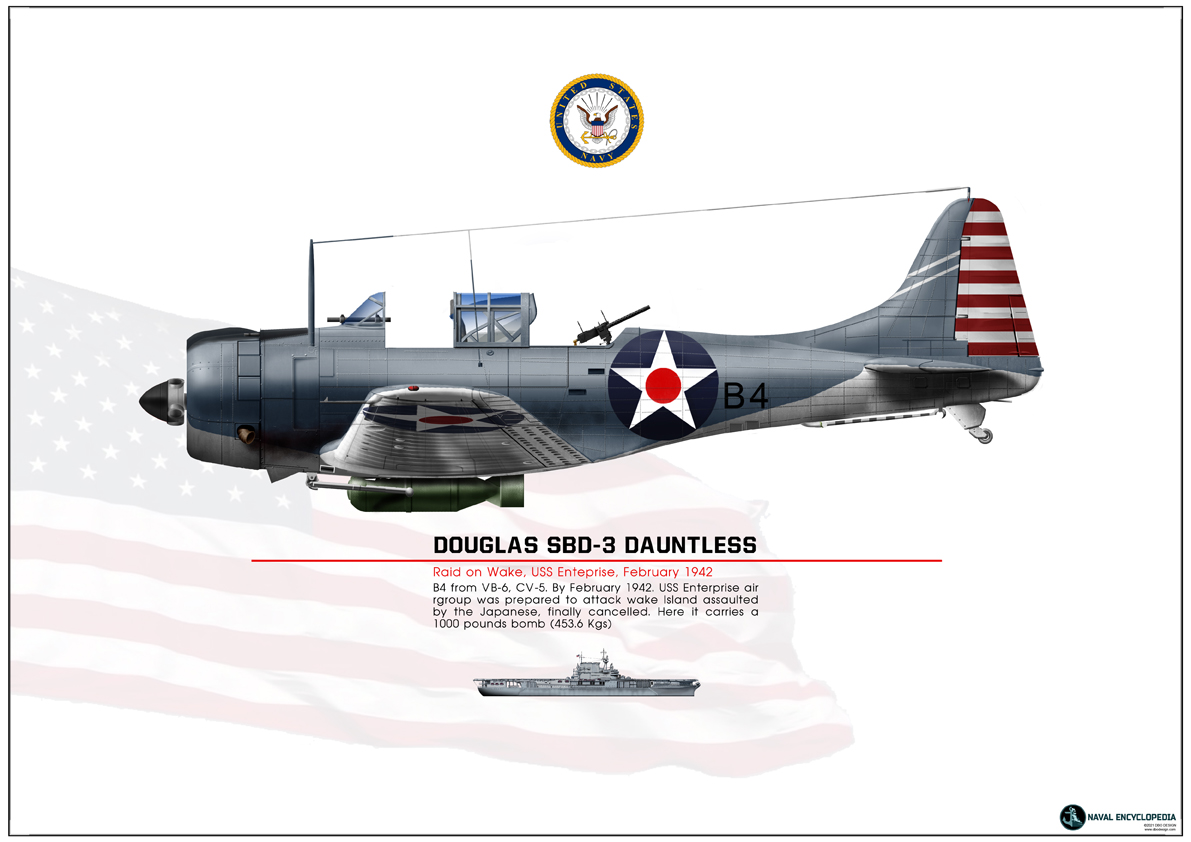
SBD Dauntless USS Enterprise
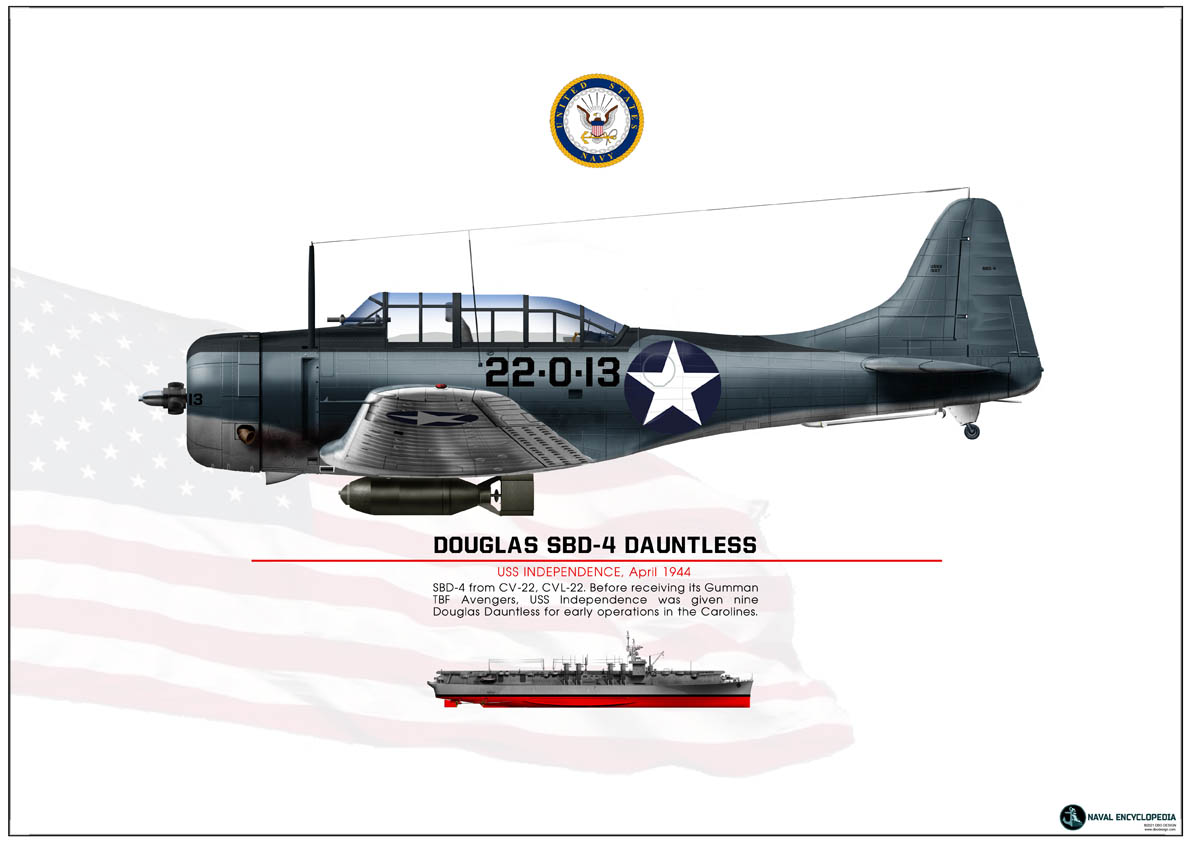
SBD-4 CV22