Lavotchkine LA-15 "Fantail" 
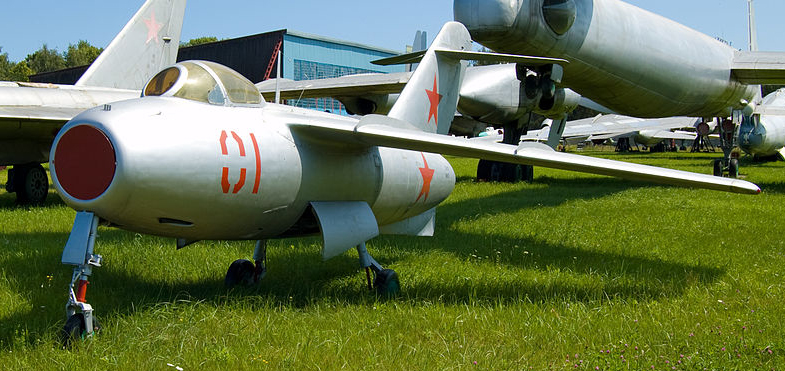
The Lavochkin La-15 was an early Soviet jet fighter, rival of the Mikoyan-Gurevich MiG-15, even better in some areas, but much more complicated and costly. It was known as NATO "Fantail", but also Plant 21 Izdeliye 52, and USAF Type 21.
Development
Lavochkin already produced many propeller fighters in the War and already produced the La-150 to answer a 1945 order for a single-seat fighter using the German Junkers Jumo 004 turbojet adapted from captured Me-262s. The La 150 first flew in September 1946, followed by the La-152 in December 1946 with the engine relocated to the nose, reducing thrust loss. The La-160 was given the benefit of some German studies, and for the first time, swept wings. It flew in June 1947. Eventually the next La-168 (April 1948) used the new promising turbojet based on the Rolls-Royce Nene, in response to a 1946 specification for a transonic interceptor. Crucial to these developments, the recently acquired -out in the open- Rolls-Royce Derwent V and Nene turbojets were comprehensively reverse engineered and re-emerged as the Klimov RD-500 and Klimov RD-45. The La-15 Aircraft 174 was a backup but the main production was intended for the the Nene-powered Aircraft 168. The first was flown before the Mikoyan-Gurevich I-310 (MiG-15 prototype), on January 1948 but lost in May due to vibrations. The second 174D underwent State Acceptance Tests from August 1948 and had virtually identical performances to the MiG-15, better maneuverability but reduced rate of climb. Approved for production in September 1948 it was given the designation La-15 in April 1949.

Design
The plane had a barrel-like fuselage, the Klimov RD-500 (Derwent) engine was placed behind the pilot, and it had with shoulder-mounted swept wings with 6 degrees anhedral and a characteristic T-tail. It became popular with pilots because of its easy handling and pressurized cockpit. It was equally popular with ground crews as being reliable. However official enthusiasm was not that high, since the La-15 was basically much more complex to built compared to the MiG-15 requiring complicated and expensive production tooling and highly skilled workers. In the end, total production only reached 235 La-15s. They only served with the Soviet Air Force until 1953. A far cry from the Mig-15.

Operational History
A stated above, the La-15 only served for three little years. Production started in 1949 and went on in 1951, but it was tested operationally by the 192nd Fighter Wing at Kubinka in March 1949. It was directed to front-line combat units but this was accompanied by numerous accidents, which aggravated its case for the top brass although this was also the case for the MiG-15. In the end, the Soviet doctrine about ease of production being paramount, the development of this alternative fighter was killed and all the green lights were given to the MiG-15. The Soviet authorities therefore stopped production, but the La-15s already in service were disarmed by 1953. Some apparently never even flew. Their engines were dismounted and reused in the massive KS-1 Komet air-to-surface missile while the emptied planes were expended as nuclear bomb tests fodder. Of course the La-15 was never use in Korea and quickly faded into history and the unlucky MiG-15 rival.

Variants
- Aircraft 174/174D: First ad second prototypes with the Klimov RD-500 engine
- Aircraft 180: It was a planned trainer, two-seat conversion intended designation La-15UTI, that was dropped when the La-15 development was stopped as a whole.
Specs
| Dimensions | To come |
| Weight | 2,575 kg (5,677 lb)/3,850 kg (8,488 lb) |
| Engine | Klimov RD-500 centrifugal compressor turbojet, 15.59 kN (3,500 lbf) thrust, Fuel capacity: 1,060l (233.2Imp Gal), Wing loading: 238 kg/m2 (49 lb/sq ft), Thrust/weight: 1:2.4 |
| Performances | 1,007 km/h (626 mph; 544 kn) at 8,000m (26,350ft), Range: 1,145 km (711 mi; 618 nmi) at 10,000m (32,810ft), Service ceiling: 13,500 m (44,300 ft), Rate of climb: 31.7 m/s (6,240 ft/min), Time to altitude: 5,000m (16,400ft) in 3.1min, 10,000m (32,180ft) in 9min |